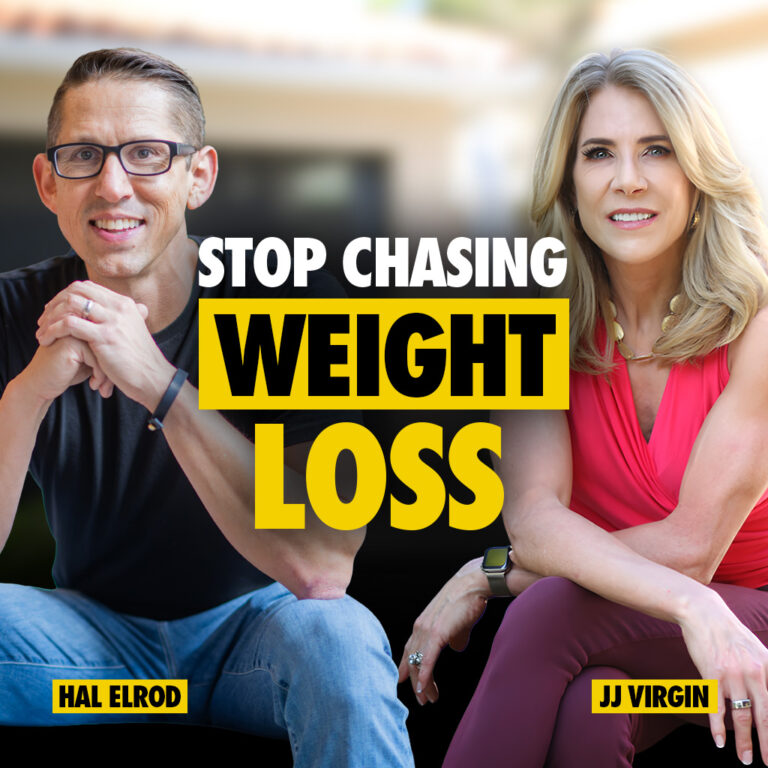


What if losing weight is actually making your metabolism worse?
JJ Virgin has spent more than 40 years studying nutrition, fitness, and metabolism. She’s a four-time New York Times bestselling author who has helped millions of people lose fat, build muscle, and improve their health.
And she believes we’ve been taught to think about weight loss completely wrong.
In her new book, The Metabolism Fix, JJ explains why getting lighter doesn’t necessarily mean you’re getting healthier. Losing the wrong kind of weight can leave you weaker, slow your metabolism, and make it easier to regain fat.
So why does metabolism seem to slow as we get older? Why can dieting repeatedly make the problem worse? Is cardio actually helping you lose body fat? And what are GLP-1 medications really doing to your muscle?
JJ also explains why the number on your scale may be one of the least useful ways to measure your progress, and what you should be paying attention to instead..
KEY TAKEAWAYS
- Build Muscle And Lose Fat Fast
- Why Your Metabolism Isn’t Broken
- The Scale Can Damage Your Metabolism
- Redefining Weight Loss
- Fasted Vs. Fed Workouts
- The Metabolism Fix Explained
- What JJ Eats In A Day
- Foods JJ Virgin Avoids
- The Best Exercise For Longevity
- HIIT Training For VO2 Max
- How JJ Virgin Entered Fitness
- The Book She Waited 40 Years For
- The NEAT Metabolism Secret
- How To Audit Your Macros
- Better Health Metrics Than Weight
- GLP-1s, Fat Loss, And Muscle
- The Metabolism Fix Bonuses
AYG TWEETABLES
“I don't believe that we lose muscle because we age. I think we're aging because we're losing muscle.”
JJ Virgin Tweet
“What's great is the things that make you look better also make you live better.”
JJ Virgin Tweet
“The most important thing is to consistently move, and then the second most important thing is to find things you'd like so you'll consistently do it.”
JJ Virgin Tweet
“Continue to improve on that resistance training by continuing to do more than you thought you could, so that your body has to get stronger and adapt.”
JJ Virgin Tweet
RESOURCES
- JJVirgin.com
- JJ Virgin on LinkedIn | Facebook | Instagram | YouTube | X/Twitter
- The Metabolism Fix: Restore Your Body’s Ability to Build Muscle & Lose Fat Fast by JJ Virgin
- The Virgin Diet: Drop 7 Foods, Lose 7 Pounds, Just 7 Days by JJ Virgin
- The Sugar Impact Diet: Drop 7 Hidden Sugars, Lose Up to 10 Pounds in Just 2 Weeks by J.J. Virgin
- The Biggest Loser
- Sam Horn
- Rory Vaden
- Body for Life: 12 Weeks to Mental and Physical Strength by Bill Phillips
- Good Karma Flaxmilk
- Green Chef
- Catalina Crunch
- Fresh Pressed Olive Oil Club
- Richard Simmons
- Mark Sisson
- Tony Horton
- Body by Jake
- Jenny Craig
- Cronometer
- Oura Ring
- Fitbit
- Hume Health
- Health by Path
- The Miracle Morning App
THIS EPISODE IS BROUGHT TO YOU BY:
CURED Nutrition:
I want to talk about two of my favorite products. I’ve been taking these for four years, and they’re now a sponsor of the podcast, CURED Nutrition, Flow Gummies. I start every day with two of these. I meditate for 30 minutes without any supplements, and then I take Flow Gummies seven days a week, almost every day.
And then I go to bed with Night Oil. 30 minutes before bed I take Night Oil and it helps me fall asleep and stay asleep. So I start my day with Flow Gummies, I end my day with Night Oil.
If you want to implement my routine into your day with CURED Nutrition, go to CUREDnutrition.com/Hal and use the discount code HAL at checkout for 20% off your entire order.
Flow Gummies to start the day Night Oil to fall asleep. You’ll feel better, you’ll act better, you’ll perform better. Check it out.
RATE & REVIEW THE PODCAST
Reviews for the podcast on iTunes are greatly appreciated and will allow us to get the word out about the show and grow as a community. We read every single review and believe each one goes a long way in helping us make the show even better! If you received value from this episode, please take a moment and rate and review the podcast by clicking here.
Copyright © 2026 Miracle Morning, LP and International Literary Properties LLC
[INTRODUCTION]
Hal Elrod: If you want to build muscle and lose fat fast, today’s episode is for you. My guest today is JJ Virgin, four-time New York Times bestselling author, board-certified nutrition specialist, Hall of Fame fitness expert, and she’s spent over 40 years helping millions of people build muscle, lose weight, boost their metabolism, and live longer. Her new book we’re talking about today is The Metabolism Fix: Restore Your Body’s Ability to Build Muscle and Lose Fat Fast. This episode will help you do exactly that.
[INTERVIEW]
Hal Elrod: JJ, we keep seeing each other.
JJ Virgin: I know. You can’t stay away from me.
Hal Elrod: I can’t stay away from you. I was in Florida at your studio doing a podcast recently, and then we’re at, of course, Author for Author Mastermind.
JJ Virgin: Which was amazing.
Hal Elrod: Yeah. And now you’re here in Austin.
JJ Virgin: And here I am. I seem to be in Austin a lot. I love it, especially in August. I try to come as often as possible.
Hal Elrod: Oh, yeah. I mean, you want to make sure it’s at least over 100 when you’re going to visit.
JJ Virgin: Yeah. It’s like, oh my gosh.
Hal Elrod: Isn’t it brutal?
JJ Virgin: I figured out there’s actually two good months of weather in Austin. And I think everyone moves here. It’s like a Burning Man thing, where everyone’s proving that they’re resilient and they can suffer together.
Hal Elrod: Yeah, I like it.
JJ Virgin: That’s my take.
Hal Elrod: Nice. Yeah, there’s the few months where it’s unbelievably hot. My wife and I are like, “What, should we just go back to the San Diego area? This is really harsh.” You’re Florida, though. That’s not much better.
JJ Virgin: Actually, we were walking last night. It was 80 degrees. I mean, it really has been pretty mild. Yeah.
Hal Elrod: So, I want to talk about the new book, The Metabolism Fix, and I want to start with the biggest misconception that people have about metabolism
JJ Virgin: That they think their metabolism is broken.
Hal Elrod: Okay.
JJ Virgin: They think it’s broken, and they think…
Hal Elrod: Like, that it slows down as you age? Is that part of it?
JJ Virgin: That it slows down. They think that my metabolism has slowed down because I’m aging. It’s this huge myth. And in fact, this scientist went all over the world studying people from young to old, to see if this was actually the case. And what he discovered after looking at over 10,000 people was that our metabolism doesn’t significantly slow down, and even then it’s very small until the age of 60, which is awesome when you think about it because that’s not why your metabolism is slowing down. Age is not the problem.
Hal Elrod: And I’ve read ahead, so I know what the problem is, but can you share it?
JJ Virgin: You know the punchline.
Hal Elrod: Yeah, I know the punchline. But share it.
JJ Virgin: Well, we actually created the tagline at Author for Author Mastermind.
Hal Elrod: Amazing.
JJ Virgin: Yes, Sam Horn and Rory Vaden, and the issue is, what do we tend to lose with age?
Hal Elrod: Muscle.
JJ Virgin: Muscle. Now, I don’t believe we’re losing muscle.
Hal Elrod: Except for you, by the way.
JJ Virgin: Yeah.
Hal Elrod: You’re notorious for having more muscle than…
JJ Virgin: I have to be my walking business card.
Hal Elrod: Yeah, that’s right.
JJ Virgin: But I don’t believe that we lose muscle because we age. I think we’re aging because we’re losing muscle. If you really look at this, we don’t have to lose muscle. Really, we’re losing it because something like 20% of the people are actually meeting the bare minimum guidelines the CDC has for exercise. It’s crazy, right? So, we’re not using them, and if we don’t use them, we lose them. And so again, that’s also amazing. We know that starting at around age 30, the average person starts to lose up to 1% of their muscle a year. It’s like 3% to 8% per decade.
Hal Elrod: Starting at age 30?
JJ Virgin: At age 30. And think about what starts to happen at age 30. I think about what happened for me in that 30th decade: kids, work, all sorts of things that where you took a back burner to a lot like I think in my 20s I would work out for hours a day. At my 25th birthday, I think I went and did a big bike ride. Then I ran the stairs, then I played beach volleyball. That’s what I would love to do. In your 30s you’re like, “How do I squeeze this in and make sure I get something in?”
Hal Elrod: And the eating’s irregular also.
JJ Virgin: And then you’re eating your kids’ food, which why is kids’ food so notoriously unhealthy? Mine wasn’t until they went to Grandma’s house and learned about things like Honey Nut Cheerios. Prior to that, they didn’t know there was cereal.
Hal Elrod: Amazing.
JJ Virgin: Yeah, they thought chicken was what people had for breakfast.
Hal Elrod: And eggs, egg whites. Yeah.
JJ Virgin: But I say this because, okay, so if we start losing muscle as we’re 30 plus, but we don’t have to. And by the way, we lose muscle, but we lose twice as much strength and three times as much power, which is really important, because you see people starting to slow down. And the reason I have my grip strength tester for you…
Hal Elrod: Yeah, let’s do it.
JJ Virgin: …is we know that that is a huge marker. When we test grip strength, it’s really a proxy for your whole body strength. Like, if you have poor grip strength, it doesn’t mean go squeeze tennis balls. It means get stronger overall. But grip strength is highly correlated with all-cause mortality, so is walking gait. Like, I was walking through the Austin airport today.
Hal Elrod: Walking gait? What is walking gait?
JJ Virgin: Speed.
Hal Elrod: Oh, okay.
JJ Virgin: Like, I was watching people today at the airport, and I’m like, “They’re shuffling along.” I’m like, “This is not good.” Right?
Hal Elrod: You say the goal is not to get smaller, which is, I mean, for as long as I’ve been alive, it’s been lose weight, diet, so on and so forth. You say the goal is to get stronger. Talk about that.
JJ Virgin: Especially for women.
Hal Elrod: Okay.
JJ Virgin: So, here’s the biggest challenge. I believe that the traditional gravitational scale has done more damage for women’s metabolism, metabolic health, and mental health.
Hal Elrod: What do you mean gravitational scale?
JJ Virgin: You know, a regular scale. What’s it testing? Gravity. How much do you weigh?
Hal Elrod: Okay. Yeah.
JJ Virgin: It’s not looking at, well, what’s your weight made up of? And this is what’s mission critical. Because if you’re losing weight and it’s coming from both muscle and fat, but a lot of muscle, you’re in trouble. You want to make sure that when you’re losing weight, your muscle quality is staying the same or improving, and I say quality for a reason, while you’re losing fat. Otherwise, you could be making yourself worse, not better. So, you look at any diet out there, and, you know… So, I was on Dr. Phil’s Weight Loss Challenges for two years. I brought in a bioimpedance scale so that I could look at fat mass versus fat-free mass and make sure that as people were losing weight, they were predominantly losing fat.
I was not allowed to talk about it because it doesn’t make for good TV. It’s way more interesting to say, “They lost 20 pounds this month,” than to say, “Oh, you know what? They lost 4 pounds of fat and put on a pound of muscle. Woo-hoo.” That’s not exciting. I mean, think of The Biggest Loser, right? But the challenge is if you want to lose a lot of weight fast, it’s not going to be all from fat. It’s going to be some fat, it’s going to be some muscle, and that devastates your metabolism, and that’s the problem where you see people lose and gain. So, we try to shrink by losing as much weight as possible. We lose some muscle, and then when we go back to our normal eating habits, because no one can sustain a big caloric restriction unless they’re on a heavy dose of GLP-1 for long, then there’s something called…
Hal Elrod: I want to circle back to GLP-1 too, like how that’s impacting.
JJ Virgin: Yeah. There’s something called fat overshoot where then you overeat. Your body doesn’t put back on the muscle. No, it puts on more fat. And so, then your metabolism takes a hit because the only thing that we can do to change our resting metabolic rate, we can’t change our height and our sex and our genetics, but we can change our muscle mass. It’s the one thing that we can do to shift it, and we just downshifted it, which is really problematic. That’s why I say the scale has done such a devastating thing, because it’s played with our psyche. Any person anywhere has gone on a diet has done everything right. It’s like I always talk about this. You did everything right that day. You were like so excited the next morning.
Hal Elrod: And you step on the scale.
JJ Virgin: And you step on the scale and it went up. And you’re like, “What the heck?”
Hal Elrod: Yeah. I observe this with my wife, Ursula, all the time. And she works out like crazy, like she’ll work out hardcore, but she looks at the scale. I’m like, “You’re conditioned to think the scale is the measurement. That’s not the measurement. You look great, sweetie. You’re strong.”
JJ Virgin: Right. I mean, so that’s where I want us to reframe this and go, “We’ve got to look at what our weight’s made up of.” And so, the bioimpedance scale’s great, because it will take you and look at fat mass versus fat-free mass. But the challenge there is it doesn’t tell you how much of that fat-free mass is skeletal muscle. So, we still have to go a step farther. Now, your wife’s working out, so she knows if she can do more push-ups. She knows if she can handle a heavier weight, you know? She knows if she was doing air squats over the chair and she could do 20 in 30 seconds, and now she can do 25. These are all important metrics. But the grip strength’s an easy one to do.
That’s why I love to do this one, because it’s like all of a sudden you go, “Oh, here I was, I was in the low level. Now all of a sudden I’m in the middle. I was at the middle. Now all of a sudden I’m in the…” Like, you want to be in the 75th percentile or higher. You do not want to be below average on grip strength.
Hal Elrod: Now, let me ask you, with grip strength, is that… So, let’s say for example, you’re doing a lot of like bench press, for example, right? Is that really improving your grip strength? What improves grip strength, and why does it matter?
JJ Virgin: So, grip strength is a proxy for overall strength. We are assuming that if you are working out at the gym, you’re probably carrying dumbbells around. You see now people doing what’s called a farmer’s carry, carrying things around. It translates really well to overall life. I’ll give you an example.
Hal Elrod: Okay.
JJ Virgin: Today, we were coming from the airport to the rental car place. Well, we don’t travel light, and we’ve got a couple of destinations, and we have my red lights, a coffee maker, all sorts of things. So, we have three suitcases, plus we have one suitcase that’s got a podcast studio in it and another suitcase.
Hal Elrod: I know this about you. You bring your house with you.
JJ Virgin: Oh, yeah. It’s because I travel all the time. So, I mean, if I want to stay on my routine, it’s got to come with me. So, we’ve got three big suitcases, each weigh 60 pounds, and two carry-ons. And on the carry-ons, we each have a bag on the carry-on. Tim says, “I got it,” because the elevator was broken. So, now we have to go up the escalator with all of these things. He goes, “I got it.” He goes ahead of me with two suitcases, his carry-on, and a backpack on top. And I’m right below him. You can probably already sense what’s going to happen here. With my other suitcase and purse and carry-on, and guess what happens? It’s like bowling balls. Boom comes down his carry-on with the backpack, which I catch.
I thought, “I need some credit here. He needs to give me credit,” because I do a leg curl back, grab it with my calf and my foot. Hamstring is cramping because I did these crazy hamstring things this morning. But I got it. I got this one. I’m holding on, right? I mean, this could easily have been an all-the-way-down-the-escalator thing, but that’s why we trained. We trained so we can grab things. So, if, let’s say, the escalator was broken, too, I mean, there have been times when we’re looking at it going, “Oh, we’re going to have to carry all this stuff up the stairs.” And we can do it.
So, grip strength translates. It’s a proxy for overall strength, but it’s the picking up the groceries and carrying them up. It’s throwing something into the overhead compartment. So, it’s not the, you know, you train your grip strength. Train your grip strength by doing pull-ups or doing a flexed arm hang or grabbing heavy weights instead of going straight to the bench. Do a lap around the gym, then go to the bench. Those are the things that will transfer over to, okay, now I’ve got this crazy suitcase that I’ve got to get in the overhead.
Hal Elrod: Yeah, it’s your training for real life, yeah.
JJ Virgin: Yes.
Hal Elrod: Well, so it sounds like you’re redefining, I don’t know if that’s the right way to put it, redefining weight loss. But it’s almost that, you tell me, like, is it that you’re getting stronger? Well, when I talk to people and even my clients, like I have a couple coaching clients, and they want to lose weight. And it’s two reasons. It’s they want to look better, right? And they want to be alive and healthy and energetic for their grandkids, kind of thing, right? So, talk about how the metabolism fix and building muscle fits into looking better and longevity. Because again, I think those are the two things, right?
JJ Virgin: They are the two things. A lot of people don’t want to admit that they’d like to look better, but who doesn’t want to look better?
Hal Elrod: Sure.
JJ Virgin: I mean, everybody wants to look better.
Hal Elrod: They look good, you feel good. Yeah.
JJ Virgin: And you know what? What’s great is the things that make you look better also make you live better. So, they work together. It’s fantastic. Basically, the old way we approached weight loss has really damaged our metabolism. So, there’s the old way and the new way. The old way, and in fact, I was taught this in grad school, do not let someone lift weights until they lose the weight.
Hal Elrod: Really? Interesting.
JJ Virgin: That’s the dumbest thing. I remember looking at this going, “That is dumb. I’m not listening to you.” What was great in graduate school is that I was the only one in our grad department who wasn’t a grad research assistant in the labs, because I already had a big personal training business, and I was making far more money doing that. So, I’m like going, “You want me to do what? No, that’s okay. I’ll just pay the tuition, right?” So, I was working on the outside, and all my clients were 45 to 55-year-old women and 55 to 65-year-old men. And that’s important because women, that’s when they’re in the throes of all their hormone chaos of perimenopause and menopause. And men, this is when they start going through andropause.
So, all the clients I had were very different than what we were learning in the lab, because in the lab we have 20-year-old college students. You can do anything with a 20-year-old college student, and they get a result, you know?
Hal Elrod: Yeah, real quick.
JJ Virgin: Whatever. It’s like, “Oh, this works great.” And I saw very early on, because we were told, “Okay, they have to do 30 minutes at least of cardio to get in the fat-burning zone,” and I went, “Well, that’s not doing anything over here.” Like, they can’t lift weights. I go, “That’s not working.” It’s like all the stuff. I went, “None of that’s working, so I’m going to throw those rules out and just learn what I’m learning from you about how to build muscle and use that over here.” So, here’s the thing. We’ve always focused on lose the weight, then fix the damage you created. That’s backwards. And so, the model that I created was instead of burn off the fat, then build muscle to try to restore your health, what if we build muscle first?
And I feel like the GLP-1s have really unpacked this for us, where we’re like, “Oh, you better hold onto your muscle.” I’m like, it’s not even just hold on. It’s like, “Let’s get that cranking up,” because that’s your furnace. It’s your metabolic control center. We used to believe that if every muscle, pound of muscle you put on, you had 100 more calories a day of calorie burning, which is absolute garbage. It sounds great.
Hal Elrod: Oh, so that’s not true. Okay.
JJ Virgin: No. I mean, think about it. Think about it. If you put on 20 pounds of muscle, now you are burning 2,000 more calories a day. You’d be eating all day long. I mean, I wish it was true. It would be amazing.
Hal Elrod: Yeah, the math isn’t mathing.
JJ Virgin: Math is not mathing. I’d just carry around an ice cream container if that was the case. It’s not true. It’s about 5 to 10 calories. But it’s not nothing. However, that’s really not the point of it. What happens when you contract muscles is your muscles are amazing. First of all, when you put muscle on, it’s like metabolic Spanx. It holds everything in tighter. And it does that little metabolic boost. Plus, it’s a sugar sponge. It gives carbohydrates a place to go. Rather than those carbohydrates going, “Hey, we’re going to turn into fat and store around your organs.” Nope. It gives carbohydrates a place to go, because now they’re going to go into your muscles, where they’re stored for future energy.
But the coolest thing that muscles do is they talk. They send out these messages. And if you really want to be able to maintain amazing body composition, it’s all about that muscle contraction and the messages, because the messages are lower inflammation, trigger muscle protein synthesis, improve insulin sensitivity, burn off fat, improve your immune system. I mean, build up a better brain. Like, the most incredible things that if it was a drug, it would be the most widely prescribed drug.
Hal Elrod: Miracle drug.
JJ Virgin: And what’s so crazy is we know in just mental health that exercise is as effective as an SSRI, but it doesn’t have the side effects. So, in that case, it would be more effective, right?
Hal Elrod: Yeah.
JJ Virgin: But you have to get people to do it. And right now, we know, again, it’s like 20% of the population is actually doing the full CDC recommendations, and only 50% actually exercise at all, and I’m sure that means they took a walk. So, it’s really pretty dismal. So, we’ve got to look at the new way of focusing on weight loss. It’s really not weight loss. It’s what do we need to do to improve our body composition. And so, the first thing we would focus on is building, building muscle first. It’s not going to make you bigger. I hear every woman’s fear.
Hal Elrod: Yeah. “I’m going to be all bulky.”
JJ Virgin: I hear it. And 40 years of doing this, I’ve never had a woman lift weights and get bulky. And I am trying. Like, I am trying my hardest to put more muscle on, because I know it’s my bank account. And I’ll tell you a story about my son that showed me this firsthand. But it’s like a retirement account. But muscle holds everything in tighter. You’ve seen the picture of the muscle versus the fatty muscle in the filet and the rib eye.
Hal Elrod: Yeah.
JJ Virgin: Like, they can weigh the same, and the one with the fat’s so much bigger. So, it’s just going to hold everything in tighter. I have literally helped people for 40 years do this. Never I’ve had someone lifting weights get bigger. The only time I’ve had people get bigger is if they quit and they don’t do anything, right?
Hal Elrod: Yeah. Well, getting bigger is hard, right? I mean, guys that are trying to get bigger, or women, but usually, I would say it’s guys.
JJ Virgin: It’s usually a body fat situation if they get bigger. They got more body fat. It’s not muscle, because again, muscle holds everything in tighter. So, the first thing you want someone to do is get that engine going so that they’re able to hold onto or build that muscle before you ever do the things that are going to start to help you burn off body fat. And I say specifically body fat, because people will talk, “Oh, I’m doing this diet because it burns more fat.” I go, “But if you aren’t in a caloric deficit, it’s not body fat you’re burning.” You could eat a keto diet and never burn off body fat. You could burn fat, dietary fat.
Hal Elrod: What’s the difference? You’re burning the fat in your stomach that you’re eating?
JJ Virgin: You’re burning the fat you’re eating. But you’re not burning off body fat, right? So, if you eat a bunch of fat and you’re burning more of that fat as fuel, but you have enough calories around, you’re not going to go into your body fat and burn it off because you don’t need to.
Hal Elrod: Does that, by the way… I know that when I read Body for Life in the year 2000.
JJ Virgin: Oh, boy.
Hal Elrod: Yeah, Bill Phillips. And I was big into that, you know? But one of the things I remember from that that I coached clients on for years, and I was never a fitness coach. It was just like little things I’d picked up here or there. But it was working out in the morning on an empty stomach because you didn’t have any dietary fat to burn.
JJ Virgin: Yeah, that is one of the biggest, hottest debates online is fasted versus non-fasted workouts. A couple of things. First of all, unless you are a pro athlete, these things are called majoring in the minors.
Hal Elrod: Yes, yeah.
JJ Virgin: Okay. So, the first most important thing about exercise, as to timing of exercise, is when you’ll do the exercise. That’s the single most important thing because consistency…
Hal Elrod: Meaning that whenever you’re most likely to actually follow through and get it done. Yeah.
JJ Virgin: Yes. That’s the most important time to exercise because consistency is the single most important thing, right?
Hal Elrod: Yeah.
JJ Virgin: And so, that’s the first thing. The second thing is that whole fasted versus non-fasted. The next important thing is the quality of the exercise. So, if you eat and then you feel sick, and you can’t work out as much, don’t eat before. If you go in hungry and you can’t work out as hard, eat before. So, that’s the second part is what’s going to have you have the best quality workout? Then after that, there’s this whole idea that if you do fasted cardio you’ll burn more fat. Yeah, likely you will, especially if it’s long slow distance exercise where you tend to use more fat for fuel. But it doesn’t mean you’ll burn off stored body fat because, again, if you’re not in a deficit, it wouldn’t matter.
If you came back after that and chowed down and ate a ton of food, doesn’t matter if you used more fat as fuel during that time, even body fat, because you could replace it pretty quickly. So, there’s that piece of it. But here’s the bigger part. If you’re going to go do some high-intensity interval training or you’re doing some resistance training, likely you won’t be using as much fat during that workout anyway because that’s a more glycogen-driven workout. So, when you’re doing harder workouts, it should be more sugar than fat. One of the things I was wearing a CGM for a while, not to worry about my blood sugar.
Hal Elrod: What’s a CGM?
JJ Virgin: A continuous glucose monitor.
Hal Elrod: Glucose monitor. Okay.
JJ Virgin: I was looking at it for my exercise because I would go and see how high I could crank up my blood sugar during my workout, how hard I could push it. Because if you’re pushing really hard, your body is freeing up glycogen, dropping it into your bloodstream, cranking it up so that you can use it. Because that’s what intense exercise requires. It’s not using fat. You’re going to always be kind of, people say, “Oh, I’m burning fat.” Well, we’re burning fat, we’re burning carbs, we’re kind of in between. Maybe we’re burning some ketones. Your body’s built to be able to shift around. It’s not just a straight electrical car or gas car. It’s a hybrid.
But I think the biggest reason people do fasted workouts is because they want to burn more fat. But really, what they’re really trying to do is lose more fat. And burning fat and losing fat are different. That’s why my book says build muscle first. Restore your body’s ability to build muscle to lose fat fast, because it’s losing it, not burning it. You could burn fat all day long and not lose any off your body.
Hal Elrod: So, in your book, in The Metabolism Fix, what are the types of things that you’re… Like, what is this book teaching people? Is it teaching them what to eat, when to eat, how to work out? Like, what are the things that they’re going to learn from this?
JJ Virgin: All the things, and it’s really helping them create the plan for them. So, I’m a big fan of metrics, and so that means at first understanding what your body composition is. And then I have a calculator to help you identify your ideal body composition. And I go back old school to remember the old ectomorph, endomorph, mesomorph? Do you remember those? There’s the person who’s more, I’m a mesomorph, very more muscular leaning. There’s the people that are more ectomorph. My husband’s an ectomorph. He’s thinner. He’s naturally thinner, so are both of his kids. And then there’s the curvier endomorph. I say that because they have different body fat percentages that are more their natural state.
Hal Elrod: Oh, so each one’s going to have… So, it’s not the same across the board.
JJ Virgin: Yeah. Wouldn’t you say, “Hey, you should have that.” I had a client. She goes, “I don’t want to look like you.” She was an African American, very curvy.
Hal Elrod: Voluptuous. Yeah.
JJ Virgin: I go, “You don’t need to worry. You are never going to have my no butt situation. Like, I want yours, but I’m not going to have it.”
Hal Elrod: Oh, that’s funny.
JJ Virgin: So, don’t worry about that. So, you’re going to pick the best thing for you, the goals that fit you. And then we also see where you are in terms of your starting strength, right? So, we’re going to see where you’re at, and then again, if we’re starting first to build, what does that look like? That looks like some basic resistance training, things you could even do at home with body weight to start, just to get you moving before we start to progressively overload you. What do we need to do with food? And I like to keep things super simple. And with food, it’s really getting the right amount of protein for you. So, I just, especially for women, tell them to eat it first, because they’re like, “I can’t eat that much protein.” I’m like, “Yes, you can. You just ate a muffin first. Don’t eat the muffin first.”
If you can get through this protein and you still want that muffin, which you won’t, then go ahead, but you won’t want it. Right? So, I mean, I’ve watched. I love to watch people eat, and I love to watch people grocery shop. I admit it. I do.
Hal Elrod: Yeah. It’s one of your weird fetishes.
JJ Virgin: It’s just weird, in a non-judgmental. I’m curious, okay? I’m curious. Someone said, “You are judgmental.” I’m curious.
Hal Elrod: So, I’m going to put the curiosity on you. Run me through a day of meals for you.
JJ Virgin: Okay. So, typical meal for me, I’ll either do… I used to not be able to do dairy, but I fixed my gut from the Virgin Diet. So, I will do Greek-style yogurt, a scoop of protein powder, and I made this amazing high-protein, high-fiber granola. So, that’s one of my easiest things is just to put in Greek-style yogurt, scoop of protein powder, Greek-style yogurt, and I got 40 grams of protein right there. Or I will just make an easy smoothie. Same thing. And I’ll do Good Karma Flaxmilk because it’s got a little more protein in it, and then I add in my granola. Like, that is my easiest thing. If I’m traveling, I’ll do eggs and egg whites, because you cannot get enough from just eggs. You’ll overload. Like, you’ll get too full because of the yolks. So, I’ll do an egg, egg white combo. Usually some berries. That’s like an easy travel thing.
Hal Elrod: When you do a smoothie, quick question. Do you do nuts in your smoothies?
JJ Virgin: The granola’s got a little bit of nuts in it.
Hal Elrod: Okay. Like, I do a handful of walnuts, and I do Brazil nuts for selenium.
JJ Virgin: Oh, good one, yeah,
Hal Elrod: That’s for my smoothie.
JJ Virgin: And you get great fiber in there, too. I mean, lunch for me, if I’m home, it’s whatever protein was left over from the night before, and then on salad, and then I always have some berries. And then dinner, we… So, we get into food ruts. So, we have a freezer full of amazing protein, and then we buy fresh vegetables, and then we’ll do some kind of fun carb, so either lentils or a little bit of potato or whatever, but we get into total ruts. I’m in charge of all the vegetable part. He’s in charge of the protein. So, we’ve been ordering Green Chef to learn how to make other things and be experimental. So, at home, that’s what we do, and we just up the veggies and up the protein a little bit because they’re a little wimpy on that. And then we down like they’ll put some garbage stuff in there like I don’t know, cream cheese or oils. We control it and kind of modify it, but we’re using it for the spices.
Hal Elrod: Got it.
JJ Virgin: But it’s really actually pretty simple. A little dark chocolate. My diet is basically berries.
Hal Elrod: Yeah. Why are berries so important? Yeah, I heard you mention them multiple times.
JJ Virgin: All the polyphenols. So, part of what I teach people is eat protein first, follow it with fiber. And really what we’re looking for in the plants there is the fiber and the polyphenols because both of those feed the gut microbiome. And that gut microbiome is everything. Like, nutrient absorption, mood. And if your gut microbiome’s not functioning well, then it can get leaky, and then you have the problem where things like dairy and eggs trigger inflammatory response, and then you can’t eat those things, which is horrible.
Hal Elrod: What was I going to ask you? Oh, what do you avoid? What do you not eat?
JJ Virgin: I don’t eat gluten. If I get out of the country, I do. It’s just our gluten’s so rotten because we have hybridized it and sprayed it with pesticides, and I don’t trust the organic because it’s next to a non-organic farm.
Hal Elrod: And it’s spraying over, yeah.
JJ Virgin: Right. I mean, it has to, and the seeds blow and everything else. So, I don’t eat that. I don’t drink juice. I don’t drink soda.
Hal Elrod: Concentrated sugar.
JJ Virgin: I mean, ultra-processed foods. I don’t go no ultra-processed foods. I have, I’d say 10%, but I think that you have to distinguish between minimally processed foods, like I made this amazing granola that’s minimally processed, or a protein powder is minimally processed versus garbage. And where I will get, I would say, my 10% would be something like I’ll make pie with Catalina Crunch cereal.
Hal Elrod: Yeah. Got it.
JJ Virgin: But I still see that as it doesn’t have any garbage ingredients. But I think we should really try to keep our ultra-processed as low as possible, or I would say that’s the only ultra-processed that I would do, but I still call it kind of minimally.
Hal Elrod: Where are you at with seed oils?
JJ Virgin: Seed oils are an interesting one. I think it’s the processing that’s the problem. So, if you look at seed oils, omega-6s are essential in the diet. So, we have two essential fatty acids, and then we have nine essential amino acids. And we eat food for these things. Like, we’re eating food for nutrients. So, for protein, we’re getting the nine essential amino acids that we can’t get any other way. We need them every day. For fat, we can store these things, but we really, we have to have 3s and 6s. We say back in paleo times, we had something like a 4:1 ratio. Now, we’re at like a 20:1. So, part of the problem, I think, with these seed oils is that they’re so prevalent in the ultra-processed foods that we’re getting too much of them. But the other problem is the way that they’re processed. So, if we’re getting crappy processed seed oils, they use hexane to process them. I don’t want that.
Hal Elrod: Not in your body, yeah. I don’t even know what hexane is, but I don’t want it in my body.
JJ Virgin: I don’t want it. I know I don’t want it. So, that’s the problem I see with them is probably more of that, like if you look at some of the things. I like sunflower seeds. Like if there’s a salad with sunflower seeds, I like that.
Hal Elrod: Yeah. It adds a nice little flavor.
JJ Virgin: I’m having that, man. It’s yummy. So, some of those things, like I like those omega-6s, but I don’t do the oils at home because it’s just easier to do a little, like I use Fresh Pressed Olive Oil Club. Their olive oil, I’ve been getting it for years. I don’t even know how I pay for it. It just shows up. I was like, “I don’t know what credit card this is on.”
Hal Elrod: That’s so funny.
JJ Virgin: It just shows up, and I’m so happy.
Hal Elrod: That credit card probably canceled years ago, but it just kept going.
JJ Virgin: It’s like years ago, but I keep getting it. It’s just like the Christmas present that never ends, this Fresh Pressed Olive Oil Club. So, luckily I use that because I know it’s real, because now you’ve even heard avocado oil is fake at the store. I’m like, “What is the world coming to?” What is it?
Hal Elrod: Yeah. You can’t trust anything.
JJ Virgin: I know. That was very upsetting because I was… Anyway, it’s upsetting. But I think too with fats, so you eat protein first. Then the next goal is to get the fiber. So, it’s eating more plants as close to nature as possible, right? Then if you’re eating protein, you will get fat from that. Like if you’re eating wild fish, you’re getting fat. If you’re eating grass-fed, grass-finished beef, you’re getting fat. I think that we should really eat whole fats as much as possible. So, like the nuts you were throwing in, the avocados. Use that before you use the oils and minimize the oils. The oil I pretty much just kind of stick with extra virgin olive oil, and then I also will use a little sesame oil in some of my cooking because I love the flavor of it. But that’s it. A little ghee.
Hal Elrod: Got it. A little ghee. So, if somebody’s listening to this and obviously, there are some folks that are like, “I exercise all the time.” Some are like, “I don’t exercise at all.” And then everywhere in between, right? So, I think that it’s really, to me, the message is pretty simple. It’s like focusing on building muscle is a key to health, longevity, and weight loss, right?
JJ Virgin: Yes. And, well, fat loss and body composition. Here’s the thing with exercise. Exercise is just like diet. You go, “I’m on a diet.” What diet? Which diet? How do you eat? “I exercise.” Well, what do you do for exercise? Exercise could be Pilates. It could be marathon running. It could be power lifting. I don’t know what it is. What’s interesting about exercise is, I mean, the most important thing is to consistently move, and then the second most important thing is to find things you’d like so you’ll consistently do it. But if all that’s true, and you go, “Okay, now what would I do to really make it the best?” then I like to look at it and go, okay, what’s your muscle like? Do we need to improve your muscle quality, your muscle power, your muscle strength?
Great, let’s focus on resistance training, and let’s focus on, once we’ve set that foundation, doing some things that will help improve strength more and help improve power more. Once we have that, could we get in some high-intensity interval training? I really like that because it’s great for pushing VO2 max, and it…
Hal Elrod: What’s high-intensity interval training? I’m asking for a friend.
JJ Virgin: Yeah, asking for a friend. Because I know… Well, don’t you do that when you do your 10 minutes in the morning every day, when it’s the greatest day ever?
Hal Elrod: My bike ride?
JJ Virgin: Yeah.
Hal Elrod: Yeah, yeah, yeah. And I actually was going to bring that up. Hold wherever you were going, but just for me, you mentioned like find something you love to do. So, my legs have been skinny my whole life, and I’m like most folks don’t like leg day, right? So, I wasn’t doing leg day, you know? Really always doing upper body.
JJ Virgin: You’re a typical guy.
Hal Elrod: Typical guy.
JJ Virgin: Chest and bis.
Hal Elrod: Yeah, that’s right. And my legs and my butt were never there, and we have that in common on the butt. So, yeah, I realized I love riding a bike. It’s so fun. Like, I love it. So, every day, every morning, it’s a 10-minute bike ride. And it’s at sunrise, it’s fresh air, it’s nature, and I do all the hills, and I hit them really, really hard, and my legs and my butt have significantly grown in size and strength. So, I love to do it. And so, literally, I would rather do it than not do it. It’s not work for me, and it’s getting me the results that I want.
JJ Virgin: You just proved my point. Find the thing that you love. Like, if you hate it, you’re never going to do it. So, HIIT training stands for high-intensity interval training. There’s HIIT training, and there’s also SIT training, which is sprint interval training, which is a little harder. Basically, you can do a couple of different types of protocols. The premise is go as hard as possible and then recover actively. So, you could pump up a hill and then go down the hill. You want to go as hard as possible, and what you’re doing is you’re… And this would be for anywhere from 20 to 30 seconds to even four minutes. There’s a protocol called the Norwegian 4×4, which is really good for improving your VO2 max, how much oxygen you can consume at max, how much energy you can produce from oxygen at max.
And what they found was four minutes that you could consistently maintain a super high level, three minutes recover, do it again four times. That’s the Norwegian cross-training cross-country skiing team’s protocol. Then there’s the one-to-one, like one minute super hard, one minute active recovery. Here’s why you’re active recovering. You go super hard. Your body is producing something called lactate. Not lactic acid. Lactic acid immediately goes to lactate, and lactate’s this amazing fuel for your brain and your heart. It’s incredible. So, you want to do something that you can then recycle the lactate and do it again. And by doing that, you actually can start to improve how much lactate you can produce and handle.
It increases something called your lactate threshold. So, one-to-one works. There’s Tabata. There’s that 20 seconds hard, 10 seconds off, repeat, repeat, repeat. There’s the 30/30. There’s this thing called a Wingate test that we had to do in ex phys lab that was horrendous, where it’s 30 seconds all out. Like, you have people screaming at you. You basically are going to tank, and then you take three and a half minutes, and you recover. And you do it again.
Hal Elrod: I love that, and it’s so great for like I have ADHD, and all of this interval training is so great for an ADHD brain. And right where I’m, “All right, I’m going to hit hard for 30 seconds, as hard as I possibly can, and then I’m going to rest for 30. And then I’m…” Right? It allows you to not get bored.
JJ Virgin: It’s so fun.
Hal Elrod: Right? Because you’re like on, off, on, off, on. And that’s kind of my bike ride is like I’ve got a really steep hill, and then it’s a very gradual kind of thing. And then it actually goes down, and I get to chill. And then I go up a hill again. You know, it’s like it’s up and down, and up and down, and up and down. Yeah.
JJ Virgin: Yeah, and it’s good for your nervous system, too.
Hal Elrod: Yeah.
JJ Virgin: Like hard, recover, hard, recover. It’s great.
Hal Elrod: Yeah. And I love the parts. I literally, instead of on the downs, I will just coast, and I’ll just feel like whether it’s even spiritual, like I’m being carried. And to my nervous system, it is really like everything’s fine. I’m taken care of, right? Then, oh, now it’s time to work. Okay, let’s go, you know?
JJ Virgin: So, we talked resistance training. In the first part of this build, it’s resistance training where you continue to improve on that resistance training by continuing to do more than you thought you could, so that your body has to get stronger and adapt. And then you’re doing, you’re eating protein, and then you’re recovering. You’re also taking time to recover, which my 20s, that would be the message to my younger self. It’s like, “Day off, Missy.”
Hal Elrod: Recover more. Yeah.
JJ Virgin: Yes. Oh my gosh. It was like hitting hard all the time.
Hal Elrod: How’d you get into fitness? What got you so like… How’d you get into it?
JJ Virgin: I started teaching. Well, I started doing gymnastics and acrobatics as a little kid. And I was always the tallest girl in class. Actually, I was always the tallest kid in class except for this one kid, Charles Ward. Always the tallest kid, so I was always on the boys’ team because there were not enough boys. So, I was used to being on the boys’ team. I was no good, but I was on the boys’ team. I go off to high school, and the girls have this little gym. It’s got a ballet barre. The boys have a squat rack, a bench press, a leg press, and I’m like going over there because I am on the boys team. I’ve always been on the boys team. So, I just went over there. And I’m working out with the high school football team, thinking nothing of this, and I’m loving this, right?
And I’m also doing track and gymnastics, which gymnastics for a six-foot-tall person’s silly. But at the same time, I kept hearing, “You should be a model,” because I’m so tall. So, I go, I lived outside of Berkeley, so I go into San Francisco to the modeling agency. I walk in the door, and I immediately look around and go, “I don’t look like these people here.” I was looking at these girls, and they’re my height. That’s the only thing we had in common. Literally, it looked like someone took a five-foot-tall person and stretched them. Like, their shoulders are half the size of my shoulders. I’m looking at them, and they’re all very, very, very pale. And they’re looking at me. I’m looking at them. The modeling agent is like, “You’re tall enough. You will need to lose 20 to 30 pounds.”
Hal Elrod: Oh my gosh.
JJ Virgin: Same size as I am right now.
Hal Elrod: No way. Oh my gosh.
JJ Virgin: So, think of telling a six-foot-tall girl who was like 140, 145 that she needed to lose 20, 30 pounds, especially a 16-year-old. And I’m like, “Okay.” All right, right? And now I was doing all those sports. I get a diet book. I start doing the diet thing. Three weeks into this, one of my coaches was like, “What is up with you? Are you anorexic?” And I feel so fortunate that that happened. And at the time, what was interesting is I also was doing dance class, and my instructor started having me teach other people because she goes, “You know, you’ve gotten to a point I’ve got nothing left to teach you, so the best way for you to learn is to teach.” So, she started having me teach tap dance and calisthenics. It was during the days of Jazzercise. And so, she started doing calisthenics.
Hal Elrod: My mom was a Jazzercise instructor for many years, yeah.
JJ Virgin: So, I was not a Jazzercise instructor. I started teaching calisthenics, and then I started teaching aerobics for Richard Simmons.
Hal Elrod: Oh, for Richard Simmons?
JJ Virgin: Yes.
Hal Elrod: Oh, wow.
JJ Virgin: Yes.
Hal Elrod: Okay.
JJ Virgin: We had to teach in togas and all sorts of crazy things. And then I was in LA teaching at an aerobics studio, and someone called up and said, “We would like someone to come to our house and do private classes.” That morphed into personal training. It was in the early ’80s and in LA. And as far as I can tell, it was like me, Mark Sisson, Tony Horton, Body by Jake started this. Like, there were no personal trainers. There wasn’t a name for it.
Hal Elrod: Wow. You were early.
JJ Virgin: Yes, wild. And at the time, I’d gone to UCLA on a theater scholarship, and about, I don’t know, three months in, I’m in the theater department. Everyone’s talking about becoming a waiter or waitress when they graduate. Seriously. Like, seriously.
Hal Elrod: Wow.
JJ Virgin: And I’m thinking, I am not at UCLA to become a waitress. I mean, it was the running joke because then you would have to go to all these auditions. And I start doing auditions at UCLA, and I’m an excellent tap dancer. You did not know this about me.
Hal Elrod: I did not know that. I learned something new.
JJ Virgin: I did not get the part because someone’s friend, and I went, “Oh, this is the way it’s going to be.” Like, I have no say of my future. I’m going to be a waitress at this dive… They all were waitresses and waiters at Ships, where there was toaster ovens, and people worked all night long, and they wore orange. And I go, “I am not doing this.” So, I dropped out, and now I’m just in college, and that’s when I started finding nutrition and exercise. So, that’s where it all started.
Hal Elrod: That’s amazing.
JJ Virgin: By the time I graduated from college, I had a full-blown personal training business, and then, literally, day after graduation, I’m like, “I better go to grad school in exercise science because they’re asking me questions. I better know the answers.” So, that’s what happened.
Hal Elrod: It’s amazing. So, you’ve been in the fitness space for so long. So, you’re known for a lot of books, a lot of your work, but The Virgin Diet was a big book that I think in some ways maybe put you on the map. You were already on the map, but it became a big…
JJ Virgin: Oh, no, that definitely put me on the map.
Hal Elrod: Definitely put you on the map. How many years ago was The Virgin Diet? And then how would you say this book, The Metabolism Fix, the new book, how does it complement The Virgin Diet? Is it the evolution of The Virgin Diet? Is it something that The Virgin Diet that you weren’t aware of back then that now kind of you’re more present to? Like, I want to understand the connection to those two books.
JJ Virgin: This is actually The Metabolism Fix should be the first book in the series of The Virgin Diet and The Sugar Impact Diet. This is the book that literally I’ve been waiting 40 years to write. This, for me, because I started working with so many clients early on, and I was going against my teachers in having them lift weights, and I was taking them down to Gold’s Gym in Venice on field trips to show them that, see, unless you take steroids, you don’t get big. And so, this is what I’ve always wanted to get out there. I was taking skinfold calipers into people’s houses and telling them to just not worry about the scale and doing measurements and skinfold calipers way back when, because I knew that what they were trying to do was hurting them.
And I could see it with the clients. I remember some client came to me. She goes, “I want to lose 10 pounds.” And I’m looking at her. I’m like, “You do not have 10 pounds to lose, my friend.” She was 19 BMI, which a BMI’s normal is 18 to 22. Okay. So, she was 19, and I looked at her, and she had 25% body fat. So, she was a kind of skinny fat, right? So, over the course of a year, I worked with her, resistance training, protein. I remember she came in. She also brought in her Jenny Craig diet, and she goes, “Can we make these work?” And I look at them, and I’m like, “I’m sure I can figure this out.” And I’m looking at them. I go, “Nope, can’t do it.” Like, we’re going to have to get your protein in. It was just, I mean, talk about junk food.
So, I have her eating her protein. Then she’s doing her fiber. I didn’t even mention NEAT, which we have to talk about. Have her doing her resistance training, her HIIT. Over the course of a year, she lost 10 pounds of fat. She put on 10 pounds of muscle, which, by the way, putting on 10 pounds of muscle, she had never lifted weights before, so that made it easier, newbie gains. But it was like a heroic feat. Heroic. Like someone who’d been working out for a while, never would’ve happened. But she was upset. At the end of the year, she was now 18% body fat. She looked amazing.
Hal Elrod: Body is now toned and like fit.
JJ Virgin: Toned, ripped. Two clothing sizes down.
Hal Elrod: Oh, wow.
JJ Virgin: And she’s like, “Yeah, but I wanted to lose 10 pounds.” I’m like, “Stop it.”
Hal Elrod: She cared about the scale. Yeah. You’re like, “You have been brainwashed by society to think that that number on that scale matters.”
JJ Virgin: Right. Which is like, okay, so if we really identify what your weight’s made up of, we identify your strength, we start focusing on muscle, what’s great about muscle is you won’t even see a change in muscle for, gosh, probably like, I don’t know, six or eight weeks you’ll start to notice strength, maybe as long as 10. You’ll see strength improvements first. And connective tissue improvements. And then, as we know you’ve got that in and we’ve got your protein in, and we’re doing the fiber, now we can start to focus on the burn piece that everybody wants. And you can bring that in pretty quickly, but I don’t want someone cutting calories unless I know they’ve got their protein where it needs to be and they’re committed to resistance training.
Like, I don’t think anyone should be allowed to be on a GLP-1. Unless they are eating protein, probably supplementing with essential amino acids, and doing resistance training, they should not be on it. But there’s another piece to metabolism that is like this little secret that can make such a massive difference that people don’t know about, that could make the difference of you burning an extra 400 to 2,000 calories a day.
Hal Elrod: Okay.
JJ Virgin: What do you think it is?
Hal Elrod: What’s the secret?
JJ Virgin: Do you want to know it?
Hal Elrod: Is it NEAT?
JJ Virgin: It’s NEAT. Yes. Look at that. It’s the thing I said, “Remind me to tell you NEAT.”
Hal Elrod: Yeah.
JJ Virgin: For years, I never paid any attention to this. You know, you heard about the pedometer. Way back in the day, I used to put pedometers on people back. Remember the pedometer?
Hal Elrod: Yeah.
JJ Virgin: Yeah. And we knew the 10,000 steps was because the Japanese company thought 10,000 was auspicious, so that’s where the 10,000 came from. We now know that getting to 7,000 is where a lot of the benefits happen. But more is better. But not if it’s in place of exercise. Like walking, to me, is not exercise. I know people count it as exercise. I had a friend once say it’s controlled falling. I go, “That’s great. That’s a great way.” Walking’s like flossing. Walking is eating your vegetables. We need to move more.
Hal Elrod: It’s the basic.
JJ Virgin: We need to do it all throughout the day, because when you move after you eat, you get your blood sugar, your carbs and food, you get to digest better, you get to suck your carbs into your muscles, you get to balance your blood sugar better. So, walk or do air squats after you eat.
Hal Elrod: Post-meal walk just should be a regular thing.
JJ Virgin: It’s so good. Like dinner, we do a post-meal dinner walk every night, because if we’re traveling, we just make sure we walk from the restaurant. If we’re home, we have the dogs. And they’re little dogs, so you go, “Well, I’m not getting much of a walk.” But my new puppy is like, she could do the Iditarod, I swear. She is just amazing. Yeah. She’s a little powerhouse. Anyhow, so just focusing on your walking and getting that up, amazing what it can do for your metabolism. But I think people should think of exercise like I think of, we have your resting metabolic rate, push that with muscle. We have your energy expenditure from food, push that with protein.
And then we have your activity thermogenesis. Push that by moving more all throughout the day and then think of exercise for the metabolic effect it has, not for the calorie-burning effect it has. I think people think of, “Oh, I’m going to go do all this cardio because it’s burning these calories.” Wrong way to think of it. That’s like spending paycheck to paycheck, living paycheck to paycheck, and never doing any investments. Do the investments. It will pay you handsomely over time.
Hal Elrod: I like that you said your building muscle is your retirement account, right?
JJ Virgin: Yes.
Hal Elrod: Well, hey, before we end, you’ve brought all these fun devices.
JJ Virgin: I brought things, yes, because I want… Well, so here’s a couple things. Number one, so many of the things that we can do are very, very inexpensive and make a massive difference. Now the biggest thing, do you track your food at all?
Hal Elrod: No.
JJ Virgin: This is the most amazing, eye-opening thing.
Hal Elrod: Okay.
JJ Virgin: But you have to have…
Hal Elrod: Like tracking your macros?
JJ Virgin: Well, track your food. Macros happen to be part of food, right?
Hal Elrod: Okay. What do you mean?
JJ Virgin: But what you do is you get… I love the Cronometer app. It’s free. You get on there, and just for a week you do a macro audit. All you do is you actually weigh everything you eat for a week. And see what comes up. See how you’re doing on your fiber. Men should get 40 grams of fiber or more a day. Women should get at least 30. So, I kind of go think…
Hal Elrod: How does weighing your food give you all those…
JJ Virgin: Because if you take something and you go, “I’m just going to do it based on the cup,” or, “I’m going to do it based on what the label says,” it lies. I can tell you, having measured enough things now, you don’t know until you actually measure it what’s really happening, how much you’re actually getting. And so, weighing it, you’ll know how much fiber did I get? Like, I look at my meal, how much did I get? 10 grams of fiber in that meal? Did I get at least 30 grams of protein or more in that meal? Am I eating 0.7, 0.8 grams of protein per pound of target body weight? Like, what am I getting in? Oh, did I overload on fat? Did I overload on saturated fat or omega-6s? Am I getting enough omega-3s? You can see all that. It’s amazing. I have people focus first on protein. So, first just track, get curious, go, “All right. Am I getting enough protein in?”
Hal Elrod: And how much protein do you recommend?
JJ Virgin: So, there’s a couple different things. The most important number is the overall number for the day. And kind of the minimal amount is somewhere in the 0.7 to 0.8 grams per pound of target body weight. Easier just to go one gram. If you’re cutting calories, go higher. If you’re eating more plant-based, go higher because it’s harder to get the right balance of essential amino acids. You want to get it 30 to 40 grams, 30 grams animal, 40 grams plant, at your bumper meals, I say your first meal and your last meal, so that you trigger muscle protein synthesis and it keeps going.
Hal Elrod: Got it.
JJ Virgin: So, that’s the general recommendation there, and then 10 grams of protein each meal, 30 grams for a woman, 40 grams overall. Those are the things to hit, and then you just start to look and go, “Wow.” Like, I try to get 30 or more different types of plants a week based on the American Gut Health Project that showed better microbiome diversity when you hit at least 30.
Hal Elrod: Interesting.
JJ Virgin: Spices count.
Hal Elrod: Ah, okay.
JJ Virgin: Yes. So, you can hack it with spices. But it makes you start to go, “Oh, I’m going to try different things. Oh, I’m going to do a cauliflower pilaf and throw a bunch of stuff in here.”
Hal Elrod: But it’s gamifying eating, right? Like, you’re making it fun. You’re gamifying nutrition.
JJ Virgin: Right. And that’s what a pedometer or an Oura Ring, Fitbit…
Hal Elrod: Yeah, sure.
JJ Virgin: They made it fun. Now, literally, I get a little dopamine hit checking my steps.
Hal Elrod: Totally.
JJ Virgin: Right? I will make sure I get at least, like, 8,000 is my benchmark. The other thing is having a bioimpedance scale and getting on it every day, same time of day each day, so ideally in the morning. Have it tracked to your phone. Take the average of the week. Don’t become crazy each day, because every day it’s based on total body water. It’s going to be all over the place. It’s the trend line you look for during the week.
Hal Elrod: And this is something you’d buy on Amazon?
JJ Virgin: Yeah, I like Hume or Path. Both those I’ve seen.
Hal Elrod: Yeah. Hume I’ve heard a lot about.
JJ Virgin: They’re way more accurate. And then alongside that, it’s a tape measure. Now, Path comes with a Bluetooth tape measure, so it’s perfect. But it has this type of a little hooky. And these little hooks mean you can’t cheat. So, it will go to how tight it should be, and you don’t suck in. You just act normal. You do it around your waist. And you do a waist-to-hip and a waist-to-height.
Hal Elrod: And what’s that called again?
JJ Virgin: This is just a regular old medical, like they cost nothing on Amazon. Both these things, I mean, this is inexpensive stuff on Amazon. But you want your waist to be half or less of your height, right? That’s just the simple thing. Because a waist is your proxy for how much visceral adipose tissue you have. If you’ve got a bigger waist, I always say if you’re losing weight but not losing your waist, you’re making yourself worse, not better.
Hal Elrod: Interesting.
JJ Virgin: So, you want to make sure that you see people walking around. I watch them. I’m like, “There’s a potato on stilts.” All you know there is that person is metabolically unhealthy. And we’ve got, what, 93% of us are metabolically unhealthy, more insulin resistant. So, that is the metric, is they aren’t losing their weight or waist, right? The grip strength is one of the ways we can do muscle quality. The things I like are a push-up test. If you can’t do any, well, that’s the start of the test. Do it against a wall, then do it against a table, then get on your hands and knees until you can do a push-up, with the goal being to get up to 12 or more push-ups for a woman. I don’t know how much it is for a man. I have the norms in the book.
Hal Elrod: I wish you did, because I was about to measure how many pushups I could do against the wall.
JJ Virgin: Should we do pushups? So, there are pushups. And pushups are a couple great things, because they’re going to check your stability, too, and your core stability, right? Because doing a pushup well, it’s not just doing pushups in poor form. Squat to sit is another good one. So, you take a chair like this, and you time yourself. You start from seated. You come all the way up and down. You have your arms crossed over so you can’t use them. You want to do 20 or more in 30 seconds. That’s optimal. That’s a great power test and leg test. The power of your legs is directly correlated to the power of your brain.
And then the third one is, this is a strength test, and it’s how hard you can grip. And you do it three times to each side with a bent arm. So, you do it like this. Men, you want to be 110 pounds or more. Women, it’s 70 pounds or more. And that’s for being in the optimal range. You don’t want to be in the lowest quartile, because it’s the highest risk of all-cause mortality.
Hal Elrod: Got it. And grip strength, is that also an Amazon device?
JJ Virgin: This one’s really easy, because it’s just a digital. I brought it because we are going to do yours.
Hal Elrod: You want me to? Okay. You say you’re going to embarrass me.
JJ Virgin: You have to stand up, though. You have to stand up.
Hal Elrod: Okay. So, I stand up.
JJ Virgin: So, what you do is you stand up. You’re right here. And you go as hard as you possibly can. And then what you’re going to do is you’re going to do the other side because, and normally you would go through and do it three times each side and get the best, but we don’t need to do that. Part of it, and now you have other reasons for this to be.
Hal Elrod: This is a broken… Yeah.
JJ Virgin: So, if you had no situation, like sometimes people will have osteoarthritis or something, but if you had nothing going on that would’ve made this so, if you are 10% or more difference between the two, it can be a sign of early cognitive decline.
Hal Elrod: Interesting.
JJ Virgin: The other reason that this is a great thing to use is if you know where you’re at, and all of a sudden you feel like you’re just exhausted, check it, because you could be over-training. It’s one of those signs, like elevated resting heart rate, that says, “Hey, I’m over-training.”
Hal Elrod: And why is it a sign of cognitive decline if it’s off potentially?
JJ Virgin: I don’t know. I just know it is.
Hal Elrod: You don’t know? Got it. All right. So, The Metabolism Fix: Restore Your Body’s Ability to Build Muscle and Lose Fat Fast.
JJ Virgin: But here’s, to be clear, I was going to say lose fat faster. I got overruled. They’re like, “That’s not good English.” But that’s what I wanted it to be, because the reality is if you’re holding onto muscle, now you might lose some fat-free mass that’s not muscle. That’s okay. It might be the fat within your muscle. It reads as fat-free mass. It might be your organs being a little expanded. So, that’s why you have to combine it with muscle quality. But if you’ve got 30 pounds or less to lose, think about losing a half a percent to a percent of body weight a week. That can be, then you can lose all fat. If you’ve got more, it could be 1% to 2% of your body weight a week. This accelerated weight loss that we are seeing from GLP-1s is problematic, so don’t do that.
Hal Elrod: Yeah, and I know that we could spend a whole episode on that. But GLP-1s, I’ve seen a lot of mixed reviews on it, but are people losing muscle mass and bone density because they’re not eating as much, or is it actually an effect of the drug?
JJ Virgin: It is not the drug. In fact, so it’s the drug dosage being too high, shedding off their appetite, causing them to not eat enough. It’s the effect that they’re not doing resistance training and having enough essential amino acids, protein with it. Used correctly, they can actually help with bone, and they can help with muscle. So, using a small amount to just quiet the food noise, improve insulin sensitivity, and reduce inflammation is helpful. Using too much to shut that off is problematic, but it is not the drug causing the problem. It is the drug at the wrong dose causing the lack of appetite that’s causing the problem.
Hal Elrod: That’s what I’ve heard, is that you should be microdosing GLP, not macro.
JJ Virgin: You should use whatever the smallest amount you need to improve insulin sensitivity so it’s easier for your body to use fat for fuel. And remember, it’s helping you release insulin after you eat so that your body knows what to do with the food, right? So, it’s going to help with insulin. It’s going to help with inflammation. If you’ve got high inflammation, you’ll be more insulin resistant, and it’s hard to trigger muscle protein synthesis. So, it’s good for those things, but it’s the amount that you need for that. And as you start to improve, you’ll need less. And hopefully you get to a point where you could cycle it or need a low dose. Someone who’s got a lot of body fat, they’re not getting rid of those body fat cells, so they’ll always have the trigger from those body fat cells to eat, so they might have to be on it for life. That’s the bummer with having a lot of body fat.
But you can shrink those cells down. So, it’s really using the right amount, whatever that amount is. But it’s doing all of the things to support it, which everything, this book could’ve been written for someone going on a GLP-1. I mean, it’s very supportive of that.
Hal Elrod: Where can people grab the book right now? Is it available for pre-order?
JJ Virgin: It is, and I’ve got all sorts of fabulous, amazing bonuses.
Hal Elrod: Bonuses? Tell me about it.
JJ Virgin: Bonuses for the pre-order. So, we created that body composition calculator really to help people identify their best optimal body composition, to stop thinking of weight and to start thinking in terms of body composition. So, that is in there. And then I created… So, here’s the real reality. This is the chapter that didn’t make the book because the book got really long. You should really do a detox program that gets your detox pathways online firing, making sure that you’ve got the right habits in place. Because as you start to lose body fat, you free up toxins. You got to be able to get them out of your system. So, the part before any of this is the Protein Power Detox. That’s the bonus that you get.
Hal Elrod: Okay. So, while you’re waiting for the book to arrive, you can actually read the chapter. Okay, I like that.
JJ Virgin: Yes, you can get that. And I basically buy your book for you because I give you a $29 gift card to the store. It’s $29 right now on Amazon. And I give you a $29 gift card to my store. So, basically buying the book for you.
Hal Elrod: Basically, buying the book for you.
JJ Virgin: So, that is all at the… No, it’s at metabolismfixbook.com.
Hal Elrod: Metabolismfixbook.com. And if you’re listening to this and the word metabolism is not easily spellable for you…
JJ Virgin: They could go jjvirgin.com/book
Hal Elrod: Oh, there. Can you really?
JJ Virgin: Yes.
Hal Elrod: Jjvirgin.com/book or The Metabolism, M-E-T-A-B-O-L-I-S-M, and I’m just reading, spelling it because I wouldn’t know how to spell it potentially because it’s not a word that I use a lot. But The Metabolism Fix: Restore Your Body’s Ability to Build Muscle and Lose Fat by JJ Virgin. This is the book if you want to not just lose weight in an unhealthy way, but actually build muscle for longevity, for health, for energy, and to lose fat faster.
JJ Virgin: Right. Well, who doesn’t want better metabolic health, powerful aging? I know everyone wants to lose weight. So, this is how you can lose weight the right way because you’re going to lose fat. But if you want better metabolic health, better brain function, powerful aging, it’s all the things.
Hal Elrod: Yeah. Not losing weight at the expense of all the other aspects of your health.
JJ Virgin: Right. This is how you lose weight and improve all those things.
Hal Elrod: Yeah, I love that. Well, JJ, it’s so great to see you. And thank you for continuing to do what you do. You’ve helped countless people, millions of people, to improve their health, lose weight, build muscle, all of that. And I’m just grateful that we’re friends.
JJ Virgin: Me too.
Hal Elrod: All right. Everybody, go get The Metabolism Fix at jjvirgin.com/book or metabolismfixbook, and you’ll get all those bonuses that JJ mentioned on the show today. See you next week.
[END]