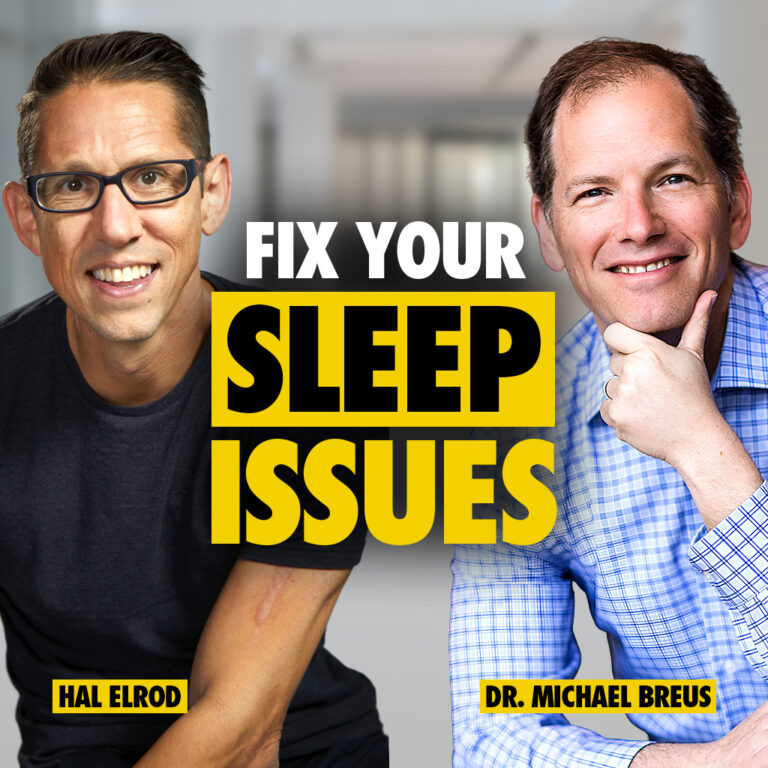


Getting a good night’s sleep shouldn’t be difficult, and yet, it can feel almost impossible at times. And when you’re not sleeping well, it affects everything from your energy and mood to your relationships, productivity, and overall health. I know firsthand how debilitating it can be, and how difficult it is to break the cycle once you’re stuck in it.
In 2020, after undergoing 700 hours of chemotherapy, I was sleeping just two to four hours a night for months. My physical and mental health had deteriorated to the point where I was experiencing suicidal thoughts, and I was terrified that my lack of sleep would prevent my body from healing. Thankfully, I reached out to my good friend, Dr. Michael Breus, and the strategies he shared helped turn things around.
Dr. Breus, also known as The Sleep Doctor, is a clinical psychologist and world-renowned sleep expert who has dedicated his career to helping people improve their sleep and quality of life. He’s also appeared in The Miracle Morning Movie, and I’m grateful to have him back on the podcast to share his expertise.
In our conversation, Michael explains why the pathway to better sleep is often simpler than we think and how our daily habits can help or hinder our body’s natural ability to rest. We also discuss the powerful connection between anxiety and insomnia, what to do when you wake up in the middle of the night and can’t fall back asleep, and some surprising misconceptions about sleep supplements, mouth taping, and other popular sleep strategies.
KEY TAKEAWAYS
- Why anxiety is one of the biggest causes of insomnia.
- The five daily habits that dramatically improve sleep quality.
- How your wake-up time determines when you get sleepy.
- Why alcohol ruins the quality of your sleep.
- The 3-2-1 rule for a better night’s sleep.
- How acceptance can help you fall asleep faster.
- What to do when you wake up at 3 AM.
- Why mouth taping can actually be dangerous for your health.
- What you should know before taking sleep supplements.
AYG TWEETABLES
"You change someone's sleep, and you change their life. It is that fundamental."
– Dr. Michael Breus Tweet
“The time that you wake up directly determines when melatonin turns back on.”
– Dr. Michael Breus Tweet
“The best way to improve sleep quality is exercise. You got to tire the body out. If you don't tire the body out, it doesn't sleep very well.”
– Dr. Michael Breus Tweet
“The biggest issue that I think people don't know about is sugar limits the production of melatonin.”
– Dr. Michael Breus Tweet
“One of the things that our body knows, it's time to do things based on the cues that we give it. Light is one, exercise is another, food is a third. And so, keeping the timing of your meals consistent is a fantastic way to be able to make sure that you're getting good sleep.”
– Dr. Michael Breus Tweet
“Sleep is a lot like love. The less you look for it, the more it shows up.”
– Dr. Michael Breus Tweet
“Acceptance turns out to be incredibly important when it comes to sleep because as soon as you have acceptance, your heart rate drops, and you fall asleep.”
– Dr. Michael Breus Tweet
RESOURCES
- The Sleep Doctor
- The Sleep Doctor on LinkedIn | Facebook | Instagram | YouTube | X/Twitter
- Michael Breus on LinkedIn | Instagram
- University of Mississippi Medical Center
- The Miracle Morning Movie
- Joe Polish
- Andrew Weil
- Sleep Doctor
- Fullscript
- Function Health
- Upgraded Formulas Magnesium
- Nordic Naturals
- The Miracle Morning App
THIS EPISODE IS BROUGHT TO YOU BY:
CURED Nutrition:
I want to talk about two of my favorite products. I’ve been taking these for four years, and they’re now a sponsor of the podcast, CURED Nutrition, Flow Gummies. I start every day with two of these. I meditate for 30 minutes without any supplements, and then I take Flow Gummies seven days a week, almost every day.
And then I go to bed with Night Oil. 30 minutes before bed I take Night Oil and it helps me fall asleep and stay asleep. So I start my day with Flow Gummies, I end my day with Night Oil.
If you want to implement my routine into your day with CURED Nutrition, go to CUREDnutrition.com/Hal and use the discount code HAL at checkout for 20% off your entire order.
Flow Gummies to start the day Night Oil to fall asleep. You’ll feel better, you’ll act better, you’ll perform better. Check it out.
RATE & REVIEW THE PODCAST
Reviews for the podcast on iTunes are greatly appreciated and will allow us to get the word out about the show and grow as a community. We read every single review and believe each one goes a long way in helping us make the show even better! If you received value from this episode, please take a moment and rate and review the podcast by clicking here.
Copyright © 2026 Miracle Morning, LP and International Literary Properties LLC
[INTRODUCTION]
Hal Elrod: If you struggle with sleep and you want to fix your sleep issues as fast as possible, this episode is for you. We are joined by my friend, Dr. Michael Breus, known worldwide as The Sleep Doctor. He was featured in the Miracle Morning documentary. You may have seen him on The Diary of a CEO podcast. And today, he is sharing with you how to fix your sleep issues, because when I was going through the most difficult time in my life, literally, after enduring 800 hours of chemotherapy, I was sleeping two to four hours a night for roughly six months, and I called Dr. Michael Breus to save me, to help me, because I didn’t know what to do.
If you struggle with sleep issues, you’ve been there, right? Your brain doesn’t work right, your energy is low, your mood is a mess. Dr. Michael Breus is possibly the most qualified person in the world to help you fix your sleep issues so you can get back to the person that you know you are, you know you’re capable of being. You just got to get a good night’s rest. It’s my good pleasure to introduce you to my good friend, Dr. Michael Breus, The Sleep Doctor.
[INTERVIEW]
Hal Elrod: What up, sleep doctor?
Dr. Michael Breus: How’s it going, brother?
Hal Elrod: Dr. Michael Breus, man, we’ve done this quite a few times.
Dr. Michael Breus: I know. I’m excited to do it again.
Hal Elrod: Yeah. Well, I don’t know, you were in the Miracle Morning movie, and I think your career, it really helped it take off.
Dr. Michael Breus: I was going to say that was the moment where everything sprang just from that.
Hal Elrod: That’s right.
Dr. Michael Breus: Absolutely.
Hal Elrod: Actually, here’s what I was thinking about to start this out. I don’t know if I know this about you, and it might just be because I’ve forgotten. But how did you get into your field of expertise? How’d you become The Sleep Doctor, world-renowned sleep expert, yeah?
Dr. Michael Breus: So, there are a couple of stories that go along with that one. So, one is how did I get into sleep medicine as an origin story. Then there’s the how did I become The Sleep Doctor story. So, the origin story is one that’s very serendipitous. I was interested in sports psychology. I went to the University of Georgia. Go Dogs. And I got my PhD there in clinical psychology, and I was very interested in sports and working with athletes and all that kind of cool stuff. And I was trying to get an internship, so when you get a PhD, you then do a year-long internship or residency where basically you’re practicing all the stuff that you learned, but you’re being monitored so you don’t screw anybody up.
And the number one sports psychology internship in the country, believe it or not, was at the University of Mississippi Medical Center in Jackson, Mississippi, for what I was interested in. I was interested in eating disorders in athletes, trying to combine the two kind of areas, but I couldn’t get in. Only the Harvards and the Yales and the Princetons of the… I mean, Georgia’s a top 20 program, but it ain’t Harvard. But they had a sleep track fully funded that was available. And so, I looked into them. I’m like, “What is a sleep track?” And it turned out they just needed somebody who’d ever worked in a sleep lab.
Well, I’d never worked in a sleep lab, but I had worked in the electrophysiology lab, and they used the exact same equipment. So, I said, “I’m going to sell myself as a sleep guy, and then as soon as I get there, I’m going to transfer,” I mean, they can’t stop me. Like, once I’m there, I’m there. So, I get in, sell myself as a sleep guy, get there, raise my hand. “Yes, Dr. Breus?” “I want to transfer.” They said, “Hey, here’s the deal. You have to stay where you are for six months because that’s paying for your existence here. Then after that you can go to any part of our program that you want.” I’m like, “This is awesome. How tough could it be? I sleep every night,” right?
Three days later, I completely fall in love with clinical sleep medicine, and I know I’m never going to change my path. Dude, I help people this fast. It’s unbelievable. You change someone’s sleep, and you change their life. It is that fundamental.
Hal Elrod: Well, and I think that one way to understand how true that is is if you’ve ever struggled with sleep, how screwed up every area of your life is. I called you in 2020 when I was suicidal. I was going through the worst time in my life. I had gone through 700 hours of chemo, and I think it was… I think that’s what caused it. I don’t know. There’s no way to exactly know. But essentially, I was sleeping two to four hours a night for, like, six months. I was a mess.
Dr. Michael Breus: Yeah, I remember.
Hal Elrod: In fact, I was such a mess that I forgot that I could call you. I was, like, talking to Joe Polish as a friend. And he’s like, “How are you?” And I’m like, “Dude,” I’m like, “I’m the worst I’ve ever been. I want to die.” And he’s like, “Have you called Dr. Michael Breus?” I’m like, “Dude, I totally didn’t even think about that,” and I’m like, “I have his number. He was in The Miracle Morning movie.” And you helped me. You helped me with, I mean, all the things that you helped with, but mindset, supplementation, all the different strategies.
Dr. Michael Breus: Yeah, the whole thing.
Hal Elrod: Let’s dive right into that, and then we can circle back to how you became the sleep doctor.
Dr. Michael Breus: Sure. That’s a more interesting story.
Hal Elrod: Exactly. Immediately give folks what… I think why sleep is important, I think we know everything functions off that. But what are the keys to good sleep?
Dr. Michael Breus: So, I think it’s more simple than people actually think it is. Like, let’s be fair, everybody’s already been able to figure out how to do this activity,
Hal Elrod: There you go. Yeah, we’re born knowing how to do it, yeah.
Dr. Michael Breus: Yeah. But that’s what’s so interesting about it is because people say to me all the time, “Well, shouldn’t my body just automatically know how to do it?” Well, it kind of does, but most people put roadblocks in front of the body without even necessarily meaning to. Simple one, caffeine, And, look, caffeine’s in everything. It’s in chocolate. By the way, you can eat as much chocolate as you want. There’s nothing wrong with chocolate. There’s caffeine, there’s nicotine, there are all these different things that come across: alcohol, cannabis. Like, lots of different things can influence the body depending upon what you ingest. And by the way, that’s not the only thing that you have to think about. You have to also think about stress and your mindset,
Hal Elrod: That’s the biggest one, I think, for most people.
Dr. Michael Breus: I would argue it’s the biggest one for everybody. When I start to see patients, and I think this tracks for you is 75% of a patient’s sleep problem is fear or anxiety. Some level of that, either fear that I’m never going to sleep again, or that there are going to be massive consequences to me if I don’t sleep. I remember, if it’s okay to share, one of the things that you said to me was you were afraid that you weren’t going to heal if you didn’t sleep.
Hal Elrod: Yeah. Yes, yeah. Yeah, like that my cancer would come back and I would die and leave my family. So, that spirals. So, then when I wake up at 3:00 in the morning, I’m like, “I’m going to die.” It’s literal, yeah.
Dr. Michael Breus: Exactly. Yeah. And so, that’s a great example of how fear, and by the way, you’re still here. You didn’t go anywhere. Thank God. We all like having you around. And it’s important for people to start to understand that there’s the environment, then there’s your physical, and then there’s your mental. And all three of those, they don’t have to line up perfectly. I want to be very clear. Sleep will happen. Somebody said something to me the other day that I thought was a great way of thinking about sleep. Sleep is a courier to your next day. That’s all it is. It’s just a transportation vehicle. A lot of sh*t happens while you’re being transported. But it’s merely a transportation vehicle. And by the way, you get to practice every night.
Right? And you don’t have to take a night off. A lot of people do, which is probably a bad idea. But generally speaking, there are about five to seven principles that I think people can follow. Let me give people a five-step plan that I think will cover a majority of that. Step number one: wake up at the same time seven days a week,
Hal Elrod: Amen. Preach, brother.
Dr. Michael Breus: So, this turns out to be very, very important, not only to have a good Miracle Morning, which is one of the reasons why we want people to do this. But also, it gives you a level of circadian consistency. So, let me break that down or double tap on that so that the audience understands. So, there are two systems in the brain that help you sleep. One is called your sleep drive. That’s the thing that makes you feel sleepy. The other is called your sleep rhythm that tells your body it’s bedtime. So, when those two are not doing the things that they need to do, that is when you have some pretty significant problems with sleeping. So, here’s what’s interesting, is when you look at the biology of it, waking up at the same time every single morning, sunlight comes in and hits your eye, sends a signal to the back of your brain to turn off the melatonin faucet in your head. But it sets a timer for exactly 14 hours later. Maybe not exactly, but pretty close.
Hal Elrod: Yeah, yeah, roughly. Right?
Dr. Michael Breus: Which is called the melatonin phase response curve. So, I want everybody to think about what I just said. The time that you wake up directly determines when melatonin turns back on. So, if you wake up at 6:00 in the morning, five days a week, and then Saturday you sleep in until 8:00, melatonin doesn’t start for two more hours at night than when it did Monday through Friday.
Hal Elrod: So, you’re going to have trouble falling asleep.
Dr. Michael Breus: Exactly. So, consistency gives the body that opportunity to continue to have that happen. And by the way, the more consistent sleep that you have, the greater the quality improves. The body wants to stay. And so, it’s doing all these great things. So, step number one, one wake-up time. Step number two is to stop caffeine by 2:00 PM. Caffeine has a half-life between six and eight hours. So, if you can stop at 2:00, that maybe stretches you to 10:00, and then at least half of it is out of your system. Here’s a sneaky little unpopular factoid is the quarter-life of caffeine is 12 hours, which means 25% of the caffeine that you have ingested in the day is still in your system 12 hours later.
So, as an example, if you had four cups of coffee throughout the day and you took your last cup of coffee, let’s say, at 2:00 in the afternoon, guess what? 25% of that, or one full cup, is floating around your head at 2:00 in the morning. So, that’s problematic. So, if you can push that caffeine earlier and earlier. Step number three has to do with alcohol. Lots and lots of people drink. I don’t have any problem with drinking. I like bourbon, champagne, a beer every now and then, sure. But at the end of the day, alcohol destroys stage three/four sleep. Now, why is that important for somebody, for example, who’s recovering from a situation like cancer? Stage three/four sleep is where all the physical restoration occurs.
The last thing you want to fu*k with is stage three/four sleep, That is super-duper important, and alcohol obliterates it. It makes you fall asleep. And so, a lot of people say, “Oh, well, it makes me feel sleepy. It must be okay for my sleep.”
Hal Elrod: But it ruins the quality, yeah.
Dr. Michael Breus: The quality is crap. And again, one of the processes that goes on during stage three/four sleep is a washing machine for your brain. So, there’s this thing called the glymphatic system, and this is a really weird statistic, but maybe people don’t know it. But when you fall asleep, your brain shrinks by, like, 2 or 3 millimeters. Cerebrospinal fluid comes in and mixes it around. That’s how all the beta amyloid and tau get out of there.
Hal Elrod: Wow.
Dr. Michael Breus: Yeah, so it’s like a…
Hal Elrod: I don’t know what beta amyloid and tau are.
Dr. Michael Breus: I’ll tell you. So, beta amyloid and tau are the two proteins that, if they build up in your brain, they wrap around the nerves. That’s called Alzheimer’s disease.
Hal Elrod: Wow.
Dr. Michael Breus: Yeah, we don’t want that. So, we want the washing machine to work and get that beta amyloid and tau out, so we want as much stage three/four sleep as we can, which means alcohol is a problem. But we still want to be able to enjoy an adult beverage every now and then. So, here’s the rule, is you want to stop alcohol three hours before bed. You want to have limited yourself to two drinks, and you want to have a glass of water in between each drink. This fills your stomach up, gets the process of moving it through your system, and then when you wait for about three hours, that should be enough time for two drinks to get out of the system.
Hal Elrod: Got it, yeah.
Dr. Michael Breus: Step number four has to do with exercise. The best way to improve sleep quality is exercise. You’ve been a big exerciser for a very long period of time. You know and understand that. You got to tire the body out. If you don’t tire the body out, it doesn’t sleep very well. But you can’t exercise too close to bedtime because you’ll cause increase in core body temperature. So, a lot of my cyclists, they can’t cycle late at night, you know? And some of them have even tried to, like, cycle and then get into a cold plunge to drop their temperature. It doesn’t work as well as they would hope, certainly not on the regular. So, what I tell people basically is exercise daily, but stop exercise four hours before bed.
And the last one is an easy one. It’s a morning routine, which I know you love. I call it the three fifteens, and it’s something that you could do as you’re doing your Miracle Morning. So, all I ask people to do is swing their legs over on the bed, put their feet on the floor, and take 15 deep breaths, just waking up the respiratory system. I want them to drink 15 ounces of water, and I want them to get 15 minutes of sunshine. I ask that they do it all together if at all possible. So, if you don’t want to breathe in your bedroom, walk outside to a nice hardback chair. If even possible, take your shoes off and put your feet on the earth. It’s called grounding. There’s not a lot of data, but it feels really good, so you might as well do it.
And 15 minutes of sunshine is the exact amount of time that your body needs to start creating vitamin D, and vitamin D turns out to be a circadian pacemaker and helps keep your body on that pace. So, those are the five. Step number one: wake up at the same time. Step number two: stop caffeine by 2:00. Step number three: stop alcohol three hours before bed. Limit yourself to two drinks. Step number four: exercise daily but stop four hours before bed. And step number five is: while doing your Miracle Morning, do my three fifteens.
Hal Elrod: I love that. I love it. I’ve got a question on that and where this fits in. I’m not a scientist, and so I practice the science of common sense. I’m like, “That makes sense to me.” So, one thing, and I’m sure I actually read about this, but it’s eating before bed. So, for my non-PhD, I will often tell people, “If you eat right before bed, then your body isn’t getting to rest while you’re sleeping. It’s actually you’re burdening your digestive system with a ton of food.” And, for me, when I feel like I was hit by a truck in the morning, it’s usually when I ate too close to bedtime, and my body worked all night, then I woke up. What does that play? And how do you advise eating and…
Dr. Michael Breus: So, that 100% tracks. So, you’re correct. You have earned your now sleep doctor degree.
Hal Elrod: Hal Elrod, PhD. Yeah, exactly.
Dr. Michael Breus: That’s right, your new sleep doctor degree, for sure. So, it’s interesting. So, number one, there are a couple of factors in here. So, first of all, if you haven’t eaten all day, going to bed starving is a terrible idea. This does not include people who are doing fasting. That’s a whole separate wheelhouse. We’re not going to go there. For just regular folks out there who are not necessarily doing fasting, you need to have had something in your stomach, If you’re waiting until 9:00 or 10:00 at night to have your latest meal, that’s going to be definitely problematic. Number two, what you eat matters. Look, I love Buffalo chicken wings, but I got to tell you something, brother. If I watch a game late and I’m eating them at 10 o’clock at night, I’m done, right?
Like, my sleep is screwed, I wake up feeling like crap, all of that kind of stuff. So, you want to be thoughtful about that. And then the amount turns out to be important, as well as the macros that you’re eating. And so, carbs will make you feel sleepy. Protein will make you feel more alert. So, what happens for some of my patients is if they’re, like, doing strict keto and they don’t get to eat until 9 o’clock at night, they’re up until 11:30-12:00 because they’ve all been doing is protein. So, you want to be thoughtful about how you want to do things. I think the biggest issue that I think people don’t know about is sugar limits the production of melatonin.
And so, when you have a big piece of cake or pie or ice cream, which, by the way, ice cream is my kryptonite. I absolutely will never turn it down when offered. It’ll mess up your sleep pretty bad.
Hal Elrod: Totally. That makes sense to me. And spikes your blood sugar as well,
Dr. Michael Breus: Which is not a good idea right before bed.
Hal Elrod: So, you mentioned what you eat matters. What would you recommend? So, let’s say it is, like for me, I try to eat dinner between 5:00 and 6:00. I’m going to bed at 9:00, so I’ve got three hours to digest my meal.
Dr. Michael Breus: Yeah, I do what I call the 3-2-1 rule.
Hal Elrod: Okay.
Dr. Michael Breus: Three hours before bed, stop all food and fluids. Two hours before bed, stop all work. One hour before bed, stop screens if you can.
Hal Elrod: Amazing. And I was going to ask you, so you just answered that essentially, So, stop screens an hour before bed. So, if you do have to eat before, if you’re like, “Oh, I didn’t eat, I was whatever, and now it’s 9:00 PM, and I’m going to bed at 10:00,” what would you recommend somebody eat?
Dr. Michael Breus: Great question. So, I would say there are a couple of different ways you could go about doing it. It depends upon how many calories you took in, but I would say probably some type of a smoothie would probably be your best bet. Not a high-fruit smoothie with a lot of sugar in it. Something more, maybe like a peanut butter, banana kind of thing. It’s going to have some sugar in it. Everything’s going to have some sugar in it. But you want to keep it more towards that side of things. I think that would be a good thing. Sometimes just having a protein shake is not the worst idea in the universe.
Hal Elrod: Yeah. What about…? So, what I’ll do a lot is I’ll do an avocado with salt.
Dr. Michael Breus: Oh, that’s a great idea.
Hal Elrod: So, fat and salt. No carbs or no sugar.
Dr. Michael Breus: Yeah, so that’s my late-night snack.
Hal Elrod: Okay.
Dr. Michael Breus: I thought you were asking about dinner. But if people want a snack, I like a 250-calorie snack that’s 75% carbs and 25% protein. So, like, I would take the avocado, and I’d put it on a rice cake.
Hal Elrod: Okay. Now, why carbs? See, that’s counterintuitive. So, this is where my common-sense science is going to fail. No, it’s going to fail. Meaning, which is like to me, carbs are what you take when you need a bunch of quick energy to burn. So, I’m thinking at night I wouldn’t want that. So, how does that work?
Dr. Michael Breus: One of the things that seems to happen is when your body begins digesting the carbohydrates, it seems to, for whatever reason, draw enough energy to start making you feel sleepy. And so, I think it’s the process of the digestion more so than the carbs itself, but carbs do require a certain way that your body digests, and that could be an energy portion from that. Other than that, I’m not 100% sure. I can tell you that a lot of times it depends on the carb. So, if it’s a carb where, like if you take a sugar packet and you throw it in your mouth, that’s not going to work. You know what I’m saying? I’m talking about eating an apple. So, it’s all packaged in fiber, carbs, all the good stuff that you want. And actually, an apple would be a perfect snack before bed.
I also like, I mean, if you wanted to have a scoop of ice cream, you could, but you would probably want it to be dairy-free. You probably want it to have as little sugar in it as possible, which doesn’t sound like ice cream to me.
Hal Elrod: Yeah. Well, it’s interesting. In the same way that you mentioned how important it is to wake up at the same time every day, for me, that goes with diet, right?
Dr. Michael Breus: I can see that.
Hal Elrod: So, meaning, I’m eating at the same times every day, including the dinner time. So, it’s not sporadic where I’m like, “Oh, one night I’m at 7:00, one night I’m at 9:00.” It’s like, no, I’m on this regimented, and it just makes it easy that, like, I know that I eat, so I’m able to fall asleep.
Dr. Michael Breus: Also, I want to be clear that the regimented eating actually helps with circadian consistency. So, one of the things that our body knows, it’s time to do things based on the cues that we give it. Light is one, exercise is another, food is a third. And so, keeping the timing of your meals consistent is a fantastic way to be able to make sure that you’re getting good sleep.
Hal Elrod: Got it. So, I think I want to ask you. It’s interesting we haven’t covered this because the number one cause you mentioned of people struggling with sleep is stress, is fear.
Dr. Michael Breus: Yes.
Hal Elrod: How do you recommend that people address that? So, let’s say a real quick scenario: stressful day, million things on my plate. Maybe I even fought with my spouse. Like, there’s just like so many, and I got a million things at work, and finances aren’t good. It’s just like the average person’s life, sadly.
Dr. Michael Breus: I hear it every day. Yeah.
Hal Elrod: And now I hit bedtime, and I have my approach. I want to hear yours first, and if it makes sense, I’ll maybe contribute to it. But, yeah, so what’s your approach? Like, what do I do when I head into my bedroom to go to bed?
Dr. Michael Breus: Got it. So, first of all, want to take a half a step back and say in that situation, cognitive behavioral therapy for insomnia is probably the place to start, which is what we worked on together, actually. I used the principles of that in a lot of our discussions and conversations. So, let me just double tap on what is cognitive behavioral therapy for folks. So, cognitive behavioral therapy is where you change the way you think about sleep. In the scenario that you presented to me, it’s a fricking disaster day, and all I want to do is escape and get some rest. But I can’t turn off my brain because it was a disaster day. Totally understand that. Where cognitive behavioral therapy comes into play, and I want to be clear: this doesn’t happen overnight. This takes time. You start to think about your sleep differently.
Let me give you some examples, and then I’m going to give you some faster ways to fix your sleep versus taking the time for cognitive behavioral therapy. And these can both be used in conjunction with one another.
Hal Elrod: Best of both worlds. Great.
Dr. Michael Breus: Or you can just use them with each other. So, as an example, when you look at cognitive behavioral therapy, you’re looking at what we call cognitive distortions, things like, “If I don’t sleep, if I don’t get at least eight hours of sleep, I’m going to make a mistake at work tomorrow, and my boss is going to fire me.” There’s really no reality in that situation. However, you’re so sleep-deprived, and you’re so stressed, you don’t know that. And so, you tell yourself this story, and you begin to spin yourself up, like what we were talking about before. This spiral just goes…
Hal Elrod: I’m going to die because I am not sleeping, and I’m going to lose my job, or I’m going to… Yeah, on and on.
Dr. Michael Breus: All of that. So, first of all, one of my mantras is sleep is a lot like love. The less you look for it, the more it shows up.
Hal Elrod: I like that, yeah.
Dr. Michael Breus: So, when you’re out there looking for that perfect person, you never find them. As soon as you stop looking, they show up. Sleep is exactly the same way. The more you try to sleep, the harder it is to sleep. Now, within cognitive behavioral therapy, there’s a second field of therapy called ACT, acceptance and commitment therapy. This is a little bit different. Cognitive behavioral therapy has some strict rules, some strict guidelines that you go through, but this ACT therapy is more like, “Hey, if you don’t sleep tonight, you’re going to be okay.” It’s acceptance. Acceptance turns out to be incredibly important when it comes to sleep because as soon as you have acceptance, your heart rate drops, and you fall asleep.
There are three ways to get somebody to fall asleep, and all three must occur at the same time. You have to lower your temperature, you have to lower your heart rate, and you have to lower your anxiety. If you don’t do those three things, there’s no universe that you’re sleeping. ACT therapy is one of those ways that it can help you do that because it has a lot to do with acceptance. But let’s take a look at your situation. Let me give you some fast tips of things that people can use in the beginning of the night, or, which is the more case that I hear, “Michael, what do I do if I wake up at 3:00 in the morning and I can’t fall back to sleep?”
Hal Elrod: And the older you get, the more you end up peeing in the middle of the night and you just can’t not wake up at 3:00 in the morning. It’s like, how do you get back to bed after? Yeah.
Dr. Michael Breus: Right. It’s a big deal. So, lots of different things are going on here. So, one of the things that I tell people all the time is don’t go pee. Yep, you heard it here. Don’t go pee. Now, I want to be clear. If you honestly have to go to the bathroom, I really do… Like, somebody called me up one day and like, “Should I wear Depends?” No. No, no, no. That’s not what we’re talking about. What I want you to do, though, is do you really need to go pee? Because remember the heart rate thing? Like, you need your temperature to come down, your heart rate to come down, and your anxiety to come down. What do you think happens to your heart when you go from a lying position to a seated position to a standing position and walk across the room?
Your heart rate goes up. So, when you come back, you have two issues. Most people, when they wake up at 3:00, here’s what they say. “I’m up. I might as well go pee.” That’s the problem. If you really, if you got to pee, please, go pee. But if you don’t have to pee, don’t pee. And how do you tell? Most people sleep in the fetal position on their side. So, if you roll over to your back, count to 20. If you still have to pee, please get up and go pee.
Hal Elrod: Hopefully, you’ve fallen back asleep by the 20th.
Dr. Michael Breus: A lot of times that’s what happens. So, step number one, don’t go pee. Step number two, don’t look at the clock.
Hal Elrod: Yeah. Oh, yeah. Thank you. I’m big on that.
Dr. Michael Breus: Dude, this is such a big one. People instantly do the mental math.
Hal Elrod: That’s the anxiety-inducing, yep.
Dr. Michael Breus: Shoop. There’s nothing you can do to stop it. You instantly do the mental math and then all of a sudden you’re pissed. You’re like, “Oh my God, here I am again. This happened again. Oh, I didn’t fall asleep last night. I bet I’m not going to fall asleep tonight.” And here’s the other thing that a lot of people don’t realize is your brain is inherently negative when you wake up in the middle of the night. Think about it. If you got woken up at 3:00 A.M., would it be a good scenario?
Hal Elrod: No.
Dr. Michael Breus: Never. Nobody’s walking in at 3:00 A.M. and saying, “Happy birthday.” “You got a raise.”
Hal Elrod: “Hey, sweetie, I love you.”
Dr. Michael Breus: Doesn’t happen. That sh*t doesn’t happen at 3:00 in the morning. What happens at 3:00 in the morning is alert. So, when your body alerts, you are naturally going to be spinning negative. I learned a long time ago, it’s very hard to stop your first thought. You can definitely stop your second. And so, once you notice that you’re being negative, remember, “I’m being negative in the middle of the night. This is not going to be helpful for me.” Don’t look at the clock. Step number three. Michael, I didn’t pee, I didn’t look at the clock, but I’m still awake. What do I do? My favorite technique is called 4-7-8 breathing by Dr. Andrew Weil.
So, Dr. Andrew Weil, Harvard-trained naturalist, developed this technique, but what’s great about it is it drops your heart rate to 60. Sixty is the magic number to enter into a state of unconsciousness. And it’s exactly what it sounds like. You slowly breathe in for a count of four, you hold for a count of seven, and then you exhale gently for a count of eight, all done through the nose. Now, why does this work? It’s very interesting, but when you push for eight, you actually click on the parasympathetic nervous system. Okay. There’s documented evidence about it. There’s a whole maneuver that it’s called. But trust me on this one: when you push longer than you hold… And by the way, you don’t have to hold the whole seven. So, for example, I’ve got some clients who will draw in for four, hold for five, and then push out for six.
Hal Elrod: Got it. Okay.
Dr. Michael Breus: So, as long as we’ve got that kind of ratio that it slowly inclines, you’re going to be in good shape. Now, here’s the key, is you need 20 cycles. Here’s the problem. I lose count. This happens to me. I’m in the middle of the night. I’m trying my own damn stuff, 4-7-8 breathing. And I’m like, “Oh, crap. I lost count.” My anxiety goes up, my heart rate goes up, my temperature goes up. Now I’m pissed. So, I figured out a technique. What I do is I take my hands, and I make gentle fists, and I put them behind my side. Stick out a finger for a cycle. Stick out a finger for a cycle. Once I get to 10, I wrap them back, and I’m at 20. Usually, I’m asleep before I get there.
Hal Elrod: I love it. I love it, yeah.
Dr. Michael Breus: So, 4-7-8 breathing, 20 cycles, but there’s one more caveat that turns out to be the kicker. When you’re breathing, you want to picture a number. So, when you’re breathing in, you picture a four, then a three, then a two, then a one. Then you picture a seven, a six, a five, a four, a three, a two, a one for the hold, and then when you push out, you picture the number in your head because you can’t count and be worried at the same time. It’s actually impossible.
Hal Elrod: Interesting.
Dr. Michael Breus: So, we’re distracting the brain with the counting, with the digits, right, and then the breathing is actually lowering their heart rate. It’s a twofer.
Hal Elrod: Love it.
Dr. Michael Breus: So, we distract the brain, we get the biology on, and we’re going. “Okay, Michael, I’ve listened to you. That 4-7-8 thing, it’s awesome. It kept me relaxed. I feel good, but I still didn’t fall asleep. What do I do here?” There’s something called non-sleep deep rest. We used to call it yoga nidra. I think it’s still called that. All it is is lying with your arms crossed, relaxing. When they do the studies, it turns out that that’s rejuvenative. It’s not as good as sleep, but if you do that for an hour, it’s worth about 20 minutes of sleep.
Hal Elrod: Just laying on your back, like in the mummy position essentially?
Dr. Michael Breus: Yeah.
Hal Elrod: Okay.
Dr. Michael Breus: Just lying there and relaxed. The key factor is not getting upset. And that’s where the negativity part comes in. You got to stay positive. So, I have a little mantra that I tell myself. So, if I get through my whole 4-7-8 and I still haven’t been able to fall asleep, I’ll just say, “You know what? For some reason, my body seems to want to be awake right now. I’m okay with that. I’m going to relax. I’m going to do some more gentle breathing, and I’m going to think about some pleasant thoughts.” Dude, within three to five minutes, I’m done.
Hal Elrod: Yeah. Well, you talked about the ACT. What’s it stand for again?
Dr. Michael Breus: Something commitment therapy. Acceptance. Thank you. Acceptance and commitment therapy. Thank you.
Hal Elrod: So, acceptance is a big thing that I teach in terms of, like, finding inner peace. And I always say acceptance is the key that unlocks the door to inner peace.
Dr. Michael Breus: Ah, I like that.
Hal Elrod: And resistance is the cause of all emotional pain and turmoil. So, it makes sense that…
Dr. Michael Breus: Same with sleep.
Hal Elrod: Sleeping, exactly.
Dr. Michael Breus: It’s exactly the same.
Hal Elrod: Yeah, it’s like, “Oh, it’s this time. Oh, I’m not sleeping.” Like, you’re resisting reality, and you’re therefore creating turmoil and stress versus accepting reality as it is. What are your thoughts on mouth tape?
Dr. Michael Breus: I think it’s the second-stupidest idea I’ve ever heard.
Hal Elrod: Okay. We’re going to have to go ahead. All right. Tell me.
Dr. Michael Breus: So, let me tell you. So, mouth tape is problematic for multiple reasons, and I’ll tell you why. The number one reason that mouth tape is problematic is because 94% of people will sleep with their mouth closed as long as they don’t have nasal congestion. The reason people sleep with their mouth open is because they have nasal congestion. Fix the root of the problem. Mouths are meant for eating, not for breathing. There’s no filter. You get unfiltered air coming straight in, so every particulate that’s flying around your house is now inside your lungs. This is not what this was designed to do. And so, then people say, “Well, of course, then we should tape it shut, Michael, so then all the air is just going through my nose.” Couldn’t agree with you more, but have you been screened for sleep apnea? So, most people have never been…
Hal Elrod: What is sleep apnea? I don’t even know what it is. I’ve heard of it a million times. But what is it?
Dr. Michael Breus: Sleep apnea is a situation where you stop breathing in your sleep. You stop for a period of 30 to 90 seconds, then you wake up gasping for air. By the way, this can happen hundreds of times a night. And there’s well-known treatments for it. If you don’t get it treated, you will end up with a major cardiac problem. So, when you stop breathing, your heart rate slows down to conserve the oxygen that’s in the system, and then your brain says, “Oh, sh*t, there’s no more air,” and so your heart rate speeds up in order to breathe. So, your heart rate is slowing down, speeding up, slowing down, and speeding up. It puts an extra load on the heart. Over a couple of years, that turns into an irregular heartbeat because the musculature is different. Once you get an irregular heartbeat, you end up with atrial fibrillation. Now there’s no turning back.
Now, you’re going to have to get cardioverted. You’re going to have to get an indwelling pacer. Like, there’s a lot more issues. And by the way, all of this could’ve been avoided if you just decided to do a sleep study. But here’s what’s interesting, is people don’t want to do a sleep study because they don’t want to end up on a CPAP machine. So, the treatment for sleep apnea is a machine that you wear on your face. Now, I want to disclose fully here for everyone: I have sleep apnea. So, I stop breathing in my sleep 26 times an hour. Yeah. I had no idea. I felt like crap, and I talked to my doctor, and she said, “Hey, sleep doctor, have you done a sleep study on yourself lately?” And I was like, “You know what? Who cares?”
Hal Elrod: “I don’t need to. I’m the sleep doctor.”
Dr. Michael Breus: Well, here’s the funny thing, is I used to do studies on myself all the time because whenever we got new equipment at the lab, I wouldn’t try it on a patient. I’d try it on me. I haven’t had a lab in, like, 10 years. So, I hadn’t really done one in a while. I do a sleep study. So, it was really funny. I called the guys over at Sleep Doctor, because that’s one of the things that sleepdoctor.com does, is we can actually provide sleep studies anywhere in the United States for under $200. So, I called up one of my guys there, and I’m like, “Hey, send me a study.” So, he sends me a study. I wear it the next night. I said, “Give me the results.” He gives me the results. I said, “There’s something wrong with the study.”
Clearly, I can’t have sleep apnea because also, I don’t look like somebody that has sleep apnea. A lot of people who have sleep apnea, or what people think people look like who have sleep apnea, is that they’re larger people, that they’re obese or that they’re bigger or that they’re just heavier, bigger people. Because when you add adipose tissue, it will crush the windpipe and increase sleep apnea. So, a lot of times what we can do is we can fix the sleep apnea by helping people lose weight. This is one of the reasons why there’s a GLP-1 that’s specifically now used for sleep apnea.
Hal Elrod: Interesting. Okay.
Dr. Michael Breus: Anyway, I’ve digressed off of the point. So, when we look at sleep apnea, it’s a deadly disease if left untreated. When you tape your mouth shut, you have no idea if you have it or you don’t. And it can progressively get worse and worse, and you, again, have no idea. By the way, at least a few people have died from mouth tape for asphyxiation.
Hal Elrod: Interesting.
Dr. Michael Breus: Also, a lot of people who do mouth taping, especially when they’re snoring, has to do with when they’ve been drinking alcohol because alcohol increases that snoring. And so, their bed partner’s like, “Oh my God, you’ve been drinking tonight. You better put on your mouth tape.” And then we have a real problem on our hands.
Hal Elrod: All right. So, you’ve given a ton of tips today. If somebody wants to keep learning from you and you mentioned sleepdoctor.com, which they can also go there to get a sleep test. What’s the best way to learn more from you or handle their sleep problem in the way that you have an expertise to help them do?
Dr. Michael Breus: Of course. So, there are a couple of different ways. My YouTube channel, I’d say, would be a great place for people to swing on over and check out. We have over 1,000 videos on there. Everything you can imagine about sleep I have hopefully educated people on, and I’m excited because I get to do new videos all the time because that’s the best part about sleep medicine, is it’s ever-changing.
Hal Elrod: Always evolving, yeah.
Dr. Michael Breus: Dude, it’s so cool. Like we learned something brand new about narcolepsy last month. Like, how did that happen?
Hal Elrod: Wow.
Dr. Michael Breus: So, it’s fun to be able to do that. So, YouTube is a good place. I’m on all the social media. And the channel is all the same. It’s The Sleep Doctor.
Hal Elrod: Okay. Easy. And I have one more question for you that I almost forgot, which is a big one for me and people listening I would imagine and watching, which is supplements. In fact, you asked me if I was taking melatonin, and I said I don’t like taking all this synthetic crap made in the lab. Most of my supplements I take are whole food, you know, Vitamin C from…
Dr. Michael Breus: As they should be.
Hal Elrod: Yeah, from a million cherries.
Dr. Michael Breus: An orange.
Hal Elrod: Or an orange, yeah. But you recommended herbatonin, which was made from a grass, and I still take that to this day six years later.
Dr. Michael Breus: You should.
Hal Elrod: Yeah. So, what are the sleep… And I’ll tell you what I take. Actually, I’ll just tell you.
Dr. Michael Breus: Please.
Hal Elrod: So, 90 minutes before bed, I take organic valerian root. I take magnesium.
Dr. Michael Breus: Good.
Hal Elrod: I take lithium, which I’ve found helps for the mood. Like, when I wake up in the middle of the night, I’m very much at peace from the lithium I took before bed, so it’s a little interesting kind of strategy. And then one of the biggest ones that’s been a game changer for me, and I just recommended it to a friend who tracks his sleep, and he said he averages 20 minutes of REM sleep a night. He took this supplement the other night. First night, two hours of REM sleep. He was like, “I’ve been tracking my sleep for years. I’ve never gotten two hours of REM sleep.” And it is a capsule CBD and CBN oil, a blend of the two. And so, those are my main supplements that I take. And then the herbatonin is 30 minutes before bed. So, that’s what I take. What do you recommend? And any critique on those?
Dr. Michael Breus: Yeah, of course. So, I’m very staunch about my supplementation. And when we were talking about your supplementation, I want everybody out here to understand you’re a very different human. I know quite a bit about your medical history, quite a bit about what’s going on, so I made very specific recommendations. Giving more general recommendations for supplementation for sleep, here’s my theory. Do blood work first. Remember, supplementation is the idea that we’re not getting something in our diet, so we need to supplement it. I want to know what you’re not getting enough of, and let’s figure out if you can get it in your diet first before we start popping as many pills as there are out in the universe, which becomes unnecessary.
The blood work that I ask people to do is fairly specific. There are several different areas that if you have a deficiency, a true deficiency, it will have a big effect on your sleep. Iron is one of them. Vitamin D is another. Melatonin is one. Magnesium, less evidence, but still one that I would look at. And I would stick to those four. I would stick to those four. So, you do blood work on that, and if you are out of range, you want to fix that first.
Hal Elrod: So, they go to their doctor and just say, “Hey, I want blood work to measure these four elements.”
Dr. Michael Breus: Believe it or not, you don’t even have to go to your doctor. There’s a website called Fullscript where you can go on and you can actually order your own blood work. I can’t imagine you haven’t seen. There’s a lot of companies out there now where…
Hal Elrod: Yeah, Function Health.
Dr. Michael Breus: Function Health is one where you can go and get a ton of blood work done. So, this is not that, because it’s much, much smaller. It’s only four tests. But this will allow you to have an understanding. If you are deficient in any of those, there are recommended daily allowances to get you back to your clinical baseline. Here’s the thing that’s crazy, dude. 25% of the people that show up in my doorstep, if I have them do that and we just fix their deficiencies, everything gets better. Literally, a quarter of my patients, I just send them for blood work through Fullscript, and then they do the blood work. Then we have the ranges and things like that for them to look at. Then they’ll come back, and they’ll ask me, like, “What should I take?”
Then we look at some of those. We clear it with their doctor. By the way, that’s another thing that a lot of people don’t know about is supplements can interact with other medications. And it’s very important to know and understand that. As an example, melatonin interacts with birth control. Yeah, you heard it here. Birth control. Every SSRI on the planet, high blood pressure medication, and diabetes medication. So, before you go willy-nilly popping a bunch of pills, this is a good reason to do blood work and talk with your medical provider to make sure you’re not doing anything that could interact. Those are the areas that I would start to look at. You can never go wrong with omega-3s. As you get older, basically it’s fat for your brain, which is a really good thing.
So, I can tell you what my stack looks like is… And I’m not a big supplement person. I went, I did my blood work. I saw what I was deficient in. And I take the Nordic Naturals omegas with vitamin D because it’s all in one pill, because I get pill fatigue. There’s just too many to swallow. And I have one magnesium that I take. Now, magnesium is interesting because you can’t find a lot of good data on magnesium and sleep. And another problem is there are 13 different types of magnesium. So, people are like, “Michael, which one do I use?” I actually ran a clinical trial, a double-blind placebo-controlled clinical trial. So, I had a guy come up to me. He said, “I got the best magnesium on Earth. Makes people have tremendous deep sleep. This is going to be fantastic.” And I was like, “Give me $75,000, and we’ll run a clinical trial, or leave me the hell alone.” He handed me a check. He was right.
Hal Elrod: Oh, wow.
Dr. Michael Breus: Yeah. Upgraded Formulas Magnesium. Doesn’t have anything to do with upgraded coffee. Upgraded Formulas Magnesium. He’s a flow dynamics engineer, and he was really concentrating on absorption. And he developed a formula that absorbs like nothing I’ve ever seen. I mean, we did a double-blind placebo-controlled study, so there was a sham bottle of stuff that people took versus his. We saw an increase that was dramatic, like 40% increase in deep sleep. Yeah.
Hal Elrod: Wow.
Dr. Michael Breus: So, there was a lot of things that made sense. But again, when you’re looking at these things, if you’re deficient, it’s going to improve it. But if you’re not deficient, taking magnesium is just going to give you diarrhea if you take too much.
Hal Elrod: Got it.
Dr. Michael Breus: Now, your stack is interesting. And again, a lot of it is based on your background and my understanding of your medical situation. I want to double tap on the CBD, CBN because I think that’s an important one because a lot of people, I think, look at that. I want to be very, very clear. CBD lowers anxiety and helps with inflammation. CBN helps with sleep. If you have anxiety or inflammation and it’s affecting your sleep, CBD’s a great, great source. But CBN is really, I would argue, the bigger, better cannabinoid for sleep.
Hal Elrod: And that makes sense with my layman’s understanding, which is CBD helps you fall asleep, thus lowering your anxiety and your stress. CBN helps you stay asleep, which is exactly what you just said.
Dr. Michael Breus: So, CBN lowers your, what’s called arousal threshold. So, you don’t get aroused as easily any longer. There’s at least two studies to show that.
Hal Elrod: Not sexually aroused, you mean like aroused in…
Dr. Michael Breus: Like aroused in terms of your brain.
Hal Elrod: Okay, got it. Cool. Well, this has been a mini masterclass as always in sleep, Michael, and I really appreciate you. The Sleep Doctor on all your social medias. Sleepdoctor.com or thesleepdoctor.com?
Dr. Michael Breus: Both.
Hal Elrod: Both. Yeah, of course. Either. Yeah, miraclemorning.com or themiraclemorning.com. Just in case, yeah.
Dr. Michael Breus: Exactly.
Hal Elrod: Awesome, brother. Well, hey, I appreciate you. I’m so grateful we did this.
Dr. Michael Breus: Yeah, so am I. Thanks again.
Hal Elrod: Take care.
Dr. Michael Breus: Sweet dreams.
[END]