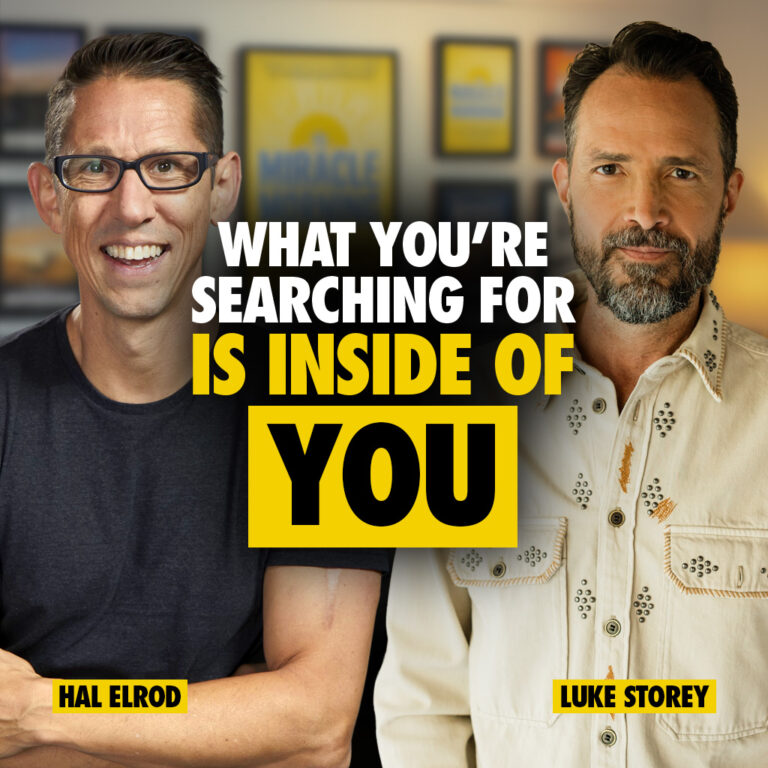


Today I’m sitting down with Luke Storey, host of The Life Stylist Podcast and author of A Horse Named Lonesome.
When Luke’s book landed on my desk, my first thought was, “I’m not lonely.” Then I read how he defines loneliness, and I realized it has very little to do with how many people are around you.
You can have a great career, a full calendar, and plenty of friends and still feel unseen. You can feel like there’s a pane of glass between you and everyone else. You can chase goals that look good on paper but don’t fulfill you. Luke spent 15 years in a career he never cared about for exactly that reason.
The mistake is trying to fix that disconnection from the outside, with more relationships, more achievement and more self-improvement. And if you’re wired for growth like me, that same drive can quietly turn into a voice telling you you’re never enough.
Luke and I talk about where that disconnection really comes from, what’s actually running the show when you feel it, and why the goals you’re setting right now might be far too small.
KEY TAKEAWAYS
- From Rock Star Dreams to Rock Bottom
- Why You Feel Lonely Around Other People
- What Luke Would Tell His Younger Self
- The 5-Minute Stop Thinking Test
- Put Your Ego in the Passenger Seat
- Why Vulnerability Creates Deeper Connections
- How to Meditate Beyond Your Morning Routine
- Making Meditation Part of Everyday Life
- Context vs. Content: The Key to Acceptance
- Are You Being Controlled by Your Ego?
- Breaking the Patterns That Keep You Stuck
- How to Grow Without Hating Yourself
- Using Surrender to Move Through Grief
- The Story Behind A Horse Named Lonesome
AYG TWEETABLES
“Winning friends doesn't do much good if the friends you make don't truly see you or know you.
– Luke Storey Tweet
“God isn't something that you have to go find out there somewhere. God is something that is inherent to who and what you are.”
– Luke Storey Tweet
“The ego mind is very shortsighted. It's clever, but it lacks wisdom.”
– Luke Storey Tweet
RESOURCES
- LukeStorey.com
- Luke Storey on LinkedIn | Facebook | Instagram | YouTube | X/Twitter
- A Horse Named Lonesome: Tales and Teachings to Reclaim Connection, Transcend Separation, and Discover the Divine Within by Luke Storey
- The Life Stylist Podcast
- Jimi Hendrix
- How to Win Friends and Influence People: Updated For the Next Generation of Leaders by Dale Carnegie
- Marianne Williamson
- Byron Katie
- Joe Dispenza
- NuCalm
- Freedom
- Roger Love
- The Miracle Morning App
THIS EPISODE IS BROUGHT TO YOU BY:
CURED Nutrition:
I want to talk about two of my favorite products. I’ve been taking these for four years, and they’re now a sponsor of the podcast, CURED Nutrition, Flow Gummies. I start every day with two of these. I meditate for 30 minutes without any supplements, and then I take Flow Gummies seven days a week, almost every day.
And then I go to bed with Night Oil. 30 minutes before bed I take Night Oil and it helps me fall asleep and stay asleep. So I start my day with Flow Gummies, I end my day with Night Oil.
If you want to implement my routine into your day with CURED Nutrition, go to CUREDnutrition.com/Hal and use the discount code HAL at checkout for 20% off your entire order.
Flow Gummies to start the day Night Oil to fall asleep. You’ll feel better, you’ll act better, you’ll perform better. Check it out.
RATE & REVIEW THE PODCAST
Reviews for the podcast on iTunes are greatly appreciated and will allow us to get the word out about the show and grow as a community. We read every single review and believe each one goes a long way in helping us make the show even better! If you received value from this episode, please take a moment and rate and review the podcast by clicking here.
Copyright © 2026 Miracle Morning, LP and International Literary Properties LLC
[INTERVIEW]
Hal Elrod: Luke Storey, it is such a pleasure to finally be sitting face to face with you.
Luke Storey: Here we go, man. Let’s do it.
Hal Elrod: Dude, I’ve known about you, I’ve followed you, I’ve been inspired by you for, I don’t even know, probably like 10 years.
Luke Storey: Awesome, man. Likewise. Well, here we are.
Hal Elrod: Yeah, we’re finally here. So, for anyone that doesn’t know you, if they’re meeting you for the first time, like give them some backstory on who is Luke Storey.
Luke Storey: Well, Luke Storey is a guy who is a former musician. I lived for a long time in Hollywood, 32 years, and tried to make my way up to being a rock star.
Hal Elrod: So, was that the dream when you were coming up?
Luke Storey: That was the dream from the time I was probably eight years old.
Hal Elrod: Wow, okay.
Luke Storey: Or whenever the first time I heard Jimi Hendrix.
Hal Elrod: Nice.
Luke Storey: And I set up a pretty far north star there with Jimi Hendrix.
Hal Elrod: There you go.
Luke Storey: But I ended up playing bass. You don’t have to be Hendrix to play bass in a rock and roll band, thankfully. But, yeah, so I spent a few years doing that in Hollywood and proceeded to burn my life to the ground with drugs and alcohol. And then, thankfully, was gifted the grace of sobriety when I was 26 in 1997, and still pursued music for a bit, but eventually found my way into the fashion industry, dressing rock stars in place of being one. So, the second best career path was being a shoe-shine boy for my heroes rather than become a hero.
Hal Elrod: You’re in their world at least. I mean, that’s a dream come true, yeah.
Luke Storey: Yeah. And so, I did that for about 15 years. And throughout the course of that career, I was deeply immersed in my spiritual path and recovery and alternative healing, things that are now called biohacking all these years later. Back in the late ’90s, you just called it being a health nut. And that led to eventually me realizing that I was building a career that I didn’t particularly feel called to, and I really wanted to get into the space of spirituality and healing and kind of find a way to merge my personal passions and personal life with the professional life. So, in 2016, I launched my podcast, The Life Stylist.
So, I’ve been doing that for 10 years, and that’s, of course, led to a lot of other opportunities to speak on stage and do workshops and all these kinds of things. And eventually that got to a point where I needed to sort of put into writing everything that I had learned, and that led to the writing of this book, A Horse Named Lonesome, sitting in front of us.
Hal Elrod: So, the premise of this book is… Well, I want you to answer it, but from my perspective, and I haven’t finished reading it. I’m reading it right now, and your writing is so good. Like, from the moment of the opening story of you on the floor, waking up in an apartment, overcoming a heroin addiction from your weed dealer who helped you by locking you in an apartment 30 miles away from town with no money to get into town. I mean, it’s a gripping story, and I love how you really combine storytelling with wisdom, which, to me, the best books do that because stories are fun and interesting and captivating to read versus just step one, step two, step three, step four.
What is this book? What’s the premise of it? Who’s it for, and why did you write it? So, three-part question. What’s the premise of the book? Who is it for? And why did you write it?
Luke Storey: The premise of the book is to explore the very prevalent issue of loneliness. And so, on a surface level, it’s written for people who feel alone and don’t have fulfilling relationships and community.
Hal Elrod: Let me interject as you answer that because you define loneliness in a different way. Because when I got the book, I was like, “I’m not lonely, I don’t think.” And you talk about loneliness as it’s not who you’re surrounded with. It’s literally you could have all the friends in the world and have a great job, but it’s feeling seen. How do you define loneliness?
Luke Storey: Well, in two ways. The way that I just was beginning to describe is relational and interpersonal loneliness, which is the physical aspect. But beyond that, and at the root of that, is the metaphysical aspect, which is a sense of separation. So, the way I describe it is loneliness is being alone in your life, where you just lack the kind of intimate and healthy connections that you desire and need in order to function and thrive. But beyond that is the existential separation or existential loneliness, which is when we feel cut off and untethered from spirit, from source, from who we really are, from our true calling in life, from the place that we fit, like the sense of belonging that is independent of other people.
And so, there are kind of two layers. The loneliness piece is more of a superficial problem. And to your point, many people who have done some work on themselves wouldn’t identify as someone who’s struggling with loneliness. But I think most people can identify with, at least at times in their life, feeling this sense of separation and a lack of belonging. “What am I supposed to be doing in this world? Why are we here?” That kind of thing. Or having spiritual ideals or goals but not necessarily feeling them or applying them in a way that is tangible. In other words, having a life view that is inclusive of the idea that connection is always present, and that it’s not something that you can lose, but it’s something you can easily forget.
And so, the purpose of the stories in my book, and really the purpose of the teachings and the exercises, is to identify what is blocking me from feeling truly connected to my life and to myself. And so, what the book offers are a number of ways to identify what’s blocking us from what is always present, which is this illusion of separation. How can we see through that? And also, to cultivate healthy habits and ideas and practices that can help us to overcome those blocks to feel more connected. So, if you look at connection and separation from the metaphysical versus the physical, in the metaphysical, which is the base reality that we call quantum physics, there is nothing in separation. Everything is one thing. Everything is consciousness from the unmanifest expressing itself in physicality.
So, if I’m sitting here with you, you can’t convince me that table is not solid and that I’m here and the table’s over there. It’s a dualistic way of experiencing the world, which happens when we believe that we’re a body or we believe that we are the sum total of our thoughts, feelings, sensations, intellect, and so on. But beneath that and beyond that is the realm of quantum physics. And in quantum physics, there is only one thing happening at any given time, and that thing that’s happening is connection. So, if we’re feeling disconnected, why is that? It’s not that we need to make more friends and learn how to influence people and all of this kind of stuff. I’m thinking of the Dale Carnegie book, How to Win Friends and Influence People. So, winning friends doesn’t do much good if the friends you make don’t truly see you or know you.
And being around a lot of people doesn’t solve that sense of separation. In fact, in my experience, which is one of the reasons I did a lot of drugs, is because I couldn’t naturally and inherently feel connected to people, feel seen, to be fulfilled, to have healthy, reciprocal, mutually beneficial relationships because those blocks were still present in me, because I was so deeply invested in the surface-level separation. I only knew myself to be a body and to be my name and the persona. In other words, I was living so much of my life in ego identification that I didn’t know there was a guy above and beyond that, not a guy, but a spirit, right, who is actually observing the phenomenon of the body person, the ego mind person living their life.
And so, I was motivated by the ego without even knowing what it was and how to find any healthy relationship with that and to develop a hierarchy, really, where, okay, I have an ego, I have a mind. They serve a purpose. Evolution designed them that way. I can’t get rid of them. Fighting them only makes them stronger. So, what do I do? If those are the things that are making me feel isolated, whether I’m around people or not, how do I overcome that? And how I explain overcoming it is through building an awareness that goes beyond the body and the mind. So, when I’m sitting here with you, I’m present, as present as I can be.
I identify that you’re over there and I’m over here, but there’s a more true realization and awareness that you and I are part of the same thing, and therefore, I might feel disconnected from you, but that’s actually a hallucination. I can’t be disconnected from anything or anyone. But I can sure feel that way unless I’m really paying attention.
Hal Elrod: Wow. Good answer. It’s a deep answer, and it’s one that I want to ask around… How do I want to say this? If I go back to the younger you, in fact, the you that you open the book with, what would that version of you want to hear or need to hear from the version that sits across from me now?
Luke Storey: That you are worthy of love, and that love is all that you are. And that God isn’t something that you have to go find out there somewhere. God is something that is inherent to who and what you are, and that the reason you’re not having that experience is because you have a case of mistaken identity and a case of spiritual amnesia. In other words, I would tell that 26-year-old scrawny, jaundiced kid, who was completely hopeless and full of self-hatred and self-loathing, that the moments before you were born, you existed in a state of oneness with your mother. And when you came out, you opted into a world of separation, and that the game is to exist and thrive in the world of separation, but to remind yourself that it’s not real.
And the more I can live in this world in a very grounded and practical way, the more connected I feel because I am always aware, at least on a good day, that there’s more going on than meets the eye. There’s something beyond the physical experience of living a life, and that’s where I derive the meaning and purpose that I’m seeking from. In other words, I’m not acclimated to the physical world as my primary motive and the primary terrain. I would tell that kid that there’s a spiritual dimension to life, which is the actual basis of reality, and that the pain and suffering that you’re experiencing, 26-year-old Luke, is because of it’s due to your own making, and you’ve constructed and built this life as a response to unhealed trauma and pain that pushed you into separation.
That everything you’re doing, every adaptation through addiction and everything else, are all futile attempts to get back to that place that you experienced before you were born. So, it’s truly an invitation to rebirth oneself.
Hal Elrod: A return to wholeness as Marianne Williamson would say.
Luke Storey: Yeah. I would say, “Luke, you need to be reborn, and you can be. And here’s how.”
Hal Elrod: So, let’s get practical. I’m always trying to put myself in the mind of a listener, right? That might be going, “Wow, this is interesting.”
Luke Storey: I just went fully esoteric out of the gate.
Hal Elrod: Yeah, exactly, right? “This is interesting. This is fascinating. I like what I’m hearing, but I’m not sure that I’m grasping it.” I’m asking for a friend.
Luke Storey: Yeah, totally.
Hal Elrod: And there’s, like, multiple parts to what I’m thinking about asking right now because part of it is you’ve interviewed like hundreds of brilliant minds. I mean, some of my favorite authors, Byron Katie, and others, Marianne Williamson, and folks that have, like, written some of the most prolific spiritual books, and of course, most of those folks are making them very practical. So, you have also spent decades implementing various, not just mindsets and perspectives, which is much of what you shared, but practices to embody the stuff that you are talking about. So, with that, what are some of your favorite, as in most effective, practices to embody what you would view as truth that you are speaking of?
What are the most effective practices that you’ve tried, and maybe some that you’ve left behind that you’re like, “Yeah, tried it, didn’t work”? That might have been affirmations until we talked earlier. But, yeah, so what are some effective ways that people can actually, things they should do to embody this higher truth to return to wholeness?
Luke Storey: Well, the first thing one could do if they feel like they have agency over their life and if they feel that the intellect is the ultimate tool in their toolkit, yet they feel at times captured by it and unable to control it, is to try to stop thinking for five minutes. And just observe what happens. And how far you can go without a thought entering your mind? And I would venture to say for most people, it’s not very long.
Hal Elrod: It’s like five milliseconds.
Luke Storey: Yeah. Something like that, right? So, the first thing is to identify that the mind is powerful. But it’s not always used for constructive purposes. And so, rather than seeing the mind as an adversary, let’s just acknowledge that it has a tendency to overtake us, and that we overthink and overintellectualize, and that there’s a certain value to the intellect, obviously, right? I mean, there’s a reason why we’ve built the built world where animals haven’t, although I would argue many animals are probably much more intelligent than people in many ways. But we’ve become so addicted to thinking and so addicted to the mind that it begs some humility to say, “Okay, the mind serves its purpose. We have one for a reason.” But due to the fact that we can’t stop it or control it, it’s going to do what it’s going to do.
The mind is going to mind. Then how can we find ways to employ the mind where it’s appropriate and find the utility in it and the value in it, but how can we also supersede the mind? And for me, there’s been a number of practices that start with sitting there going, “Hmm, I wonder how long I can go without thinking.” Boom, there goes a thought. So, I wouldn’t say that that’s necessarily a problem, but if we try that exercise and we see we don’t make much progress, then it sort of begs, okay, well, how can I perhaps find more spaciousness in my experience? How can I expand my awareness beyond just being a thinking machine? And for me, that has largely been meditation.
And you know, as we discussed earlier, meditation has many styles. There’s no right or wrong. What I recommend in the book, in terms of which is the best style of meditation, is the one that you’ll sit for. It’s like, what one will you do? And for me, that has evolved over the years. But the purpose of meditation for me is more important than the particular technique. And for me, the value in meditation and the purpose is to become more familiar and acquainted with the aspect of myself that is beyond and above and outside of mind, meaning my soul or spirit, the witness observer, the one who is sitting here as you and I talk, who is aware of the guy sitting here talking.
So, it’s like you can imagine yourself sitting in a room and try to observe yourself sitting in a room, which is an exercise most people could do using a little visualization. So, my question would be: Who’s the one watching? That’s the one I’m very interested in getting to know and the one I’m interested in being the manager of my life, rather than the one who is the subject of the thoughts, right? So, it’s like a sense of agency from a spiritual perspective. And I don’t know many things other than meditation that allow you to build that muscle of witnessing and observing the phenomenon of your life: thoughts, feelings, emotions, sensations, being in a body, being hot, being cold, all of those things that we sense and feel.
Those are all real, but if that’s all we know ourselves to be, we’re going to live a very limited and ultimately isolated life. Because the ego mind is very shortsighted. It’s clever, but it lacks wisdom. So, if I want more wisdom, if I want to make sound decisions, if I want to feel connected to myself and to other people, then it makes sense to get to know the truer, more dominant aspect of self, which is awareness or consciousness. So, how can I be in the world but not of the world? It’s like we were talking about acceptance before. It’s like who’s the one accepting? Who’s the one surrendering? There’s got to be a driver in the car.
So, I lived most of my life with the ego as the driver in the car, when in reality, a more healthy dynamic for that relationship would be for the ego to sit in the passenger seat of the car. And to allow it to, you know, it has some opinions. Turn left, turn right. Okay. I’ll keep that in mind. But it can’t be the driver, because if it’s the driver, I’m going to live a life of separation.
Hal Elrod: So, you would say, it sounds like that transcending the ego, tap, meditating, you’re tapping into your higher self is one way that you could, one term. In fact, do you have a term that you call it’s connecting with God, it’s connecting with your higher self, it depends on the day? Like, what would you call that?
Luke Storey: I think that what’s important is not so much that we have a particular name for it, because names can be dogmatic, right? And many people are opposed to any sort of dogma, and because we all have a sense of sovereignty, right? It’s like, I want to live my own life and be my own person and not follow the dictates of a particular path or teaching. But the fact is that we all have a body and a mind and this sort of phantom self that we call the ego, but behind all of that is who and what we really are. And whether you call it our spirit or our higher self, or if you go above and beyond and you call it God or source or higher power, whatever you call it, at the end of the day, it’s all one thing. There is no separation in any of it. So, what I’m interested in is…
Hal Elrod: And this is proven scientifically with quantum physics, right?
Luke Storey: There you go. Yeah. So, what I’m interested in and what I’m encouraging people to do is to form a relationship with your innermost true self. And from that emerges the capacity for healthy, fulfilling relationships with other people. You can have a lot of toxic codependent relationships and feel completely alone even though you have people around you all day, every day, right? And you still feel like you’re not understood. You can’t feel safe to express who you really are. So, living from our true self, our higher self, is an automatic way to live with more authenticity, and also to develop the discernment to determine the people with whom we can show ourselves and share our true selves, right?
So, it’s like if you’re living in this case of mistaken identity where you only know yourself as this very limited version of mind, ego, body, etcetera, your name, your gender, your race. If we have too much adherence to that, then that’s the only mask or costume that is seen by others, who likely are only able to show us that limited version of themselves. What I’m seeking is intimacy. I’m seeking true connection. I’m seeking safety that creates a template where I can be vulnerable. You know, just this morning, my dad died last year, and back when I was halfway through writing the book, I was like, “Whoa. Need an extension on that deadline.”
When grief comes for me, it’s usually when I’m meditating, which is really interesting, because I’m allowing the thoughts and feelings to just exist, but I’m also observing them and witnessing them from someone or somewhere else. So, this morning, I had a good cry, and because I have the type of intimacy and safety that I’m describing with my wife, I didn’t feel embarrassed. I didn’t feel I needed to be saved. This is just the Luke body and the Luke emotions, and the Luke mind needing to express some grief, and it just reached out its hand and said, “You want to dance?” And when it does that, I say, “Yes,” and I get on the dance floor. And it went on for about 30 minutes, and I didn’t need to, like, try to pretend like I was tough or squelch the feelings or bypass them because I know that there’s an unconditional love and acceptance from my wife because we’re both relating through our true higher selves, right?
She already knows that she loves me unconditionally. I love her unconditionally, so there’s no pretense, and there’s no hiding necessary. But I wouldn’t have been able to do that with someone with whom I don’t feel that degree of safety. I can only do that with someone freely when we both know who we are as individuals, and that’s what allows us to know who the other person is. There’s a soul behind those tears that goes beyond just, “Oh, he’s a male. He should be tougher, and it’s not the time for this,” or whatever it might be, right? So, it’s like creating… Living from this way creates an intimacy with the world and an authenticity with the world and allows for vulnerability that wouldn’t be possible if I didn’t know who I really am, because I would be wanting to put on a mask or a costume and front in some way in order to protect myself.
But if I know I’m safe because I know I’m an aspect of God, what is there to protect? Why would I need to protect? Sure, I need to take care of the body. I don’t want to be injured or harmed or exploited or abused or anything like that, right? I mean, I have self-preservation, but the self-preservation is coming from the spirit who’s saying, “Man, with a little more time here, you could evolve a little bit more.” So, let’s stay in the body as long as God means for us to do in order to accomplish the goal of Earth University, which for me is very simply an opportunity to evolve. And we live in a world that gives us ample opportunity because we live in a world of duality and polarity, so I could be a serial killer today if I chose to be.
And I could have to deal with the karma of that, or I can be an altruistic, loving, compassionate, empathetic person who is my, this is my true nature, and I believe the true nature of every human being. I can be, do, and express that, and have the instant karma of that, which is having a fulfilling life that gives me the ability to feel connected to who I am and connected to the world around me.
Hal Elrod: So, mentioning, or you saying that you don’t need to protect, what came up for me is, right, the ego is what has to protect itself, right? It feels this need to protect and to appear strong in all of the things, versus being vulnerable like you were this morning. Vulnerable with yourself first, and then vulnerable with your wife. Talk about your meditation practice. And I know you’ve been meditating for decades. You’ve got many different versions you’ve tried. But I guess what I want for anyone listening or watching is, again, going with what you’ve talked about, like getting in touch with your highest self, who you truly are beyond your thoughts and your identity, how do you do that in meditation?
Because you mentioned meditation is the most effective way, the only way to do it. What does that actually look like? What are you doing? Walk us through. If someone’s like, “I like the way Luke talks. I like the way he thinks. I like his frame of the world. Like, I want a little bit of this. How might I get there in my meditation practice?”
Luke Storey: Yeah. Well, as silly as it might sound to someone who hasn’t had the same experience, I’m meditating right now. To me, the purpose of meditation is to engage the witness, the observer. And what that observer witnesses is the nonstop thoughts and the feelings. My toe hurts, I need to move my back, all the things that cause us to sort of resist meditation. There’s a place where any of us can experience that is the one who’s observing that. And so, the practice for me has evolved over the years. I’ve tried a lot of different formats and teachings, the Joe Dispenza guided meditations, Vedic meditation. I use an app. Most of the time now, I use an app called NuCalm.
Hal Elrod: N-U-C-A-L-M?
Luke Storey: Yeah, which is a neuroacoustic software. Imagine binaural beats on steroids. It’s just like, it’s a very reliable way to settle the nervous system, put your brain in a theta brainwave state, and it just happens quickly. And it’s so reliable that I prefer that because if I’m going to take 20 to 60 minutes once, if not twice a day, I don’t want to have to settle myself down because I’m in beta brainwaves and I’m being proactive, and I’m doing things and working and running around. It’s like you can’t just lay down or sit down and be like, “Zhooh,” I’m in theta. The brain doesn’t work that way. Takes a little bit of time. So, I’m a time maximalist. It’s like if I’m going to do something, I want to get the maximum benefit from the time spent. So, most days for me now I use NuCalm because it’s just quick. It’s reliable.
Hal Elrod: Gets you there quicker.
Luke Storey: Yeah. But beyond the method, it’s more like the purpose of it. I think many of us look at meditation as, “Ah, it’s this thing that I have to do because I know it makes me feel a little better. I’m a little less reactive,” and things like that. It settles my nervous system down. I have a moment to rest and just kind of decompress, right? And meditation’s fine for that, but for me, the goal of meditation is to get so used to that broad sense of awareness where it’s just like open awareness, I guess, is a way you could say it, that witness-observer perspective, so that I can then become familiar with it enough to the point where I can go about my daily activities but still have one toe in that water.
So, it’s like, that’s why I said I’m meditating right now. Obviously, I’m not. I’m engaged, and I’m talking and moving around and very much awake, right? But yet, there’s still a part of me who’s in that place of absolute stillness and awareness. And that is the one who is talking, right? That’s where the answers are coming from. That’s where the intellect is employed by that to be able to deliver words and to communicate, to make these sounds in a way that hits the microphone, that hits people’s ears, and so on. But because of 30 years of meditation, on a good day, all of that is coming from somewhere above and beyond that. And so, that’s why I’m very invested in meditation, because I want my whole life to be a meditation. And the same could be said for prayer.
I think these practices, oftentimes, we compartmentalize them, and we know that there’s benefit while we’re doing them, but to me, prayer is the same way. It’s like I want to be in communion with God right now, talking to Hal. I don’t want it to just be when my wife and I often do formal prayers together, which she’s usually the one encouraging that, by the way. God bless her. And it feels nice. It’s a great way for us to connect. It kind of sets the tone, and it creates like a kind of an anchor point for my day. But it doesn’t do a lot of good if I leave it in our meditation room where we did the prayers. It’s like, no, I want to be in constant prayer. I want to have a relationship with God. And if I wanted a relationship with a human, I don’t just talk to them for five minutes here and there. I got to be in communion with them all the time.
Hal Elrod: Like if your wife and you just talked, you know, “All right, sweetie, let’s do our morning quality time. Great. That was five minutes, so I’ll see you tomorrow.”
Luke Storey: Yeah, I’ll see you tomorrow morning at 8:30. Yeah. And not that there’s a right or wrong way to do any of these things. But I think it’s important for me to share the experience that I’ve had and how much these practices have enriched my life. And specific to the point in my book, is not only enriched my life, but helped me to feel more connected. And this morning, when I was having that little grief moment with my dad, what it was really about was I had the thought. I observed the thought that I was having, right, because I’m kind of out here in this spaciousness going, “Hmm,” just watching the thoughts. And one thought was like, “Where are you, Dad?” You know? It’s like, “Where is he?”
He’s somewhere. I know when he left his body, he’s not in the morgue or cremated. And when I spread his ashes at the top of Snowmass Mountain, he’s not there. That’s not him. He was the spirit animating the body. Just like when you have a light bulb, and you run electricity into the light bulb, and then you turn the light bulb. You turn the power off, the light bulb’s not dead. It’s just not animated with that energy anymore.
Hal Elrod: Light bulb is the body, yeah.
Luke Storey: So, where is my dad? And that’s where that sadness came from because I’m not that skilled yet at communicating with him. But I’m getting better at it because I’ve also spent decades communicating with a God that I can’t see, that doesn’t talk to me, that doesn’t appear in form, in a vision. It’s just, it’s this etheric sort of intangible thing, yet I know it’s real because the closer I am to it and the more dedicated I am to maintaining that indivisible relationship, the better I feel, the more connected I feel, and the more wise are my decisions in life because they’re always weighed against, “God, if this is your will, I’ll do it. If it’s not, show me a sign. Steer me in another direction.”
In other words, I don’t want what I want anymore. I want what God wants. Because God is infinitely more intelligent and powerful than single me. So, meditation is a way to expand my awareness so that it can be inclusive of that relationship with God even when I’m busily living my life. I don’t want it to be something that’s compartmentalized because I just have found less benefit in that. I want a spiritual experience throughout every day, not just at a set time.
Hal Elrod: Well, the analogy that comes up for me is working out. Like, you work out not to work out. You work out to get stronger, and then those muscles serve you all day long, and that strength stays with you all day long.
Luke Storey: That’s a great analogy. I’m going to steal that.
Hal Elrod: Yeah, you can have it.
Luke Storey: Right, because what’s the point of, like, how much you can bench press in that morning? You’re, like, what are you going to do? Live your whole life in a bench press? Well, we’re bench pressing all kinds of stressors. There’s hormetic stress the minute you open your eyes, and you’re just dealing with being alive, right? Life is a stressor.
Hal Elrod: So, meditation would be your spiritual exercise, right?
Luke Storey: That’s a great analogy.
Hal Elrod: So, now you can live in a meditative state. Because I was thinking about that for someone that’s like, “Well, how can you be meditating right now? You’re not meditating.” And it’s like, well, yeah, but in the same way that if you’ve been working out and you’re like, “I’m sitting here with X amount of strength. It’s always available to me at any given moment.”
Luke Storey: Yeah, that’s a great way to put it.
Hal Elrod: In the same way you’re meditating, you’re like, I’ve…
Luke Storey: So, there’s an X degree of awareness, right? There’s an open, more expanded awareness that supersedes how people are going to understand or like what I’m saying. Are they going to like my shirt? Am I making sense? I don’t know. I’m a little uncomfortable. Should I move? I mean, there’s just an endless array sort of activities that the body and mind are just doing on their own, right? So, it’s like if I’m only having the experience of me being a body, that’s a very limited experience of life. That’s discounting the vast majority of reality. Our reality is based on this very narrow bandwidth of visible light. I mean, that’s like what we think reality is. And even hard science, hard physics, tell you that there’s a multidimensional aspect to reality, and we’re only aware of a narrow bandwidth of it.
So, it’s like, do I want the choice of 12 channels on my TV? Or do I want a potentially infinite number of channels? So, I’m more interested in the infinite number of channels because those are the ones that help me pick the immediate channels in the visible light spectrum, meaning in my practical day-to-day life, how to choose the best channels in the appropriate moment. So, there are times where I need to be much more grounded and centered, maybe during this podcast, for example. And there are times for me to just be completely devoid of mind and floating in space. That’s where my creative ideas come from. That’s where my book came from. It didn’t come from thinking.
It came from inspiration in those moments of prayer or meditation, where I have insights. Boom. Oh, there’s the title. Oh, I should rethink this chapter. Maybe there’s a way I could say this that’s more relatable or applicable to a wider number of readers, rather than going too deep into the granular nuance of consciousness, yada, yada. It’s like, okay, boom. What’s the boots-on-the-ground version of this? That broad awareness of the full spectrum of the human experience or the reality of our existence here is what allows me to tune into what’s important. Otherwise, I’ll just be tuned into what’s immediate and what is available to me based on my senses. Most of us live by our senses. That’s hot. That’s cold. Attraction, aversion.
We’re always living in a state of fear that we’re not going to get what we want or that we’re going to lose what we have. If you look at those motives and just observe the decisions you make and the actions you take every day, it’s usually based on one of those.
Hal Elrod: Yeah. Versus your higher consciousness, your highest self. And what I think about, too, when you say you’re able to be in a meditative state right now, that comes from reps in the same way that exercising the strength doesn’t just come because you hear about it, right? You have to do the reps. And in the same way, you have to meditate each day, and you have to connect with God, Source, whatever you call it, in order to then be able to access it. Because what’s interesting is I’ve done, you know, I’ve meditated for 18 years. And so, as soon as you were like, “I’m meditating right now,” and you talked about being the witness observing the thoughts, I was able to like, “Whoop.”
I was able to go, “My consciousness was able to elevate within my…” For me, it’s like going into the back of my head, I feel like. That’s where I feel it, where I’m able to observe the thoughts and what I’m seeing and what I’m thinking and what I’m feeling from this place of witness consciousness. So, yeah, but it only comes from the reps. You have to do the daily meditation over an extended period of time, in the same way you’ve got to do reps to get stronger physically. To get stronger spiritually, you’ve got to do those reps.
Luke Storey: Yeah. Another way to say it would be context versus content. Most of us, most of the time, are looking at the immediate content of our life of a daily situation, right? It’s like the minutiae of the details, the immediacy of what we’re experiencing in that moment, and that makes it difficult for us to accept things. That’s where resistance comes from. That’s where conflict comes from, is we’re looking at things with such a narrow-mindedness, right, like a closed-mindedness. This open awareness from meditation and prayer and other practices gives us the capacity over time, and it keeps growing, in my experience, to look at the context. So, say something happens that is not preferred.
I didn’t get what I wanted, or I don’t want what I have, right, is another way of saying that. Content would be completely locked into a narrow scope of vision where everything is right, wrong, good, bad. Everything is caught, polarized, and dualistic. Whereas zooming out and looking at the context allows me to see, oh, okay, maybe this thing is happening because that thing that I did over there set this thing in motion. Or maybe the thing that I’m foreseeing in my future is possible but perhaps doesn’t serve me. Perhaps there’s a higher aspiration or a higher goal. In other words, zooming out and not getting attached to the meaning that I’m attributing to any given moment.
It’s like, whoa, what if I just let go of the meaning and the opinions the mind has about it? He’s right, she’s wrong, like left, right. All of the drama we see in the world just comes from a dualistic perspective, and the dualistic perspective is born out of ego. That’s the only way ego knows how to operate in the world is by focusing on the content. It’s incapable of looking at the context because context requires a higher intelligence. The ego’s incapable of experiencing a wider perspective because what it’s focused on is keeping the body alive. It’s focused on survival. It’s the animal, instinctive part of ourselves, which is important. We need it. If you want to stay alive, you better have an ego, right? It’s like you got to know where your boundaries are.
But if that’s the only place we know how to live from, we’re going to live in a constant state of contrast and polarity and be stuck in the immediate content without being able to zoom out. And from the perspective of the ego, ideas like acceptance or surrender are antithetical to life, when from a higher perspective, that’s actually the key to life. That’s the key to mental health. That’s the key to physical health. That’s the key to making wise decisions and being proactive. It’s like I was telling you about my career. It’s like I was in fashion for 15 years. I don’t think I ever really liked it or cared about it at all.
Hal Elrod: But your ego thought it was the right thing to do.
Luke Storey: Yeah, it was like, well, what other skills do I have? Playing bass in a mediocre fashion, waiting tables, driving prostitutes around. I mean, that’s, you know… Dealing drugs. I’m not doing any of that anymore, right? And so, I was limiting myself without knowing it because I was driven by ego, and it looked good on paper.
Hal Elrod: And I think that’s the distinction is you were driven by ego versus what you said earlier, which is to employ your ego. You know, like my ego, right, to be aware of ego, and I think most people, if you’re like, “I am my ego,” versus, “I have an ego and I can use it for good or evil.” I think that’s one thing that’s interesting is that you can look at, like, my ego, I can either be driven by it unconsciously, or I can go, “Hey, I have an ego.” So, like, I personally go, “I like when people talk positively about me.” My ego loves that. But being aware of that versus, like, just seeking it out unknowingly why you’re doing that. I think that’s the difference of, like, enlightenment, higher consciousness is, right, being able to separate and go, “My ego is a tool that I employ,” versus, “I am my ego, and I’m driven by it completely.” Your thoughts?
Luke Storey: Yeah. And I think without a practice like meditation or some sort of mindful practice, it’s difficult, if not impossible, to know yourself as anything other than that, right? Because the persona or the ego is so convincing, right? Because it comes from within us. It’s not like a thing across the room that’s going, “This is who you are. This is who I want you to believe yourself to be.” It manifests through our thoughts, and we tend to believe our own thoughts. So, it’s like truly opening our mind and getting a more broad perspective also puts us in the position to question our own thoughts, like Byron Katie that you brought up, right? I mean, such a simplistic yet potent way to approach life.
I’m pissed off because this person did this or that. The mind and ego will tell you, “Absolutely, you’re 100% right. I’m going to co-sign that. Fu*k them.” Pardon my language.
Hal Elrod: That’s all right.
Luke Storey: But that’s usually how we talk when we’re upset, right? Or I could ask myself, “Can I really know that to be true? Did they do that for the reason I thought?” On and on, right? We make up all these narratives, and because they’re coming from within us, we just wholesale believe them to be true. But that practice of self-inquiry, “Can I really know the meaning of why that person said that little comment that I perceived to be snide? Yeah, they did it because they’re jealous and they don’t like me because this one time I did this and that,” you know, makes up all these stories, writes all these scripts. Without this sense of awareness, we’re just going to live by that.
That’s the gospel truth to us. And just one question just going, “Is that really true?” The ego’s going to go, “Yep, damn right it’s true.” And I go, “Hold on, ego. Hold on. Hold up. Can I really know that that’s true?” “Well, I mean, it’s possible that they said it and just they didn’t mean anything by it. They weren’t trying to hurt me or put me down or whatever,” right? So, it’s like, who’s the one asking the question, “Is that true?” That’s the guy I want to get to know more. And that’s the guy who I want in the driver’s seat of my life, the one that has the capacity to observe without judgment. And then out of that observation comes the discernment to determine truth from falsehood, because the mind is completely and unequivocally incapable on its own of discerning what’s true from what’s false.
And if you don’t believe that, look at the influence the media has. The media tells you, “Here’s what’s true,” on the evening news, and people go, “Ah. The TV told me to put a diaper on my face,” or whatever. I mean, you just look at people are zombified when they are programmed.
Hal Elrod: It is wild. It’s like the right versus left. “This is right. The left is wrong. This is right. The right is wrong.” You know what I mean? And just completely, I don’t want to go down that path because you’ve said some things in the last few minutes that are just profound, and that’s one of the things I love about your book, is as an author, when I read a book, I read it through two lenses. I read it as a reader for the content, and I also read it as a fellow author, where I’m like, “Oh, this is brilliant. I love…” So, for example, from the opening page of your intro, I’m like, “Oh, this is so well-written. I love how, like, I’m so interested in this. I’m so invested.” And then when I got to you lay it out with this, what you call inner missions.
Not intermissions, but inner missions, where everything you’re talking about, you bring it down to Earth, and you make it practical. And throughout the book, people get time. Every time they’re learning something, they get to go on an inner mission where you take them through this guided journey of self-inquiry so that they can apply this to their life. Talk about that. Like, talk about the tactical aspect of how these inner missions are helping people that are reading the book actually embody what you’ve been talking about for the last 40 minutes.
Luke Storey: Yeah. Well, one reason was because I wanted the book to be experiential. And I wanted people to actually be able to transform their lives, and that’s probably not going to happen from me telling a bunch of crazy stories, you know, about separation, loneliness, addiction, all these things, right? And even the teachings, as you said. It’s like, “Oh, you can grab one line and go, ‘Okay, yeah. You know what? I’m going to remember that.'” But what’s most useful in my experience is personalizing teachings and applying the teachings, right? So, if I’m writing about heroin addiction or being a sex worker or any of the crazy ass sh*t that I write about in my book, most people aren’t going to relate to some of those stories, right?
So, you could be like, “Oh, this is kind of engaging.” It’s maybe interesting to read, hopefully. I want to keep people reading so they can get to the teachings. Yet not everyone’s going to relate to that, so how can I make my experience that might be vastly different from theirs relatable? And that’s where the inner missions come from. It’s like, okay, cool. I’m telling you about some of my life experience. Here is the wisdom I’ve derived having lived through and overcome some of those periods of suffering, and etcetera. Well, let’s make it about you. Because the book isn’t for me. The book is for the readers, right? I mean, I could’ve written 15 books with the crazy stories. It’s like, well, who’s really going to benefit from that other than just being distracted?
Hal Elrod: Your ego.
Luke Storey: Yeah, exactly.
Hal Elrod: Look at all my stories.
Luke Storey: But one thing that’s been really useful for me is personal inventory. I mean, I came out of the 12 steps. That’s what saved my life. And there is something called a personal inventory, which is when you get honest with yourself, and you say, “Okay, rather than comparing myself and my behavior to other people,” because how do you even measure that, right? It’s like it becomes lost in relativity, right? It’s like, well, he was more hardcore than me, therefore I can quit. I don’t need to quit drinking. Or I was more hardcore than all these people. They don’t even deserve to be here. I mean, that’s like in the recovery circles, right?
So, personal inventory is, I guess, you could say journaling in a way, but it’s actually getting really honest with yourself in a way that you would write or just ask yourself questions that you would probably never tell anyone the answers to, right? It’s like, let’s get deeply real and find ways that we can identify some of these patterns. It’s about pattern recognition. So, I might tell a crazy story, and then there’s a teaching associated with it. What I’m really doing there is I’m showing you a human pattern of behavior that is ubiquitous. And the details, again, the content might change, but the context is universal. The context is things happen when we’re born that are traumatic. They impact our capacity for bonding and relating with other people.
If we come from a dysfunctional family system like I did, and we experience early sexual trauma, as I did, and other forms of trauma, if we get addicted to anything, not just drugs, it could be our phone, there’s patterns that are universally associated with that. So, the inner missions are an invitation to go within and identify context, which is the pattern recognition to find yourself in that pattern and apply the teachings to undo that pattern and interrupt it so that it’s no longer motivating you and causing you to feel this sense of separation. You know, undoing the patterns is like we’re tearing down the scaffolding of a building that you’re not happy living in.
You know, and I mean, not all of us are unhappy living in the building of our life, but for all of us, there’s at least some aspect of our life that feels unattainable or distant or disconnected. We don’t feel fully whole and integrated within ourselves. We don’t feel that very real and necessary sense of belonging, whether it’s at work or our community or even within our own family. It’s like many of us feel like the black sheep.
Hal Elrod: I’ve got a couple more questions. And most of my audience, they are into personal growth, personal development, either one. Miracle Morning, and you know, the essence of it is personal development. How do you engage in personal development and trying to grow and become a better version of yourself while actually being at peace with and loving the person that you are right now? How do you handle that dichotomy?
Luke Storey: Oh, that’s great. Yeah, that’s like, you know, how do I be deeply grateful for the life I have and also want to improve it? It’s the same thing, man. This is difficult for me, actually. It’s a really great question. I am so oriented toward growth that it’s more difficult for me to pause and acknowledge the progress that I’ve made. Because I’m always looking at the next thing that could use refinement. I’m always looking for any chinks in the armor of my integrity. Where am I being just a little selfish or a little phony or whatever, right? I tend to be, on the ego side, something I read about in the book is you have… The ego is like a coin. It has two sides, right? One is inferiority, one is superiority.
Superiority is much easier to spot because it’s such a turn-off, right? You meet someone who’s grandiose and egotistical and arrogant. It’s like, “Oh, that guy’s an egomaniac.” Well, the person over there sulking in the corner that’s afraid to talk to anyone, they’re also egomaniac. Yeah. And so, my ego tends to be predominantly inferior. And so, because of that, when I approach personal development, personal growth, and so on, I tend to focus in on, zeroing in on these things that are relatively unimportant in the big picture, but it’s like, “Oh, I still need to work on that.” Like, we were talking earlier about the morning routine, right? And there are some days when I don’t hit the Freedom app on my phone that blocks all social media, which shout out to Freedom. No affiliate relationship, but it’s a great way to discipline yourself.
There are days when I wake up, and I’m like, “Cool, I’ll just check Twitter for just two minutes while I’m doing my morning business.” And next thing you know, 20 minutes go by. And I’m, like, paralyzed in some doomsday scrolling hell hole. So, it’s like, I’ll find myself doing that and go, “Ah, see? You’re still a loser. You can’t control yourself. You’re still an addict.” Whatever it is, right, that self-critical inner dialogue. And so, I think it’s important for me and maybe some other people that are geared toward personal development, let’s not bypass, let’s not go unconscious and just give ourselves free reign to be too human. But let’s also have the humility to just acknowledge that we’re all only human, right?
Hal Elrod: Grace, right? A little bit of grace.
Luke Storey: Yeah. And also, I’m saying this to myself, it’s like I’m always looking at the mountain that I need to climb, right? It’s like, “Okay. Man, I’m still kind of short in this area.” And because I do a lot of personal introspection and personal inventory, I know the sh*t that I need to work on, and if I don’t, my wife will usually let me know.
Hal Elrod: She knows.
Luke Storey: She knows, right? Way better than I do, probably. And that’s a great growth mindset to have. But for a guy like me, it’s also really important to turn around and go, “Whoa, dude. Holy sh*t, brother.” That’s a lot of evolution in 56 years, man, to go where I came from, and the odds that I had stacked against me to become anything other than a serial killer is pretty good. It’s a good track record. Yet we can’t rest on our laurels and just go, “Well, I’ve changed enough. I’ve evolved, and I’m spiritual enough. I have a positive mindset enough. I’m good. I made enough money. My family’s taken care of, so I’m just going to chill and eat Doritos and drink beer on the couch and watch football every day.”
It’s like, okay, let’s look at our goals. Let’s look at where we’re falling short, but let’s not ignore the progress we’ve made, because there’s so much momentum available to us when we go, “Wow, okay, my dad died. That was really difficult.” I’m learning how to accept that. I was thinking about this this morning, too. I’ve been learning to accept that my dad’s never going to read my book. That hurts, man. You know, it’s hard. But if I’m living a surrendered life, then that goes above the immediate practice of acceptance. So, if I’m having a hard time accepting, and if it’s painful for me to accept that my dad’s never going to have the joy of reading my book and I’m never going to have the pride and happiness that he would have likely felt of me accomplishing such a feat, that becomes much easier when I’ve already surrendered to the larger context, which is people enter bodies and people leave bodies.
That’s the way the universe is ordered by God. Who am I to say it should be another way? How do I know that? I’m not God. That’s the way this game is set up. Those are the rules of the game.
Hal Elrod: Those are the rules, yeah. No wishing or wanting changes those rules.
Luke Storey: Yeah. There’s an impermanence to everything, right? There’s an impermanence to our greatest joy and bliss and success and fulfillment. It’s going to change. It’s going to evolve. It’s going to fade. Yet there’s also an impermanence to suffering. And so, when I’m sitting there going, “Oh, man. God, this really hurts. My dad’s never going to hold this book in his hand,” that’s real, and I can allow myself to feel that. But it’s not that difficult to accept because of that underlying context of surrender that’s just like, “Hey, man, God’s in charge.” You know, I turned my will and my life over to God on the first day in rehab in 1997. I didn’t even know what it meant. I didn’t even know how to pray. I didn’t even believe in God one iota.
And I was struck sober that day. I was addicted to crack, alcohol, heroin, cannabis. People argue you can’t be addicted to cannabis.
Hal Elrod: Oh, yeah, you can.
Luke Storey: I was. I don’t know about you. I was very psychologically addicted.
Hal Elrod: I’ve been addicted to cannabis before, so yeah.
Luke Storey: So, what happened in that moment? Why did that prayer work? Because I was so beaten into a state of humility, teachability, that I had no choice but to surrender. So, it’s like if I’m going to surrender the fact that my dad died or that other people I care about are going to die, sometimes I cry just knowing that someday my wife’s going to die or that I’m going to die or our dog. It’s like I’m pre-grieving just by allowing myself to accept the nature of impermanence and that everything in this material world is like it’s on a recycling system. It’s like things come into being, they go out of being, but beyond that, there’s a state where everything is eternal. And that’s the place I want to live, even while I’m in the world of temporary form.
Again, it’s hard for me to not get super esoteric because this is the way I think and talk. I don’t want people to get lost in the weeds of, like, what is this guy talking about? But it’s like living from a place of non-attachment. That’s what context give you. That’s what meditation gives you. That’s what prayer gives you when you’re trusting in the Creator, that the Creator just knows more about how this is supposed to go than I do. And I could kind of adjust the rudder on my little ship. I want to head in that direction. I’m feeling called to move over here with a career or a marriage or having kids or where I want to live, all these kind of things, and I can exert my will, but I’m not attached to my will because I don’t trust my will to have the kind of intelligence that God has when I align myself to God’s will.
Hal Elrod: Your will is tainted by all sorts of experiences and limitations, and all of it.
Luke Storey: Yeah, totally. Like, if I set goals, it’s like, who’s the guy that’s setting those goals? I’m setting my goals based on all the programming that I’m carrying from my life up until this point. So, I could still set the goal, but I know in five years I might see the goal that I set today and be like, “Oh my God, you were aiming so low. God had something so much more magnificent for you, and you just couldn’t see it.” I’m usually aiming too low rather than aiming too high. That’s the kind of guy I am, back to that kind of inferiority side of the scale of ego.
Hal Elrod: Yeah. Can I offer two possibilities that the Creator has shared with me to deliver to you?
Luke Storey: 100%.
Hal Elrod: One is that your dad’s already read the book. But the second is that your dad helped you write the book.
Luke Storey: Aw, thank you.
Hal Elrod: So, I think one of those two or both of them are… Probably both of them.
Luke Storey: Thank you. I appreciate that. Yeah. It’s funny because, like, I write some pretty disparaging things about my dad in the book, which are just true stories about the reality of who he was. But because he had worked on himself for so long and with such commitment, I know that it would’ve been well-received, because he wasn’t that man by the time he passed. He was a very different guy than he was when I was a kid. So, I appreciate that perspective. It’s a funny thing, like, I’ve never had anyone close to me pass before. So, it’s all new. Like, how do you do this? It’s just like, whoa, wasn’t expecting that one. But what’s interesting is, like, I find it easier to feel close to God than I do my dad, which is a funny thing.
I can only chalk that up to being, well, I have 30 years of cultivating a relationship with the unseen God of my understanding, and I only have one and a half years of trying to do that with my dad in the unseen.
Hal Elrod: Got it, yeah.
Luke Storey: So, I’m doing my best to try to merge those and reconcile that what you’re actually trying to do, Luke, is the same thing. And I’ve kind of compartmentalized them, and as a result, I’m finding the latter to be more difficult, where it could be as sort of automatic and present as the former, which is the relationship with God.
Hal Elrod: I want to end with one and a half questions.
Luke Storey: Cool.
Hal Elrod: Or probably two questions. Why did you call your book A Horse Named Lonesome? And what do you hope or expect that someone who gets your book and reads it will gain from it?
Luke Storey: Oh, phew. Those are both easy.
Hal Elrod: I got you.
Luke Storey: The book is called A Horse Named Lonesome because when I was a kid, my dad was a cowboy. He was a rodeo cowboy. And he had a bunch of horses and mules and cattle and stuff, and he assigned a horse to me, and it was this black gelding, super badass, like, just mysterious kind of loner horse, and its name was Lonesome. And I wasn’t even particularly close to this horse. I didn’t like riding horses. I felt sorry for the animals to, like, have a bit in their mouth, and rodeos are, no offense to anyone who likes rodeos, but to me they’re quite abusive of the animals. So, I was this really sensitive, empathetic kid, and my relationship with Lonesome and the other horses was I felt sorry for them, because they’re sitting out in the snow, freezing ass subzero temperatures in the winter in Colorado, and they’re held in by this little flimsy fence.
And I remember thinking there, sitting there after some traumatic experience with my dad, and be sitting there crying, looking out the window at this horse, just going, “Man, I know what it feels like to be out there in the cold. And why don’t you guys just break through the fence?” And in hindsight, 50-something years later, it’s like, whoa. I’ve been living behind invisible fences my entire life and I didn’t know that I could break free until I asked God to give me the strength to do so. So, there’s a lot of symbolism around the horse archetype. We measure power by horses, right? Horsepower. I mean, horse is just an archetypal animal with which we can really learn a lot.
And the second part of the question would be my goal is to help people live a more connected life. I’ve come from a place of just complete isolation in my past, in childhood. I mean, I just felt so alone most of my life. And not only alone in a physical sense, but even today, to some degree, having written a book about it doesn’t mean that you’re an expert or that you’ve mastered what you’re writing about. Even today, sometimes it’s like, I feel like there’s like a two-inch piece of glass between me and other people. It’s like I’ve always felt this sense of separation. And for a long time, I was completely separated and divorced from myself, just completely fragmented, right? Especially in the years of addiction.
And so, what I’m aiming for in my own life, and what I hope readers can glean from my book, is to feel more connected, to feel more whole, to feel like you belong wherever you are, which is how I felt when I was on drugs in the beginning. Caveat there. It was very brief. When I first started using heroin, it’s like, “Oh my God, I’ve arrived.” Like, “I feel totally comfortable.” I don’t care where I am, who I’m with. It’s just like, ah, I’m home. It was just a feeling of being at home because I was using anesthesia. I mean, if you think about that.
Hal Elrod: It was an illusion.
Luke Storey: Yeah, it’s like I don’t judge drugs as right or wrong, but opiates are anesthesias, right? So, why would I use an anesthesia if I’m not in pain? And there’s a lot of side effects associated with that, so what I was really looking for in hindsight was I wanted to feel at home in my body, I wanted to belong amongst other people, and I wanted to belong to myself. And there are many other ways to do that that are less deleterious to your life than using heroin.
Hal Elrod: Yeah, brother. Well, the book, people go to wherever books are sold?
Luke Storey: Yep, wherever books are sold, or if you want to learn more about it, you can go to ahorsenamedlonesome.com. And it’s also available on audiobook, which is really fun for me.
Hal Elrod: Did you read the audiobook?
Luke Storey: Yeah, I did.
Hal Elrod: Amazing.
Luke Storey: I was terrified.
Hal Elrod: It’s a pain in the butt, man. I’ve done it a couple of times.
Luke Storey: Yeah, because I’m not that great at reading aloud. I stumble on my words a lot and stuff, so I was like, “Oh, man, am I going to be able to do this?”
Hal Elrod: You pulled it off.
Luke Storey: But I rehearsed a lot.
Hal Elrod: Yeah, good for you.
Luke Storey: On the NuCalm app that I was telling you about, there’s a training by Roger Love, who’s kind of a movie star voice coach. I do that every day now. It’s part of my morning routine. It’s part of my morning miracles, just to work on how I’m able to express myself, and so that was very useful. And I did a lot better than I thought I would reading the audiobook. I actually finished early. I was like, they booked me four days, and I was like, “You guys, I’m going to need probably six days.” Like, “I suck at this.”
Hal Elrod: And you got it done.
Luke Storey: Yeah. I was 45 minutes early. I was like, “Holy sh*t, did I do it right? Wait.”
Hal Elrod: Yeah, yeah. “What did I mess up?”
Luke Storey: But yeah, it was fun. It was fun.
Hal Elrod: Awesome. Well, again, the book, I’m reading it right now, and love your writing.
Luke Storey: Thank you, man.
Hal Elrod: Love your vulnerability, love your story, love your wisdom, and I love how you made it practical, right? You could’ve left out the inner missions and the self-inquiry and those aspects that make it totally applicable to anybody who reads it to feel more connected with themselves, with other people. So, Luke, a long-overdue book, brother, but thank you for finally writing it.
Luke Storey: Yeah, thank you so much for your kind words. Yeah, it’s always daunting to set out to achieve something when you have zero experience or training or qualifications. So, it was, I don’t know. I see my peers just cranking out books every two years, and I’m like, “How are they doing that? This is so hard. Can I do that?” And so, yeah, there’s a real sense of accomplishment, and I appreciate your support.
Hal Elrod: Well, anybody listening, go get A Horse Named Lonesome by Luke Storey to feel more connected with yourself and others, to connect with the highest version of you, and bring that version into the world, into everything that you do. I love you all so much. Thanks for listening. And thank you, Luke, for being here.
[END]