

A year ago, I had serious concerns about the impact AI could have on humanity. Today, I use it in nearly every area of my life, from my business to my marriage and even with my kids. But learning how to use AI effectively requires a lot more thought and intention, and treating it less like a smarter version of Google.
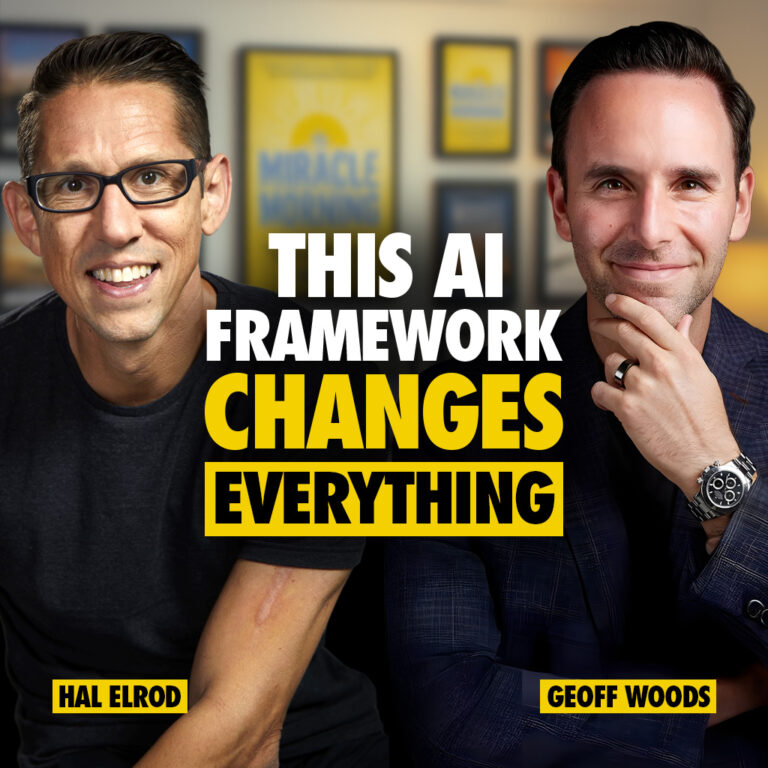
Today, I’m sitting down with my good friend Geoff Woods. Geoff is the author of the #1 international bestseller The AI-Driven Leader: Harness AI to Make Faster, Smarter Decisions. He helps individuals and executive teams use AI not as a replacement for human thinking, but as a thought partner that helps them solve problems, challenge assumptions, and make better decisions.
In our conversation, Geoff shares his CRIT framework and explains how it can completely transform the way you use AI. He also shares how he created an AI marriage coach and how his executive assistant used AI to completely redefine her role, earning two promotions and putting herself on a path to becoming Geoff’s COO.
Whether you’re skeptical of AI or already using it every day, this episode will challenge the way you think about what’s possible.
KEY TAKEAWAYS
- Why Most People Are Barely Scratching The Surface Of AI
- Stop Searching For AI Use Cases
- The CRIT Framework For Thinking More Strategically
- The Skills That Will Always Remain Valuable
- Geoff’s Biggest Concerns About AI
- How To Leverage AI Improve Your Professional Life
- Using AI To Become A Better Parent And Spouse
- How AI Helped An Employee Become 100X More Valuable
- How Geoff Can Help You With Your Business
- Where You Can Learn More From Geoff Woods
AYG TWEETABLES
“It's not about using AI as an assistant, it's using it to elevate how you think as a human.”
– Geoff Woods Tweet
“Stop asking AI questions. Start asking AI to ask you questions to elevate how you think.”
– Geoff Woods Tweet
“It's tough to read the label when you're inside the box. Use AI to get outside the box to help you see what you can't see and give you the non-obvious strategies.”
– Geoff Woods Tweet
RESOURCES
- AI Leadership
- AI Leadership on LinkedIn
- Geoff Woods on LinkedIn | Facebook | Instagram | YouTube | X/Twitter
- The AI-Driven Leader: Harnessing AI to Make Faster, Smarter Decisions by Geoff Woods
- The AI-Driven Leader Podcast
- The ONE Thing
- John Gottman
- Dan Sullivan
- 10x Is Easier Than 2x: How World-Class Entrepreneurs Achieve More by Doing Less by Dan Sullivan and Dr. Benjamin Hardy
- Uber
- Waymo
- Tesla
- Jeremy Reisig
- Front Row Dads
- The Miracle Morning App
THIS EPISODE IS BROUGHT TO YOU BY:
CURED Nutrition:
I want to talk about two of my favorite products. I’ve been taking these for four years, and they’re now a sponsor of the podcast, CURED Nutrition, Flow Gummies. I start every day with two of these. I meditate for 30 minutes without any supplements, and then I take Flow Gummies seven days a week, almost every day.
And then I go to bed with Night Oil. 30 minutes before bed I take Night Oil and it helps me fall asleep and stay asleep. So I start my day with Flow Gummies, I end my day with Night Oil.
If you want to implement my routine into your day with CURED Nutrition, go to CUREDnutrition.com/Hal and use the discount code HAL at checkout for 20% off your entire order.
Flow Gummies to start the day Night Oil to fall asleep. You’ll feel better, you’ll act better, you’ll perform better. Check it out.
RATE & REVIEW THE PODCAST
Reviews for the podcast on iTunes are greatly appreciated and will allow us to get the word out about the show and grow as a community. We read every single review and believe each one goes a long way in helping us make the show even better! If you received value from this episode, please take a moment and rate and review the podcast by clicking here.
Copyright © 2026 Miracle Morning, LP and International Literary Properties LLC
[INTRODUCTION]
Hal Elrod: Are you using AI to its full potential to take your life, your business, your relationships, every area that matters most to you to the next level and beyond? My guest today is Geoff Woods, and Geoff came on the podcast a year ago. He’s the author of the number one international bestseller, The AI-Driven Leader: Harness AI to Make Faster, Smarter Decisions. And today, we’re talking about AI, not just for professional use, but how do you use AI to accelerate and amplify your ability to think as effectively as possible. He’s going to share today how he and his wife have used AI to transform their marriage, to make them better humans.
The way that Geoff sees AI is it’s not to replace you, it’s to make you irreplaceable by acting as a thought partner while you’re still the thought leader, so you can think better, make better decisions. And I’ve used it in every area of my life over the last year. And, today, I also ask him the tough questions. What are his biggest concerns with AI, and what are the biggest advantages that you can apply to your life today, whether you’re not using AI at all, whether you don’t like AI, or you’re already using it on a daily basis? Geoff is literally one of the world’s leading experts in this topic.
Again, his book, The AI-Driven Leader, is the number one book in its category. And today you’re going to learn a lot about how to take yourself, your life, your business to the next level using AI to not replace you, but to enhance you and make you irreplaceable.
[INTERVIEW]
Hal Elrod: Geoffrey Woods, I haven’t seen you since the 4th of July party at my house, dude.
Geoff Woods: I know, right?
Hal Elrod: It’s been like a week.
Geoff Woods: Ugh, I missed you so long.
Hal Elrod: I know. Yeah, dude. It’s good to do these with friends, you know? It’s like I’m just talking to my homie, and who also happens to be a brilliant number one international bestseller. When I talked to you last, it was roughly, I don’t know, a year, give or take, last year at some point, and I had you on. I started by saying, “Geoff, I represent the percentage of people, maybe it’s 50%, maybe it’s 70%, I don’t know, that aren’t using AI, either because…” Then I said, “I fall between, like, I don’t fully get it yet.” But also, I’m not convinced it’s good for humanity,” right? So, I was kind of on that edge. And I tell this story all the time, by the way, whenever I’m talking to somebody about AI. I say, “Yeah, I interviewed my friend, Geoff. He wrote the AI-Driven Leader. It’s like one of the best-selling books in the AI space. In fact, number one in its category.”
I said, and I told him, “I am, like, kind of anti-AI. I don’t know.” And you’re essentially, the way I describe it is you convinced me. You’re like, “Look, AI is not going anywhere.” This would be like someone that’s like 30 years ago, “I don’t trust the internet. I’m not going to use the internet.” It’s like the internet’s now part of our life. And so, using it for good and utilizing it to make you a better human, and AI is just kind of the next technological advancement in that regard. So, here’s the premise of today. So, a year ago, it was, “Why should I use AI?” You’re like, “Geoff, convince me.” And now I’ve been using AI for the last year or so, and, very effectively, personally and professionally. And still have my concerns.
But now it’s how do we use AI effectively? And I imagine some people listening are still like, “I’m still not really using it.” Or they’re like I tell my mom, like, I think a lot of people use AI just like a search engine, like an advanced search engine, right? So, let’s start with answering the question, not why should we use AI. I just answered it. AI is here to stay. It’s a tool that we’ve got to use. You can use it for good or evil. How are people using AI in a very primitive way, and how can they get the most out of it?
Geoff Woods: Yeah. When I look at the market today, I still feel like people are using this majority one of two ways, which is like a really smart Google. They’re asking it questions and getting answers, or they’re using it like an assistant to help them write better emails. And the thing is, if that’s you who’s listening to this or watching this, you get double high-fives from me. Because you’re at least in the game. You’ve started to use it. I can give you a very subtle tweak that will take your results into a different stratosphere. If you’re not in action yet, using the technology, okay, we got some inertia to overcome. Hopefully, this conversation today will get you into motion.
But for me, I remember before I wrote the book, I was a chief growth officer for a public company, and I remember when I first saw ChatGPT, I said… And it literally had been two weeks after it hit the world, I made a personal commitment to say, “I’m going to use this once a day, every day.” Something in my soul, Hal, said, “Geoff, you need to understand this if you’re going to lead the company.” And very quickly, I realized I was using it for the things that frankly didn’t really matter that much. If I look at my role in driving growth of a large company, my ability to use a search engine or write better emails was not the 20% that would drive 80% of the results.
Hal Elrod: Yeah. Sure.
Geoff Woods: And I found myself thinking, “Oh my gosh, I’m trying to major in the minors.”
Hal Elrod: Yeah.
Geoff Woods: What does it look like to major in the majors? And that’s when I realized if we talk about using technology to enhance us as humans, a core skill that I think is going to matter more than ever before, Hal, is your ability to think strategically. It’s the difference between growing your business or going out of business. It’s the ability to navigate the problems in your professional or your personal life comes down to your ability to think strategically. And I think that’s the greatest opportunity. I think this is why The AI-Driven Leader has had the staying power that it’s had is it’s not about using AI as an assistant, it’s using it to elevate how you think as a human. Because when you can do that, oh my gosh, the things you can start to achieve in both professional and personal sides of your life is truly extraordinary.
Hal Elrod: So, give a simple example of how somebody would use it as a strategic… Because that’s how you talk about it. It’s a thinking partner. You’re the thought leader. You remain the thought leader. You don’t delegate. And a lot of people, that’s a whole another problem we could talk about, right, is they are delegating their thinking to AI, but you remain the thought leader as the human, and then this just simply enhances your ability to think strategically.
Geoff Woods: Did I tell the story of the Japanese board the last time we talked?
Hal Elrod: I heard it on your podcast recently, but no, share.
Geoff Woods: Okay. This is a great story. A lot of people are asking, “What’s the right AI use case?” I don’t think that’s the right question because you end up making AI a solution in search of a problem. AI adoption is not your goal. So, I don’t go asking, what’s the right AI use case? A question that I like to ask people is, what’s one of the biggest problems that you are facing, period? That if we could just solve it, it would make a huge impact for you, whether in your business, in your personal life. I asked this to a leader, and he said, “Okay, I’ve got a really interesting one. I run a manufacturing company here in the US. I leased all this capital equipment from a company in Japan. Things have really shifted in the market. The debt structure’s now killing us. We’re going to go bankrupt if we can’t get it restructured.”
And I asked him, “Okay, what have you done?” He goes, “Man, I think we’ve tried everything. I hired all these expensive consultants. We deployed these five strategies. Nothing has worked because this is a public company in Japan. The board is refusing to restructure the debt because they think they’ll lose face in Japanese society. I have no alternatives. We’re going out of business, unless you think AI can help.” Now, does that sound like a natural use case for ChatGPT?
Hal Elrod: Yeah. Not exactly, no.
Geoff Woods: Any problem you are facing, any goal you want to achieve is an AI use case. So, don’t ask what’s the right AI use case. Ask what’s the problem I need to solve, the goal that I need to achieve. That is your AI use case. Now, I have a very specific way that I talk to AI called CRIT. That’s my prompt framework.
Hal Elrod: Yes, talk about that. And we could go deeper into it, but I want to…
Geoff Woods: Yeah, yeah. We need to go deep on this. This is the whole backbone of the AI-Driven Leader. CRIT, it stands for context, role, interview, task. If you can start to communicate with AI following CRIT, you’ll go to top 1% of people in the world using this for strategic thinking. So, context, you give AI lots of context about the situation because it doesn’t know you, your business, your life, how the way that you do. Role is where you tell it the kind of experts you want it to be to advise you for this use case. But the real game changer is the interview. I don’t ask AI questions. I make AI ask me questions.
Hal Elrod: Yeah. That was transformative for me.
Geoff Woods: To pull deeper context out of my head, and then it can accomplish the task. So, I’m actually going to rattle off the actual prompt I wrote for the CEO following CRIT. Context: “I’m a manufacturing CEO. I leased all this capital equipment from a company in Japan. Things have shifted in the market. The debt structure’s killing us. We’re going to go bankrupt if we can’t get it restructured. I think we’ve tried everything. Here’s the five strategies we’ve deployed,” and I listed all of them in vivid detail. “None of this has worked because this is a public company in Japan, and the board is refusing to restructure the debt because they think they’ll lose face in Japanese society. I have no next steps, and I fear we’re going out of business.” That was the context section.
Role: “Your role is to act as an investment banker with deep expertise in restructuring debt. Interview me: Ask me one question at a time, up to three questions to gain deeper context. Then your task is to give me five non-obvious strategies I could deploy to get the board to restructure the debt.” That’s CRIT.
Hal Elrod: Yeah. And by the way, I want to pause real quick. If someone’s listening to this and they’re like, “I don’t have a manufacturing company,” this CRIT formula, I’ve used this in my marriage. I’ve used this to figure out getting along with my teenage daughter when I can’t figure it out. And it doesn’t do it for me, right? It helps me figure it out and see different perspectives that I would not otherwise have even… Like, my mind is blown when I get the response. I go, “Oh my God, I didn’t realize that.” And it’s harnessing, to your point, you had this role being an ex-investment banker.
I’ll be like, “Hey, I want you to act as,” for my marriage, for example, “I want you to grab everything known about John Gottman, the world’s greatest relationship expert, and I want you to act as John Gottman. That is your role.” And then you literally, based on everything John Gottman’s ever written, instantaneously, that’s who’s giving you, asking you questions. So, I just wanted to, like, broaden people real quickly and pull them out and go, hey, you can apply this to your finances, your business, your marriage, parenting, anything. Yeah, go ahead.
Geoff Woods: Everything. And here’s why that’s possible, Hal. I mean, think about how many books you’ve read in your life, 100, 500, 1,000. If you think of every page you’ve ever turned, every word you’ve ever consumed, what percentage of that collective knowledge do you think you can recall and apply right now?
Hal Elrod: Less than one.
Geoff Woods: Right. And you’ve done remarkably well.
Hal Elrod: Yeah.
Geoff Woods: Even though you can only recall and apply the minority of what you’ve learned, which is the minority of the information of the world. These models have been trained on about 500 million books’ worth of data.
Hal Elrod: Wow.
Geoff Woods: They can remember 100% of them. How long do you think it took to read through 500 million books? Even imagine what that would look like to understand how an investment banker with deep expertise in restructuring debt, who also knew 2,000 years of Japanese culture and history, would think, act, turn the tables, and ask the first question. Under a second. Here’s the question it asked. “Do you have any relationships with any other influential executives in Japan that the board would respect?” I look at this leader, and he goes, “Oh my gosh. What a great question. I would have never asked that. Holy smokes, I do.” And it asks him two more questions at that level before it turns the tables and gives him five non-obvious strategies.
The number one recommendation it called the Saving Face Consortium. It said, “You have enough relationships with all the right people in Japan. Why don’t you just approach them to acquire your debt? Give them really favorable terms. Your debt will get restructured. Your board will save face.” I turn, and I look at him, Hal. His whole body language has shifted, and he’s actually holding back tears. And he looks at me and very vulnerably admits, “I have not slept in 90 days. I have been making peace with the fact that we are going out of business, but in less than 10 minutes, I got hope.”
Hal Elrod: Wow.
Geoff Woods: Two months later, my phone rings, and it’s a text from him that says, “The ball is moving. I actually think this is going to get done.” So, for you who’s listening to this, I think one of your greatest opportunities, you can ask, “Will AI replace me?” And you could probably come up with ways that you might find a yes to that. But I think you can ask a better question, which is, “How might AI make me irreplaceable?” I guarantee you can find answers to that, too. And when I think about the skills that are going to matter as humans, our ability to think strategically is so core. Stop asking AI questions. Start asking AI to ask you questions to elevate how you think.
Hal Elrod: Incredible. I want to back up to what you just mentioned, the skill piece, and I know that one of your early mentors when you were getting out of college, right? You asked, “Hey, what’s the best job for me to get out of college?” Like, “What’s the job of the future? What job will be here for a long time?” And I think right now, people are for sure asking that. It’s like if AI’s going to replace 300 million jobs, what do I do? And your mentor told you what?
Geoff Woods: “You’re asking the wrong question.” He said, “You really should be asking, what are the skills I can master that are so valuable they’ll serve you no matter where you go. Then go find jobs that help you build those skills.” I think that quote is more timely than ever before. Because if you really think about, “What is a job?” a job, it’s think of a formula. Job equals skills you apply times processes you follow. Your job is skills you apply and processes you follow. If you study technology throughout history, from the printing press to the steam engine, assembly line, electricity, internet, what you will realize, Hal, is it did not replace jobs. It made the value of certain skills and processes skyrocket in value, and the value of certain skills and processes plummet in value.
It’s why six out of 10 jobs that exist today did not exist in 1940. What happened to employment? Overall, it’s up. But what we do is different, because technology changes that. And this is why I think it’s so important that we get back in touch with what are those skills that we can master that are so valuable they’ll serve us no matter where they go?
Hal Elrod: I would imagine you would say AI is one of those skills.
Geoff Woods: I think learning how to wield it as a thought partner, absolutely. And this is, I think, one of the greatest risks that people aren’t talking about is people abdicating their responsibility as the thought leader, with AI as a thought partner. A lot of people are asking AI questions and trusting the answers, or they’re asking AI to draft communication or things they think they should do to hit their goals, and they’re just blindly trusting it.
Hal Elrod: AI slop, they call that, right?
Geoff Woods: Yes. And I think your brain is a muscle. When you use it, it gets stronger. If you stop, it atrophies. And I think the key here is when AI gives you an answer, don’t trust it. Apply discernment. Apply judgment. Have taste. And use it as a thought partner where you are constructive in saying, “Here’s what I like about what you gave me, but here’s what I don’t like. Here’s the top changes I want made.” Like, you are the thought leader. You are in the driver’s seat. Do not outsource your thinking.
Hal Elrod: Yeah. I think it’s really important, too, for folks to realize that AI is designed to just kiss your butt, for lack of a more technical term, right? And it’s so funny, because I don’t want to name names, but people in my family that use it, they’re like, “Man, AI just said I am right on in my thinking.” And I go, “No, no, you have to actually tell it to push back and challenge your thinking.” So, yeah, that’s a piece that I think is important.
Geoff Woods: And this is called an echo chamber. These models are designed to please you. They want to affirm you. They want to make you feel good so that you keep using it, and this is where you just got to be really thoughtful and purposeful. As a thought leader, I understand that it’s going to say that way. One of my favorite roles to give it, after I write a CRIT and it gives me the initial response, I then do not accept it. I apply skepticism and judgment and say, “Here’s what I like about it. Here’s what I don’t like about it. Here’s the top changes.” And I’ll go back and forth with AI several times, almost like we’re playing pickleball. Back and forth, back and forth, until I like the answer.
Then, Hal, I recognize that’s just the best that I can do with AI. It’s not the best that can be done. And I’m interested in the best that can be done, which then I will flip the role and tell AI to now act as the challenger, whose superpower is stress testing the insufficiency of my plan, who challenges my biases, challenges my assumptions, helps me see what I can’t see. As that person, tell me what you like about this, what you don’t like about this, the top changes you want made to it, and then make it better. There is always gold in that thing. When I do this with people, it blows their minds, the stuff that AI will call out, and then help make it better.
Hal Elrod: Wow. What are your concerns, if any, with AI in society?
Geoff Woods: Yeah. My number one concern is that I think a lot of humans are lazy. And for me, it’s why The AI-Driven Leader is more of a leadership book than an AI book. I am trying to create a new category of leader. In an AI-driven leader, where we take a stand for humanity, and, as the leaders, as those who are leading by example, we teach people how to use this to enhance you, not to replace you, where you do not let this undermine your thinking. That’s part one. And then I think you have the societal impacts. I mean, the water consumption is real. The electricity needs is real. And I think as humans throughout history, we have proven we always solve the biggest problems.
These are two very big problems. I am not the expert on how to solve them. I do believe we can be using AI to figure out how we can solve those. And there are so many kids coming out of college right now who have a negative perception of AI. I was at dinner the other night with a few other CEOs, and the waiter heard us talking about AI, and he scoffed. And I asked him, “What was that?” And he goes, “I hate AI.” I said, “Tell me more.” And he goes, “Well, I’m a senior in college. I’m a software engineer.”
Hal Elrod: Oh, God.
Geoff Woods: “There are no jobs for software engineers because of AI.” Number one, he’s 100% wrong. I’m hiring them in my company. The demand for people who can write code with AI is through the roof, more than ever before. So, like, he’s just off. But there is this perception that there are no jobs because of it. And I asked him, “Do you have any idea how many CEOs I know who ask me, ‘Do you know any young kids coming out of school who know how to use AI that I can just unleash inside my company?'” It’s all of them. And so, I think there’s a lot of people who, because they think it’s impacting the jobs out there, or they have questions about the environmental impact, which I can fully support. And I think you also have to ask what your long-term career viability looks like.
Because imagine if you’re a hiring manager and somebody applies and says, “I’d love to work here, I think I’m a great culture fit, but something you need to know about me, I don’t use the internet, and in fact, I actually refuse to use electricity overall, but I’d still like to work here.” There’s no chance you’re hiring that person. And AI is not optional when it comes to the workforce. I think you can be discerning on your usage of it, if that’s a concern for you. But I really would challenge you to think about getting into the game.
Hal Elrod: Yeah. What’s your point, the waiter, I think you said that was a software engineer, afraid there’s no jobs available. I don’t know if it was you that said it, but it’s not that AI will replace you, it’s that someone who uses AI will replace you.
Geoff Woods: Totally.
Hal Elrod: And a good example is a graphic designer on our team, I forgot this was six months ago, whatever. We asked him to do a project, and he got back to us within a day, and he said, “This would’ve taken me a week before,” but because I… But we are not the graphic designers. We need a human to spearhead the implementation of the AI. It’s just that now he can get way more done much faster, right? And I think that kind of goes across the board. But going back to your mentor’s point, which is like figure out the skills that are valuable moving forward. And to your point, AI, like it or not, it’s just like the internet. It’s non-optional.
Geoff Woods: And, you know, I had my own experience with this, which is before writing The AI-Driven Leader. The last decade of my life, I’ve been a coach to executive teams, whether as a chief growth officer in my previous experience with running the company behind The ONE Thing. My skill was asking leaders the right questions to drive new levels of growth. When I first realized that AI could ask me the same questions or better ones, Hal, it scared the crap out of me because I went, “This is how I’ve made my money. Oh my gosh. Is it going to take my job?” But that’s when I had read Dan Sullivan’s book, “10X is Easier Than 2X.”
And it’s a really interesting concept that if you want to double your income or double your revenue, you can keep doing 80% of what you currently do. You only have to change 20%, and you can double. But if you want to grow 10X, you literally have to stop doing 80% of what you currently do, hold onto the core 20% that drives 80% of the results, and reinvest that 80% in higher levels of capability. And I started to pay attention to the questions I was asking myself. If I’m asking, “Will AI replace me?” I could find plenty of reasons that could be true. But then I thought, “Can I ask myself a better question? How might AI make me irreplaceable?”
And I actually wrote a CRIT on this to identify what are my greatest strengths as a human that differentiate me from everybody else. How do I harness those strengths and focus them on the 20% priorities of my role that are in alignment with the goals of my company, and use AI to turn those strengths into superpowers? And then all the other 80% stuff, I have developed so many skills I would have never thought, couldn’t have even imagined. Like, you can’t imagine Uber or Waymo or self-driving Teslas if you haven’t seen the internet. And I think people are trying to imagine what their life is going to look like in an AI-driven world with industrial ways of thinking. Industrial Revolution is over. AI is here. You have to get in the game because otherwise it’s like you’re living in black and white every day trying to describe color. You got to see it first.
Hal Elrod: So, I want to ask you, what are your, I’m thinking schedule here. So, if someone’s like, “Okay, I’m using AI,” or, “I want to use AI,” and even for me, I’d love to know your rhythms on this. But what are your daily or weekly rhythms? Do you have, like, blocks of time where you go, “Okay, for this hour a day, I have my AI executive coach”?
Geoff Woods: Nope.
Hal Elrod: No.
Geoff Woods: Nope.
Hal Elrod: Okay. As needed or?
Geoff Woods: Now, when I was starting, I had time blocks to be testing minimum an hour a day when I was starting. And I was listening to podcasts. I was watching courses. Like, I was all in on aggressively learning it as fast as possible. And I had to… What I realized is there’s so much crap out there. I realized that 80-plus percent of the news, the tools, the use cases didn’t matter. Because for me, our mission as a company is to build better leaders who create better businesses and ultimately help people live better lives. Better leaders, better businesses, better lives. When I look at an AI tool or a use case or news about AI, my first question is, “Is this a 20% priority that’ll drive 80% of the impact toward me becoming a better leader who builds a better business and helps people live better lives?”
That’s an exceptionally high bar, Hal. Almost nothing qualifies for that. So, I actually ignore most of it. But I realized using it for strategic thinking, that was a place that I could go that was universal for any person, whether you’re in the professional world, if you’re looking to harness this in your personal life, it works for everyone. And so, for you who’s watching this or who’s listening to this, I would just… The simplest thing you can actually do is get two sticky notes and a Sharpie. And on sticky note…
Hal Elrod: We’re getting old school. Let’s go. I like it.
Geoff Woods: Yeah, we’re getting real. Yeah. The AI guy’s going old school, because it works. On sticky note number one, you write, “How can AI help me do this?” Sticky note number two, you write, “Context, role, interview, task,” and put it on your desk or put it on your computer. Here’s why. It’s tough to read the label when you’re inside the box. Every day, you’re doing something the way you’ve always done it.
Hal Elrod: Totally.
Geoff Woods: I was reading my financial statements one day, and I looked down and I saw that first sticky note, and I went, “Huh, how can AI help me do this? What would that prompt even look like?” And then there’s the second sticky note that says, “Context, role, interview, task.” So, I literally opened up, in this case, I think it was ChatGPT. Wrote in context, role, interview, task.
Hal Elrod: Run through that. I want to keep doing CRIT for people and then even we’ll unpack it, but I want to give…
Geoff Woods: Sure. So, I’ll get real technical. I actually put the caps lock on because I want the context, role, interview, task to be in all capital letters as headers so it stands out more for the AI. So, I literally typed with all capital letters CONTEXT, and then I held down the Shift key, and I hit Enter three times so that I would skip lines without sending the prompt. Then I wrote ROLE. Then I held down Shift, and I hit Enter three times. Then I wrote INTERVIEW. Shift, Enter, TASK. Now I have CRIT as, like, this ladder inside the text box. Then I just went up to the context section, and I said, “Attached is my financials.” And I literally dragged and dropped my financial statements into a secure instance of ChatGPT.
ROLE, I said, “Your role is to act as a strategic CFO whose superpower is telling a CEO who doesn’t know how to read financials the top things they need to know about their business that they don’t know about their business. Interview me. Ask me one question at a time, up to five questions, to gain deeper context. Your task is to tell me what those five things are. It conducts an interview and tells me the things I needed to know. It was mind-blowing. One of the things it called out, it said, “Your DSO, your days sales outstanding,” I didn’t even know that was a metric, “is 105 days, meaning the time you close a deal to collecting the cash is 105 days. I did research on your business and your industry. Industry benchmark would be 45 days, which means you’ve got X millions of dollars that you’re essentially giving your customers a free bank loan. And last time I checked, you’re not a bank.”
Hal Elrod: Wow.
Geoff Woods: And so, its whole suggestion was go on a sprint to crush your accounts receivable. I didn’t see that. My finance team didn’t flag that to me. They just gave me the books. I did that. That was my first month. Second month, it delivered something remarkable. Third month, it delivered something remarkable. Now I realize this was a 20% that really mattered. I then went and actually created a full-blown AI CFO that’s an agent that every day scans my emails. The finance team sends any financial reports, it automatically, without me having to do anything, runs a highly sophisticated analysis, turns it into a PowerPoint doc that’s on brand, and sends it to our finance channel in Slack, where very specific people have access to that, putting it into language that non-financial people can understand, not telling us what performance was of the past, but telling us the top 20% priorities we need to focus on in the next 30 days to optimize the financial health of our company.
Hal Elrod: Wow.
Geoff Woods: Now, I want to be really clear here. I am not suggesting that somebody goes out and builds an AI agent. I think that’s a distraction. I don’t think they’ve earned the right to yet. I’m asking you to get two sticky notes and a Sharpie out. I’m asking you to get those on your desk, and then once a day, every day, write CRIT on something that you’re already doing. Knock that domino down. The others start to fall.
Hal Elrod: I’m going to give you an example from my own business. So, keynote speaking is my favorite thing to do in the world. It’s what I think I’m best at. I’m a better speaker than I am a writer, better than a podcaster, you name it. It’s what I’m best at. And Jeremy Reisig who’s been on my team for a long time, and he kind of helped me realize. He goes, “Hal, what’s your favorite thing to do?” “Speaking.” “What do you do better than anything else?” “Speaking.” “How much energy do you put into figuring out how to get speeches?” “Zero.” And what happened was for years, all my speeches were incoming, we’ve had this conversation, because people just read The Miracle Morning and came in.
Because I had kids, and then when I went through cancer, I dialed my speaking way back. So, I have never tried to book a speech for a decade, or really, yeah, for a decade. And so, he kind of realized, like, “Hal, you want to speak more now. Your kids are older.” My kids are teenagers. They’re like, “Dad, leave for a few days. Give us a break,” you know? And so, here’s what… So, I’m trying to figure it out, and he goes, “Have you asked AI?” And I’m like, because I’m literally like, because for a week, I’m like, “I’m going to start prospecting.” And then we get on a call, and he goes, “So how’d it go?” I’m like, “I just don’t know what to do. Like, half these people I’ve spoken for before, and then some I haven’t, and duh, duh, duh.”
He goes, “Well, have you asked AI?” And I go, it’s your whole sticky note point, but I’m like, “No.” And it was just a duh moment. I’m like, “Why haven’t I asked AI?” So, I ask AI, right? I follow your CRIT formula. I’ve read your book. He’s read your book, too, by the way. In fact, he always reminds me, “CRIT, Hal. CRIT, CRIT.” He always reminds me. And so, I ask it. I pick one person on my client. I’m like, “I’ve got a bunch of clients.” It helps me narrow it down. First, it’s, “I’ve got a bunch of clients.” It’s like, “All right. Well, let’s choose one who you think, who you’ve spoken for before, ideally more than once. They’ve brought you in more than once. So, pick, like, your best client that you’ve had.” I’m like, “Great, got it, okay. All right, what do I do now?”
“Okay, schedule a call with them of Zoom to catch up and find out what’s going on in their world.” “Okay, great. Okay, reach out. Schedule the call. Okay, how do I prep for the call?” It’s like, “Okay, ask the person this, this, this,” and I gave it the context of what I’ve spoken from before. So, this gets really, really cool. I want people to understand what AI can do. So, it helps me prep for the call and what questions to ask on the call. I uncovered that there’s this huge opportunity where they’re holding a meeting where every international general manager for all 18 international territories where Miracle Morning’s a bestseller, they’re all coming to an event together.
And so, I end up booking the event, right? And then I’m like, “Okay, I really want to get this, knock it out of the park.” And we had a fireside chat the first night, so I’m like, “Okay, I want to really ask good questions.” So, what I do is I upload the transcript, which I took with an AI note-taker from the previous calls that we had. I uploaded my previous slides, everything. Then I went and got the agenda for the meeting, which is in a couple of weeks. And I uploaded the agenda, so AI was able to see what these GMs will be learning on day one, what they’ll be learning on day two, and then day three, and I come in for the fireside chat that night and the keynote the next morning.
So, it helps formulate questions for my fireside chat going, “Okay, hey, these GMs are going to be… Their brains are going to be overloaded because they’ve been talking about financials on day one, then they learned about these on…” Right? And so, all of it, and so it prepared the questions on and on and on. But this is, like, from start to finish, from, “I don’t know what to do, I want _____ result, which is I would like to book some more speeches,” all the way to, “Do this first, book a call. Here’s what you ask on that call. Record the transcript of that call. Upload the transcript of that call. Upload the agenda,” right? So, it’s like multifaceted, multidimensional, multi-step, all from I don’t know what to do, but I had two Post-it Notes on my computer, theoretically. What was the first one? What’d it say?
Geoff Woods: How can AI help me do this?
Hal Elrod: How can AI help me do this? And CRIT.
Geoff Woods: Yes.
Hal Elrod: And those two Post-it Notes changed everything.
Geoff Woods: Yeah. And even as you describe that story, I had this visual in my head, which is shifting from being the player of the instrument in the orchestra to becoming the conductor of teams and technology. It’s not about you having to come up with all those ideas. We understand this fundamentally as leaders. You don’t have to have all the answers. You surround yourself with really smart people, and if you point them at the goal and ask them the right questions, you get out of their way. Now, you’re harnessing AI, and I think to have the humility to say, “Maybe I’m not the smartest person in the room or thing in the room, but I can cast the vision of where am I going to point this thing, which is how do I drive more keynotes?”
And I can give AI the outcome, have it interview me, and then give it some agency to give me non-obvious ways to approach it. And it’s coming back and saying, “Book this call. Ask these questions. And oh, by the way, don’t just stop there. Feed me the transcript from that thing. Upload the agenda.” It’s tough to read the label when you’re inside the box. Use AI to get outside the box to help you see what you can’t see and give you the non-obvious strategies. I’ll share a personal one. We went through a pretty significant event with my 13-year-old daughter earlier this year, which I won’t get into the details of what happened, but life-changing in a traumatic way.
And the moment it happened, I remember when my wife was going to pick her up from school, we’re talking on the phone about, “How are we going to handle this?” And I remember we had aligned on what we were going to do, and I stopped Amy, and I said, “Hold on. That’s what we think we should do. I want to test and challenge our assumptions. I’ll call you right back.” And I wrote a CRIT. And in the context, I explained everything that happened with my daughter, the choices that she had made that we wish she hadn’t made, the results of those. “Your role is to act as a world-class parent coach, also pediatric psychologist. I want you to interview me. Ask me one question at a time, up to five questions to gain deeper context. Your task is to walk us through how you think we should approach this and keep it really simple for us, because the emotions are very charged.”
And it conducted an interview, and basically, it came back and said pretty much everything we were planning to do was wrong. And it said, “Right now she needs two things. You have two jobs: support and stability. Your job is not to criticize right now. Your job is not to enforce consequences right now. Your job is to be her support and to show her stability because her world just got shattered.” And that was phenomenal advice. Now, did I just blindly trust it? No. As the thought leader, I applied my judgment and thought, “Do I agree with this?” Which I really did, but it helped us see what we couldn’t see in that moment, which, in that case, like for me, showing up as a better parent is one of the most important things I can do.
Hal Elrod: Sure. Front Row Dads, baby.
Geoff Woods: Yeah, that’s right.
Hal Elrod: That’s right. Yeah, man. No, similarly, I’ve had it in my marriage where I’ll write a response to my wife when we’re in an intense moment or something, and I’ll breathe, and I’ll throw it into chat. I’ll just go, “Hey, just real quick, am I missing the mark here?” And it’s like, “Whoa, whoa, whoa, buddy. Please tell me you didn’t send this yet.” You know? And then it offers it in perspective. I’m like, “God, that makes so much sense.”
Geoff Woods: Did we talk about the marriage coach? Did I tell you about this?
Hal Elrod: No, tell me about that. But we have friends that are using it as… Like, many people are using the marriage coach, yeah.
Geoff Woods: So, it was January, February this year. Every year, Amy and I will do a couples goal-setting retreat, where we get a hotel downtown, nanny for the kids, and it’s a chance to connect but also to set our goals for the year. And I remember, we were getting into certain tiffs, and one was around my travel schedule. I mean, the book’s been a rocket ship. It’s required a lot of traveling for speaking, which I get to do this. It’s an honor. But she said, “It’s not the time away that’s my challenge. It’s the reintegration.” I struggle to reconnect to you once you come home.” And I said, “Great, how can AI help us do this?” And I said, “Do you mind if we write a CRIT to have AI interview us to create a system so that we can reconnect faster when I get home?” She goes, “Great idea.”
And so, I write this prompt, and I told AI I want it to interview us, ask one question at a time, the five questions. But I said, “When you ask a question, ask Amy first, wait for her answer, then ask me the same question.”
Hal Elrod: Smart husband.
Geoff Woods: Yeah, yeah. Right. And so, what ends up happening is it asks five questions one at a time, but each of us is giving five to 10-minute-long answers. Like, we’re literally talking to it, speech to text, not typing. Hal, I’m realizing by the end of the fifth question, the amount of context that this thing has unearthed on how Amy thinks versus how I think was extraordinary. And I flipped the task. At the end, I said, “Instead of building a reconnection system, I actually want you to build a full-blown psychological profile for Amy and for me. And I want you to write the custom instructions that we could upload into a project inside of AI so that this thing could be a marriage coach, and I need you to write the instructions for Geoff versus the instructions for Amy’s, so that it knows when each of us is playing with this on our own, like who is who.”
And it did it. Two hours later, I remember we get into a little bit of an argument because Amy’s venting about something, and I tried to solve the problem, and it really frustrated her. And I thought to myself, “How can AI help us here?” So, I’m going to read you what actually it said.
Hal Elrod: Okay. I love this.
Geoff Woods: So, I opened up the marriage coach, the AI marriage coach, which had the psychological profiles, and I’m doing it in mine, so I had to tell it, here, where we go? Projects. Marriage coach. Here we go. This is so good. All right.
Hal Elrod: So, this is what it’s telling you?
Geoff Woods: No, geez, just wait. Hold on. The Wi-Fi in here is not great. I’ll paraphrase what it… I said, “I’m talking on behalf of Amy, but why is it that when I’m venting about something that’s not going well in my life and my husband tries to solve it, I get really upset with him?” And it said, “Neither of you are wrong. It’s a nervous system mismatch. When you, Amy, are talking about a situation, your need is actually to be held and experienced. The need is stay with me, land with me. For Geoff, when he hears you discussing a situation like that, he hears a call for action and to perform. He’s trying to restore stability to you, but he doesn’t realize that speed is showing up as abandonment for you, which is causing grief and loneliness and shame.”
And the moment that I’m reading this to her, she looks at me, she goes “That’s what you’re trying to do?” And I go, “That’s what you need?” And we both go, “Yeah.” And it was just like all tension was gone because it understood us. And, like, how often in a relationship with another human are we talking past each other versus actually listening and validating and empathizing? I mean, that’s a real example.
Hal Elrod: Yeah. No, that’s incredible. And again, it’s not replacing you.
Geoff Woods: No.
Hal Elrod: And it’s not replacing Amy. It is enhancing your ability to think and show up for the other person in the most effective way. And that’s a microcosm for, to me, what the AI-Driven Leader is about, what your work is about. You’re just doing it for companies, for organizations, for leaders, right? Helping them to enhance their ability as a human to show up better for the people that they love and the people that they lead in the way that the marriage coach helped you and Amy show up for each other.
Geoff Woods: Yeah. And I’ll give you a real use case on that. I mean, drinking our own champagne is a core value, meaning we practice what we teach. So, there’s nothing that I say here that I do not personally live myself. Because that’s how I show up, because I drink my own champagne, I am then able to set, I’ve earned the right to set the example for my team. Marianella is my former executive assistant. Have I told you this story?
Hal Elrod: No.
Geoff Woods: Oh, you’re going to like this. Four months into her working with me, she’s absolutely crushing it, like 10 out of 10 on every KPI. And so, I’m going, “Wow, she hit it that fast. Let’s give her bigger shoes. Let’s promote her. Let’s give her a bigger opportunity.” Now, I did this a completely different way, because in the past, when you’re a leader, and you want to promote somebody, you write a job description, you might write an onboarding or a transition plan. You give it to them and say, “Congratulations. Here’s your new title. Here’s your new role. Here’s your new comp. Here’s your new performance metrics for the next 90 days. Go.”
But what you’re really doing as a leader is assuming that you know better than them how to maximize their potential inside an organization. That’s top-down. That’s a very industrial way of thinking. And I think in an AI-driven world, you turn it on its head. So, I did something completely different. I sat her down, and I said, “You’re crushing it. I’d like to give you a promotion. We’re going to do this a little differently. I want you to use AI. I want you to write a CRIT or have AI interview you to help you self-discover what are your greatest strengths that you may or may not even be harnessing in our company today.
And I want you to cast a vision for how you can harness those strengths, focus them on what you think the 20% priorities should be for your role that would drive 80% of our results toward the company goals, and how AI could turn those strengths into superpowers. Bring me that vision, and it has to be able to make you at least 10 times to 100 times more valuable to the company.” Only reason I can do that is because I see color. Like, I can cast the vision for that. She looks at me, and she goes, “Got it.” Now, I want to be really clear. Before working with me, Hal, she knew how to spell AI. That was it. She had never used any AI tool. I literally gave her a copy of The AI-Driven Leader. I taught her how to write CRIT.
Like everybody who’s watching this or listening to this, you can do this. She comes back to me the next week. She goes, “I’m ready.” I go, “With what?” She goes, “My vision.” I go, “Awesome. Let’s hear it.” She goes, “Well, here’s what I’ve gotten clarity on that are my greatest strengths. Here’s the 20% things I’m currently doing that if I harness my strengths there and double down, it’s going to bring 10 times more value. But based on my strengths, here’s the things I’m not doing that I really think I should be doing. Like, I think I should be running our advisory practice for Latin America because I speak the language. We don’t have anybody else can. Like, I think that’ll bring 10 times more value. And if I focus on these two areas, here’s all the things I’m going to have to stop doing.
Now, I’ve segmented these into three groups. Here’s the ones I just think we should stop. They don’t really matter. I don’t think we need to do them anymore. Here’s the things I think we can use AI to augment or automate, so they’ll still get done, just not by a human. Here’s the ones that still are going to require a human. Based on that, here’s a job description for my replacement. Here’s their 20% priorities, their 90-day onboarding plan. I did research on compensation. Here’s the research to back up what I’m about to recommend. I recommend we pay them X. Do I have your approval?” I go, “One, approve. Two, holy smokes, I am blown away.” And she goes, “I really appreciate that, but I’m not done yet.”
I go, “What do you mean?” She goes, “Geoff, that was my vision for 10 times more value. That’s not what you asked. You asked for a vision of 10 times to 100 times more value.” I sit back in my chair, Hal, and I’m just like, “You’ve got to be kidding me.” She goes, “Here’s my realization. There is no way I can bring 100 times more value unless I made you 100 times more valuable first. So, here’s a CRIT I’ve architected so that AI will interview you, Geoff, to cast a vision for how you can bring 100 times more value.” I go, “I can’t wait to do this.” She goes, “Good, you’ll do it now. I’ll wait.” And she literally waits while AI interviews me, spits out this vision, but it also created a system of rules that she would have to embed in the company to transform my time allocation.
Hal Elrod: Wow.
Geoff Woods: I tell her, “It’s the most valuable prompt I’ve ever done,” and she goes, “I appreciate that, but we have a problem. I can put these rules into place, but I know you. You’re going to break every one of them. You don’t follow rules.” And I’m like, “Dude, she’s so right.” And she goes, “Don’t worry, I got you. Here’s another CRIT I wrote where AI’s going to interview you to identify how you’re going to try to break all these rules and will come up with a defense process, so if you ever want to go break a rule, you’re going to have to go through AI first.” This has literally transformed what my calendar looks like.
Her job description as executive assistant went from check my email, check my calendar, manage my 80%. Her new title is now executive multiplier, and now we’re actually promoting her again to lead operations for the company where she’s going to, her multiplier JD was to make me 100 times more valuable, run our Latin America advisory practice, and run all the internal systems around our rhythm of the business to ensure we hit our revenue goals.
Hal Elrod: Wow.
Geoff Woods: I would’ve never, never swung so big from a job description standpoint for her. But I gave her the permission to get in the driver’s seat, to use AI as a thought partner, to harness her strengths, focus them on the 20% that would make the biggest impact toward the company, how to turn those strengths into superpowers. She brings that to me, and then I get to apply my discernment to say, “What do I like? What do I not like? What are the top changes?” She has crushed that role, and like I told you, now we’re promoting her again to run all of operations. She could be our COO one day.
Hal Elrod: Wow. Incredible. I mean, you’ve got me excited to go home and model the kind of the process that she ran herself through and then ran you through. Oh, man, we could keep talking. I’ll have you on next time you update the book, and that’ll probably be in the next six months because AI is changing so fast. So, before we wrap, just one last question for anyone who doesn’t know. What are you doing for companies and for leaders? I know more than half of our listeners aren’t running businesses. They might be solopreneurs. But there are quite a few that are executives and CEOs and that kind of thing. So, what are you doing for folks?
Geoff Woods: We are the best in the world at helping leaders become AI-driven leaders. We do that one of two ways. If it’s a larger company, we come into the executive team and literally evangelize them. If it’s somebody who’s a solopreneur, an employee inside of a company, we do a team accelerator, which is coming up in October, where two days in person in Austin, day one, you will become an AI-driven leader. We will show you how to write CRIT at a world-class level, how to use AI to cast a vision where you’re at least 10 times more valuable, how do you think about agentic AI in a way that matters, because most people are doing it in a way that’s actually a distraction.
And day two is all around how do you use this to actually accelerate growth inside your company, because most use cases are not giving an ROI, and we’re going to show you where to focus in a way that does. That’s all available. And then beyond that, we partner with larger companies to embed AI in the company in a way that aligns their company strategy with the execution of the workforce that moves the enterprise value of the company, which this is my whole background over the last decade plus. We’re now using AI to do it.
Hal Elrod: You were doing it at The ONE Thing, and now you’re doing it at your own company.
Geoff Woods: Yeah, different level.
Hal Elrod: What is the best place to connect with you, learn more from you, work with you?
Geoff Woods: Yeah, sure. So, the website is aileadership.com. The book is The AI-Driven Leader. It’s anywhere books are sold, in all forms from hardcover to e-book to audiobook. And I am on social media, Geoff Woods. LinkedIn’s where I’m most prominent and check out The AI-Driven Leader podcast.
Hal Elrod: And if anybody’s listening to this, it’s Geoff, G-E-O-F-F Woods.
Geoff Woods: That’s right. Which is, isn’t that Latin for man of your dreams?
Hal Elrod: Of my dreams or just in general?
Geoff Woods: Yours. Yours.
Hal Elrod: Okay, yeah, mine specifically, yeah.
Geoff Woods: Yeah.
Hal Elrod: No. But, dude, this is great. This was my goal for today, and it really helped. You know, a year ago, it was getting me to actually, “Okay, I’ll try AI. I’ll use it.” And then now it was like, how do I uplevel, and how do I really use it effectively? And I feel like you’ve really helped me do that, man. So, thank you, brother. I appreciate you.
Geoff Woods: It’s my pleasure.
Hal Elrod: All right. Goal achievers, I love you so much. Make this a great week. Check out Geoff’s book, The AI-Driven Leader. Highly recommend it. I think it applies to any human being. You don’t have to be in a “leadership position” at a company for this to apply to you. It literally is how do you use AI effectively so that you can be the leader of your own life. Aileadership.com, grab the book, AI-Driven Leader, and I’ll talk to you next week.
[END]