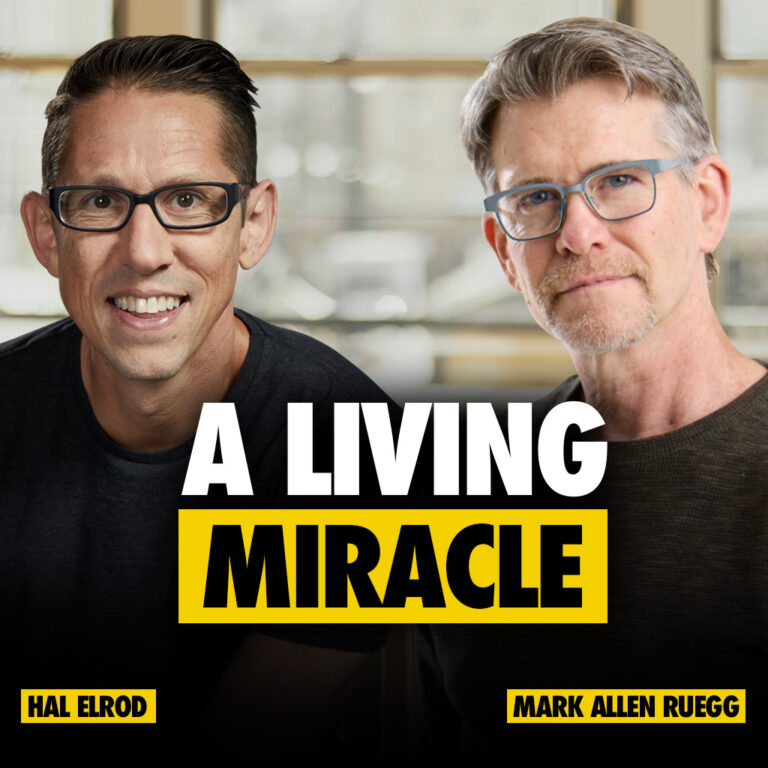


What would you do if you were told you were diagnosed with cancer and had only 4 to 6 months to live? That’s exactly what happened to today’s guest.
Two and a half years ago, Mark Allen Ruegg was diagnosed with stage 4 pancreatic cancer that had already spread to his liver and lymph nodes. His doctors hoped chemotherapy could stabilize the cancer and give him more time, but Mark wasn’t willing to accept that as the best possible outcome. He wanted to do everything in his power to beat the odds.
After discovering the documentary Heal, Mark began taking an integrative approach that combined conventional treatment with major changes to his diet, meditation, spirituality, exercise, stress, and mindset. Within months, his scans showed no evidence of cancer, and even his doctor was stunned when he could no longer find the tumor in Mark’s pancreas.
But Mark’s story didn’t end there. Three months ago, a tumor was discovered in his pancreas again. The fears and unknowns came back with a vengeance, sending him into what he describes as a deep, dark place.
In our conversation, Mark shares how that recurrence forced him to confront his fear, return to the fundamentals of his Healing Recipe, and recognize the missing ingredient he needed most: unwavering faith.
We talked about why healing doesn’t have to be an either/or choice between conventional and holistic medicine, what it means to surrender without giving up, and how the combination of unwavering faith and extraordinary effort can help you navigate even the most difficult moments of your life.
KEY TAKEAWAYS
- Why Mark refused to accept a terminal prognosis
- Combining conventional treatment with an integrative approach
- The lifestyle changes Mark made after his diagnosis
- How Mark’s cancer disappeared after his initial diagnosis
- Why Mark believes fear became his greatest challenge
- What happened when Mark’s cancer returned
- Unwavering faith and extraordinary effort leads to results
- How to get Mark’s Healing Recipe of seven ingredients
- The journey to becoming someone who fears less
AYG TWEETABLES
“The belief is the foundation. It is the dough of the pizza. From there, it was meditation, spirituality, increased positivity, decreased stress, diet, and exercise. And when you put these things together, and you do them on a daily basis, you create a safety in your body, a place where healing can actually occur."
Mark Allen Ruegg Tweet
“You cannot heal in fight and flight. When you're in stress mode, those mechanisms shut down.”
Mark Allen Ruegg Tweet
“I was missing the unwavering faith. I was missing this element. So, if the ingredients are the thing, the unwavering faith is the oven that it all needs to go in and bake.”
Mark Allen Ruegg Tweet
“The body knows how to heal. We just have to get it back into alignment, back into balance, back into homeostasis.”
Mark Allen Ruegg Tweet
“It's not necessarily healing the disease. It's becoming somebody who no longer has it.”
Mark Allen Ruegg Tweet
RESOURCES
- Mark Allen Ruegg on LinkedIn | Facebook | Instagram
- The Healing Recipe
- Heal With Kelly
- Steve Jobs
- Reader’s Digest
- TECENTRIQ
- HEAL
- Joe Dispenza
- Gregg Braden
- Bruce Lipton
- Anita Moorjani
- Chris Wark
- Chris Beat Cancer
- Stories of Transformation
- Blessing the Energy Centers
- Lewis Howes
- Summit of Greatness
- Rory Vaden
- The Surrender Experiment: My Journey into Life’s Perfection by Michael A. Singer
- Radical Remission: Surviving Cancer Against All Odds by Kelly A. Turner
- The Miracle Morning App
THIS EPISODE IS BROUGHT TO YOU BY:
CURED Nutrition:
I want to talk about two of my favorite products. I’ve been taking these for four years, and they’re now a sponsor of the podcast, CURED Nutrition, Flow Gummies. I start every day with two of these. I meditate for 30 minutes without any supplements, and then I take Flow Gummies seven days a week, almost every day.
And then I go to bed with Night Oil. 30 minutes before bed I take Night Oil and it helps me fall asleep and stay asleep. So I start my day with Flow Gummies, I end my day with Night Oil.
If you want to implement my routine into your day with CURED Nutrition, go to CUREDnutrition.com/Hal and use the discount code HAL at checkout for 20% off your entire order.
Flow Gummies to start the day Night Oil to fall asleep. You’ll feel better, you’ll act better, you’ll perform better. Check it out.
RATE & REVIEW THE PODCAST
Reviews for the podcast on iTunes are greatly appreciated and will allow us to get the word out about the show and grow as a community. We read every single review and believe each one goes a long way in helping us make the show even better! If you received value from this episode, please take a moment and rate and review the podcast by clicking here.
Copyright © 2026 Miracle Morning, LP and International Literary Properties LLC
[INTRODUCTION]
Hal Elrod: My guest today is a living example of why doctors, experts, and statistics don’t have the final say in our healing. Two and a half years ago, Mark Allen Ruegg was told he had only a few months to live after he was diagnosed with a stage 4 pancreatic cancer. Today, he has defied the logic of doctors and is here to share his unbelievable story that will challenge everything you think you know about healing, faith, and what it means to fight for your life. In this powerful conversation, I sit down with Mark to unpack his mindset after receiving that terrifying diagnosis, the integrative approach that helped him go from terminal cancer to cancer-free, and the mindset shift that may have been just as important as any of his treatments.
This is not just a cancer story. It is a conversation about belief, surrender, and resilience, and the kind of faith that can carry you through the darkest moments. Stay to the end because Mark reveals the one insight that changed everything, as well as his healing recipe, both of which may change the way you think about healing forever.
[INTERVIEW]
Hal Elrod: Mark Allen Ruegg, it is so good to be with you, brother.
Mark Allen Ruegg: Ah, so good to be with you, Hal. I can’t believe I’m talking to you. We will get into it, but this has been very serendipitous.
Hal Elrod: Wow, yeah, and I don’t even know what you’re, like, I don’t know the context of that statement, which is exciting. And I’m going to give full transparency. You and I had a call scheduled today to get to know each other, and I spent about… You know, I always, if I have a call with somebody, I want to do a little prep. I spent 30 minutes this morning just kind of going, “Okay, who is this Mark that my friend Jeremy introduced us?” And as I dug in, I’m like, I don’t just want to have a call. And so, I texted you. I go, “Mark, can we turn this call time into a podcast?” I would love to, yes, we’re going to get to know each other, but you have a fascinating story. Diagnosed with stage 4 cancer. We have so much in common. Life-threatening cancer, both took an integrative approach to healing, didn’t just trust the doctors blindly. And we were both recently on Heal With Kelly, which is within a matter of weeks of each other. There’s a lot of commonalities.
So, let’s start here. For those who don’t know what an integrative approach is, and before we started recording, you were saying that there’s all this new stuff you’ve discovered that you’re sharing now. So, you know what? The floor is yours, Mark. You begin where you want to begin. And at some point, defining what an integrative approach is and the approach that you took when you were given… And you know, you can take us back to that time. Like, you’re given this stage 4 cancer, you’re going to die in four to six months. Like, how did you approach it?
Mark Allen Ruegg: Yeah, I mean, it’s crazy. It’s crazy how we got here. And I will try to keep it as a Reader’s Digest version. I will try to…
Hal Elrod: That’s hard. I know, I know.
Mark Allen Ruegg: It’s hard. But, dude, the reason I’m talking to you is two and a half years ago, I was diagnosed with stage 4 pancreatic cancer, a very rare pancreatic cancer. It’s called a neuroendocrine carcinoma. It’s high grade. A lot of times it gets confused with a neuroendocrine tumor, which is what Steve Jobs had. They call that an NET. Mine’s an NEC. NETs are actually slow-growing. There’s different protocols in treating it. Mine, very high grade, very aggressive. They do what they call a Ki-67 to measure how fast the cells are dividing and multiplying. Typical, like a neuroendocrine tumor would be around 20%. Mine was greater than 90%.
Hal Elrod: What does that mean? What percentage were you?
Mark Allen Ruegg: So, greater than 90%. So, it was dividing and multiplying fast and spreading. It had already spread. It was a four-centimeter tumor in the head of my pancreas. It had already spread to my liver and my lymph nodes. My first oncologist gave me four to six months to live. We fired him, and we found a specialist, a specialist for neuroendocrine. And out here, I’m from Los Angeles, California. I found there was one here at Cedars in Beverly Hills, and I go to see him, and he’s showing me my liver. It’s basically black and white. It looks like zebra stripes. And he’s like, “Mark, we’re going to put you on two different rounds of chemo, a carboplatin and etoposide, and we want to do this immunotherapy with you.”
Now, they did do a pathology report, and they did some genomic and genetic testing to see, because this immunotherapy, TECENTRIQ, is to target this specific protein on the tumor called PD-L1. But my tumor actually was not producing that protein at all. There was 0%. So, typically they would not provide immunotherapy in that case. In fact, my insurance denied it, but my doctor was able to work some magic, and he put me on this immunotherapy. So, I was doing…
Hal Elrod: Now, why did he put you on the immunotherapy if it was supposed to target a protein that you didn’t have?
Mark Allen Ruegg: So, he was like, “Why not?” He was like, “It can’t hurt. Let’s just try it.” So, with my tumor, it was causing some pain, and he was pretty sure that the chemo would shrink it a little bit to help ease my pain. But basically, the goal was to stabilize it for as long as possible and give me as long a time as I could. But I didn’t want…
Hal Elrod: So, it was literally just delaying your death. It wasn’t to save your life.
Mark Allen Ruegg: Pretty much.
Hal Elrod: Okay.
Mark Allen Ruegg: It was not to save my life. I’m terminally unstoppable.
Hal Elrod: How old were you at the time, by the way, Mark?
Mark Allen Ruegg: So, this is two and a half years ago. I’m 54. I just turned 57. So, maybe 55. And I mean, to me, in my brain, I have a long life to go. I’m like, “I still got things to do.” And stabilization was not in my cards. That’s not what I wanted. I wanted elimination, but I didn’t know anything. And they put me on this chemo regimen, and I do my very first round, and I’m at home, and I’m on my computer. I’m sitting on this couch that you see me on now, and I’m scrolling, and somebody sends me this documentary called Heal. And I put it on, and I mean, you know this documentary, but I mean, there are people on there like Dr. Joe Dispenza, Gregg Braden, Bruce Lipton, Anita Moorjani, and they’re talking about healing.
And I remember talking to my wife, and I’m saying, “Babe,” I’m like, “My doctors, my cancer support groups, they’re giving me four to six months, and they’re only talking about stabilizing my tumor.” I go, “These people are talking about healing, about curing.” And I’m like, “If I got six months to live, I’m jumping over here.” And that’s exactly what I did, Hal. I dove in headfirst. And I started to do as much research as I possibly can. And I think I read more books in the last two and a half years than I’ve ever read in my entire life. I’m still reading. So, one of the things that I gravitated to very quickly, were two really, I wanted to change my diet. You know very well I followed Chris Wark and Square One Protocol.
Hal Elrod: Yeah, me too.
Mark Allen Ruegg: So, I jumped in, and I started following Chris Beat Cancer. I started doing my juicing every day, my two large salads. I eliminated sugar. I eliminated processed foods. I stopped eating meat. I’m from Ohio. I mean, I’m a meat eater. I loved eating, drinking my cocktails after work. All of that done. And then I started to gravitate towards Dr. Joe Dispenza’s meditations. And I jumped in, and I’m watching his Stories of Transformations on YouTube, and people are having these profound experiences. And I’m just like, “Okay, we’re going to do what they did.” And I’m googling them. What meditation are they doing? And there was a lot of them that were healing or claiming to heal from cancer, that were doing this Blessings of the Energy Centers. And so, I downloaded that, and my wife and I make this our go-to.
We are going to meditate first thing in the morning, last thing before bed. And we do this for about a month, and about a month in, I have this crazy bolt of energy going into my body. I am flipping, and I’m flopping like a fish out of water. And I don’t know if there’s energy coming into me, if there’s energy being released from me. It didn’t hurt, so I just kind of allowed it to happen.
Hal Elrod: So, real quick, was this during a meditation?
Mark Allen Ruegg: It was during my meditation.
Hal Elrod: And when you say your body was… Like, you were literally like flipping and flopping?
Mark Allen Ruegg: I could not control my body. It was just, my head was going. Like, my body, I thought I was going to actually flip and flop off the ground. It was intense. But it wasn’t hurting.
Hal Elrod: It was unprovoked? Like, it just all of a sudden?
Mark Allen Ruegg: I wasn’t trying, and the more I released, the more it happened.
Hal Elrod: Wow.
Mark Allen Ruegg: And it was intense. And so, I end up going to bed that night. I remember my wife was next to me, and she’s like, “What was that?” And I’m like, “I have no clue.” I’m like, “I don’t know. I just went with it.” And we went to bed that night. And it was about 3:00 in the morning. I woke up from what I felt was an explosion out my spine. It exploded. I woke up. It was loud. It popped. It hurt. I screamed. I woke my wife up. She’s like, “What’s going on?” I’m like, “Babe, I don’t know. Something just exploded out my spine.” And she’s like, “Mark, you’re dreaming.” I said, “Babe, if I’m dreaming, it’s the most realistic dream I ever had in my life.” There was the brightest light, and the way I explain it was it was like those old Batman TV shows, like bam and kapow.
Hal Elrod: Yeah, yeah. With the pow, yeah.
Mark Allen Ruegg: And I’m seeing this light. And we sat, we talked about it for a little bit, and we went back to bed. And it was two weeks later that I was already scheduled for another PET scan. And at this time, I had my first round of the two different chemos and with the immunotherapy, and then I think I might’ve just had my second round. And we went in to have a PET scan. And, Hal, the tumor was gone. There was no more cancer in my body. The tumor was gone. My liver was clean. My lymph nodes was clean. It was insane. My doctors were mystified. And I mean, so just to kind of put in context, my tumor was about four centimeters round. It was pressing up against my bile duct. It was making me go jaundiced.
And so, they had to put a stent in, and it was a metal stent, but my body rejected the metal. I ended up back in the hospital, 104-degree fever, infection. And so, they had to replace it with a plastic one. The problem with the plastic one was it was going to have to be exchanged every three months.
Hal Elrod: Oh, man.
Mark Allen Ruegg: This was going to be my life.
Hal Elrod: Yeah.
Mark Allen Ruegg: And so, my scans are coming back that it’s clean. So, I remember I was talking to my doctor, and he’s the head of this department at Cedars in Beverly Hills. He’s seen it all. He’s done it all. And I’m like, “Doc, what are the odds of just taking it out altogether?” And he’s like, “Mark, I’m sorry.” He goes, “It’s just not the protocol.” He’s like, “If this thing comes back, there could be scar tissue if we take it out. We have to leave this in.” He goes, “But I tell you what I’m going to do.” He goes, “Just because it’s not in the scans, I’m sure it’s still there.” And he goes, “I’m going to go in.”
Hal Elrod: Of course, that’s what they tell you.
Mark Allen Ruegg: Yeah. And he goes, “So, I’m going in anyways. I’ll take a look around, and I’ll measure it. And when we get to, when you come back, we’ll talk about, we can discuss options and stuff.” And I was like, “Okay.” And he puts me under, and I come to, and I kid you not, Hal. This doctor, he is jumping around like a kid in a candy store. He’s telling all the nurses, he’s like, “This guy’s a miracle.” He’s like, “I have never in my career seen a tumor disappear from the pancreas in my life.” It was gone, Hal. It was gone. And I’m like, “This is a miracle.” Crazy things happen. And all of a sudden, I am trusting this idea of surrender. I am surrendering to this, whatever is.
And so, I continued on my treatments because they didn’t want to stop. But every CT, every MRI, I was clean. And this was going on. And so, I was loving Dr. Joe. I go, and I want to see Dr. Joe speak at this Lewis Howes event, this Summit of Greatness event. And it was here in LA, and I go to see him talk. And as he’s talking, there was another speaker there, and his name is Rory Vaden. I don’t know if you’re familiar with Rory.
Hal Elrod: Yeah, I do. I was texting with Rory yesterday.
Mark Allen Ruegg: So, he’s on the stage, and he’s like, “Yeah, I’m looking for mission-driven messengers.”
Hal Elrod: Messengers, yeah.
Mark Allen Ruegg: And I’m like, “I think I have a message. I think I have something to share.” And so, he’s like, “Call this number.” So, I call the number, I go on, and I’m talking, and I join the program. Now, I am not a speaker. I am not a writer. I am a dancer in another life. My wife and I have a small production company here in Los Angeles. I work as a child wrangler. I work directing children on sets for commercials and print ads. And all of a sudden, I’m like in this world with speakers, and keynote speakers and authors, and I’m just going. I’m going wherever it’s telling me to go. And I’m just following the…
Hal Elrod: How long ago was this, by the way, that you went to the Lewis Howes event, saw Joe Dispenza and Rory Vaden speak? How long ago was that?
Mark Allen Ruegg: Yes. This was right almost two years ago, almost two and a half years ago. So, I mean, I was literally, my cancer was gone. I was loving the meditation. He’s showing up in LA. I just kind of follow these serendipitous moments and see where it’s taking me. And so, I’m working on this book with brand builders, and I’m starting to go through my methodology. And what I realize is that I have seven main ingredients that I followed while I was healing. And I call it my Healing Recipe.
Hal Elrod: The Healing Recipe. I was looking at it this morning. I love it.
Mark Allen Ruegg: And basically, it’s belief. You got to have a strong belief, and I believe that the belief is the foundation. It is the dough of the pizza. From there, it was meditation, spirituality, increased positivity, decreased stress, diet, and exercise. And when you put these things together, and you do them on a daily basis, you create a safety in your body, a place where healing can actually occur. And I know I’m preaching to the choir, but what I realize is you cannot heal in fight and flight. When you’re in stress mode, those mechanisms shut down.
Hal Elrod: Yep.
Mark Allen Ruegg: And so, I was keeping my body in safety, and then I just start following wherever I go. I go to a Dr. Joe event, and out of 2,000 people, he picks one person to get on stage and share their story, and it was me. And all of a sudden, people are contacting me, and they’re DM’ing me, and that led to being on Kelly’s podcast, Heal With Kelly, and I’m talking to her. And between those two, millions of people are seeing my things. Like I said, I am not… My wife is like, “When did I marry an influencer?” It’s like, it’s been insane. And so, then I’m writing, I’m talking with my strategist, because with VBG, they give you a strategist. His name’s Trey. He’s good friends with your friend, Jeremy.
And he saw, and I had just finished reading your book, The Miracle Morning, and I started doing my SAVERS. And I’m talking to Trey, and he’s like, “Mark, you need to meet my friend Jeremy.” So, I go on, I meet your friend, and we’re talking, and I’m telling him my story. And he’s like, “You got to meet Hal.” He’s like, “I’m just going to introduce you to Hal.” And so, we had set up this meeting kind of way back. And since then, and so I was all on board. I was going to talk to you how you create a community. How do you do this book thing? These were all my questions. But then something happened. And, Hal, you’re seeing me as I crawl my way out of a very deep, dark place. Because three months ago, I get a scan back, and my tumor’s back in my pancreas.
Hal Elrod: Whoa. Whoa.
Mark Allen Ruegg: And there it is. And I’m freaking out. And I’m scared. And I go, and I go to my doctor, and I’m seeing my oncologist, and he’s like… And he’s looking at all the good things. I can’t see anything but the bad. That’s exactly where my brain goes. I’m like, “Oh my God, this is horrible.” And then he’s like, “Mark.” He’s like, “Nothing about you has been typical with this disease.” Typically, with my disease, he goes, if it came back, or when it came back, it would show up in my metastases. So, it would have showed up in my liver and the lymph nodes. And all of that is clean. There’s a 1.8, it’s now two-centimeter tumor in my pancreas.
Hal Elrod: It’s still every cancer survivor’s worst nightmare, right? Like, the fear is, “Oh my gosh, what if it comes back?” So, it’s like a reoccurring fear for, I think, anyone that has survived cancer. Yeah.
Mark Allen Ruegg: And to be honest, Hal, I truly think it was the fear that brought it back. Because all of a sudden, I was doing these podcasts. I’m talking about writing a book. I’m going on this wave of all these things happening. And then about three months ago, all of a sudden, my brain started questioning all of it. Doubt started to creep in. Am I for real? Am I a fraud? Am I telling people the real stuff? Is this true? Did this even really happen? Is it coming back? And just all of the thoughts. And they just, like a tornado, it came to me. And like I said, I went into a deep, dark place. And this is the serendipitous part, Hal. Because I’m in that place, and I’m sitting there, and I’m depressed, and I’m sad, and I don’t know what I’m going to do. And I’m listening to you speak on Heal with Kelly.
Hal Elrod: Oh, wow.
Mark Allen Ruegg: And I’m listening to your podcast, and all of a sudden you start talking about your new book. I think it’s the name of The Miracle Equation, or I don’t know if it’s your new book, but you start talking about…
Hal Elrod: It’s a previous book. But it was my, yeah.
Mark Allen Ruegg: Okay. But you start talking about The Miracle Equation, and I never heard of it. And you said it’s two parts. It’s this unwavering faith and extraordinary effort. And I started to decipher this, and I’m like, “You know what? I think my ingredients was the extraordinary effort.” It was getting up, making the juice, eating the salads, being strict, turning off the news, not getting on there, staying positive, meditating, being spiritual, believing. But you know, I was missing the unwavering faith. I was missing this element. So, if the ingredients are the thing, the unwavering faith is the oven that it all needs to go in and bake.
Hal Elrod: There you go. There you go.
Mark Allen Ruegg: And, dude, all of a sudden I started thinking about that, and it started to bring me out, and I started to read Michael Singer’s The Surrender Experiment again. And I’ve already read it, but I’m reading it, and I’m like, I’m just surrendering. Because it didn’t make any sense in my brain. I’m like, “How can God set all these things up so divinely?” Everything was divinely designed, Hal. I didn’t set out for any of it. And all of a sudden, I’m speaking to people on podcasts, on stages. I’m writing a book. I’m helping people. I created this community. I don’t know how to create a community. And I mean, it’s nowhere compared to yours, but I got 300 people from all over the world, and they’re talking.
And then all of a sudden, I get stress test. My healing recipe gets stress-tested with this one tumor. And it fell apart like a house of cards. And what it’s teaching me is that I have to go back to the beginning. I have to go back to the basics, and I have to build a much stronger foundation, much stronger belief. And it all stems back to that unwavering faith. And from there, I will build back my ingredients. From there, I will continue to do the extraordinary efforts. And it’s already started to happen, Hal. Because when I was first diagnosed, I mean, everything was off the table. The only thing I was inoperable, I was terminal, and the best-case scenario was to stabilize this tumor with the chemo.
And now it’s coming back, and because it’s only a small tumor inside my pancreas, there is an option of radiation. There’s options of surgery. Now, I don’t want any of that. But it goes back to that old joke that I used to tell people with the guy on the rooftop with the flood coming in, and the neighbor comes by and throws him the life preserver, and he’s like, “No, I’m fine. God’s going to save me.” And three times the neighbor comes by with the boat and the helicopter, and the guy dies, and he’s like, “God, I thought you were supposed to save me.” And he’s like, “I threw you a life preserver, a boat, and a helicopter. What more do you want?” And so, if my radiation is my life preserver, then I’m going to jump on it.
And this is where it goes with the integrative approach. I’m not either/or. And I’m not going to throw out the baby with the bathwater. Like, I need to do whatever is necessary. And that’s where the surrender comes in. And so, Hal, this is another moment. This is divinely designed. I was supposed to speak to you on the phone, and I almost canceled the conversation. I’m like, “What am I going to talk to him about? I’m a mess. My cancer’s back.” But I believe it’s part of the… It’s part of the design. It’s to make my belief stronger. It’s to make my faith stronger, and from there I will build. And once I know how to do that, I can share it with as many people as possible. So, anyways, I’ve talked enough. I’ll let you jump in with some questions. That’s my story.
Hal Elrod: No, this is great, man. I can keep talking to you. So, phenomenal. I’m so inspired by you. And you and I for sure, same approach, very similar approaches. Like, we discovered Chris Wark, right? I mean, like so many. And for those that don’t know Chris Wark, I had him on the podcast a few months ago. Chrisbeatcancer.com. It’s this idea that it’s not an either/or. And the sad part is I think if you go just the Western medicine route, like I don’t know about you, but I tested my doctors by asking them questions that I knew the answers to, and they failed time and time again.
Like, my oncologist, who’s the best oncologist, one of the best in the world, which probably means he prescribes more chemo than any other oncologist. I don’t know how you get the award. But I said, “What role does diet play in my healing journey?” And it was, again, I was asking him a question that I generally knew the answer to. And he said, “It doesn’t matter. As long as you do the chemotherapy, you can eat whatever you want.” And then I would go to the cafeteria at the hospital, and I’d see these people carrying their IV tower around with chemo going in their veins, eating cake and pie and drinking soda. And it’s like sugar feeds cancer. That’s one of the… Right?
So, anyway, my point is, and then I reached out. So, it’s like just trusting the Western medical community that doesn’t make money off of you doing all these natural healthy things, so therefore they don’t put any energy into studying those things, right? And then the other end, which is like just going purely natural, I reached out to some of the best holistic oncologists in America, and they had said, “Hal, actually, we can’t help you. You have to do chemo. Your cancer…” I was given a very short time to live as well. And it was like, they’re like, “You have to do chemo, but let’s do everything else.”
So, for me, it’s like, okay, it’s yes-and. I’m going to do the best of Western medicine and kill the cancer, but I’m going to do every, like to your point, read books and relentlessly research and implement every holistic practice that has ever worked for anybody. And I love that you’re talking about the Joe Dispenza success stories, because I think one of the most people that are in the matrix, right? They’re ingrained like, “If the doctor and the scientist doesn’t say it’s true and there’s not a double placebo blind study, then it doesn’t count, and ha, ha, ha, you’re a goof for listening.” I think anecdotal evidence is one of the most underrated. Like, oh, wow, like Chris Beat Cancer, Chris Wark has interviewed thousands of people that healed their cancer naturally. Like, you’re going to dismiss it because no one studied them and wrote a paper about it? So, anyway, again, we could go all day on this, but I’ve loved that you…
Mark Allen Ruegg: And what’s so important about those stories? I just want to cut you off for a second. What Chris Wark is doing with the interviews, what Dr. Joe Dispenza’s doing for those Stories of Transformation, is the more you hear these people talk, the more you see that they are people just like you and I that we are all capable of doing this. The body knows how to heal. We just have to get it back into alignment, back into balance, back into homeostasis, and you can do that through diet, you can do that through meditation, and you can also do it through chemo can help, and it doesn’t necessarily, but it’s in that integrative approach. And why wouldn’t you not throw spaghetti against the wall and see what the hell sticks?
Hal Elrod: It’s your life. It’s your life that’s on the line, yeah. It’s not about, “I’ll try this for a little bit to see if it works, and then if I’ll try…” It’s like, no, I’m going to throw every… Especially when it’s holistic and natural and builds the body and the immune system up, right? Like, there’s zero downside to getting sunlight and eating healthy food and cutting out sugar and alcohol and unhealthy food and so on. Before we go any further, I know we got just a little time left. Where can people get The Healing Recipe? Because I’m looking at it right now. There are seven ingredients. I implemented all seven of those ingredients to heal my cancer, and I want to show or really highlight these seven ingredients to me are how you heal cancer. Or if you’re listening, you’re like, “Well, I don’t have cancer,” this is how you make sure you don’t get cancer, right?
Because our environment is designed to give us cancer, whether it’s the toxin. There’s just all the toxins in our environment: radiation, cellphone, electricity, et cetera, et cetera, et cetera. So, to me, this healing recipe is something that every single person, 100% of people listening to this right now, I’m going to send this to my dad. I already downloaded it this morning. I’m looking at it right now. Where can people get The Healing Recipe?
Mark Allen Ruegg: So, right now, it’s just go to my Instagram page, Mark Allen Ruegg. And on Instagram, you can click on The Healing Recipe guide, and it’s basically a nice little Reader’s Digest of each one of the ingredients, why it works, why I believe it works, and how to begin to start implementing it into your life. And then from there, I have a little also a community that I’m starting, if you want to get on there and talk to people. Because, I mean, what you found with your world and your community is once people start to do these things, and once they start to see a difference that it makes, now they start to share it, and that’s the whole thing. And, Hal, I’m back. I’m doing my SAVERS. I’m doing all of them. And it’s changing my life.
And I think the biggest change right now is that unwaivable faith, creating that belief system that is unbreakable. And trusting that God has a plan. And surrendering to that fact. In fact, at 3:00 today, I am meeting with a radiation oncologist to discuss what’s going to happen if I go the radiation route. And if I, so be it, if that’s where I’m surrendering to. But just between you and me, Hal, I am still under the belief that I’m going to go on that table into that MRI machine, and they’re going to pull me out, and they’re going to be like, “We can’t do the radiation.” And I’m going to be like, “Why not?” And they’re going to be like, “Because we can’t find it.”
Hal Elrod: Yeah. Well, I love that, and here’s the thing. Your first ingredient, which is belief, and like, I call that unwavering faith, right? Just semantics. The same thing, right? But that belief is the foundation. I believe that we do create our own reality, we do create our healing, and you mentioned that fear potentially brought your cancer back. I don’t know, well, you probably don’t know this, but, after I got cancer, my good friend, Matt, reminded me, he goes, “Hal, do you remember a week or two before you were diagnosed with cancer, you and I were talking? And you were just stressed and overwhelmed.” and by the way my career was going the best it had been, but I was just so stressed with it and overwhelmed.
And he said, “And do you remember you told me that you had this feeling that some major adversity was around the corner for you?” And so, the power of belief. So, whether I had that belief and I picked up on it, or I literally created it, I believe we create our own reality. And so, I love that that is the first ingredient, and I believe that you healed yourself, right? And using all the tools. So, yes, you got a little chemo, but like you said, your doctor’s like, “That doesn’t happen. You don’t get rid of the tumor entirely, including all of the little tumors around the body. That doesn’t happen. We’ve never seen it.” And so, people need to take control of their health, responsibility for their health.
And, Mark, you are a living example, and I’m so excited that you found Rory Vaden, who’s one of the, you know, that you are a mission-driven messenger. Like, that you’re going to make an impact in the world. You have an amazing energy about you. I know you said you’re not a speaker. You’re a phenomenal speaker. And so, I want to tell people where to grab your stuff again in case they didn’t catch it. Go follow Mark on Instagram, and it’s Mark, M-A-R-K, Allen, A-L-L-E-N, and then Ruegg is spelled R-U-E-G-G. So, Instagram, Mark Allen Ruegg, R-U-E-G-G. And then click on his bio, and that’s where I found it this morning. I downloaded The Healing Recipe. And it’s like a six-page or eight-page? How many pages is it?
Mark Allen Ruegg: Yep, yep, yep. And it comes in different… The first one will come, and then the second one. And you just kind of sign up for the guide, and it kind of steps you through. And then send me a DM, and I’m trying to answer as many questions as possible, but that’s getting a little insane. And if I have a second, because I think this is very important for your listeners, and it was so important for me, and I’m going to try to say it very quickly, but when I was first diagnosed, I read the book Radical Remission.
Hal Elrod: Me too.
Mark Allen Ruegg: And in that book, early on, this woman talks about having a ceremony with her cancer to find out why it came. And I did this thing. I turned out the lights, lit the candles. It was just me and my cancer. Why are you here? And very, very quickly, fear rose to the top. It was fear that brought it. And I had to think about it. And it was fear that I wasn’t enough, I wasn’t saving enough, I didn’t have enough clients, I didn’t have enough work. And so, I worked on that fear, Hal. I released all of it. But the problem was I released that fear, but I didn’t release fear. I replaced that fear with another, with the fear of it coming back, with the fear that I was telling people the wrong things.
So, this is the process. And Dr. Joe says this all the time. It’s not necessarily healing the disease. It’s becoming somebody who no longer has it. So, instead of just working on healing the cancer, I’m becoming fearless. Not becoming fearless of everything, but I’m fearing less. And so, much of that has to do with the unwavering faith that you talked about. So, Hal, I cannot thank you enough for your words of wisdom, for your book, The Miracle Morning, and the fact, I almost will cry, that I’m sitting here talking to you. And not only are we speaking, but we get to be on a podcast where you get to share it with all your people. I’m truly blessed and honored.
Hal Elrod: Yeah. Amen, brother. Mark, I feel the same way. And I follow you on Instagram now, so I’m going to keep up with all your happenings. Everybody, again, follow Mark Allen Ruegg, R-U-E-G-G, on Instagram. Go get The Healing Recipe. And by the way, we got to get you the domain. Have you looked up healingrecipe.com? I don’t know if you have that yet. We got to grab that for you.
Mark Allen Ruegg: Yeah, yeah, yeah. No, I have it. I just haven’t done anything with it. But it’s there.
Hal Elrod: You haven’t set it up. Cool. Fair. Hey, everybody, check out Mark on Instagram, go get The Healing Recipe, and take ownership of your life in every category. Healing is one category, and Mark, what you just said, which is not being fearless, where you don’t fear anything, and that’s inhumane. Like, fear is a part of who we are. But if there are two polar opposites of fear and love, it’s visiting fear when it’s appropriate and when it protects you, and it’s living in a state of unconditional love 90% of the time. And for me, that’s what my Miracle Morning, my morning bike ride, it’s conditioning joy, love, gratitude every single day, and starting the day with that so that that’s the energy that you’re in and that you carry into the rest of your day.
And when you feel fear, you get to wake up the next morning and revisit and reconnect and cultivate that love, that joy, that gratitude. So, Mark, you are a blessing, brother. I’m so grateful that we got to do this today and thank you so much. And can’t wait to keep getting to know you and your work and can’t wait to have you back on when the book’s out.
Mark Allen Ruegg: I love it. Thank you, Hal. Thank you for everything.
Hal Elrod: All right, brother. Take care.
Mark Allen Ruegg: Peace.
[END]