

Do you ever feel like you’ll finally be happy once you achieve your next goal, get through a difficult season, or have fewer things to worry about?
It’s easy to fall into the trap of believing that happiness is waiting for us somewhere down the road, when life finally starts going according to plan. But what if that way of thinking is keeping us from appreciating the life we have right now?
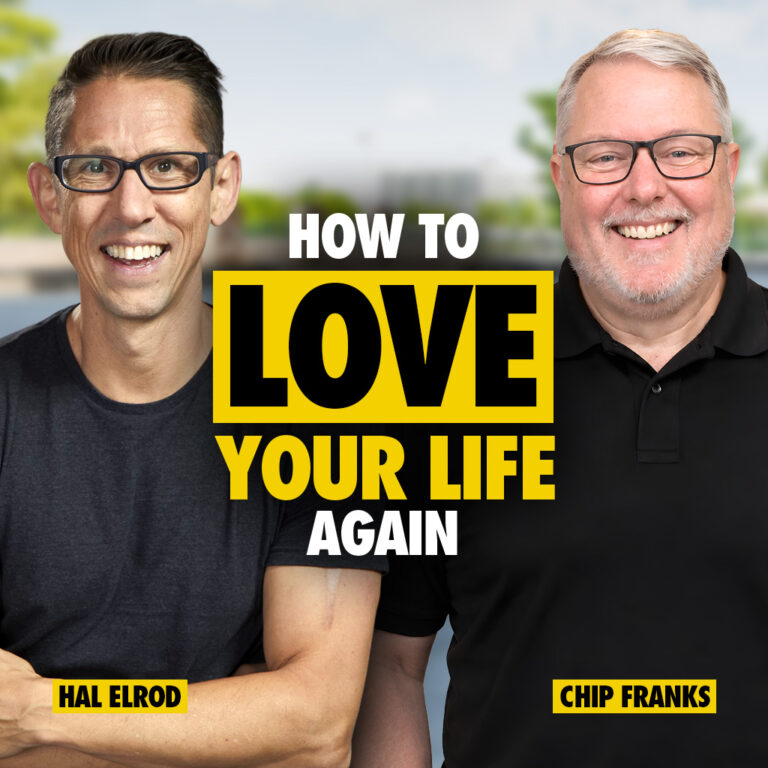
Today, I’m joined by my good friend Chip Franks, author of Love Your Life Again, to explore why we tend to tie our happiness to our circumstances and what it takes to genuinely love our lives, even when things are hard.
Chip has faced his share of adversity, including a stroke, severe depression, ongoing health challenges with his son, and a recent fight to keep the school he founded open. Yet he’s one of the most grateful and joyful people I know.
We talk about why traditional gratitude practices often fall short, how our perspective shapes the way we experience life’s challenges, and what we might be overlooking when we keep waiting for things to get better before allowing ourselves to be happy.
KEY TAKEAWAYS
- How to Love Your Life Again
- When Life Tests Your Message
- Raising a Son With Down Syndrome
- The Lens That Determines Your Quality of Life
- Why Your Gratitude Journal Isn’t Working
- The 3 Levels of Gratitude
- Finding Gratitude After a Stroke and Depression
- The VIP Protocol for Lasting Gratitude
- The 3 B’s: Bookends, Boosts, Breakthroughs
- Turning Bad Things Into Blessings
- When You Can’t Find Anything to Be Grateful For
- Simple Gratitude Boosts for Every Day
- Why Knowing Isn’t Enough to Change Your Life.
“Gratitude is not something we have as much as something that we do.”
– Chip Franks Tweet
“Rewiring the way that we see the world is probably the best skill that we can have as humans.”
– Chip Franks Tweet
RESOURCES
- ChipFranks.com
- Chip Franks on LinkedIn | Facebook | Instagram | YouTube | X/Twitter
- Love Your Life Again: Rewire Your Brain in 30 Days to See Everything Differently by Chip Franks
- Acton Academy
- Jim Rohn
- Tim Ferriss
- Tony Robbins
- Tony Robbins UPW
- Jesse Elder
- The Obstacle Is the Way: The Timeless Art of Turning Trials into Triumph by Ryan Holiday
- Louis C.K.
- Wayne Dyer
- What A Wonderful World by Louis Armstrong
- The Miracle Morning App
THIS EPISODE IS BROUGHT TO YOU BY:
CURED Nutrition:
I want to talk about two of my favorite products. I’ve been taking these for four years, and they’re now a sponsor of the podcast, CURED Nutrition, Flow Gummies. I start every day with two of these. I meditate for 30 minutes without any supplements, and then I take Flow Gummies seven days a week, almost every day.
And then I go to bed with Night Oil. 30 minutes before bed I take Night Oil and it helps me fall asleep and stay asleep. So I start my day with Flow Gummies, I end my day with Night Oil.
If you want to implement my routine into your day with CURED Nutrition, go to CUREDnutrition.com/Hal and use the discount code HAL at checkout for 20% off your entire order.
Flow Gummies to start the day Night Oil to fall asleep. You’ll feel better, you’ll act better, you’ll perform better. Check it out.
RATE & REVIEW THE PODCAST
Reviews for the podcast on iTunes are greatly appreciated and will allow us to get the word out about the show and grow as a community. We read every single review and believe each one goes a long way in helping us make the show even better! If you received value from this episode, please take a moment and rate and review the podcast by clicking here.
Copyright © 2026 Miracle Morning, LP and International Literary Properties LLC
[INTERVIEW]
Hal Elrod: What if you could learn how to love the life you have even when it’s hard, even when it’s not going according to plan, and maybe it’s the most difficult it’s ever been? I am joined by my longtime friend, my soul brother, Chip Franks, to talk about how to love your life again, which also happens to be the title of his brand-new book. Chip is truly one of the most grounded and grateful human beings that I know. I’ve known him for over a decade, and today he shares perspectives and practices that you can implement immediately that I promise will change the way you see your challenges and the way you feel about your life. He also shares the real-life challenges that tested him and his book’s message as recent as four days ago.
His son struggles with Down syndrome, why he views having a child with Down syndrome as an honor and a blessing, and the sudden fight he’s facing right now to keep his Acton Academy school open for their 70 students, or whom he refers to as their 70 heroes. Chip shares how he meets those moments with love, gratitude, and joy, and you’ll hear how the lens that we bring to life can shape, in fact, it does shape what we experience, and how gratitude can include the painful, uncertain parts, too. And stay through until the end to learn Chip’s daily practices, what he calls his bookends, his boosters, and his breakthroughs that will enable you to love your life again and possibly love it more than you ever have before.
[INTERVIEW]
Hal Elrod: Chipster, what’s up, brother?
Chip Franks: Oh, Hal, just living the dream. This is wonderful. I appreciate seeing you again. It’s been too long.
Hal Elrod: I know. I go, “Chip, we have to…” We’ve been talking for 12 minutes. I go, “We got to hit record.” Like, I just want to catch up with you all day, but we have a podcast to record. So, yeah, and I love actually… We’ll get to catch up on something you’re very passionate about, which is this new book you’ve written, which I was just telling you I love the title. I love the premise. The book has not been released yet, so I have not read the entire book. I’ve just read a multi-page study guide for the book. Where do I want to start? Actually, let me back up. Before we get to the book, we’ll talk about that. You posted something on Facebook the other day that got me choked up, and I think it did for a lot of people. I’m sure, I know you. You’re a crier. You wear your heart on your sleeve. You were probably emotional.
Chip Franks: Not going to cry on the podcast, Hal.
Hal Elrod: Yeah. You were probably emotional writing it. And, Chip, one thing I love about you is you are one of the most authentic, kindest, like you’re always looking to serve, and you’re always willing to be vulnerable in service of others, and that’s what this Facebook post was. And just to summarize it, you said, “I just finished this new book, Love Your Life Again,” and within days you said life handed you what you called a Venn diagram of hard things. Can you talk about what prompted you to write that post? What was it about? What happened? What is this Venn diagram of hard things that you were willing to share, and why did you share it online?
Chip Franks: Oh, gosh. I did that in the wee hours of the morning and I had it released later in the day, but it was because several very hard things happened. And it happened exactly as the time I finished this book, which is called Love Your Life Again. And it’s all about gratitude, and it’s all about loving the life that you have, even the hard things. Amor Fati, love fate, love everything, love it all, good, bad, and the tragic. All of it. And God saw fit to give that to me on the week that I finished the book. And it was kind of a walk your talk kind of week. Really bad things happened, and I say they’re bad, but actually, they’re working out for good, and I think that they always can.
But my son has some health issues, and he regressed some, which was probably the biggest thing. And another one, and I can’t mention the third one because there actually might be a lawsuit involved in it. But the second one was that the city of Belton shut down my private school due to zoning and a code that needed to be fixed on it. So, I had to scramble.
Hal Elrod: And that is Acton Academy.
Chip Franks: It is, yes.
Hal Elrod: Which is an incredible school. My kids used to go to Acton for many years until we moved away. And that was a passion project for you. It wasn’t making you lots of money. In fact, I think there were months or years where you were, like, struggling to keep it afloat, but you really cared. When did you start that school, for people to understand how many years you put into that, and for it to be shut down all of a sudden?
Chip Franks: It started September of 2021, the week that I got COVID. So, I remember that, yeah. And I’ve been working at it for quite a while. And it is now profitable, and it helps a lot of families. We’re up to 70 heroes now, which is wonderful, and we have our own place. Well, we had our own place. We’ll get it back here shortly after a city council meeting. But that’s one of the things that hit for that Facebook post. And it just seemed like…
Hal Elrod: So, you’re not giving up on the school. You are fighting to keep the thing going.
Chip Franks: Oh, yeah. And actually, the school is still going. I mean, we scrambled. I got on my feet, and I found a place to have school for 70 children, and eight guides. Yeah. So, it happened between Friday and Monday. All of that happened. So, we have a place for the children, which…
Hal Elrod: Amazing. Congratulations on that, man.
Chip Franks: Well, thank you.
Hal Elrod: And props to you for the perseverance to keep going. Talk about your son. You mentioned the first challenge was your son’s health regressing, if you don’t mind, and feel free to share as much or as little as you want. Your son, Alec, what is his condition? And because you do post about, I mean, he has thousands of fans on Facebook just because he’s such a sweet human, and you share a lot about him and your journey as a father and a son and as a family. But what are the challenges that Alec’s faced, and what happened recently for, again, as much or as little as you want to share?
Chip Franks: Yes. He is the amazing Alec, and he has Down syndrome, and he just turned 15 years old. And about five years ago, about the time he turned 10, he suffered from what we now know is called Down syndrome regression disorder. And we didn’t know what that was at the time. We just know that he regressed severely. Like, he went from being able to read, even as he, a 10-year-old with Down syndrome, and being able to do that, to stimming and not being able to read. His speech regressed a lot, and lately he’s been having episodes of just I don’t know how to put it, but it’s where I can’t even reach him, where he’s sad, and he’s angry, and he’s punching the air in front of him.
And we are getting it fixed. Actually, last year we did a study in Denver, Colorado, and we went to Denver, I think, eight times in four months, something like that, to have him treated for this disorder, and he’s gotten better. And it’s trended a lot better with it. And then recently we started something called IVIG for him at Dell’s Children Hospital, and an IVIG basically replaces his antibodies that are somewhat tainted with hypothyroidism and other things that cause inflammation, and it dilutes it essentially. Like, it gives him good antibodies with it, which is supposed to help him out and help him return more to normal. But the past few weeks, those episodes that I talked about have, actually, they disappeared when he started the medicine in Denver.
And they just reappeared, and they’ve gotten a lot worse in the past few weeks since he started the IVIG. And his neurologist is astounded. She said, “I’ve never heard this happen before, and it’s just strange.” And this past several days, it’s gotten much better, and they’re less frequent. So, I’m thinking, I’m hoping it’s working itself out of his system. So, anyways, that’s what’s going on.
Hal Elrod: Chip, what is it like to go through the, I mean, so being a parent is hard, right? Being a parent is hard, period. And you’ve got healthy children or children that don’t have Down syndrome. So, parenting is hard, period, but I can’t even imagine having a child with Down syndrome and having to just dedicate your life to… I mean, you mentioned you’re taking him to this hospital in this state, and this, and this. And what I’m thinking is like he’s 10 years old, and you’ve worked so hard to support him to learn to read and to make progress, and then to actually start regressing and going backwards, and then this kind of rollercoaster it sounds like, where it’s like one step forward, sometimes two steps back, maybe two steps forward, one step back. If you don’t mind being open about that, what is that like as a parent?
Chip Franks: It sounds cliché or strange, but it is an honor. It really is. And I love that boy. I’d do anything for him. And it’s like that old song, they say, “He’s not heavy, he’s my brother.” And yeah, it’s the same thing. He’s not a medical diagnosis. He’s my son.
Hal Elrod: He’s your son.
Chip Franks: And I don’t, I mean, I guess I do know what life is different with a healthy child and someone not going through this, but I literally feel honored that he’s, I call him my buddy for always, because I’m his caretaker. He is with me almost all the time if he’s not at his therapy. And I love that because I get to look over and see him, and I get to feel his affection. And it’s like when he was going through this regression, he lost a lot of his affection. And he’s gotten a whole lot of that back this past year. And it’s just so sweet. And like, there’s a tender moment where he’s going good nights, and usually I tell him, “Hey, Alec, it’s time for night-night.” And he tells me, “Five minutes, Dad.” And I go, “Five minutes? Are you crazy?” “Five minutes. Okay, I’ll come back in five minutes.”
So, in five minutes I tell him to go to sleep, and he walks across the living room and just gives me a hug and a kiss on the head, and that hadn’t happened for, like, literally years. And things like that, just the milestones are so much sweeter.
Hal Elrod: It’s beautiful, brother.
Chip Franks: Yeah. And it’s wonderful.
Hal Elrod: I think that is a perfect transition, Chip, into your book. And because you are one of the most grateful human beings that I know, the way that you just described it as having a son with Down syndrome, you didn’t say it’s a challenge, which of course there are challenges. You said it’s a privilege, it’s an honor, it’s a blessing, right?
Chip Franks: Yes. It is.
Hal Elrod: I mean, and that just shows the lens that you view your life through, and I don’t mean just you, I mean us, we, human beings. The lens that we view our life through determines the quality of our life. It’s not the external factors, forces, and circumstances. It’s the lens we view it through. And the way that that’s proof is two different people can have the exact same challenges in their life. One person says their life’s horrible. One person, like you, says their life’s a privilege, it’s a blessing, it’s an honor to be able to deal with challenges, to serve friends, family, loved ones, no matter how difficult it might be. So, talk about the lens. That is really the premise of your new book, Love Your Life Again.
Chip Franks: It is. And you and I know we do personal developments, and we’ve done that for a while. And all of the Jim Rohns and Tim Ferrisses and Tony Robbins, whatever, we go through all of that. And I think that in most of those cases, it’s working on the exterior. It’s your bank accounts and your health and your six-pack abs, being a billionaire. And all of that is fine, and it’s good, and it’s worthy. It’s a worthwhile goal to strive for. Yet if we don’t have that lens that you talked about, that lens of gratitude and appreciation and divine love, because there are levels to this, and we can talk about that, but if you don’t have that and you’re a miserable millionaire, it’s not a good quality of life.
And I think that, and it’s not just because I wrote the book about it, but I think that lens and developing that lens and just changing and literally rewiring the way that we see the world is probably the best skill that we can have as humans, as in life quality, for certain. And very few people ever think about that. Like, they don’t think about, “How do I get better at gratitude? How do I learn to appreciate everything, even the hard things?” It’s not something that’s mentioned a whole lot in self-development circles, and I think it might be at the base of being the most important thing that we can do.
Hal Elrod: I agree with you so much because I think about at the end of our lives, and I want anybody listening to this or watching this right now to imagine the end of our lives. When you look back, when we look back on our lives, I believe that the greatest measure of success will be how much of our life we were grateful for, how much of it we actually enjoyed. Because life’s going to do what life’s going to do, and the government’s going to do what it’s going to do, and the economy and cancer and bankruptcy and divorce. It’s all going to… right? All of it. And the quality of our life, I feel like we are trying to manipulate external circumstances to make us feel good inside versus learning how to do what your book teaches you, which is, “No, here’s how you feel good inside no matter what life throws at you so that you win no matter what.”
And that when your life ends, you look back and go, “Yeah. Woo! That was quite the ride. I had ups and downs and challenges and wins and losses. But I was grateful through all of it. That was the lens that I viewed every experience in my life.” I just got back with my family from Tony Robbins UPW, right? And that’s one of the famous Tony Robbins-isms is, “Life is happening for you, not to you.” And that’s a big premise of kind of what you’re talking about. What do people get wrong about gratitude? Like, I think most of my listeners have tried a gratitude journal, and maybe they probably quit inside of a couple of weeks. It’s like, “Yeah, that was cool, but it didn’t change my life.”
I feel like there’s a difference between intellectual gratitude, which is like, “Okay, I wrote down three things in my journal. Check, check, check,” right? We’re up in our head. And this heartfelt, soulful gratitude that you embody, Chip, right? Which is like, no, because I’ve seen you come to tears with gratitude many times, right? That’s gratitude. That’s the kind of gratitude that’ll change your life. So, what do people get wrong about gratitude or not? They don’t do it quite as effectively as they could or should, and what’s the better way?
Chip Franks: Okay. Well, thank you for offering that. That’s awesome. I think a few things. One is people don’t understand that it’s a skill, that gratitude is not something we have as much as something that we do. And we do it, and it’s weird because gratitude isn’t a verb. Appreciate, that’s a verb. And there are also levels to this. So, one, that it’s a skill, and maybe the most important skill that we can do, possibly. And two is that there are levels to this, and that, so you just consider someone to be grateful. And I used to consider myself a very grateful person before I went on any of this. And I think it doesn’t take too much for someone to appreciate a beautiful sunset, say, “Oh, God, thank you for this. This is wonderful.”
But that is passive, and it’s reactive, and it’s you waiting for the world to give you something versus the next level of gratitude, which I call active appreciation. And that is where you go out to meet the things that you can be grateful for, and that you actually control it. You don’t wait passively for a waiter to give you your drink before you say thank you. You go out and find things to be grateful for, and that’s part of the practice with this. And that is active appreciation. And for a little while, I thought that that was the highest level we could get to. And I need to give credit to Jesse Elder for that because he said that at an Archangel conference we were at, and he said that, “He said that gratitude is to appreciation as walking is to running.”
And I remembered that. I wrote that down in my journal and got it down and everything, and I thought about that for a long time. And when I meditated on it, I thought about it, I talked to God about this, and God told me that there’s a higher level than that. And that is what I’ve chosen to call divine love. And that is loving it all through the hardships, through the difficulties, through the tragedies, through realizing, and I hate to get really be a downer on this, but everyone that we know in life will die, or we will die before them. And that’s a certainty. It’s going to happen. And that used to literally devastate me. Like, I would have wonderful moments with my children, and you’re talking about on your deathbed, and I remember specifically Alec reaching up for me on the shore of a beach and reaching back to hold my hand, and I just, like, snapshotted that, and I’m like, “Oh, this is what I want to remember on my deathbed.”
And we think about that, and that used to bother me because I would think this too shall pass. And I’m never going to have that magic moment again. And that just made it so difficult. And I think about this because my head is like you probably operate the same way. It’s like having 1,000 browser tabs open in the background. And you’re thinking about this, and I have this running in my head that this too shall pass. I’ll never have this moment again. And I don’t even enjoy it in the moment because I’m already thinking about the loss of it, if that makes sense.
Hal Elrod: So, how did you shift that? Because I think most people, that’s a challenge for most of us.
Chip Franks: Yeah. And actually, this is the science of it. And I have to be honest with it, I didn’t understand the science until I actually did it. And then I looked back and said, “Wow, that was serendipitous that this came to me. Why does it work?” And it’s like, oh, this is how the brain is wired. This is how the neuroplasticity works with your brain changing. And all of this really started and got underway because I was already on the gratitude path, but then I had the stroke in 2017, and that was just a few months after you were diagnosed with your leukemia. And I remember because you inspired me through that, by the way. And I remember that very distinctly.
But it changed for me after that stroke and me going through the most acute, worst terrible, no good, awful depression ever afterwards. And it was acute, and it was dark, and I realized that I needed to change. And after the stroke, the neurologist told me, he said, “You’re going to be a lot more likely to emotion,” which I’m like, “Oh, God.” I mean, just the way you had said before, like I’m not emotional enough, doc, come on. And also, depression. And that’s proved very prophetic because my brain, like you often say, my brain was broken and it wasn’t working right, And I was actually suicidal. And I told you I wouldn’t cry. I don’t know. I’m going to try and keep it together here.
But I can even remember that so vividly now of how that felt, and I wanted to leave the world. And what saved me, and what was just divine, what’s wonderful is, one, I wouldn’t do that because of my family. And that led to learning gratitude in earnest and figuring this out. And I remember the next day I got my journal, which you know me and journals. I have my journals with me.
Hal Elrod: Oh man, you have more fulfilled journals than anyone I know.
Chip Franks: Yeah, they’re behind me right now. But, yes, I got that, and I do what I now call a breakthrough practice. But I just started writing, and I probably wrote for an hour of everything that I’m grateful for. And just page after page after page in handwriting. And it sounds cliché or performative because I didn’t know I’d write a book about this or anything like that, but it was a tear-stained journal. And I remember doing that, and what was awesome about it is it made me realize that I felt better after I did it. And I started off with like little things, like I have shoes. Shoes are great. They’re awesome. I mean, my feet would really hurt if I couldn’t wear shoes. And I went through the big things, through my wife taking breath every morning and seeing her breathe.
And maybe what a miraculous, serendipitous event that it was that she crossed my path at the exact same time. And that was November 19th, 1994. I still remember it. And if that hadn’t happened, what would life look like? And it led me to the bigger things. But during that practice, I felt better measurably, and I could sense that, and I could feel it. And that led me to really sharpen the practice, to look for it, to make it better, to try new things, make myself as the test subject and figure it out, and actually become better at gratitude, appreciation, and divine love.
Hal Elrod: Beautiful. Beautiful. So, similar to how I resonate as the Miracle Morning being like the practice that helps me through the difficult, challenging times, and gratitude is certainly a part of that practice. This was your practice to go, “Okay, life’s not going to be always easy and always going according to plan. So, how do I have a tool, a practice to regenerate, to refocus on in a way that optimizes your mental and emotional well-being and allows you to enjoy the life you’re living while you’re creating the life that you want?” Is that accurate?
Chip Franks: Yeah, absolutely. Yeah, and that’s a Jim Rohn thing.
Hal Elrod: What’d you say?
Chip Franks: That’s a Jim Rohn thing. Be grateful for absolutely everything you have while you strive for more, and finding that balance with it.
Hal Elrod: Interesting. Jim Rohn. Everything, Jim Rohn was like the originator of most ideas, man.
Chip Franks: Yeah. I miss that man. Yeah, he was wonderful.
Hal Elrod: Ah, me too, man. Me too. And yet he still lives in our hearts and our minds and our spirit, and we embody his practices, as we hope others will, right, when we leave this earth. Talk about some of the practices for people. So, for folks that are listening like, “Okay, this is awesome. I’ve never thought about gratitude as a skill. I’ve never really, you know, it’s something that kind of is like on the fringe, in the background. Like, yeah, I should be more grateful.” And I find as you demonstrate that, like, when gratitude is the lens through which you view every moment, every aspect, every challenge, everything in your life, it brings you a level of joy as a baseline that most people don’t have, right?
Chip Franks: Yeah, absolutely.
Hal Elrod: So, what does the practice look like each day? What’s something someone can do tomorrow to embody and implement what you’re talking about?
Chip Franks: Well, the first thing, and just before I get to the practice, is how you conduct yourself and how you conduct the practice, and I call that the VIP protocol, which stands for variability, intensity, and persistence. Because you won’t remember what you had on lunch three weeks ago because it wasn’t intense. It wasn’t emotional. And of course you can bring this back. So, when you practice your gratitude, you want to have different types of gratitude that hit from different angles, and I’ll talk about that in a second. And then the intensity is actually slowing down your breathing and letting it sit in your soul, like you said, the deep, soulful gratitude.
And science says about 20 seconds for it to actually transfer from just a nice thought you have to something that you remember. And that’s a big thing is to actually hold it for more than 20 seconds. And then the persistence is doing it over and over again, because, like you said, gratitude you asked me what misconceptions people have on it. It is something that you can work on, and it’s literally like being at the gym and lifting weights.
Hal Elrod: It’s like a muscle, yeah.
Chip Franks: Yeah. The more you do it, the better you get. So, the persistence that you do it over and over again, it literally rewires your brain. And I learned about that with neuroplasticity after the stroke and getting better and improving with that. And it’s the same way that you change to become more grateful. So, the practice that I have, and I have many years of doing this, I wish I had this framework when I started, but it’s the three Bs. And I call it the bookends, then the boosts, and then the breakthroughs. And the bookends are starting and ending your day the right way. And I do what’s called the Mighty 5 when I first wake up and right before I go to sleep in the morning. And the Mighty 5 is writing out five things that I’m grateful for. And it’s important that they are varied. Don’t just write down your wife, your job, and health.
Hal Elrod: Every single day.
Chip Franks: Every day. Yeah, that’s numb. It’s like lifting a pound weight all day and expecting a change with that. You have to get very specific, and that makes it more intense as well. But being very specific, something you haven’t written before, so you’re expressing more things. And I do it in the pattern of this. It’s five. So, I start off with a big, profound blessing, like something that, like my wife, for instance, looking over at her one morning, I just talked about this, and I saw her breathing. And I thought, “Oh my gosh, what a miracle that is.” That is amazing that her lungs are letting her breathe 100,000 times a day, and we don’t have to think about it.
And we’re not entitled to any of that. I’m not entitled to my wife breathing right now, and yet it’s given to me. And that’s something profound. It can be lots of those, or language, or there are so many things that are profound that you think about. Then it’s another gratitude. The second one is the often taken for granted, and that is hot water in the morning. Like, kings didn’t have that when several centuries passed, and we get it, and we take it for granted. And, yeah, the opposite of gratitude is actually entitlement. And to think that we deserve that, or not that we deserve it, but that it’s owed to us. Hot water is owed to us, and we get mad, “Oh, we don’t have hot water this morning,” when it’s such a blessing.
Hal Elrod: I love that Louis C.K. bit of the internet, right, his first time flying on a plane, it was like 20 years ago. And he goes, “They had internet, and everyone was so excited, and then the internet went down.” And he goes, “Immediately everybody was pissed off that this thing they didn’t even know existed an hour before didn’t work anymore,” right? Versus like, “Wow.”
Chip Franks: Dammit, that’s my life.
Hal Elrod: Yeah, yeah. “I’m grateful that I got to experience that internet. I can’t wait to tell my friends and family, and maybe it’ll work again on the next flight.” Like, totally different perspective, same experience, affects how you feel and your quality of life. So, yeah, continue.
Chip Franks: Yeah. That’s it. And then the third one, this is when I really started. I learned this through Ryan Holiday, The Obstacle Is The Way, and Stoicism. And I call this the no good, very bad, horrible blessing. And that is you write the thing that is bad, and I say bad in… Ah, sorry.
Hal Elrod: Ship with the soundtrack.
Chip Franks: Yeah. That’s Godfather, by the way. But anyways, yeah. It’s the no good, very bad, horrible blessing, and you take something that is bad, that’s in air quotes bad, and you write out everything that’s good from it. And I think that one in particular prepares you for the hard things in life. And literally, it wires you to be resilient and tough, and it makes you respond rather than react when you do it over and over again, and that’s how your brain gets wired with it, which is wonderful.
Hal Elrod: I’d love to expand on that if I could, because that is big for me. Like, when I had my car accident when I was 20, when I came out of the coma, I was grateful that I was alive, and I asked myself, “What are all the benefits that could come from this experience?” One is maybe I would share with others how I overcame my challenge. I’ve always wanted to be a professional speaker. Maybe this is why God’s putting me through this so that I can learn, grow, and become a better version of myself on the other side of it, capable of helping more people. And when I had cancer, I go, “God, I’ve already learned everything I could imagine learning from adversity. Why? Why? Why would you put me through this?”
But I always flip the why, why oh why, from the victim mindset to like, “Why? Hmm. What can I learn and grow?” And you and I were friends during that time, but I learned so much. I learned that I was a workaholic, that I was putting my family behind. You know, like, the cancer was a wake-up call for me to be the dad that my kids deserved and the husband my wife deserved, and I’m so grateful for the cancer for that reason. And the last thing I want to say on this is they always say hindsight is 20/20, right? Where you can look back on your adversity, on the divorce, on the bankruptcy, on whatever it was, and go, “Oh, hindsight, I can see how I needed that to be evolved to the next version of myself.”
But I say, why would you suffer for days, weeks, months, and years and wait for hindsight to see the value in your adversity when you could do exactly what you’re talking about, Chip, which is look for the value, the gratitude in the very bad, no good blessing right now, and not suffer now and wait until later to see the value in it. So, I just wanted to add that.
Chip Franks: Well, thank you. That is awesome, and it’s the way to do it, and it develops your armor and your alchemy. Like, to take bad things and turn them into blessings, like, literally immediately as they happen, as you get better and better at it, which is wonderful. The fourth one is about people, whether you know them or not, and it’s just a person-oriented one. Like, I remember specifically being grateful for the German engineering team that’s made my door close so well and that it protects my family. And thinking that person. And when you think about something like that, and it’s very specific, and it’s something you wouldn’t think about before, but it’s a wonderful thing that they would study that hard to make my family safe,
Hal Elrod: So, like it’d be the farmers that raise the animals, right? I mean, yeah. One thing I want to ask you, for somebody listening, they might be thinking, when I try to think of what I’m grateful for other than the norms, like my family, my house, they draw a blank. How do you deal with that blank?
Chip Franks: Oh, this is wonderful. Well, one, I’ve given people a whole lot of gratitudes in the book. I call it the ridiculously long line of long list of blessings, I think is what it’s called. And I give 500 blessings, like, as just as starting points to think about or whatnot.
Hal Elrod: Oh, thought joggers. I love it.
Chip Franks: Yes. Exactly. But here’s the thing, and this is what’s so wonderful about it, is that blank mind is a blessing because that means they get to work on it. That means that your gratitude muscles are soft and flabby, and you need to get to work on it. And when they are searching, and they’re looking up at the sky and thinking, “What can I be grateful for?” That is when the good is done. That’s when your neural circuitry gets rewired when you’re thinking about it like you’re lifting the heavy weights. And that’s when the change happens. So, I would say be thankful for those moments, and you’ve got to get better at it.
Hal Elrod: Yeah, I think the first thing that comes to mind is I’m grateful that I’m trying right now to think of what I’m grateful for, right? Yeah. I’m grateful that I heard this episode with Chip so that I can lean into gratitude more, that I can develop that skill, and I’m developing that skill right now, right? I mean, yeah, if you look for it, you’ll find it.
Chip Franks: How about just even the dignity of thinking, of being able to think and have your own thoughts with that? I mean, it’s amazing that we are given that right of free choice to be able to consider our blessings. I mean, that’s wonderful. I don’t think that’s been done by too many people throughout history. And here we are thinking of how blessed we are and actually going out for active appreciation to find that. It’s awesome. It’s a wonderful thing.
Hal Elrod: All right. I think we’re on number four now?
Chip Franks: Yeah. Number four is the people blessing.
Hal Elrod: Okay. And then five.
Chip Franks: And then the number five is just a free-for-all, and it can be anything and everything, whatever you want to put on it. And it can be any of the previous four or something else. And you do that, and that’s The Mighty Five. That’s the bookend as you wake up, as close as you can to waking up, and that can be your scribing practice for Miracle Morning, which it is for mine. And right at bedtime, I call it the quick and dirty, so you don’t have to get real specific with it, but I’d recommend writing it down because it actually imprints on your soul a little bit better. Yeah, it gives you reinforcements on your neuro circuitry to be able to imprint it more.
And the last one is kind of what you go to sleep on and what you dream about and think about. And that’s actually when the change is made, is actually when you’re sleeping, which is pretty interesting because your brain repairs and gets better. So, that’s the bookends: morning and night. Then there’s the boosts, and these are like little gratitude practices sprinkled throughout the day. And I’ll give you just a couple real quick that you can do right away. One is, I call it the Wayne Dyer. And oh my gosh, it’s getting up here. Well, the Wayne Dyer is just waking up simply and saying, “Thank you. Thank you. Thank you.”
Hal Elrod: We can go another five minutes or so, buddy. No rush.
Chip Franks: Okay. Gotcha. It’s the Wayne Dyer, waking up, putting your feet on the ground, and the first thing you do is say, “Thank you. Thank you. Thank you.” And you like let it sit in your heart, try and take it over 20 seconds with it. And just that sets your cell for the whole day. And it’s just a little practice that you can do, and it doesn’t have to be first thing in the morning. You can do it throughout the day. Another one that I’ve had for over a decade now is the joy alarm, and that is when my phone goes off and it plays. Right now, it plays What a Wonderful World by Louis Armstrong. And wherever I am, I’ve been changing it to different times so I don’t expect it. And it just interrupts your day. It makes me stop and breathe. I do the 4-4-6 breathing with it specifically to help it sit in your soul a little bit more, and you think of how grateful you are and something to be grateful for, and just again, what a privilege it is to even live this life, which is wonderful.
That’s one. And I’ll leave another one with you, and this is one of my favorites, and it’s in a three-day challenge I have on the website for people, but it’s the silent art of blessing. And I read a book with that title, and it’s literally watching someone you don’t know or that you know, and just putting yourself in their shoes for a little bit, having that compassion for them and thinking of that you want them to be blessed and you want them to feel good, and it’s basically a little silent prayer for someone. And just doing little boosts throughout that, and I think I have 22 in the book. I mean, so there’s lots of little boosts like that that you can do, but that kind of keeps it going throughout the day and helps imprint it on you when you go to sleep at night.
And the last one, the last B is breakthroughs. And that is the heavy lifting, like the real big ones, like that dark night of the soul I had, and the next day I did what I call the plethora o’ gratitude, and where you just keep riding until an alarm goes off, and until you feel better. And it can be 30 minutes, 45 minutes. You can also write a heartfelt letter to someone that’s meant something in your life and actually mail it to them. And again, I have 11 of those that you can do. But the three Bs is bookends, and you do that morning and night, the boosts, and I choose at least three throughout the day, including an A okay a day, which we haven’t even talked about, which is an act of kindness for another person.
And then at the end is a breakthrough maybe once a week or so, where you actually take time to do it. And that does the lifting of changing your mind to be more grateful and to actually put you on the path. It gives you a gym routine for your mind and your heart and your soul to be more grateful.
Hal Elrod: That’s one thing I love about the way that you write. I’ve read your other book, and it’s that you don’t hold back in terms of making the reader do any guesswork. Like you said, you give a list of 500 thought joggers, gratitude starters for people that are like, “Oh, I could probably find at least a 100 or 200 of these that apply to me, if not all 500 of them,” right? And then that you give the different boosts. Like, you give people a buffet to choose from, rather than just saying, “Here’s the concept. Figure it out on your own.” And so, I do love that about how you teach, Chip. It’s one thing that makes you… You really care, and you’re really thoughtful in how you teach people.
And so, I want to acknowledge you for that and let people know that this book, Love Your Life Again, is going to set people up to do exactly that, to love your life again. This isn’t just “Hey, let’s do a little gratitude.” It’s literally all-encompassing how you completely gradually transform your experience of this one life that you’ve been blessed to live. And, Chip, I can’t think of anybody more qualified through ups and downs and adversity and through actually practicing what you preach at a level that I do not know too many people, myself included, that are at your level of consistency. And I don’t have that many journals filled out. I mean, you really embody what you teach and, therefore, there’s nobody better than you to teach others how to love the life they have no matter what hand they’ve been dealt, dude. So, thank you so much.
Chip Franks: No, I appreciate that. And I think the same thing about you. You’re one of the most grateful people I know, and you walk your talk like no one else, like your Miracle Morning. I actually have that in the book. I didn’t even tell you this, but I have your story about going to the UFC and leaving before the main event, so you can actually get your Miracle Morning in. And that is amazing to me. So, yeah, ditto, sir, and wow. I mean, that’s tough to live up to. But that’s wonderful.
Hal Elrod: Awesome, brother. Well, what is the best…? Actually, anything else to share? No, before I end with that, where’s the best place for people to go get the book? And I know you have some bonuses and stuff people can go to the website and get. I know it’s available. I pre-ordered my copy right now. It comes out on December 8th, but I pre-ordered the copy. Where’s the best place for people to go so they can get all the goodness that you have to offer?
Chip Franks: Go to chipfranks.com. And that’s it. And sign up there. If you sign up, there’s of course you join an email, but you get three emails for a three-day gratitude challenge. So, you can actually walk through The Mighty Five and know what some of the boosts are and actually feel them in your life and actually go through a breakthrough. And be able to do that and know what it feels like. And then, of course, if you want the whole buffet, like you said, the book is available. And I hope if I’ve earned the right for that, that folks not only order it, but actually read it and start doing this. Because it really does make a difference. And I know it’s made a difference in my life and several hundred people I’ve taught this to. So, I hope it works for them too.
Hal Elrod: Well, I’ve pre-ordered the book. I will be reading it, and I want everyone listening to think about this. When you’re exposed to a new idea, it rarely transforms your life, right? Today, Chip exposed you to a bunch of new ideas, paradigms, perspectives, practices around loving your life again. But that’s not what changes your life. That’s not what enables you to love it again. It’s going deeper. It’s implementing. It’s integrating these practices into your world. And so, one year from now, life is going to be where life’s going to be, but you will either have taken Chip’s wisdom today, ordered the book, Love Your Life Again, and you will have implemented this, and you will either a year from now go, “Wow, Chip’s practices, gratitude, the daily, the boosts… Go through the three Bs again.
Chip Franks: Okay. It’s bookends, boosts, and breakthroughs.
Hal Elrod: And the breakthroughs. Either those will have transformed your life to where the life you are living has so much more love and joy and happiness, or you go, “This was a cool podcast,” and you don’t take the next step. And then I’m sure it’s going to be a positive impact no matter what, just hearing Chip’s perspective. But I encourage everybody to check out the book, Love Your Life Again, and go to chipfranks.com to get the three-day gratitude challenge. And, Chip, any final closing words for everybody watching and listening to this?
Chip Franks: Oh, gosh. Something that just that I thought of is Wayne Dyer’s quote, “When you change, the things that you look at change.” And that’s it.
Hal Elrod: “When you change the things you look at, the things you look at change.”
Chip Franks: Hal, of course you know it exactly word for word. That’s awesome.
Hal Elrod: It’s one of my favorite quotes.
Chip Franks: Yeah. That’s awesome. And you have the ability to change with this. And I wish that for everybody. I want everybody to have a deep, profound, wonderful love of life. So, please take Hal’s advice.
Hal Elrod: That’s right. Yeah, Chip, you’re very humble. I’m going to encourage people to really take the next step. Well, Chip, God bless you, brother. Thank you for the work that you do in the world. And when I say in the world, first and foremost, at home. You know, you are a shining example of being the husband that your wife deserves and the father that your kids deserve. And you inspire me to elevate my standards in the areas that matter most. So, I love you, brother. Thank you for that.
Chip Franks: Thank you, Hal. And there is a chapter in the book, How to Become the World’s Best Lover, specifically, so you can be a great, great husband. And it’s probably not what you think. So…
Hal Elrod: I love it. But it’s catchy. It’s provocative. I like that. All right, everybody, I love y’all so much. Love your life again starting today. Check out Chip’s three-day gratitude challenge at chipfranks.com, and pre-order the book on Amazon. And together, let’s love our lives again because we deserve nothing less, and the people that we love deserve nothing less from us. All right. I love y’all, and I’ll talk to you next week. Bye-bye.
Chip Franks: Bye.
[END]