

Nobody achieves anything meaningful alone. Yet, we’re led to believe that success means being “self-made.”
The truth is, the relationships you surround yourself with can either keep you where you are or help bridge the gap between where you are today and the person that you aspire to become.
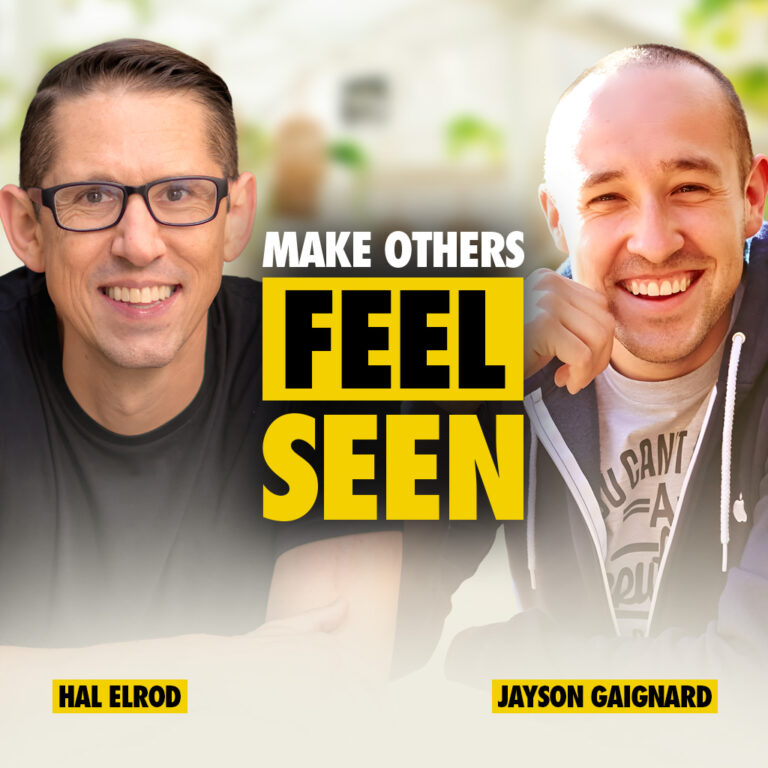
Today, I’m joined by my good friend Jayson Gaignard, author of Community Made: The Truth About Success and the Relationships That Create It, and founder of Mastermind Talks. When Jayson got married, he had only two people at his bachelor party: his brother and brother-in-law. But today, he’s created an extraordinary network of entrepreneurs and leaders and just recently sold 20,000 copies of his book on Kickstarter, despite having roughly 2,500 Instagram followers.
In our conversation, Jayson shares three simple questions to help you intentionally decide who belongs in your life and why generosity is the foundation of meaningful relationships.
He also explains why asking someone “How can I help you?” doesn’t actually help the person you want to help, how to make people feel genuinely seen, and how you can build relationships with extraordinary people even if you don’t have money, status, influence, or an existing network.
KEY TAKEAWAYS
- Why Nobody Is Truly Self-Made
- How To Intentionally Design Your Peer Group
- Three Questions For Choosing The Right Relationships
- Generosity Is The Foundation Of Meaningful Relationships
- Six Ways To Make People Feel Genuinely Seen
- Why Gratitude Gains Power Through Witness
- Deepen Relationships By Showing Up When It Matters
- How To Build A Network Without Money Or Status
- One Cold Email Can Open Life-Changing Doors
- Use Service To Get Into The Right Rooms
AYG TWEETABLES
“No matter what you strive to achieve in life, it will naturally have the fingerprints of others.”
Jayson Gaignard Tweet
“The notion of being self-made is both nonsense and it's toxic because it leads to isolation.”
Jayson Gaignard Tweet
“Making people feel seen is the foundation of relationships, intimate relationships, co-working relationships, every single relationship.”
Jayson Gaignard Tweet
“Gratitude gains power through witness.”
Jayson Gaignard Tweet
“If you're not getting an invitation to the table, you can build your own table.”
Jayson Gaignard Tweet
“It doesn't matter how many friends you can count. It matters how many friends you can count on.”
Jayson Gaignard Tweet
RESOURCES
- JaysonGaignard.com
- Jayson Gaignard on LinkedIn | Facebook | Instagram | YouTube | X/Twitter
- Community Made: The Truth About Success and the Relationships That Create It by Jayson Gaignard
- Mastermind Dinners: Build Lifelong Relationships by Connecting Experts, Influencers, and Linchpins by Jayson Gaignard
- Mastermind Talks
- Good to Great: Why Some Companies Make the Leap…and Others Don’t by Jim Collins
- Marie Kondo
- Stephen Dubner
- Freakonomics: A Rogue Economist Explores the Hidden Side of Everything by Steven D. Levitt and Stephen Dubner
- Nathan Barry
- Kit
- John Ruhlin
- Giftology: The Art and Science of Using Gifts to Cut Through the Noise, Increase Referrals, and Strengthen Retention by John Ruhlin
- Glossier
- Claude
- ChatGPT
- Mel Robbins
- Chandler Bolt
- Selfpublishing.com
- UJ Ramdas
- The Five Minute Journal
- Oprah Winfrey
- Genius Network
- Summit
- Andrew Wilkinson
- Never Enough: From Barista to Billionaire by Andrew Wilkinson
- Aubrey Marcus
- Robert Kiyosaki
- James Altucher
- Joe Rogan
- Brad Weimert
- Tim Ferriss
- Silicon Valley Tech Association
- Jack Canfield
- The 4-Hour Workweek: Escape 9-5, Live Anywhere, and Join the New Rich by Timothy Ferriss
- Ryan Holiday
- Robert Greene
- Kickstarter
- The Miracle Morning App
THIS EPISODE IS BROUGHT TO YOU BY:
CURED Nutrition:
I want to talk about two of my favorite products. I’ve been taking these for four years, and they’re now a sponsor of the podcast, CURED Nutrition, Flow Gummies. I start every day with two of these. I meditate for 30 minutes without any supplements, and then I take Flow Gummies seven days a week, almost every day.
And then I go to bed with Night Oil. 30 minutes before bed I take Night Oil and it helps me fall asleep and stay asleep. So I start my day with Flow Gummies, I end my day with Night Oil.
If you want to implement my routine into your day with CURED Nutrition, go to CUREDnutrition.com/Hal and use the discount code HAL at checkout for 20% off your entire order.
Flow Gummies to start the day Night Oil to fall asleep. You’ll feel better, you’ll act better, you’ll perform better. Check it out.
RATE & REVIEW THE PODCAST
Reviews for the podcast on iTunes are greatly appreciated and will allow us to get the word out about the show and grow as a community. We read every single review and believe each one goes a long way in helping us make the show even better! If you received value from this episode, please take a moment and rate and review the podcast by clicking here.
Copyright © 2026 Miracle Morning, LP and International Literary Properties LLC
[INTRODUCTION]
Hal Elrod: What if you could develop a network of extraordinary people who would help you achieve your most important goals without needing money, status, or a following to attract those folks? I want you to sit with that for a second, because your ability to build and harness your network might be the exact thing standing between you and everything you are capable of. My guest today, Jayson Gaignard, will close that gap. He is the author of the brand-new book, Community Made, and when he got married, he had two people at his bachelor party. That’s it, two. No network, no following, nothing handed to him. Today, he’s the author of Community Made, and he just sold 20,000 copies of that book on Kickstarter, a quarter of a million dollars, with 2,500 Instagram followers.
He’s not some huge influencer. What makes this conversation different is that Jayson built his entire world of relationships from nothing using a specific approach that anyone can follow, whether you’ve got money and status or you’re starting exactly where he did, from scratch. So, stay with us, because you’re going to learn the three questions that tell you exactly who belongs in your life. You’re also going to learn why the most common way we try to help people actually pushes them away, that you should never ask, “How can I help you?” And you’re going to learn how somebody with no platform and no clout can still end up in the room with the people who move the needle. It is my great pleasure to bring you this conversation with my good friend, Mr. Jayson Gaignard.
[INTERVIEW]
Hal Elrod: Jayson Gaignard, it is good to be with you, brother.
Jayson Gaignard: I appreciate you having me, man. It’s an honor.
Hal Elrod: Dude, I mean, I’ve been a fan of yours since I attended Mastermind Talks over a decade ago, and just watched your journey ever since, man. So, the fact that this book, I have your first book, Mastermind Dinners, right?
Jayson Gaignard: Yeah.
Hal Elrod: Yeah. And this one is the culmination of all the work since then. So, I want to jump right in. You argue that people have been conditioned by society to value being self-made, but that nobody builds anything meaningful alone. What does the self-made myth cost people, and especially entrepreneurs like us, who continue believing it?
Jayson Gaignard: Yeah, I mean, it’s just one of those things that just permeates business culture and the American dream, one could say. I mean, you look at the cover of Forbes, it’s usually a self-made man or self-made woman. There’s usually only one headshot on the cover of Forbes. It just reinforces this nature. And it’s funny that just nobody questions it. And then when you actually get to know people who’ve achieved anything in life, even if it’s an individual sport, let’s take it outside the context of business, they have coaches, they have trainers, they have therapists, and all that kind of stuff that have contributed to their success. So, it’s a very clear pattern that no matter what you strive to achieve in life, it will naturally have the fingerprints of others.
And if you can let go of that notion of being self-made and be in a position where you’re willing to ask for help and get people to fly in formation to support you, it makes you very conscious as far as where you allocate your energy, especially when it comes to relationships. So, that’s really the premise behind the book is planting my flag that the notion of being self-made is both nonsense and it’s toxic because it leads to isolation
Hal Elrod: So, for people listening, you teach us that we can design our peer group instead of simply inheriting it. Most of us, it’s like we grew up with these folks. We work with these folks. This is the people that we met, right, the inherited peer group. But walk us through your bus framework. How should we decide who gets a seat, where they sit, whether somebody may need to get off the bus, which can be hard sometimes? But walk us through that framework.
Jayson Gaignard: Yeah. So, a lot of the books in the space, there are almost two different types of books in the relationship space. There’s either like the transactional networking books, which feel a little icky to some people, me included.
Hal Elrod: Yeah. I want to talk about that a bit.
Jayson Gaignard: And then there’s other books in the space that emphasize the importance of relationships, but they don’t give you anything tangible to actually forge these relationships, one could say. So, with Community Made, I kind of set out to hopefully bridge that gap for those that have a desire to build those types of relationships. And I struggled. I’ll be honest, I struggled at first. There were so many. There were hundreds of aphorisms I collected over the years as far as how to decide if you should have somebody in your life and energizing and all this kind of stuff. And then ultimately what I landed on was this frame, one could say, from Jim Collins when he wrote his book, Good to Great.
And the premise behind Good to Great is he has this bus analogy that you want the right people on the bus, the wrong people off the bus, and the right people in the right seats. Now, he was sharing that in the context of growing an organization, but I think that’s a framework for life as well. To what you said, we kind of start off in life with these proximity-based relationships. We go to a certain school, we belong to a certain community, we join a certain kind of sports league, and all these relationships just kind of happen by default, one could say. And if you’re a driven kind of A-type individual, as you start to have ambitions and goals, sometimes those existing relationships may not take you there.
And to bridge that gap from where you are to where you want to go, oftentimes, is bringing, again, awareness to those relationships. So, the idea of the bus is, again, you want the right people on the bus, the wrong people off the bus, and the right people in the right seats. The right people on the bus, there are really two frames that you can definitely embrace, and this was something I uncovered just in conversations with friends and how they approach their lives. But ultimately, you can look at relationships either transactionally or through the lens of transformational-based relationships. So, transactional relationships, especially if you’re early in a business or what have you, and you have very clear goals, you are most likely optimizing for relationships that can help bridge that gap to those goals and help you get there as quickly as possible.
So, the frame I use, the question I use is, “Does this individual shorten the path?” So, whenever you meet somebody new, that you ask that kind of question, and you won’t get it 100% all the time because, obviously, there’s a lot of nuance you don’t necessarily know. But it’s one of those things that when you ask a question like that, you’re really trying to identify, can this person, again, help me kind of bridge that gap? And I was inspired by a story of these rowers who competed in the, it was early 2000 Olympics. They had a horrible showing in the Olympics as the British rowing team, and they had one more shot to make the Olympics next year.
And what they did was they implemented a question of, “Will this make the boat go faster?” So, throughout the three-plus years of training, every time they considered going to the pub, they’d ask themselves, “Will this make the boat go faster?” And the answer was no. Then they wouldn’t go to the pub. If it was to wake up early on a Sunday morning for a training day, will this make the boat go faster? The answer is yes, so they did that. So, they kept that as the North Star.
Hal Elrod: Nice. Their North Star, yeah.
Jayson Gaignard: Yeah, and I think that’s a really helpful thing when you’re considering bringing awareness to your relationships is what are you optimizing for? And if it is something along the lines of goals-oriented, then you’re most likely optimizing for transactional-like relationships. And it’s a spectrum. There are certain stages of your life where, again, you need the bulk of your relationships to be transactional. But that’s kind of that first frame is, will they shorten the path? The second frame is actually an energy-like frame or an energy question, one could say. When I started MMT, which is an invite-only community for entrepreneurs, we had to curate those that we had kind of in the room.
And I belonged to a lot of other organizations and groups in the past where they were criteria-based frames as far as how they considered somebody. So, as long as you were an entrepreneur and you did seven figures, you could join this group. As long as you did eight figures, you can join this other group. And you and I have been in this space for a long time. We know a lot of very successful people, I’m sure, on paper, who you wouldn’t necessarily want to spend much quality time with, because there’s a misalignment of values there. So, for me, when I was considering folks for MMT, the question I landed on was, would I want to have dinner with this person? And if the answer was no, I didn’t care how successful they were on paper.
I didn’t extend an invitation. And that ultimately, a question like that is a really quick gut check of kind of core values. Is there an alignment of core values here? Now, these questions, the question around the values and asking, “Would you want to have dinner with this person?” it’s, again, those are more transformational relationships. There’s not a clear path that they can help you achieve your goals, or what have you. Oddly enough, though, even though that’s not the case, oftentimes these are the relationships that really open the big doors. So, when you find yourself at a later stage of your life where you’re seeking more significance instead of more achievement and that kind of stuff, oftentimes you start shifting your energy towards those transformational-like relationships.
And then it begs the question, well, what happens to the people who are kind of already on the bus? And so, those are two great questions if you’re considering bringing somebody on the bus, but what happens with those who are on the bus that exist already?
Hal Elrod: So, your existing relationships, how do you pour into those? How do you nurture those, you’re saying?
Jayson Gaignard: Exactly, yeah. And the question I’ve used there is Marie Kondo’s… She has her philosophy of: does this bring me joy? And for me, I use that kind of same lens of does this person energize me, or do they deplete me? So, it’s very much an energetic question. And that is a common theme I’ve seen amongst a lot of high achievers, is just being very conscious and doing almost these time audits as far as where they allocate their time and how much those things give them energy. And specifically, I had a lunch with a gentleman named Steven Dubner probably eight years ago, who wrote a book called “Freakonomics.”
Hal Elrod: Oh, yeah.
Jayson Gaignard: Yeah. And over lunch, he shared with me that every day, he looks at his calendar for the next day and notices and pays close attention if he has an up feeling about having a phone call with somebody or a meeting, or if he has a down feeling. And based on that alone, he starts to kind of curate and course-correct, one could say, where he allocates his energy. So, that is the bus kind of framework along with the three questions you could ask yourself.
Hal Elrod: I want to circle back to what you just said about the kind of the first criteria of, does this person close the gap where I’m going? Because I know you, I mean, we’re not best friends, but I know your heart, your character, your reputation, and I’ve worked with you and known you as a friend for, oh, a decade. You’re known for being someone that adds value, that shows up selflessly, that pours into people that looks to give before you get. And my radar went off when you were just sharing, which is if someone’s like, “Well, but aren’t I going to be seen as transactional if I’m just looking at the…” Like, how do you handle that where you’re like, “I don’t want to be seen as like I’m only in it for people that I see can advance my career, and I’m transactional”? That came up for me because I know that’s not how you operate. I’m trying to understand the difference.
Jayson Gaignard: Yeah. Well, I mean, there’s something called the social exchange theory where it’s rooted in research that unconsciously we are always assessing relationships. And ultimately, we want to surround ourselves with individuals who can help advance our goals. Now, transactional relationships may help us achieve, again, writing a New York Times bestseller or starting this business and that kind of stuff. But even other relationships that I have in my life, they may not have a clear path to support me financially, but they bring something to my life. Maybe they bring friendship, maybe they make me feel seen in a relationship, maybe they are incredibly supportive.
So, there’s definitely value there. So, it’s this inherent attribute that we have as humans. And an exercise like this just kind of brings it to surface. But it’s one of the things too that, like, and I’m sure you’ve been to events before or networking mixers where you engage in conversation with somebody, and you’re not looking for a transactional relationship, but you can tell that they are. And when there’s that mismatch, that’s problematic. But if you both go into a relationship where you both want the transactional value of it, then the game is stable, so to speak. So, that is one thing to kind of keep into consideration. As long as there’s not a mismatch there, it’s good. And again, we all have unconsciously or consciously these goals, and it’s just bringing awareness to how we kind of want to navigate them.
And at the same time, I’m at a stage in my life where, again, I don’t have much of an appetite for transactional-like relationships. I just want to bring great people into my world, and I want to pour into them. And as Steve Jobs says, “You can’t connect the dots looking forward. You just need to trust that they’ll somehow connect.” And for me, that, again, these relationships pay kind of dividends over time in ways you can’t even imagine. But it was one of those things. When I started writing the book, I first vilified transactional relationships. I’m like, “I don’t navigate the world this way.”
Hal Elrod: Yeah. And that’s what I would think about you, yeah.
Jayson Gaignard: Yeah. And I try to put, again, a flag in the sand of that’s what these books talk about, or that’s what these people talk about, but this is how I kind of navigate the world. But when I kind of really looked in the mirror and really, really sat with it, again, there is an element of transactional relationships, one could say. And we all engage in these, but again, it’s a spectrum, and it shifts over time. If you’re early in your career, you may be approaching a lot more of your relationships transactionally. And if you’re later in your career, you’re looking more for companions on the path, which is what I’m, you know, for the most part. And as a result, you look at those transformational relationships instead.
Hal Elrod: I’m curious to hear your thoughts. Like, so the way that I view how to approach this is adding value first, right? Looking to add value. So, determining, okay, this is a relationship. Give an example, right? I’ve been off the speaking world, not speaking nearly as much. I still speak once, twice a month, but my kids were young, and now they’re teenagers. They’re like, “Dad, go speak. We don’t need you here all the time.” So, I’ve just finally realized, oh, I need to put myself in circles with professional speakers because I actually am ready to take that really seriously, right?
Jayson Gaignard: Yeah.
Hal Elrod: So, now it’s like, okay, I’m actually looking for speakers, people that can help me take my career to the next level. Yet the way that I approach them, right, is not like I want to get from this person whatever I can. It’s, “Oh, I’ve identified this person. How can I add value?” Like, that’s the first and fundamental leading question, right? How can I add value? What do they care about? How can I support that? That kind of thing. Because I think that’s how you approach relationships as well. What are your thoughts on that?
Jayson Gaignard: Yeah, I mean, generosity is the foundation of relationships. So, I mean, that’s a very kind of key feature. Even if you’re entering in a relationship, again, they can help bridge that gap. And it doesn’t, again, have to be this icky, very much like a tit-for-tat thing. But you even bringing awareness to, like, one of your areas of focus is starting to speak again, and finding yourself in that environment again, is like surrounding yourself in individuals who can help kind of bridge that gap. So, I think the language of transactional relationships doesn’t have necessarily a great kind of connotation to it and doesn’t bring great energy to it. So, in hindsight, maybe I should’ve rebranded.
But it’s one thing that people do relate to. They do know what that word means. But yeah, I mean, obviously leaning into relationships with generosity is the posture you want to take. Leaning into relationships with bids of trust, that’s a big component too, because if you lead into a new relationship not trusting somebody and you feel like they have to earn your trust over time, that could really keep your relationship small. And the notion of – and I know you to be this kind of guy, which I think is really important – I talk about in the book why the idea of asking someone how I can help you actually does more damage to a relationship than benefit it.
Hal Elrod: Talk about that, because that’s so important.
Jayson Gaignard: Yeah. So, it was years ago, people would often ask me how I am, I’ll say so good, one could say, at like nurturing relationships and deepening relationships specifically. And it’s not a natural thing for me. When I got married in 2012, I had two people at my bachelor party. I had my brother and my brother-in-law. I knew nobody. So, I had to really learn all these social skills, but as a result, a lot of it became unconscious, and I couldn’t figure out how I navigated the world necessarily, or if somebody asked me something specific of like, “How do you deepen a relationship?” I wasn’t necessarily sure. So, for me, every time I did do something that I knew advanced a relationship or deepened a relationship, I jotted it down, and it came up with this framework of six things you can do to kind of deepen relationships.
Ultimately, all six of these things, what they do at their core is make people feel seen. Making people feel seen is the foundation of relationships, intimate relationships, co-working relationships, every single relationship. So, I share this because when you ask someone, “How can I help you?” oftentimes you’re asking somebody that question who’s probably overwhelmed to begin with. You’re putting the onus on them to come up with a series of ways that you could actually support them. They don’t have full inventory over your experience, your expertise, your network, and all that kind of stuff. So, in the spirit of making them feel seen, in that moment, you’re actually doing the opposite. Now, again, it’s a very nice sentiment. Like, it’s coming from a beautiful place.
Hal Elrod: Yeah, but you’re burdening them. It’s the same thing with your wife. When you go, “Hey, sweetie, what can I help with?” She’s like, “Dude, how do you not know what needs to be done around this house?” Not that I’ve ever had that happen in my…
Jayson Gaignard: Well, I have. I’ll go out and say I have. But I mean, intimate relationships specifically, the study of intimate relationships and being in a marriage for 13, 14 years, a lot of those principles that I learned in those environments helped me tremendously coming up with the principles kind of for this book. So, when it comes to asking someone, “How can I help you?” it is much better to engage them in conversation, lean in with curiosity, try to pull those threads in conversation to see how you can support them. And there are different ways you can get it, but one of the ways I like to do it, and you can get playful with it, is I’ll ask a question like, “Hey, if we were to meet a year from today with a bottle of champagne, what are we celebrating?”
Ultimately, you want to get a clear understanding of what their goal is. That’s a fun way to kind of go about it instead of be like, “Hey, what’re your goals over the next 12 months?” So, I’ll ask that champagne moment question, and they’ll say, “I want to start a podcast.” I’ll say, “Fantastic. In order to achieve that, what do you need to solve or overcome?” and they’ll say, “I can’t find,” let’s say, “a producer. What have you.” Fantastic. Now I know what their goal is, what that roadblock is for them. Now I can take my own kind of inventory, look at my relationships or my experience, and maybe I can effectively support them. That is a much better way to actually help someone than asking them point blank and putting the onus on them.
Hal Elrod: What are the other six ways that you just referenced?
Jayson Gaignard: Yeah. So, the first is the check-in. There’s huge value in following up in relationships, especially if you have a friend that’s navigating something challenging. And it’s not a thing you should seek out necessarily, but when it comes to relationships, when people are most vulnerable, that’s the most powerful time to kind of show up for them. Because we remember the silence of our friends when we needed them, and vice versa. If you show up powerfully in that moment, you could really, again, do wonders as far as deepening that relationship. So, the first is the power of the check-ins. The second is gratitude. So, gratitude is such an important vehicle to invest in relationships.
Now, that can be a one-on-one kind of gratitude. I could send you a note after this and say, “Hey, Hal, thank you so much for this opportunity. I kind of took the wish out of…”
Hal Elrod: Well, I’m expecting it now. It better be a good note, dude.
Jayson Gaignard: Now it’s not going to be a surprise. I have to use one of the other six to share. But gratitude’s an important one. And gratitude gains power through witness. So, recently I was…
Hal Elrod: Ooh, I love that. Say that again for the people in the back.
Jayson Gaignard: So, gratitude gains power through witness. And I was recently, about a week and a half ago, I was speaking at a friend’s event. You probably know Nathan Barry from kit.com? You’re familiar with Kit?
Hal Elrod: I’m familiar with Kit, but I don’t know Nathan.
Jayson Gaignard: Oh, dude, he’s amazing. So, I was at his team offsite, and they had me on stage, and they asked me, “If you were the CEO of Kit for a week or something like that, what would you do to run the organization?” And I said, “Well, probably nothing. This is above my pay grade. There’s a reason he’s in that seat and not me.” But I used that as an opportunity to share how much I appreciate him as a leader, and how I’ve had a front-row seat of his growth of the last 10 years, and how truly impressive he is. I could’ve shared that one-on-one in conversation, and that would’ve meant a lot to him. It was even more powerful to share that in front of 150 of his staff.
So, looking for opportunities for gratitude is I don’t even think looking for opportunities. Oftentimes, it’s just taking inventory. So, gratitude’s available everywhere. So, gratitude is another. Gift-giving, obviously, our friend, the great John Ruhlin, was the master at gift-giving. He wrote a fantastic book called Giftology. I mean, I borrowed a lot of his kind of concepts, sharing how to really buy and craft meaningful gifts for people. Again, it’s a fantastic way to make people feel seen. Another one is the inner circle, so taking care of the inner circle. And the story I share is I do these daddy-daughter trips with my daughter ever since she was 3. She’s 14 now. So, they take place roughly about once a year, and our last one took us to London, England. And we went to… My daughter’s dabbling with makeup and teenagehood.
Hal Elrod: Yeah, yeah. Good luck, buddy. I’m at 17 years old, man. The next three years are going to be something special.
Jayson Gaignard: Share with me the path.
Hal Elrod: Oh, man.
Jayson Gaignard: She wanted to go to this place called Glossier, which is a makeup brand, which I’d never heard of. But she wanted to go there on this daddy-daughter trip, and the spirit of these trips is she gets to kind of design it however she wants. And I don’t question anything. We do it. Anyways, we showed up to this place. We showed up 42 minutes early because she was so excited. And this wasn’t a grand opening. It was a Tuesday. But regardless, we waited in line even though there was no line. They opened the doors. She goes in, and I said, “Listen, I don’t want to be hovering over you as you’re shopping for makeup. I’ll wait outside.” When she came outside, she wanted to show me the items that she bought.
And as she was going through the tissue and all that kind of stuff, she realized there was items in the bag that she had not purchased. So, there were things like stickers and a makeup bag, and this kind of stuff. And there was a note saying, “Thank you so much for joining us today. You were so sweet. We just absolutely loved you and your curiosity. Love, the team here at Glossier.” And I looked over, and I saw three of the team members on the steps of the store, and they were like, they were so excited to see that my daughter was excited by these gifts. And I broke into tears. I broke into tears because you can’t buy me anything that would like trigger that level of emotional response. I’m 41 years old. Whatever I want to buy, I can buy.
Hal Elrod: Yeah.
Jayson Gaignard: But if you make my daughter feel special, I’m a puddle. And that is actually one of the things John did so well.
Hal Elrod: Yeah.
Jayson Gaignard: He, I mean, there’s moments that he… His inner circle philosophy and taking care of the inner circle is kind of very much John’s thing.
Hal Elrod: Yeah. And an example of that, by the way, just for anybody that doesn’t know John Ruhlin’s work in Giftology, is so the idea is that, let’s say a CEO hires him to speak at the event. He’s like, “This CEO gets stuff all the time.” So, he will find out what maybe the CEO’s wife and/or kids value, and then he would surprise them with an incredible gift. And then that made him stand out in the CEO’s mind, because no one had ever really taken care of his family before from that gifting standpoint. So, yeah, so I love that example with your daughter. Like you said, yeah, you buy a gift. That’s sweet. I appreciate that. But your daughter, it’s like that’s powerful.
Jayson Gaignard: Yeah. And the final one is the biggest fan philosophy. So, it’s identifying when people are in a position where they’re potentially most vulnerable and showing up for them like you cheer on a sports team through the highs and lows. And a great example, you’re obviously an author, and you’ve published many, many books. Before your book goes live, there’s a ton of fears in the lead-up, right? What if nobody buys a copy? What happens if nobody leaves a review? What happens if they leave a review and it’s a negative review? So, the idea of being a biggest fan, let’s use that lens for a moment. You know, how would you be a biggest fan for an author in that time period? I’ll ask you that question. So, if you have a friend coming out with a book, how could you be their biggest fan in that moment?
Hal Elrod: So, what I would do is I would reach out. I would pre-order the book, buy the book, share the book, and then, most importantly, I would invite them to be on my podcast.
Jayson Gaignard: Beautiful. This is why you’re so great.
Hal Elrod: Yeah. That’s why you’re on my podcast, dude. I want to support you.
Jayson Gaignard: That’s why I’m here.
Hal Elrod: Yeah, yeah.
Jayson Gaignard: But no, yeah.
Hal Elrod: You’re a living example. Yeah.
Jayson Gaignard: Yeah. So, that is the premise of the biggest fan philosophy. If somebody’s trying to raise money, try to be the first one to support the donation. It’s really spotting those moments. Even I have friends who have speaking engagements, sending them a text the morning of. Again, being their biggest fan, it’s a fantastic way to invest in relationships. But all six of those ways really, at their core, drive this notion of making people feel seen. If you hit gifting out of the park, it makes people feel seen. If you take care of their inner circle, it makes people feel seen. If you check in on how they’re doing health-wise and you remember something about, like, something their parent is navigating, where the case may be, that makes them feel seen, and that is how you deepen relationships.
Hal Elrod: I love it. I love it. Now, quick logistical question. How do you track this? Do you have a spreadsheet? Like I have a spreadsheet for, and I’m terrible at updating it and such, but, in theory, I know the most effective way is that I’ve got a spreadsheet with all my relationships and then notes on when my last contact point was. And a separate one we have for Giftology, where every gift that we’ve given to clients and that sort of thing. But how do you track all this, Jayson?
Jayson Gaignard: Yeah. I mean, I’ve dabbled, one could say, with different CRMs over the years, and there’s a certain phase of my life where I got very kind of focused on having the proper systems in place and all that kind of stuff. And other times I haven’t emphasized it so much. Things are getting really interesting now with AI. So, I’m exploring a lot of different CRMs over the last week, because now, through MCPs, you can connect them to Claude or you connect them to ChatGPT, and you have a conversation and you have the transcripts that go right into these things. So, actually, it’s getting really, really interesting.
As opposed to historically, people like you and I were very much the bottleneck. We’d have a conversation, then we now have to take notes and then put it in the CRM, and it’s a lot of work. So, it’s starting to be a lot less friction now with these tools. But for me, when it comes to those six ways, I’m pretty impulsive about it, and it works. So, if I have a conversation with a friend, so last week, for example, a friend shared with me that his wife just passed her nursing exam, and they were going to go out on the weekend to celebrate. So, I made a mental note right away. I’m like, “I’m going to send them a gift card for a beautiful dinner.” So, as soon as I got home, I got in front of my computer, I sent them a gift card.
And then they went out to dinner, and they had a beautiful experience. If I have a conversation with a friend and they’re like, “Oh, I’m navigating something hard right now,” like a cancer diagnosis, what have you, and I start treatment on this day, I’ll try to remember that date. Maybe I’ll put a note in my phone, and then next time I’m sitting in front of my computer, I will schedule something in my calendar to follow up or even pre-write something to send out on that day. So, I tend to be pretty impulsive about it, and it works. To me, it’s like the 80/20. There’s an element of like I almost rather be impulsive and hit it out of the park kind of like 80% of the time than having this well-oiled kind of CRM that takes tens of hours a week for me to kind of maintain properly. But again, I think these new tools, with the assistance of AI, are getting really interesting, and I’m very much exploring them now.
Hal Elrod: Yeah, I do like what you just said, though, which is like lowering the barrier to entry, that you don’t have to have this bulletproof, well-oiled system. And for me, that is often what it is, is I just use my calendar, and if somebody is like I forgot what they did, but it was just this last week where someone had this thing that they told me about a week or two before that they were doing that was important to them, and then I put a note in my calendar, like the next day after they told me they had the thing, just, “Hey, reach back out to Jon and ask him how it went.” Right?
Jayson Gaignard: Yeah.
Hal Elrod: It’s like it took me a minute to put that note in. Now I’ve got the reminder. Now it’s on a date, right? I don’t have to remember to find it in a mile-long to-do list. And he really appreciated that I remembered to follow up and ask him how it went.
Jayson Gaignard: Yeah. No, absolutely. Yeah, it’s a great approach.
Hal Elrod: So, I want to ask you, this is a big question to me. It’s an important question because I think that it applies to most people listening. So, for anybody who knows that they need better relationships, but they don’t have access to influential rooms, right? They weren’t accepted to Mastermind Talks, or they don’t have the network, or they don’t have the clout or the social media following, right? They’re like, “I’m not on the level of those folks that I really want to be around in some way.” And I know I deal with this insecurity all the time, like in my space, like the authors that are…
It’s this: I always call it like when I was a freshman in high school, it’s how I felt about the seniors. That freshman still exists in me, the Mel Robbins and all these folks, like they’re all the seniors, and I still feel like the freshman. So, with that said, how can someone attract extraordinary people in their life before they have money, status, influence, or anything obvious to offer for them?
Jayson Gaignard: Yeah. Well, before I jump into that is humorous to me that you look at some of these other authors and you’re like, “I’m not on the same level,” because I very much put you on that level. So, sometimes…
Hal Elrod: Well, I appreciate that. But no, it’s real, man. We’re all just teenagers in 40-year-old bodies, dude.
Jayson Gaignard: Yeah. It’s funny. So, yeah, I mean, buying access is definitely one of the fastest ways to tap into communities and all that kind of stuff. You can condense decades of networking into a few short days.
Hal Elrod: And what do you mean buying access? Give me an example.
Jayson Gaignard: So, to what you said, getting access to the right room. So, buying into the right community, going to the right event, those types of opportunities. Sometimes they are pay-to-play. Sometimes you have to earn your way there. Sometimes it’s a mix of both. For example, I know there’s a series of authors that meet up in early August that are all best-selling authors. And I know there are certain thresholds to kind of meet in that group, but that’s a very, very powerful group of authors. So, there is that element of you can sometimes just buy access, and that’s…
Hal Elrod: Well, and I’ll tell you. Obviously, I invested a lot of money to go to your event, Mastermind Talks, and that’s where I met Chandler Bolt, who he and I do a lot of stuff together. Founder of Selfpublishing.com. I met UJ Ramdas, where Five-Minute Journal founder, and I had 500 Five-Minute Journals mailed for my event, donated from him, within six months that Chandler Bolt then gave out like he was Oprah Winfrey on the stage. “You get a Five-Minute Journal. Everybody gets a Five-Minute Journal!” right? Like, all of that, and there are so many more that I’m sure I’m not thinking of, so many more relationships that came out of me being willing to invest and go to that event. And I’ve gone to Genius Network and all these events. So, that’s the pay-to-play or the investing that you’re talking about.
Jayson Gaignard: Yeah. So, that’s definitely one vehicle, one could say. The other one is, I mean, if you’re not getting an invitation to the table, you can build your own table. And that was kind of my path. People look at my relationships now, and they’re like, “Oh, you’re super connected,” and again, that wasn’t the case. And I couldn’t necessarily buy myself access into the right rooms. But I started hosting dinners for entrepreneurs, and then that became me hosting an event. And then the rest is history there. So, that is one vehicle. There’s such an appetite for people to connect. And you look at the humble beginnings of a lot of events. It was a very kind of simple thing.
Summit Series is a great example of this. Summit Series is this enormous series of events. They have one called Summit at Sea that takes place every year where they take over a cruise ship, and they have like the who’s who in tech, and that kind of stuff attend these events. They started as a ski trip of like 30 entrepreneurs. It was these young college kind of dropouts that wanted to, again, bring a bunch of interesting people on a ski trip, and that evolved into kind of Summit Series. So, there are always opportunities to kind of be the catalyst, bringing those people together.
There’s also just this idea of… There’s huge value in almost cold outreach. This has had more appeal to me over the last couple of months than it has in the past, one could say. I mean, I used cold outreach a lot when I was kind of building my network initially. So, if I read a book and I thought the book was fantastic, I’d try to reach out to the author just to share my gratitude. I didn’t want anything from them, but there was an opportunity potentially to not only share my gratitude but maybe plant the seed of a relationship that may flourish into something five, six, seven years down the road. A friend of mine, Andrew Wilkinson, who wrote a book called Never Enough: From Barista to Billionaire.
He’s a billionaire, owns a company called tiny.com, which is a hotel… sorry, a holding company for e-commerce businesses. And he is like, the amount of doors that have opened for him as a result of him just doing cold outreach is absolutely wild. So, I think that’s one of the things. You may not have access to large amounts of capital to win charity auctions or go to the right events, but you probably have access to email, and it is surprisingly easy to find people’s email address and to email them. And maybe one out of every five respond. But that relationship can fundamentally kind of change your life. So, I’m a huge advocate for that kind of cold outreach. And the other…
Hal Elrod: Real quick, I want to give a couple examples of that recently for me. And I can be on both sides where I’ve done it and I’ve had it done for me, which a guy named Robert Valentine sent, like a 20-minute video, and it was him sharing how he discovered The Miracle Morning in prison. He was in prison for 11 years. He was serving his third sentence, eight-year sentence on year three. Discovered my podcast, which led to The Miracle Morning, and completely turned his life around. He lost 90 pounds in prison. He became a yoga instructor. He taught The Miracle Morning to all of his other cellmates, and he got out four years early on good behavior. And now he’s spreading positivity to the world, and he’s rekindled his relationship with his family. And it all goes back to Miracle Morning.
So, cold outreach. He sent me a video, and I was like, “Dude, will you please come on my podcast? You’re so inspiring.” And then one example on the other end, I was a big fan of Aubrey Marcus and his podcast. So, I actually sent him… This is, so this is Ruhlin Giftology style. I sent Aubrey, and this was John’s. I’m like, “Oh, Jon, I want to give Aubrey something just I appreciate what he does.” So, we sent him a set of Cutco knives, and John had one of his quotes engraved on every single knife, which I’ve done for Robert Kiyosaki, James Altucher, a bunch of folks since then. That’s when I gift, it’s like I engrave their quotes on the knives a la John’s idea. But Robert, or not Robert, Aubrey was doing a podcast and talking about this conversation, kind of like how do you connect with people? They were asking how he got with Joe Rogan as his partner.
And he goes, “You got to find ways to add value.” He goes, “Give you an example. People want to be on my podcast all the time. They reach out.” Like, he goes, “This guy, Hal Elrod, sent me this set of knives.” And thank God my buddy Brad Weimert heard this. I wouldn’t have even known. But he sent me this set of knives. He goes, “If that guy reached out to me and wanted something like a favor or whatever, of course, I would say yes in a heartbeat.” And I was like, Brad Weimert sends me that. I’m like, “Hey, Aubrey, I…” Anyway, so he had me on his podcast, and the rest is history, so to speak.
Jayson Gaignard: Oh, that’s amazing, dude.
Hal Elrod: But, yeah, cold outreach, cold value-adding, right? Like adding value, finding ways to add value. The gifting like putting those pieces together.
Jayson Gaignard: And removing expectations, too.
Hal Elrod: Totally. That’s so important.
Jayson Gaignard: Yeah, I think it’s absolutely key. But it’s such, I think, an unutilized, I’ll say, tactic or strategy, but it’s incredibly powerful. Because, like I said, even if one out of five end up getting a response and you can maybe plant a seed and forge a relationship, it’s powerful. I look at my relationships now. It is comical how some of these relationships that have fundamentally changed the trajectory of my life, how the first interaction was so simple. It was, again, oftentimes, like a cold outreach from me or just a very, very small, simple introduction that, at the time, looked like nothing but just was paid huge kind of dividends in the future. So, cold outreach is another. And I think there’s also the opportunity to be in a position of service. So, you mentioned Chandler Bolt. Chandler is a G. He’s the best, man.
Hal Elrod: Yeah. And he volunteered at your event, then he volunteered at my event, being of service.
Jayson Gaignard: Yeah, there was a series of years where he volunteered everywhere. And he didn’t do it from, again, like a transactional, like a scarcity-minded place or any of that kind of stuff. Like, I remember him vividly at our event, really leaning in, trying to be as supportive as possible, but knew if he found himself in those types of rooms, inevitably it may lead to something interesting. And, I mean, as a result, he is way more successful than me now.
Hal Elrod: Yeah, me too, dude.
Jayson Gaignard: And it’s been amazing to see.
Hal Elrod: The student has become the teacher.
Jayson Gaignard: Yeah, and there’s a bunch of examples like that, like Tim Ferriss, that’s how he got his start. He volunteered at an event where he had to bring in speakers for the Silicon Valley Tech Association or something like that. And that’s how he connected with Jack Canfield, who connected him with his agent, which then became “The 4-Hour Workweek,” which became this big success. So, there are opportunities like that for basically volunteer for events. Even like you look at Ryan Holiday, how he volunteered, and was the intern for Robert Greene, doing a lot of his grunt work, like transcribing and all that kind of stuff.
And then you look at Ryan Holiday now, and he’s written some 14 best-selling books and has a huge kind of media company. But he leaned in with service, and again, without any expectations, and led him to kind of where he is. There are many, many stories like that.
Hal Elrod: Yeah, I love that. I really like that as a strategy for anybody listening. If you’re like, “I don’t have $5,000 or $10,000 to go to Mastermind Talks or one of these other events,” volunteer. Like, go find all the events in your area, in your niche, with the type of attendees that you want to have, and then just volunteer, and then you’re in that room, and you get to be the best. Like, Chandler’s like, “I was the best volunteer at every event, you know? I went over and above. I worked harder,” right? And then now all of a sudden he has all these relationships. And I want to close out by, for anybody that doesn’t know, you just launched your book, Community Made. You basically did two launches for it. The first one was on Kickstarter, and then now you can go get it on Amazon where all books are sold.
Jayson Gaignard: Correct.
Hal Elrod: For those that aren’t following you, I want to point out how what you teach in your new book, Community Made, the results speak for themselves. Jayson, a lot of people don’t know who you are. You do not have a big social media following. You are not a New York Times bestselling author, right? You’re not some huge influencer that has a million fo-… In fact, how many followers on Instagram do you have, just so I have a real number?
Jayson Gaignard: I have about 2,500.
Hal Elrod: Okay, that’s not very many. No, I’m teasing you, but here’s the point. Dude, you just sold 20,000 copies of Community Made on Kickstarter, 250-some thousand dollars because of your relationships, not your platform, not your following, not your New York Times bestselling status, none of that, because of what you teach in this book. So, what I love is, like, this is the book for everybody. It’s like, hey, whether you’re an employee or an entrepreneur, do you want to take your success to the next level and beyond? And you don’t know how you’re going to do it, or you’re not…
Like, this is, to me, Community Made gives people the foolproof plan from somebody who is walking, talking, living, breathing everything that you teach, and generating extraordinary results consistently over the last decade plus, filling your events with the most extraordinary entrepreneurs on the planet. So, yeah, man. Anything else to share about this book, Community Made, who it’s for, and what you hope it does for people?
Jayson Gaignard: Well, that’s going to be a hard one to follow. I really appreciate that, and that was very much the hope of doing a Kickstarter. I mean, leaning into something like a Kickstarter, there’s a lot of uncertainty. There’s a lot of Kickstarters that don’t do well, and people who have big followings that can’t do well on the platform. But ultimately, as I kind of say in the book, it doesn’t matter how many friends you can count. It matters how many friends you can count on. And although I don’t have a large following, I do have a core group of relationships that I’ve invested in heavily over the years, and they’ve just, for the most part, been waiting for me to put something out there where they could support.
So, I’m very, very grateful for that support. But yeah, the book really encapsulates a lot of what we kind of talked about today, but it’s divided into three sections. The first section is how to find the right relationships. So, again, moving away from those proximity-based relationships, or at least bringing awareness around them to kind of bridge that gap from where you are to where you want to go. The second section is on how to nurture those relationships and really kind of deepen them. And then the third section is mastering the vulnerable art of asking for help, because that is a…
Hal Elrod: That’s a tough one.
Jayson Gaignard: It’s a challenge for many of us. And very much me included. There’s a saying that the book that changes you isn’t the one you read, but the one you write. That third section was for me. I have a really hard time asking for help. And oddly enough, when I was doing something like the Kickstarter, I was referencing the third section of the already final manuscript of to look through how I navigate this. And it paid off kind of dividends. So, if you are an individual that is focused on your relationships, or you want to be that type of individual and know that to bridge that gap you need to kind of have the right people on the bus, then that’s who this is for.
Hal Elrod: Awesome, man. Well, I’m grateful that you wrote it. I can’t wait to read it. It’s an area of my life that I feel like I’m good but not great at, and I really want to be… I want to be the Jayson Gaignard level in relationship building, dude.
Jayson Gaignard: Well, dude, you’re there. I hold you in very high regard. So, it was an honor to be here and thank you so much for the opportunity.
Hal Elrod: Awesome. You got it. And everybody listening, go grab the book, Community Made. You can pre-order or order it on Amazon right now. And, yeah, it’ll add so much value to your life. I can’t wait to hear all the stories from people who apply what you teach, Jay. Appreciate you, man.
Jayson Gaignard: Appreciate you, man. Thank you.
[END]