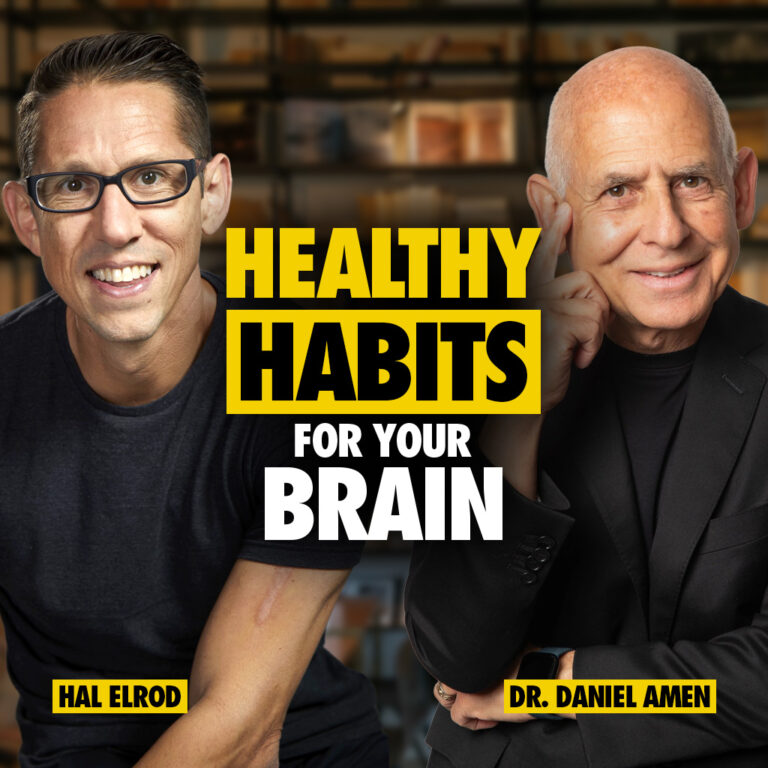


The most important organ that we need to take care of is our brain. Yet it’s also the organ most people ignore, even though it influences every thought we have, every decision we make, and every emotion we feel. From our finances to our relationships, our brains shape nearly every aspect of our lives.
That’s why I’m so excited to introduce you to Dr. Daniel Amen. Dr. Amen is one of the world’s leading experts on brain health, a double board-certified psychiatrist, founder of Amen Clinics, and the author of more than 40 books, including Change Your Brain, Change Your Life. In his clinics, they’ve scanned nearly 300,000 brains, giving him a unique understanding of what helps the brain thrive and what damages it over time.
In our conversation, Dr. Amen shares his BRIGHT MINDS framework, which addresses the major risk factors affecting brain health, what most people misunderstand about free will, and simple daily habits that will help you think better, feel better, and live a better life.
KEY TAKEAWAYS
- Why Brain Health Matters More Than You Think
- How Your Brain Impacts Free Will
- How Damaged Brains Can Heal
- The 3 Keys To Brain Health
- Daily Habits That Are Terrible For Your Brain
- Dr. Amen’s BRIGHT MINDS Framework
- Is ADD A Problem Or A Superpower?
- Natural Supplements & Treatments For ADD
- The Truth About What Alcohol Does To Your Brain
- The Damage That Smartphones Are Doing To Kids
- Morning Routines to Promote Healthy Brains
- Dr. Amen’s 7-Day Brain Challenge
- How You Can Learn More From Dr. Amen
AYG TWEETABLES
“When you have a better brain, you have a better life."
– Dr. Daniel Amen Tweet
“When your brain works right, you work right. And when your brain is troubled, you're much more likely to have trouble in your life.”
– Dr. Daniel Amen Tweet
“When you stop learning, your brain starts dying.”
– Dr. Daniel Amen Tweet
“Growing up, I just sort of thought free will was black or white. You had it or you didn't. And then with all the scans, it's like, oh no, free will's very gray. Some people have 80% or 90% free will, others it's more like 30% or 40%. If you give the 30% or 40% person a six-pack of Michelob, they can kill other people.”
– Dr. Daniel Amen Tweet
RESOURCES
- Amen Clinics
- Amen Clinics on LinkedIn | Facebook | Instagram | YouTube | X/Twitter
- DanielAmenMD.com
- Daniel Amen on LinkedIn | Facebook | Instagram | YouTube | X/Twitter
- Change Your Brain, Change Your Life: The Breakthrough Program for Conquering Anxiety, Depression, Obsessiveness, Anger, and Impulsiveness by Daniel G. Amen
- Change Your Brain, Change Your Pain: Breaking the Doom Loop to Heal Chronic Physical and Emotional Pain by Dr. Daniel G. Amen
- Brain Thrive
- BrainMD
- Sigmund Freud
- Tarek El Moussa
- Kenny Troutt
- Tana Amen
- The Miracle Morning App
THIS EPISODE IS BROUGHT TO YOU BY:
CURED Nutrition:
I want to talk about two of my favorite products. I’ve been taking these for four years, and they’re now a sponsor of the podcast, CURED Nutrition, Flow Gummies. I start every day with two of these. I meditate for 30 minutes without any supplements, and then I take Flow Gummies seven days a week, almost every day.
And then I go to bed with Night Oil. 30 minutes before bed I take Night Oil and it helps me fall asleep and stay asleep. So I start my day with Flow Gummies, I end my day with Night Oil.
If you want to implement my routine into your day with CURED Nutrition, go to CUREDnutrition.com/Hal and use the discount code HAL at checkout for 20% off your entire order.
Flow Gummies to start the day Night Oil to fall asleep. You’ll feel better, you’ll act better, you’ll perform better. Check it out.
RATE & REVIEW THE PODCAST
Reviews for the podcast on iTunes are greatly appreciated and will allow us to get the word out about the show and grow as a community. We read every single review and believe each one goes a long way in helping us make the show even better! If you received value from this episode, please take a moment and rate and review the podcast by clicking here.
Copyright © 2026 Miracle Morning, LP and International Literary Properties LLC
[INTRODUCTION]
Hal Elrod: Today, I’m talking with Dr. Daniel Amen, one of the world’s leading voices on brain health and author of the book Change Your Brain, Change Your Life. Dr. Amen has spent decades helping people understand that if you want to improve your thoughts, your emotions, your relationships, your behavior, your habits, your career, almost anything, you have to start with the organ that drives all of it, your brain. In today’s conversation, we’re talking about what hurts your brain and what helps your brain, free will, how it might not be what you think it is, chemo brain, ADD, and ADHD, and ultimately practices that will help you to think better, feel better, and live better.
[INTERVIEW]
Hal Elrod: Dr. Amen, it is so good to be with you.
Dr. Daniel Amen: Hal, thank you so much for helping me share this message.
Hal Elrod: I appreciate you. I’ve read your book twice now, and, as somebody who’s suffered brain damage and really struggled with a lot of brain issues, your work is so important to me. I want to ask you just off the bat, what do people not understand about how important learning about their brain, understanding how it works, caring for it, what do people not realize that they need to be doing?
Dr. Daniel Amen: Nobody cares about their brain. Why? You can’t see it. You can see the wrinkles in your skin or the fat around your belly. And in 1991, when I started looking at the brain here at Amen Clinics, I have 11 clinics around the country, we do a study called brain SPECT imaging. SPECT looks at blood flow and activity, looks at how your brain works. And so, I went to a lecture in 1991 on brain SPECT imaging, literally has changed everything in my life. And so, I’m 37 at the time I order my first scan, and I don’t care about my own brain. I’m a double board-certified psychiatrist. I was the top neuroscience student in medical school, and I didn’t care because I’d never seen it.
And the week before I scanned my mom, she was 60 at the time, stunningly beautiful brain. And it just fit her life. And then a week later, I scanned myself, and it wasn’t healthy because I played football in high school. I had meningitis twice as a young soldier, and I had bad habits. I was only getting four hours of sleep at night. I was overweight. I was eating bad food. And I just didn’t care, until I saw her brain, and then I saw my brain, and I was irritated. And I developed a term I call brain envy. I wanted a healthy brain like hers.
Hal Elrod: And she was your mother, so much older. You would think, like common sense would think, you’d have the better brain.
Dr. Daniel Amen: I was so mad. And what I’ve learned is women tend to have healthier brains than men, and it could be the estrogen, or it could be they don’t hit soccer balls with their forehead as much.
Hal Elrod: Yeah. I was going to say, as men, men do a lot of stupid things that hit their heads.
Dr. Daniel Amen: And that’s why men go to jail 14 times more than females. So, brain envy, and I thought to myself, Freud was wrong. So, penis envy, I’ve not seen it once in 45 years as a psychiatrist. The only organ where size really does matter is your brain. And everything I’ve done since 1991 is to get a better brain. Because when you have a better brain, you have a better life, because your brain is involved in everything you do, how you think, how you feel, how you act, how you get along with other people. It’s the organ of selling. It’s the organ of managing your money. It’s the organ of love, of discipline, and every decision you make. In my experience, after scanning now almost 300,000 brains over the last 35 years.
Hal Elrod: 300,000 brains?
Dr. Daniel Amen: Yeah. That when your brain works right, you work right. And when your brain is troubled, you’re much more likely to have trouble in your life.
Hal Elrod: You talk in the book about free will in a way that is you would think everyone has free will, they can do what they want. But you actually talk about, no, your brain health affects your free will because if your brain if it’s hindered, you can’t make the same decisions. Talk about that. Just talk about how free will is not as black and white as we would imagine it to be.
Dr. Daniel Amen: So, when I first started scanning people, a lot of attorneys heard about my work, and they’re like, “Do you think you could help me with this case?” And I ended up testifying in a couple of death penalty cases. And growing up, I just sort of thought free will was black or white. You had it or you didn’t. And then with all the scans, it’s like, oh no, free will’s very gray. Some people have 80% or 90% free will. Some people it’s more like 30% or 40% free will. And if you give the 80% to 90% free will person a six-pack of Michelob, they get drunk, but they don’t make really bad decisions. If you give the 30% or 40% person a six-pack of Michelob, they can kill other people. They can make really bad decisions.
And is it the sign of an evolved society to kill sick people? It’s not. And before then, I just had no opinion. I hadn’t really thought about it. But these murderers that I saw, very damaged brains. And I’m like, “I wonder if I can make them better,” because that’s what brings me the most joy is taking a bad brain and making it better. And so, much of the time you can.
Hal Elrod: You just told me before we started recording about, I believe, his name was, is it Tarek?
Dr. Daniel Amen: Tarek El Moussa. Yeah.
Hal Elrod: Tell me, you said he came to you, and you did a SPECT scan on him, brain had a lot of issues, and then within a year of hyperbaric oxygen, and I’m sure some other supplements and stuff. But talk about that. Just as an example of someone who can change their brain that’s very recently a success story.
Dr. Daniel Amen: So, he’s a star on HGTV. He has house flipping shows. Flip Off is one, or the Flipping El Moussas is another one, and he takes really awful properties and transforms them into these amazing, beautiful homes that he flips. And when I first saw his scan, it was terrible. I mean, it’s like really terrible. And he…
Hal Elrod: And when you say terrible, what is that? What are you seeing? What does that mean?
Dr. Daniel Amen: So, he had really low blood flow. So, for people who’ve seen my scans, it looks like one of those moth-eaten scans. And when he was born, he was in the neonatal ICU for five weeks, which means he had birth trauma. And then he had problems in school, and problems with his temper, and problems with substances. I mean, there are a lot of reasons his brain looked bad, but when I first saw it, I’m like, “Your brain sort of looks like the cockroach-infested, moldy hoarder houses that you flip.” And a year later, he did 89 hyperbaric oxygen sessions. Dramatic improvement. And he said his life was dramatically better.
And nobody thinks about that, that you’re suffering because you had a bad childhood, or you’re suffering because you lost your job, or you’re suffering because you lost your marriage. And very few people go, “You’re suffering because of the car accident or the chemotherapy, or you have post-COVID inflammation, or you have Lyme disease.” And when I started scanning, so I’m a psychiatrist by training, I’m like, “Oh, I have to learn all about your body, because if your body’s not right, your brain’s not going to be right.”
Hal Elrod: You mentioned, well, my own experience, like with chemotherapy, I can attest to this because after 700 hours of chemotherapy over the course of three years, I felt like my brain broke. And my life was actually great circumstantially, but I was depressed. I had extreme anxiety. I stopped sleeping well, chronic sleep deprivation, severe, and I became suicidal for the first time. And I had a great family, our income was great, like everything was fine, but my brain, I felt like it was being destroyed by evil forces. Like, that’s what it felt like. And I immediately stopped all of the drugs, the intense chemotherapy drugs, and that’s when the healing began.
So, I want to ask you, chemo brain in general, that term almost bothers me because the oncologist was so dismissive, “Oh, that’s just chemo brain.” “Doc, I want to kill myself.” “That’s just chemo brain.” For any cancer survivors like myself that are listening, what can they do if they’ve gone through chemotherapy and they want to heal their brain?
Dr. Daniel Amen: So, then get a look at it to see, is it chemo brain? And you have overall low activity because what kills cancer cells can also kill healthy cells. And so, you can look at it. And brain health for all of us is ultimately three things. Brain envy, got to care about it; avoid things that hurt it, know the lists; and do things that help it. And you just have to know the lists.
Hal Elrod: Yeah. It’s kind of like…
Dr. Daniel Amen: And so much of The Miracle Morning is on the list of what’s good for you.
Hal Elrod: All right. So, our audience is already ahead of the game.
Dr. Daniel Amen: So, your audience is already ahead of the game. But it all comes down to this one question. I’m working on this national brain health revolution and the decade of brain health, and it all centers around this one simple question. Is what I’m doing now, talking to you, good for my brain or bad for it, and does it make the world better? If you can answer that one question with whatever you’re doing with information and love, love of yourself, love of your family, love of the reason God put you on earth, your brain’s going to be better. And so, grabbing your phone first thing in the morning, bad for your brain because it’s a dopamine destroyer. Staying up night up late scrolling, it’s bad for your brain. Alcohol, it’s bad for your brain. Marijuana, it’s bad for your brain. Not exercising, bad for your brain. Ice cream, alcohol, no.
Hal Elrod: Wait, is ice cream bad for your brain?
Dr. Daniel Amen: And it’s all about… Love ice cream. Yes, bad for your brain. Sugar is pro-inflammatory. And I published three studies on 33,000 people that show, as your weight goes up, the actual physical size and function of your brain goes down. Should scare the fat off anyone. When I figured that out, lost 20 pounds. And I sort of always been a bit chubby. I say we have fat people in my family. My dad hates it when I say that. I’m like, “We have fat people in our family.” So, I have the genes that I just put on weight really quickly. So, I have to be very intentional because of the 11 major risk factors. If you’re overweight, you have all 11 because the fat on your body decreases blood flow, promotes aging, increases inflammation, turns on health-disease-promoting genes.
You’re more likely to have a head injury. It stores toxins. You’re more likely to be depressed. Your immune system’s not as healthy. Takes healthy testosterone, turns it unhealthy, cancer-promoting forms of estrogen, and it impairs your sleep. So, it’s like healthy weight is important. And in our sort of cancel culture, people go, “Oh, you can’t talk about it.”
Hal Elrod: Yeah. Body positivity.
Dr. Daniel Amen: Just like know the truth and the truth will set you free. You want to be at a healthy BMI. You don’t want to be skinny. Skinny’s not good. But you also don’t want to be overweight if you want a healthy brain. And ultimately, there’s another question, I like questions, is do you love food that loves you back? That you’re in a relationship with food. And we have a high school course called Brain Thrive by 25, where we teach young people to love and care for their brains, decreases drug, alcohol, and tobacco use, decreases depression, improve self-esteem. And in the course, I always go, “If you had a million-dollar racehorse, would you ever feed it junk food?”
And the smart kids go, “No.” And I’m like, “Well, why?” “Well, it wouldn’t win. Your investment, it wouldn’t pay off.” And I was at a fancy lunch recently, and I got to sit next to Lisa Troutt. So, Lisa and her husband, Kenny, own Justify. So, Justify is the last Triple Crown-winning racehorse. And so, I was, like, so excited. And they sold him for $75 million. And I’m like…
Hal Elrod: A horse?
Dr. Daniel Amen: A horse.
Hal Elrod: Wow.
Dr. Daniel Amen: I’m like, “Would you ever feed him junk food?” And she laughed. She goes, “No.” I said, “Would you ever get him drunk?” And she laughed, and she said, “No.” I said, “Would you ever get him stoned?” And then she rolled her eyes at me.
Hal Elrod: Yeah. Cause you want him to perform at the best, right?
Dr. Daniel Amen: And I’m like, “Why?” “He would never live up to his potential.” But isn’t that what you want for yourself? Isn’t that what you want for your kids? Isn’t that what you want for your partner? But yet we just feed them like crap. And with 70% of the food in America ultra-processed, it’s a real problem. And we just had the NBA finals, and if you watch them, it’s about online gambling, bad food, and alcohol. And I’m like, “Well, no wonder our society’s in trouble.”
Hal Elrod: Yeah. That’s a whole another podcast we could do, about our society and what it’s doing to our society. So, you shared a list there, a partial list of the bad list, right, of the things to avoid. Alcohol, bad for the brain; you’re waking up and scrolling, bad for the brain; phone before bed, bad for the brain; being overweight, all of these things. What’s on the good list? What are like your top five-ish?
Dr. Daniel Amen: So, I have an acronym called BRIGHT MINDS. If you want to keep your brain healthy or rescue it, you have to prevent or treat the 11 major risk factors. And I actually went through all 11. I surprised myself. But the good things, so blood flow, BRIGHT MINDS, B is for blood flow. It’s exercise, which is part of your program. Head-to-head against antidepressants. They’re equally effective. Walking like you’re late for 45 minutes four times a week, equally effective to Zoloft, which is one of the really good SSRIs.
Hal Elrod: So, wait, walking 45 minutes four times a week, like you’re late. So, it’s speed walking.
Dr. Daniel Amen: Yes.
Hal Elrod: Okay.
Dr. Daniel Amen: The R is retirement and aging. When you stop learning, your brain starts dying. Learn something new. So, new learning has to be part of your life. And so, for you, it would be reading. The I is inflammation, and you have more inflammation in your body. Think of inflammation as a major cause of cancer, of depression, of dementia. And well, what gives you inflammation? Processed foods.
Hal Elrod: Processed foods
Dr. Daniel Amen: Gum disease, low omega-3 fatty acids. So, simple things, take an omega-3 fatty acid or put more of it in your diet. Floss. Flossing is a brain exercise. And get rid of the sugar and foods that quickly turn to sugar. There was a study from the Mayo Clinic where they look at people at a fat-based diet. So, avocados, nuts and seeds, green leafy vegetables, fish, 42% less risk of Alzheimer’s disease. And then they looked at people who had the standard American diet: bread, pasta, potatoes, rice, fruit juice, sugar, 400% increased risk of Alzheimer’s
disease. It’s the sugar, and it’s the foods that quickly turn to sugar.
Hal Elrod: The pasta, the bread, all the high-carb sugars, bread, foods, yeah.
Dr. Daniel Amen: So, G is genetics, and people go, “Oh, well, I’m overweight because it’s in my genes.” And, well, it’s in mine, but I’m not. Why? Because I’m on an obesity-heart disease prevention program every day of my life. So, you need to know your genetic risks and just look at your family and go, “So, if you’re a child of an alcoholic, you should be on an alcohol prevention program every day of your life.” We adopted our two nieces because both their parents were drug addicts.
Hal Elrod: Oh, wow.
Dr. Daniel Amen: And I hammered them. It’s like, “You need to be on an addiction prevention program every day of your life. If you never use, you’re never going to have a problem. If you use, it might cost you your life.”
Hal Elrod: For me, it’s anti-cancer lifestyle. Like, after I got cancer, I’m like, “Oh, I should have been living an anti-cancer lifestyle. What are all the things that I have been putting in my body that could cause cancer?” And it was all just the artificial…
Dr. Daniel Amen: So, what killed your sister?
Hal Elrod: She was born with a very rare heart defect. It was called, Ehlers… No. Ehlers-Danlos? No, that’s a different one. I actually can’t remember, but she was born with a rare, a form of dwarfism that also caused a heart defect and she died of heart failure at 18 months old.
Dr. Daniel Amen: Wow. So sorry.
Hal Elrod: Yeah.
Dr. Daniel Amen: But know what your people have. The H is head trauma, a major cause of psychiatric problems. So, when I’m listening to your story, that depression after cancer, well, issues stack, right? Losing your sister when you’re eight, chronic stress, chronic stress in the family, so clearly traumatic. And then the brutal car accident, and then the chemotherapy. So, it’s not the chemotherapy by itself. There’s a term I like called brain reserve. It’s the extra tissue you have to deal with whatever stress came your way. So, we would agree, cancer and the 700 hours of chemotherapy, that’s really stressful, but it’s the brain you bring into cancer and the chemotherapy that often determines how you do. And your brain reserve had gotten stolen or hurt.
Now, with your parents really turning pain into purpose, that probably boosted your brain reserve. And so, every day, our brain reserve is growing, or it’s shrinking. T is toxins. And I talked about alcohol and marijuana, not a fan. But it’s also environmental toxins, so it can be mold exposure, it can be heavy metals like I did that, I don’t have much hair, but I did a hair sample. My mercury was way too high. And so, detoxing was really important to continue to have a healthy brain. M is mental health, and there I really think about negativity bias. Negativity, low hope, low happiness, bad for your brain. All of them go with low frontal lobe function.
And so, one of the things I hear from you is you’re really teaching people to have hope and part of that is have a healthy brain. But then it’s developing agency. Tomorrow can be better, and I have a role. And there are multiple paths to get what I want. And so, I teach a lot of my patients positivity bias training. “Today is going to be a great day. What went well today?” When I go to bed tonight, I always do this. “What went well today?” I’ll think about you.
Hal Elrod: I’ll think about you, Daniel.
Dr. Daniel Amen: Because this was fun and this was important, but it’s a daily practice. And even the day my dad died about six years ago, because I’d been doing this practice, I went to bed, and I went, “What went well today?” And it was the worst day of my adult life, but I found three things that were truly gifts that day. The second I is immunity and infections. COVID just did such a number on our society in part because it causes an inflammatory bomb to go off in the brains of vulnerable people. I want everybody to know their vitamin D level because vitamin D strengthens your immunity. The N is neurohormones, so your hormones. You know why our hormones drop with age?
Hal Elrod: No.
Dr. Daniel Amen: It’s the planet’s way of getting rid of you. And I’m like not okay with this. I’m like, “No.” So, I think everyone should have their hormones tested and optimized. And for the women who are listening, progesterone drops 10 years before they go into menopause, and progesterone is sort of like the brain’s natural Valium. It sort of calms things down. So, when they’re 40, they’re like anxious, they can’t sleep, they end up on an SSRI or a benzo or a sleeping pill. I’m like, “No, your doctor should test your hormones and maybe 100 milligrams of progesterone could save your life.”
Hal Elrod: In supplement form?
Dr. Daniel Amen: Or in medicine form. It can be both.
Hal Elrod: You can get both.
Dr. Daniel Amen: The D is diabesity, if you’re overweight, as we talked about, or you have high blood sugar, bad for your brain, which is why I like lower simple carbohydrate diets. And then S is sleep. It’s so important. When you sleep, your brain cleans and washes itself. But all of it comes back to this one question, is what I’m doing now good for my brain or bad for it? And now you have the list.
Hal Elrod: Yeah. I love that. Well, now, that’s been for many, many years my simple diet guideline, which is does this add value to my health and longevity, right? In other words, what are the consequences of what I’m going to put in my body? Does it contribute to my health and longevity, or is it detrimental? And that was really how I went from eating a junk food, fast food lifestyle to going, I’m only going to put things in my body 9 out of 10 times at least, not perfect, but 9 out of 10 times, that add value to my body. And you’re just taking that and applying it to the brain.
Dr. Daniel Amen: Well, and I would just shift the question just a little bit.
Hal Elrod: Please.
Dr. Daniel Amen: Do I love food that loves me back?
Hal Elrod: There you go. Okay.
Dr. Daniel Amen: Because I don’t know if you’ve ever been in a bad relationship. I have. And I’m not doing it anymore. You met my wife, and she’s my best friend. So, I got that part right. I’m for sure not going to be in a bad relationship with food.
Hal Elrod: Yeah, that makes sense. One of the things I want to talk to you about, so ADD and ADHD. ADHD seems to be the more popular clinical term nowadays, but I’ve heard you leaned toward ADD, and also you talk about there’s seven types of it. As someone who– so there’s actually two parts to this question, which is the difference between ADD and ADHD, and then, I want to ask you, is it a problem or is it a superpower?
Dr. Daniel Amen: So, in 1980, when I trained, the DSM, the Diagnostic and Statistical Manual of Mental Disorders, it was ADD with or without hyperactivity. In 1987, when they revised it, they changed the term to ADHD. And I hated that because they actually threw out half the people who had it, because half the people who have it are never hyperactive.
Hal Elrod: Interesting.
Dr. Daniel Amen: So, to put it in the title, I thought was a huge mistake. The scientific term today, it’s not really scientific, I mean, they vote on these things that’s not science, is ADHD. But in 1994, they went, “Oh, we made a mistake.” And so, they changed the name again to AD/HD, highlighting that half the people are never hyperactive.
Hal Elrod: Got it.
Dr. Daniel Amen: And when I started doing imaging, I’m like, “It’s not one thing. It’s seven different things.” And initially, I thought it was six different things, and then I’ve added a seventh type.
Hal Elrod: Discovered a seventh?
Dr. Daniel Amen: I may add an eighth type, head trauma-induced ADD, because having a head injury like you did can clearly cause it. Now, if you clearly had symptoms beforehand, short attention span, distractibility, disorganization, procrastination, impulse control, then the accident just could sort of accelerate it or make it worse.
Is it a superpower? Yeah, for some people. I mean, a lot of people who run organizations, especially small businesses, have ADD because they can’t work for other people, right? It’s hard for them to show up. It’s hard for them to follow through. If they love it, they can do it. But working for someone else, you generally don’t love it. And they can be hyper-successful if they surround themselves with people who follow through.
But if they don’t, generally they get in trouble with the IRS because they’re not following through on the things they need to do. Many strengths of people who have ADD, they’re often very creative. They often have low frontal lobe, so they say the first thing that comes to their mind. A lot of my patients go, “I’m brutally honest.” And in my head, I’m going, “It’s usually not helpful.”
And often, when I lecture, I’ll go, “How many of you are married?” And half the group will raise their hand. I said, “Is it helpful for you to say everything you think in your marriage?” And they’re like, “No. It’s not helpful.” We need to inhibit our impulses.
Hal Elrod: We need discernments, right?
Dr. Daniel Amen: Discernment, and a little bit of a brake in our brain. With treatment, people get much closer to their potential. And treatment’s not always medicine. But a lot of people feel ashamed if they have to take medicine, and you wear glasses, and why? Because it’s easier to see, right? The world’s easier to navigate. And the same thing’s true with effectively treating ADD. The world’s just easier.
Hal Elrod: Easier, yeah. What are some treatments for ADD? What are some natural treatments? And then, obviously, everybody knows Adderall and Ritalin and all that, but what are some natural and/or some supplements? I know you have a huge supplement line. I’ve taken your supplements for many years.
Dr. Daniel Amen: Well, thank you. So, saffron has five studies with ADD showing it’s equally effective as Ritalin or methylphenidate. I think, all of us should be taking omega-3 fatty acids, particularly if you have ADD. And there’s two main types of omega-3s, DHA and EPA. EPA is actually more effective for ADD than DHA. So, I would take an EPA-rich product. Our Omega-3 Power has 60% EPA in it. Magnesium can be really helpful. If you’re low in iron, and you should test your ferritin level, which is a measure of iron storage, that can be really helpful. A little bit of zinc. So, our Happy Saffron has zinc. Curcumins and saffron in clinically effective doses, I like. So, saffron, omega-3 fatty acids, magnesium, ferritin if you’re low.
Hal Elrod: Got it. Two on the bad list that I want to hyper-focus on a little bit here, one is alcohol, because I think most folks, I would imagine, don’t think about the effect on their brain, right, if they think about the effect at all. Meaning it’s like, “Yeah, whatever. I only have one glass of wine every day.” And that’s actually specifically I’m curious about, because that’s a very popular, like it’s been promoted as, “You should have one glass of wine. It’s good for you.” So, I’m curious if that’s true. But most people, I think, think of, if anything, the liver and those are the things they’re thinking of, not on the brain. So, I’d love to talk about alcohol and its effect on the brain, and whether it’s okay to have one glass of wine or one beer a day.
Dr. Daniel Amen: Well, it just depends on how much you love yourself. Alcohol is a disinfectant. The American Cancer Society came out against any alcohol. Why? Any alcohol increases your risk of eight different cancers. Anything that increases your risk of cancer, I’m not a fan of. And like I said, it’s a disinfectant, and people don’t think about, well, why would it be a problem to drink a disinfectant? My wife is a nurse, and when she gives you shots, she’ll put alcohol on your skin because it kills the bugs. Well, how many bugs do you have in your gut?
Hal Elrod: That are good for you.
Dr. Daniel Amen: 100 trillion bugs, and it’s called the microbiome. And they make neurotransmitters, they digest your food, they detoxify your body. It contains 60% of your immune system. Drinking consistently damages the microbiome. And you make people make bad decisions when they drink. They make bad decisions with food. They make bad decisions with their mouth. They just, you know.
Hal Elrod: Sleep, you name it.
Dr. Daniel Amen: If you want to see a drama on television, in television, there’s so much alcohol. They’ll drink, they’ll say something dumb or do something dumb. And the drama keeps the series going. Alcohol, as a psychiatrist, I’ve just seen it devastate people’s lives.
Hal Elrod: And what’s it do to the brain specifically?
Dr. Daniel Amen: It drops blood flow to the brain. It prematurely ages your brain.
Hal Elrod: And your skin, right? I mean, it prematurely ages you.
Dr. Daniel Amen: And your skin.
Hal Elrod: Yeah. That’s one thing that when I got cancer and the doctor said, “We don’t know what causes your cancer. It’s very rare,” and it’s almost like I think a lot of people go, “Oh, well, it’s not my fault. They don’t even know. It’s a mystery.” For me, it was, “What’s everything that I’ve put in my body that is either toxic or not natural?” And alcohol was one of those things. I was having one beer a day after work. That was part of my ritual.
And then post-cancer, I went to no alcohol for a long time. Now, I’ll maybe do a beer a week at the most or half a beer a week. It’s very minimal, just there’s a little something. All right. I always have a half a beer, and then I’m like, “I didn’t even do, whatever. What am I doing?” But there’s this little, like, rebel part of me that’s like, “I still need to have a little something that’s bad for me,” right?
Dr. Daniel Amen: Why? It’s an interesting question.
Hal Elrod: Yeah, it is.
Dr. Daniel Amen: And it’s probably more than anything a habit. And what you’re trying to do is help people create helpful habits, right? If you think of The Miracle Morning and SAVERS, and I love that, but you get triggered, and it’s like, “Oh, I should have a beer.” Or I get triggered and like, if I go to Italy, “Oh, I should have a gelato.” And I’m like, am I living by my triggers or am I living by my goals? And these are my goals, right? So, it’s not what I should do, right? You tell people what they should do. They’re like, “No, I’m not going to do that.” And I always like, whenever you think you should do something, just change it. Do you want to do it? Or does it fit your goals to do it? Like, I might not want to work out, but it clearly fits my goals.
Hal Elrod: Being healthy and strong and all of that. So, are you a zero alcohol ever, or are you…
Dr. Daniel Amen: Yes.
Hal Elrod: Zero, okay.
Dr. Daniel Amen: I mean, why am I going to drink poison?
Hal Elrod: Yeah. That’s a great point. Yeah, I think for me, it ends up being like, well, a tiny bit of poison a couple times a month isn’t– but the– what was I going to say?
Dr. Daniel Amen: Will you miss it?
Hal Elrod: No, I really wouldn’t. And I go through– again, it went from once a day to a couple times a month, so I probably have a couple, two beers a month I would say. So, the next question I want to ask you, the next on the naughty list, if you will, right? Smartphones. I really want to understand what our smartphone is doing to our brain, first thing in the morning by starting, what is that doing with the dopamine, and what’s it doing right before bed? And then just in general as a whole because I think that is the biggest, it’s the most normalized problem in our society. And I think also, for me, having teenage kids that thinking about what’s it doing as their brain is still developing, right?
Dr. Daniel Amen: Yeah. Push it off as long as you can until it hurts. Kids who get smartphones early have a higher incidence of suicide. I mean, it’s like so scary.
Hal Elrod: Can you explain why that is?
Dr. Daniel Amen: Because it’s basically damaging the pleasure centers in the brain. So, there’s an area of your brain that feels joy. It feels pleasure. And the neurotransmitter dopamine works on the nucleus accumbens, part of the basal ganglia, and you notice the micro moments of happiness. Constantly pushing on that area begins to wear it out. And pretty soon, you feel flat. You don’t feel joy because the nucleus accumbens has been thrilled to death.
Hal Elrod: So, it’s just that constant, like, it’s just stimulating it.
Dr. Daniel Amen: And then if you add that to social media, to video games, to pornography, to the negative news, it’s like, no wonder this generation’s in big trouble, right? The incidents. There’s one study that came out of the CDC that said 57% of teenage girls reported being persistently sad, 32% had thought of killing themselves, 24% had planned to kill themselves, and 13% had tried to kill themselves. These are statistics we have never seen in the world, that our society is literally stealing the brain health of our children. And Britain just banned social media for kids under 16. It’s so brilliant. Australia had done it. Canada. There’s legislation. I’m a huge fan of, no, we need to protect them.
Hal Elrod: Am I making this up? Or I feel that I’ve read somewhere that looking at your cellphone, it activates the same region of the brain as cocaine does?
Dr. Daniel Amen: Yeah, these pleasure centers.
Hal Elrod: It is, okay. Yeah. So, over-stimulating.
Dr. Daniel Amen: Now, it does it in little bites, but a thousand times a day. And there’s some countries where kids are on social media 13 hours a day. And always that little dopamine, dopamine, dopamine. And I always say, “You want to drip it, don’t dump it.”
Hal Elrod: And what about for adults in terms of the– so the teenage brain is different because it’s not fully developed until it’s 25. What about for us, for 30, 40?
Dr. Daniel Amen: Your brain is always being shaped and modeled. Even at 72, my brain is, every day, it’s better or it’s worse depending on the habits I engage in. And so, I think being cautious and giving yourself a break is very helpful.
Hal Elrod: All right, let’s make this actionable for anybody listening. Actually, there’s two questions. I was going to give one more, but I have another one. If you were designing a brain-healthy morning routine, right, because I’m the Miracle Morning guy, a lot of my audience listens, or Miracle Morning practitioners, what would a brain-healthy morning routine look like?
Dr. Daniel Amen: So, I love what the Miracle Morning is because I think of it as a brain health routine. And with that, I would add sunshine to it, because vitamin D is, if you can do it for 10 minutes. Like, Tan and I, we usually go for a half-an-hour walk every morning.
Hal Elrod: Love it.
Dr. Daniel Amen: Get the dogs and just go. And I think that’s so helpful. I think you should drink 16 ounces of water just to start hydrating. If you do intermittent fasting, it’s absolutely fine not to eat until 11 o’clock or if you have protein, but I would start the day with protein, not sugar, not Pop-Tarts, doughnuts, waffles, sugar cereals.
Hal Elrod: Yeah. So, protein. And what’s your favorite source of protein for breakfast? Would it be eggs? Would it be steak and eggs? Would it be…
Dr. Daniel Amen: For me, it’s eggs.
Hal Elrod: Eggs, okay.
Dr. Daniel Amen: I pretty much have three eggs every morning.
Hal Elrod: We have 50 chickens on our ranch, so we get fresh eggs every day.
Dr. Daniel Amen: I love that.
Hal Elrod: Yeah, it’s great. All right, so that’s your morning routine. And then the…
Dr. Daniel Amen: And every day, today is going to be a great day.
Hal Elrod: Mindset.
Dr. Daniel Amen: I push what I’m looking forward to. Today is going to be a great day. And then I start looking for the micro miracles. And it’s like eye contact with my wife or just holding hands while we’re walking. We live near the beach, so go to see the waves. I mean, I’m just training my brain to look for what I like.
Hal Elrod: I love that. Seven-day brain challenge. So, for anybody that’s watched this or listened to this, and they go, “Okay, the brain is pretty important. I should probably stop ignoring it.” And actually, it may be the most important thing for me. I mean, you’d argue it’s way more important than actually working on your muscles. That’s important, but working on your brain, that arguably takes number one on the list. What would be kind of a seven-day, like, brain challenge reset? What are just some of the most important things that people can stop doing and start doing, or do less of and do more of over the course of the next week to really start to see some positive movement in their cognitive function, their memory, their emotional wellbeing, that kind of thing?
Dr. Daniel Amen: So, if you did a seven-day brain challenge, it’s that one question, three times a day. Is what I’m doing now good for my brain or bad for it? And does it make the world better? And if you can just say yes to that, and in the process, walk like you’re late for 45 minutes, hydrate.
Hal Elrod: Get some sunshine.
Dr. Daniel Amen: And then, whenever you feel sad, mad, nervous, or out of control, write down what you’re thinking and just ask yourself whether or not it’s true, right? It’s learning to manage your mind so your mind doesn’t manage you. And probably day one, we would do the one-page miracle that I do with all of my patients. Write down what you want. But in a very structured way, what do you want in your relationships, your work, your money, your physical, emotional, spiritual health? Write it down, day one. And then every day, just look at it and go, “Does it fit? Does my behavior fit the goals I have for my life?” So, it’s not anybody telling you what you should want.
Hal Elrod: I love that. Yeah.
Dr. Daniel Amen: It’s, what do you want? And is your brain working for you? Or is it sort of going rogue?
Hal Elrod: Yeah. Well, the book, Change Your Brain, Change Your Life, you’re best known for. You’ve got 40 books, is that right?
Dr. Daniel Amen: Yeah, craziness.
Hal Elrod: Yeah. What’s your most recent book?
Dr. Daniel Amen: Change Your Brain, Change Your Pain.
Hal Elrod: Okay. I saw that on a shelf the other day.
Dr. Daniel Amen: Where I wrote about the doom loop, which is how people get into pain, but then accelerate it, because they’re not managing their brain.
Hal Elrod: So, that’s physical pain. Some of it’s physical pain, that’s what it’s for?
Dr. Daniel Amen: It’s both. Okay, emotional and physical.
Dr. Daniel Amen: And did you know that if you take Tylenol, and I’m not a huge fan of Tylenol, but it actually helps to soothe heartbreak. It actually starts to soothe the pain of a breakup. So, it’s, we think of it as a physical medicine that actually has positive psychological effects.
Hal Elrod: Well, you think about emotions, just in general, right? If you’re angry, your palms are sweaty, your heart is racing, right? So, there is an inextric– or what’s the word we want? The link between physical, mental, and emotional, right? We’re all one being that everything affects everything else.
Dr. Daniel Amen: Well, and they run through the same pathways in the brain, because one of the reasons I wrote the book is why does Cymbalta, a really good antidepressant, why is it FDA approved for depression and pain? Because it works on the same pathway. SAMe, the supplement, SAMe, it’s helpful for depression, but it’s also helpful for arthritis. It’s like, well, why is that? Because it’s working on the same circuits in the brain.
Hal Elrod: I love that. What’s the best place for people to find you and get a SPECT scan, find your supplements, your books, your work, follow you?
Dr. Daniel Amen: Well, so our supplements, BrainMD.com. Our clinic’s Amen, like the last word in a prayer, clinics.com. They can follow me on Instagram or TikTok of all places.
Hal Elrod: You look like a TikToker. Well, Dr. Amen, it is truly, it’s a pleasure and an honor, somebody who’s followed your work for many years. Thank you for sitting down with me today.
Dr. Daniel Amen: Thank you, Hal. So grateful for you.
Hal Elrod: Yeah, you too.
[END]