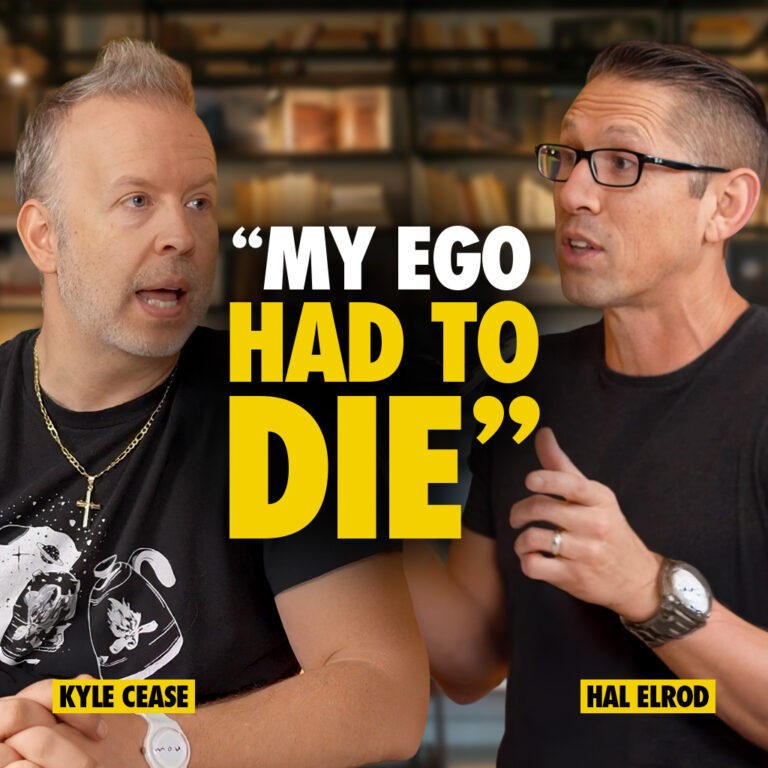


What if the strategies you’ve used to avoid pain are the same ones keeping you disconnected from your soul? So much of our desire to strive and optimize is simply the ego’s way of protecting us from discomfort. We call it growth, but in reality, it’s avoidance.
My guest today is my good friend Kyle Cease. Kyle was named one of Comedy Central’s Top 10 Comics to Watch in 2009, and he’s the author of my favorite book I read in 2025, The Illusion of Money. He was on the path to Hollywood stardom until something deeper called him to do what he was destined to do: become a spiritual teacher. Not to achieve more fame or money, but to develop a deeper connection to God, truth, and spiritual growth.
In this episode, we go deeper than I’ve ever gone on this podcast. We talk about how the internet is bombarding us with first-level insights, why “positive thinking” fails to overcome our personal struggles, and how our addiction to impact, productivity, and even self-help can keep us from real healing.
Kyle also shares how he’s learning to let his ego die, how suffering is necessary in order to truly heal, and why connecting with your soul on a deeper level will unlock your biggest breakthroughs to achieve your goals.
KEY TAKEAWAYS
- Inheriting Fear and Shame From Our Parents
- Your Soul Wants the Full Human Experience
- The Subtle Ways We Avoid Suffering
- Insight vs. Integration in Self-Development
- Why Breakthroughs Require Earned Revelation
- Ego vs. Soul: Redefining Productivity
- Perspectives on Unconditional Love and Free Will
- Honoring God to Kill Your Ego
- What It Means to Merge With Your Soul
- Freedom From Needing to Leave a Legacy
- How to Connect & Get Access to Kyle’s Courses
AYG TWEETABLES
“There is nothing more amazing than to soulfully earn true change, true healing, true revelation, true knowing with God.”
– Kyle Cease Tweet
“There's a difference between a first-level insight and then going through it.”
– Kyle Cease Tweet
“The ego disqualifies soulful things, and the soul doesn't talk in instant results.”
– Kyle Cease Tweet
“I don't want to tell God what I want anymore. I want to ask God what God wants from me.”
– Kyle Cease Tweet
“ If you get results instantly, you have made God your butler. And I don't want a God that works for my ego.”
– Kyle Cease Tweet
RESOURCES
- KyleCease.com
- Kyle Cease on Facebook | Instagram | YouTube | X/Twitter
- The Illusion of Money: Why Chasing Money Is Stopping You from Receiving It by Kyle Cease
- Infinite Expansion
- Kyle Cease’s Courses
- Comedy Central
- 10 Things I Hate About You
- Remember the Titans
- Denzel Washington
- Goonies
- Explorers
- Sea-Doo
- David Deida
- The Passion of the Christ
- Neville Goddard
- Neale Donald Walsch
- John Eldredge
- Michael Jackson
- Brian Wilson
- The Celestine Prophecy: An Adventure by James Redfield
- Glenn Morshower
- ChatGPT
- Tony Robbins
- Michael Jordan
- Applebee’s
- Prince
- Mister Rogers
- Kim Kardashian
- The Well
- The Miracle Morning App
THIS EPISODE IS BROUGHT TO YOU BY:
CURED Nutrition:
I want to talk about two of my favorite products. I’ve been taking these for four years, and they’re now a sponsor of the podcast, CURED Nutrition, Flow Gummies. I start every day with two of these. I meditate for 30 minutes without any supplements, and then I take Flow Gummies seven days a week, almost every day.
And then I go to bed with Night Oil. 30 minutes before bed I take Night Oil and it helps me fall asleep and stay asleep. So I start my day with Flow Gummies, I end my day with Night Oil.
If you want to implement my routine into your day with CURED Nutrition, go to CUREDnutrition.com/Hal and use the discount code HAL at checkout for 20% off your entire order.
Flow Gummies to start the day Night Oil to fall asleep. You’ll feel better, you’ll act better, you’ll perform better. Check it out.
RATE & REVIEW THE PODCAST
Reviews for the podcast on iTunes are greatly appreciated and will allow us to get the word out about the show and grow as a community. We read every single review and believe each one goes a long way in helping us make the show even better! If you received value from this episode, please take a moment and rate and review the podcast by clicking here.
Copyright © 2026 Miracle Morning, LP and International Literary Properties LLC
[INTRODUCTION]
Hal Elrod: If you want to learn how to get connected to who you truly are, merge with your soul, connect with God, the God that is within you, I highly encourage you to listen to or watch today’s episode with my good friend, Kyle Cease. His book, The Illusion of Money, you may have heard me a couple of weeks ago say this was my number one favorite read of this past year, and Kyle has become one of my closest friends. And I’ll say that God brought us together to really help each other on our spiritual evolution.
Today, we’re talking about Kyle’s experience throughout his life, where he went from being a world famous standup comedian, literally rated the number one comedian on Comedy Central in 2009, was in the movie 10 Things I Hate About You. He was going down the path of being a Hollywood star and realized that spirituality was calling him and that being a spiritual teacher was what he was destined to do. I don’t want to give away too much because today we really do go deep. This will be different than any conversation I have ever had on the podcast that you’ve ever watched or listened to. And it is my great, great pleasure to introduce you to my good friend, one of my favorite human beings on the planet, Mr. Kyle Cease.
[INTERVIEW]
Hal Elrod: It’s good to be with you, brother.
Kyle Cease: You too, man. You’re one of my favorite people on the planet.
Hal Elrod: Isn’t that wild? Like, you and I literally only met in person a few months ago, and I’ve never had a faster, deeper friendship than the two of us.
Kyle Cease: Same. I know. We were like, to our wives, we’re giddy, excited children about each other.
Hal Elrod: Yeah, totally.
Kyle Cease: But it’s really wonderful. It’s really wonderful to feel connected to someone who lives in the work, who I think you sure make me feel better about me. Like, you really bring so much love to me. And I think that comes from such a foundation because you’ve been through so much. And I respect you so much. My audience respects you, too. I’ve had you on stuff. I do and my audience loves you. Love to have you more.
Hal Elrod: Yeah, it’s a trip that you and I have become friends. It’s like we’re friends and we’re colleagues, right? Because we’re both in similar work. But our friendship really evolved, and then it’s interesting that our friendship even informs the work, because like how you and I are relating to each other affects how I show up in the world, and yeah, it’s a lot of depth and a lot of nuance to it. So, you mentioned, we were driving over here that you had a pretty profound morning. And by the way, it is funny or not funny that you never get a message from Kyle. It’s like, “Hey, did you see the sports score last night?” It’s always like, “Hey.”
Kyle Cease: And if I tried to, it would’ve been, “Have you seen the sports score?”
Hal Elrod: Which shows that I am also not a person.
Kyle Cease: “Did you see the sports score?” would be if I tried to be one of the guys and ad lib that, that’d be how I say it.
Hal Elrod: Yeah. With the ball that got moved around the…
Kyle Cease: Yeah, the group of team, got all the baskets.
Hal Elrod: But, yeah, every text from you is typically like, “Hey man, I had some major breakthroughs this morning during my three-hour or two-hour meditation, and healed some major trauma and connected with God,” and, “How are you doing, buddy? How are you feeling?” Like, that’s a standard text message.
Kyle Cease: Now that you say that, I didn’t know how weird that sounds until like it’s being reflected to me. That’s what life is for you? So, I’ll take it down a notch.
Hal Elrod: No, no. And it’s funny, if anybody listened to our conversations, they would be like, “Who are…”
Kyle Cease: They’re different places.
Hal Elrod: Yeah. Who are these two people? These two entities?
Kyle Cease: Totally.
Hal Elrod: And what planet are they from?
Kyle Cease: You know, it’s almost like we’re like I don’t know if I have the exact movie, but like almost some 80s movie of like a bunch of kids on a scavenger hunt like Goonies or Explorers or something where we’re like we’re figuring out what we are, we’re figuring out God, we’re figuring out our soul’s purpose at the same time. And it’s kind of a fun scavenger hunt for us of like, what am I? What do I need to heal? What can you bring more of to me and show me more of in myself? I mean, it’s really nice to have a friendship that isn’t just talking about sports or something, which I have nothing but respect.
Hal Elrod: Nothing wrong with that.
Kyle Cease: Yeah, I really do, actually. In fact, I, on a side note, was watching Remember the Titans with my daughter. And I had an insight there that I’d love to share, which was I was watching Denzel Washington play a football coach to these kids. And really, in a way, feeling through an awareness of I never got to have masculine discipline. And that it wasn’t me being a victim about it, but it was me longing for it and becoming more aware of what I didn’t get to have.
Hal Elrod: And you’re referring specifically to your father? Correct?
Kyle Cease: My father was someone who, he passed away this last year, and he was someone who was an entrepreneur and kind of lived in his head. And I don’t feel really like he guided me. I felt like a boy going, “Do you see me? Do you see me? Do you see me?” And I feel emotion saying that. And then you don’t know what you didn’t have until later. In fact, everyone I work with, I do tons of one-on-ones with people, and almost everyone thinks their childhood was normal. You, because it was your childhood.
Hal Elrod: It’s your norm. Yeah. Yeah.
Kyle Cease: So, it’s the world to you. And then you hear other people’s childhood and go, “That sounds crazy. I’m glad mine wasn’t like that.” And the longer you keep looking at it, you go, “Actually, it wasn’t good, too.” And I don’t mean it as a victim. I mean it as clarity on what I prefer, or clarity on what I need to heal, or clarity on something else. But when I saw Denzel Washington being a space for masculine energy and challenging them to be in their heart, to be okay with suffer, to all these things, I realized I never had that. My dad was home sometimes, but not home.
Hal Elrod: Not present to you, right?
Kyle Cease: Not present. And my mom, I feel like was my dad. And I feel like my mom also had a part in her that felt, understandably, because of what my dad was in her life, she felt judgmental of men. We’d see like the news would be on, and they’d be like, “Coming up,” and you’d see baseball players fighting, and my mom goes, “Men are so dumb.” And I’d be like, “Yeah,” and forget that I am one and feel shame about being a man without even knowing it and take on my mom’s shame about that. And I just had this revelation where I’m watching Remember the Titans, where Denzel Washington is being hard on them, “You will do this,” and I was just like wishing I had had that.
My idea when I was a kid, I had times where I asked my mom like, “What if I play football?” My mom was like, “You’ll be paralyzed.” And she thought in catastrophic thinking, and anything would be dangerous. I mean, I remember almost anything I could talk about, she would have how it could go wrong. Like, you’ll get testicular cancer if you have a cell phone. If you go to Hawaii, there’ll be a tsunami. In ninth grade, the class I was in wanted to take a trip to Washington, DC. And this was during like the Gulf War, and my mom was worried that a terrorist would take the plane down. So, I was the only kid that couldn’t go.
Hal Elrod: Wow. So, she was almost to the point of a phobia for her of like a real fear.
Kyle Cease: Yeah. Dude, here’s like a sad but kind of hilarious example. When I was a kid, we had a Sea-Doo. We had a cabin on a lake with a Sea-Doo, and I had to wear a bike helmet on it.
Hal Elrod: Get out. Wow.
Kyle Cease: So, I’m riding around on a Sea-Doo at like 50 miles an hour, and I’m realizing now if I fell off, that thing would like catch in the water and probably hang me.
Hal Elrod: Yeah. And you’re also realizing you’re the only human being on the lake with a helmet on your jet ski.
Kyle Cease: With a bike helmet going 50 miles an hour on a Sea-Doo and just protecting myself from women liking me. And so, I’m really discovering so many things about me and what I want. And life for me right now, at 48 years old, is a lot of revelations, a lot of humility and I think in 2026 we’re all going through that. I think just everyone is having a, “I didn’t know the world was what I thought it was.” I am feeling through a lot of this. I don’t know. And there’s a lot of surrendering to God, a lot of identity crisis, a lot of what’s the truth, am I? What’s the truth in the world? And I think it’s a really good start in a way for major true spiritual growth because our worlds, how we knew it, are being completely destroyed. And that’s good because, in a way, the world that’s being destroyed wasn’t necessarily built on truth anyway.
Hal Elrod: Yeah.
Kyle Cease: Right? So…
Hal Elrod: It was built on control. It was built on illusion, right?
Kyle Cease: Yeah.
Hal Elrod: What else would you say it was built on?
Kyle Cease: It’s built on everything outside of me is authority. Like, the government is authority, pharma is authority, the dollar is authority. Like, money is more important to me than my soul. And people’s approval, what people think about me, all these things are external. And they’re not true. And so, we’ve created this world that’s not really based on truth. And I believe the way I’ve seen it is I feel like people a lot of times go, “I wish it was so much simpler back in the past.” It was so much happier 20 years ago, and it’s like the reason you were happy was you saw through a smaller lens.
Hal Elrod: You were living in the matrix without being aware that it was an illusion.
Kyle Cease: Yeah. You didn’t know that there’s insane child trafficking, and you didn’t know that there’s all these other things. And you can see that you built the best of what your ego could build, and your lens was very small, and you didn’t know truths. And then we go through a phase in self-help and spirituality where they say, “Think positive. Don’t let those negative thoughts, you know, think positive,” which is great. But I feel like 2020 was like the lens is even bigger, and it goes, “Hey, there’s still negative in here.” There’s a whole underground of negative that we aren’t looking at. And so, our thinking positive is also true, but it’s also designed to ignore a negative that’s here.
And in a lot of our hearts was a positive thinker that’s built on because I was abused as a child, or because I wasn’t loved. Or my body’s still holding a ton of traumas that I’ve never looked at. And so, we start to see some positive thinking is an escape from something that’s here. And some of us maybe need to feel some anger and pain and darkness and sadness. And you’ll discover that the universe itself is still very positive, but we can’t deny what is here. And so, I feel like 2026 is like, I’m making you look at it no matter what. And there’s no escapism or positive thinking that’s going to stop this from coming to light.
Hal Elrod: Something that when we were driving here, talking about the pain that we avoid at all costs, right? Human beings it’s avoiding the pain. And the distinction that I made as you were talking was that our soul actually wants to experience every aspect of being a human.
Kyle Cease: Yes.
Hal Elrod: All of the painful, all of it. But the human in us, and maybe it’s egoic, I don’t know where that distinction comes in, but wants to avoid pain at all costs, right? But only in pain, typically, like that’s where the growth experience, that’s how we evolve. And you mentioned like if our soul said, “I want to develop patience and empathy,” and you have to go through things to develop those attributes of being of your soul’s highest calling.
Kyle Cease: Yeah. Imagine if you’re a soul choosing a body to go into, and imagine you really need to learn something. Now, we are learning it here but imagine you’re a soul that literally hasn’t understood empathy or humility or surrender or whatever. So, you go, “I’m going to get into a body and go learn it. I’m going to go learn compassion. I’m going to go learn this stuff.” Now, I remember David Deida saying something about unearned consciousness, which is a really interesting thing about how there can be a quick, you take MDMA or something like that, and you find this God thing.
Now, imagine if there was that same equivalent for you going to school. You’re in first grade, and you could take something that, for three hours, helps you feel like a senior at Harvard. You’re escaping what you need to learn in first grade now.
Hal Elrod: I love that analogy.
Kyle Cease: And now you’re sitting here having that glimpse, and now you’re suddenly teaching everybody, and you’re acting…
Hal Elrod: I’ve been a senior. Let me tell you what it’s like.
Kyle Cease: You haven’t. And you need to learn something, and you need to learn first grade, and you need to learn second grade. And there’s this thing about, I’m never talking about aiming for suffering. It already comes with being a human that we are ignoring our suffering. We try to avoid our suffering.
Hal Elrod: It’s not that we need to seek it. We just need to experience whatever comes up.
Kyle Cease: Right. And if we really understand that like God is going, “No. You won’t give it to me, truly, unless you suffer.” There are all these ways that we avoid suffering, and right away, we all know it would be alcohol or drugs. There are all kinds of spiritual ways, too, like optimism that you grab onto. It’s like, “Oh, well, I know God will take this.” That’s true, but are you using that optimism to avoid what you need to feel right now? That also comes with humility. That comes with true, like understanding why you’re going to God. Like, if you go, “God’s got it,” you’re just kind of cocky a little bit, and you’re not really surrendering it.
And sometimes it’s when we finally suffer so much that we fall to our knees and we really learn humility, and we get glimpses of like a false eye that’s been running this thing and saying God a bunch but isn’t. And I’ve had that Kyle a lot. There’s a Kyle that still stayed a construct as Kyle, as the spiritual teacher, even. And there’s still a level of like he has no idea what he’s doing. And when I finally go, “God, take this, like I don’t know what I’m doing,” there is a real connection that’s earned that is really special that you’ll never get not earned, meaning like not through a quick plant medicine or a quick shortcut. You really have to go.
Hal Elrod: Go through the life experience.
Kyle Cease: Yeah.
Hal Elrod: Not the illusion of life experience where you put on an eye mask, take some psilocybin, and lay back, and imagine that you’re evolving when you’re just, yeah.
Kyle Cease: And sometimes our spiritual God’s got it would be the equivalent of getting in first grade and going, “God, give me the diploma now.” And God’s like, “Dude, you got second grade. You got third grade.”
Hal Elrod: I love that analogy more.
Kyle Cease: Yeah. Like, “Give me. It’s fine. God’s got it.” I think we know what we’re doing, God. And it’s like, “No, this is a life where you got grades.”
Hal Elrod: You have tests. You have lessons.
Kyle Cease: And literally on the way to this podcast with you, I felt an absolute new understanding that I knew, but didn’t know I know of suffering, and it’s weird because not to go too religious, but I was watching The Passion of the Christ the other day, which literally… Have you seen it?
Hal Elrod: It’s been so many years.
Kyle Cease: Dude, it’s literally just suffering.
Hal Elrod: Oh, wow.
Kyle Cease: I mean, it’s not the story of him walking on water or anything. It’s just the torture and the crucifixion. That’s it. And I understand why that’s the last movie I was watching this week. Because there’s been a lot of suffering I’ve had, and I know that everyone watching has had, but something that humans have done is found a massive bunch of addictive shortcuts from the suffering that we will eventually still have to endure, no matter how many times.
Hal Elrod: We’re kicking the can down the road.
Kyle Cease: Yeah. No matter how many times you go to Cheesecake Factory, or no matter the times, you know what, without knowing it, my distraction from suffering has been, which would be a thing that society says to do, is talking about it. This is so weird. I have thought until very recently the highest solution for me would be to talk about it. Of course, you think you have a problem. Talk about it. And I think there are some people that talking about it would be growth for them. I wish my dad talked about his pain because I wouldn’t have had to endure it in different ways. But my dad was repressing by not talking about it. My repressing is talking about it.
My wife has heard every feeling I have. In fact, as you said, I text you, “I had a revelation.” Well, I actually didn’t realize that I associate connection to my problems. So, “Hey, I got a problem. My amazing wife, Amber, I’m going to tell you all about it.” She hears it, and then I feel loved with her, and the problem maybe goes away, but I feel this closer connection to her, which is great, but then she’s my God, and that attachment is my God. And it wasn’t until like this week where I was on a walk, on a hike with her, and I started feeling a massive amount of pain. And I didn’t talk about it, and it wasn’t repression. I was just with her. I was still holding her hand. I was present, and I felt pain, and I felt, “Ugh, this is here.” But I had some knowing this is supposed to be what I hear.
And I just said, “Take this pain from me internally.” And that day, I felt a massive amount of healing. I even heard in my meditation, something say, “Go get a cross.” And I got a cross, and I felt my heart being protected, and it was like, “Kyle, you need to actually heal this versus numb from suffering by getting approval or love.”
Hal Elrod: Yeah. Well, what I do similarly, so yeah, you need to feel it to heal it, versus go talk about it and project and get it out. So, for me, I bypass the experiencing of the pain by immediately going to teach it or writing it and go, “Ooh, this is…” Like, whenever I have any lesson, any breakthrough, rather than me really integrating the breakthrough, I immediately go, “Oh my gosh, this is so valuable. I need to share this with somebody else.” And then I immediately go write in my journal or like what I’m going to share and how I’m going to, “How will I teach this? When will I teach it? Where will I teach it?” It’s like, “Dude, you just realized it five seconds ago. You’re no master in this. You have to like go spend a few weeks before you go post about it on social media.”
Kyle Cease: I know.
Hal Elrod: Well, and you do the same thing, right? With recording a video where you’re like, “Ooh.”
Kyle Cease: Yeah, I made a video making fun of that. Did you see it? I made a video where I said, “Sometimes people, when they’re depressed, it’s because they need to feel deeper, and there are many ways they can deflect, like one would be to make a video about it,” and then you see me start going. And so, instead of listening, you’re making a video and hoping you get views, and you’re not actually feeling, but the joke is that I’m depressed.
Hal Elrod: You’re literally doing the thing that you’re talking about.
Kyle Cease: Yeah. But there is a weird truth in that. The amount of insights that God has given me, and I just pivot and make a video out of it, or like, oh, I’m writing that down to teach. And I feel God’s trying to go, “Dude, I’m talking to you.”
Hal Elrod: Yes, dude. Yes. So many that I’ve written and like I’ll remember it in a meditation or prayer or whatever, or just the shower, and I’ll go, “Oh, that’s the lesson that I’ve been teaching for 10 years. And I’m not actually, I don’t believe it.” Even like telling people, “Hey, you should love yourself,” for example, and then going, “Wait a minute, I’m telling people what I know that it should be done, but I am not fully doing it. And I always try to do like Miracle Morning. I do mine every day, but there’s just so much where, yeah, immediately. Or have you ever been reading a book and you go, “Oh, like I totally need to teach my wife this. She so needs to learn this.” It’s like, how about you, buddy?
Kyle Cease: Yeah. And it resonates with your heart to share because your heart’s going, “Yes, teach me that.” And we’re sitting here going, “Okay, how many views would this get?” And sadly, but also perfectly, because we’ll see the results of this, there is an epidemic of this. There is just a world of people that get a first-level insight.
Hal Elrod: Yes. First-level insight. I love that.
Kyle Cease: Yeah. Because there’s a difference between a first-level insight and then going through it. Like, think of it this way. A person could realize that’s obese, “I could get fit.” That’s different than going to the gym for a year. So, they can pivot and teach people right now, but what we’re doing isn’t as measurable as losing weight. So, we have the insights at a first level all the time, but then the go-to is tell everyone they can do it. And guess what? The people watch that insight, they have a first-level insight. And they share it with everyone. So, we’re all just having these first-level insights and not going, “This is for me to go through and be in the suffering and be in what I need to go through.”
I just will have an insight. Tell other people. They’ll go, “Aha.” They won’t even watch the whole video, share it with their partner, share it with their community, share it with their friends. That audience, just a bunch of first-level crap. And that’s why I think a lot of self-help is falling in a way because it’s down to, “Hey, you are seeing the influx of a world of people that had first-level insights share it, those people at first level.” We’re all on the surface, and we’re all suffering more than ever because those were insights that we didn’t bring in and really be with until we changed.
Hal Elrod: It’s what I call being a personal development junkie, and you could call it a first-level insight junkie, which is like it gives your brain a hit of dopamine, that, “Ooh, wow, that’s amazing. I never thought of that before.” And then you text it to a friend or whatever, and then you just go back about your business without actually integrating it. So, here’s the thing. I don’t want to move forward until we actually dig into this, which is how do we take first-level insights, a video we see on Instagram or YouTube, or something we read in a book, and how do we integrate it? Because I know you and I for sure integrate a lot and like it’s not either/or. We do both. Yeah.
Kyle Cease: Yeah. I mean, I definitely do both. Wow. Well, one of the things I would say…
Hal Elrod: And you can say, by the way, sorry to interrupt you, but you can say, “The Miracle Morning is the answer to that question, Hal.” You’re welcome to say.
Kyle Cease: The Miracle Morning is the answer to every question that you have.
Hal Elrod: I love the wink at the end.
Kyle Cease: I do. Well, I think you are offering something very real, actually. A first-level insight could be someone reads Miracle Morning and tells people to do those things.
Hal Elrod: Yeah. Good point.
Kyle Cease: Yeah. And to actually be in those steps and to actually meditate. So, what I’ll offer, first of all, because, man, there is nothing more amazing than to soulfully earn true change, true healing, true revelation, true knowing with God. And an analogy I also have used is if a person just gets a car hand, like a 16th birthday, a teenager gets the car handed to them, versus a parent makes a deal where you’re going to earn this, you’re going to work, or even I’ll match what you pay for the, you know.
Hal Elrod: That’s what we did. Yeah.
Kyle Cease: Versus just handing the kid the car, who doesn’t even know what they have. They didn’t earn anything.
Hal Elrod: Totally.
Kyle Cease: Right? There’s no value in it. There’s no connection. You are missing the truest meaning of fulfillment, which is that you truly earned something. So, we are seeing the results of a very depressed world because of a lot of first-level insights being shared and passed around as an escape and a dopamine hit that teaches you that you’re doing the work when you’re not. So, the first thing is to ask your soul, can you start to identify what’s a first-level insight? And what does my soul need? What does my soul need today? And it might be, and by the way, one thing I want to offer too is our ego tries to measure what our soul needs.
Like, in other words, well, the soul might say, “Go for a walk barefoot. Go on a hike. Go sit for an hour.” The ego goes, “That doesn’t count because it doesn’t pay, or that doesn’t count because it’s not my purpose I decided I’m supposed to have.” So, the ego’s very good at discounting true, soulful callings. And the ego says, “It only matters if I can see, I’ll get likes or people will like me, or I’ll get money.” You get what I’m saying? Or, “I’ll get a partner.”
Hal Elrod: Yeah. It’s got to be measurable so to speak. Yeah.
Kyle Cease: So, the ego disqualifies soulful things, and soul doesn’t talk in instant results. Soul is here. It’s stuck for a long journey.
Hal Elrod: Yeah.
Kyle Cease: You sent me a great thing that, what’s the author we like? Fathered by God?
Hal Elrod: Neville Goddard?
Kyle Cease: No, no, no. Fathered by God, and he did a…
Hal Elrod: Neale Donald Walsch?
Kyle Cease: No. No.
Hal Elrod: Fathered by God?
Kyle Cease: Yeah. Fathered by God, and he did a thing about how people are disciples of the internet.
Hal Elrod: Wild at Heart. John Eldredge?
Kyle Cease: Yes. Thank you.
Hal Elrod: Yeah.
Kyle Cease: We’ll cut that.
Hal Elrod: No, it’s fine.
Kyle Cease: Wild at Heart, John Eldridge. We’ll cut that. So, they don’t earn the waiting for what the name is.
Hal Elrod: Yeah. We don’t want them to develop patience. Everyone just got to develop patience.
Kyle Cease: Yeah. Figuring it out.
Hal Elrod: And suffer through our lack of remembering it.
Kyle Cease: He does this great thing that you sent me about how we’ve become disciples of the internet. And what that means is, first of all, we want a result instantly. When you’re asking God for help, you got to understand that one reason God won’t give it to you instantly is so you have the time to go through the suffering you need to go through to actually earn it. If you get results instantly, you have made God your butler. You’ve like, “And I don’t want a God that works for my ego.” You know what I mean? My ego, I want this car, I want this person to like me, I want whatever. Then the God’s like, “Okay.” I don’t trust that God because that God works for my ego.
Kyle Cease: So, when we’re making vision boards, and we’re saying, “Please give me this thing and this thing, God didn’t do what I wanted,” that’s because you don’t want that God, that God as a slave to your ego. We want your ego to dissolve. So, I don’t want to tell God what I want anymore. I want to ask God what God wants from me. And sometimes it’s like, “Put down your phone.” Sometimes it’s just listen to silence. Sometimes it’s fast. Sometimes it’s drink more water. Sometimes it’s just apologize. Sometimes it’s don’t know. Sometimes it’s be in pain for a while. But it’ll always have something. But the ego goes, “Yeah. It doesn’t have anything.” No, no, it does. It says be in pain for a while.
Hal Elrod: Well, something you inspired me to do, you know, it’s interesting that our friendship came at a time where I felt like we needed each other, right? It’s like interesting in our own spiritual evolutions. Like, we were God’s like, “Hey, Kyle, you need Hal. And, Hal, you need Kyle.”
Kyle Cease: 100%.
Hal Elrod: It brought us together at this wild moment. But I heard you talking on a video or whatever it was about you, I think you did how many? Two hours a day of meditation for a month.
Kyle Cease: Yeah. I did a hundred days of two hours a day of meditation.
Hal Elrod: And now, I mean, you meditate an hour a day.
Kyle Cease: It’s all the time. Yeah.
Hal Elrod: All the time. So, that inspired me. I was like, “All right, I’m going to baby step into that because I was meditating, really, I was at first-level meditation. Maybe second level because I’d done it for 15 years. But it was 10 minutes a day, a little bit of silence, didn’t go real deep. Usually, the brain, it’s almost like the 10 minutes that your brain is still chattering. And then I didn’t get past that. And so, this last December, a couple of months ago, I went and you inspired this. I go, “I’m going to do 30 minutes a day for 30 days.” And it was 30 minutes with God for 30 days, prayer, meditation, and I missed one day. Day two was the only day I missed. And so, I did one, missed one, did 29 in a row.
And it’s so amazing how there were so many days where, again, the ego’s going, “You’re wasting time. Dude, you have so many things you could be doing right now. You could even be reading Kyle’s book. You could be like…” You’re sitting here in silence. Your brain’s not even, you’re all over the place, whatever. And it was the 29th minute, literally. It was the final or the 30th. It was the final minute where God’s like, “Hey, you earned it. Here you go. Here’s the breakthrough. Here’s the insight.” And there were multiple days where I almost quit. I’m like, “I did 15 minutes. That’s good enough.”
And it was literally the final minute. There were so many days where it was the final minute or even the final few seconds, where it’s like, “Okay, here you go. Write this down.” I’m like, that was it. That was the breakthrough to be the dad that I’m aspiring to be, the husband that I’ve been praying for, all of the things.
Kyle Cease: Who do you think — check this out. This is what I would offer the voice that’s like, “Dude, we could do other things.” I’m honored. It said we could be reading Kyle’s book, but it says, “We could be doing other things. We should be, we should be. This isn’t productive.” Who is that? Who is that voice that has defined productive?
Hal Elrod: Yeah. It’s interesting because the ego is such a loaded word. And I think people’s first nature, and maybe we were lied to somewhere along the way to distract us from what the ego really is, which is like egotistical, right? Like, “Oh, if you have a big ego, that means you’re arrogant.” Or does that mean that you’re living in the identity that you’ve created over your entire lifetime that’s trying to protect you from higher consciousness? So, it’s like that’s a different frame of ego, right? Nothing, you don’t have to be arrogant at all. And so, I’ve even realized in my marriage, that’s a great, I love binaries because it’s simplicity. And it’s the God in me, loves my wife unconditionally exactly as she is with pure love, empathy, all of it.
And the ego in me finds all sorts of nitpicky things that bother me that I wish were. But it’s like the God in me does. So, that binary of, am I experiencing my wife as the God within me right now or as the ego within me? And that binary is great, so you go, “Oh, no, I’m going to go toward God. I’m going to choose that perspective, that response, the God response, not the egoic response.”
Kyle Cease: That exercise is also so good to do for yourself. Like, I see my, whatever, my partner, my friends, my whatever, the world through how I see me.
Hal Elrod: Yeah.
Kyle Cease: Right? Do I, in other words, like if you have an egoic construct that thinks it’s better or worse than, then it literally sees people through that. So, I guess that what you did with your wife, I’m always trying to start with me because I find that when I’m truly allowing God to come in and this me that sees myself as an image, or a story or a history or anything else can be dissolved into this God self, it’s impossible for me to see anyone outside of me other than that.
Hal Elrod: Yeah.
Kyle Cease: You can acknowledge, “Oh, they’re suffering if they’re in their illusion,” but I don’t feel the trigger with them, or I don’t feel they’re bad, or I don’t feel the more you just love yourself truly, the more you let God take over, the more you feel, “Oh, these people are on their journey, and they’re off course, or they’re on course.” Like, it’s not even off course. It’s like I’m just sending them love where they are.
Hal Elrod: Yeah. That was one of the biggest breakthroughs that I had around relating to other people, is, and I was probably 24, 25 years old, and I just had this realization somewhere along the way that if I had lived another person’s life, like we tend to judge other people from our life experience like, “Oh my God, they’re terrible. I would never do it.” It’s like, “Wait, they’re terrible,” because you would never do that because you had two loving parents who nurtured and raised you, and they actually were beaten and abused and abandoned. So, yeah, you would never do that. But what gives you the right to judge them?
So, the premise of the perspective was if we had lived another person’s life, we would likely be that person. We would make the same decisions, do the same thing, say the same thing, or not do it, right? And so, from that place, that allows me to love people unconditionally because I go, “Oh, they’re doing the best they can, so relatively speaking, with who they are.” And if I had lived their life with their parents, great examples, like if you had grown up in a gang where you were seeing people murdered all the time, and that was normal for you, then it would be normal for you. But if you never witnessed that and we were taught it was bad, right?
So, it’s like these extreme examples can kind of give us a perspective of, “Well, yeah, I guess I really have no place to judge another human being because I don’t know what it’s like to be them.”
Kyle Cease: And by the way, also to take this even weirder and deeper, what you’re saying has truth in it, and it’s also got an arbitrariness in that there have been tons of people that grew up in those horrible places and become amazing and healed. So, we don’t even know what the factor is. There are people with two loving parents that became…
Hal Elrod: It could be their brain.
Kyle Cease: Yeah.
Hal Elrod: So, then that’s what I say when you’re born, the other person, also born with their brain.
Kyle Cease: Well, yeah, that’s a weird thought, right? Because then you start to wonder the level of what free will we really have. Because if you and I don’t remember who I heard talking about this. Someone was saying if you could trade with a serial killer, like, not could, if you were made, you literally grew up with Jeffrey Dahmer’s biology, his brain, his parents, where he lived, his history, his karmic past, everything, you would be him.
Hal Elrod: Yep.
Kyle Cease: So, you start to actually play with, do we have free will? And it’s a weird thing because it’s a questionable thing. Check this out. I was meditating the other day. I was sitting in my yard and just listening to thoughts. And after a while…
Hal Elrod: Such a Kyle thing to do.
Kyle Cease: I do. I mean, I know. Well, actually, that’s a thing we’re in, in 2026. Like, I was working with my, I have amazing teammates. This guy I work with, Tyler, is such a dear friend, an amazing guy, and we’re in the studio, and I was actually recording a guided meditation, and I just still noticed when it was coming to the logistics of work, I had to take a break for a second. And I just said, “I just feel in 2026, the one Kyle who’s a doer, who’s the image who has to get enough productivity out, who’s got to get whatever, I’m very proud of what I’ve released, but I also don’t want to be identified as that. I have to heal, too.”
So, I just stopped everything, and I said, “I’m going to go. Can I just take like half an hour?” I went and sat in the yard for a while, and I noticed something. I was like watching my thoughts. And if I am not, how do I explain this? If I’m not contained in an addiction, like I’m not flipping through Instagram or I’m not talking to someone else, and I’m just watching, eventually, the thoughts, you start to realize I have no control of what these thoughts say. Like, really think of it. If I’m just sitting in a field, if you’re sitting in a field for a year and you don’t have a phone, you are just going to watch thoughts. They’re not yours anymore. Do you understand what I’m saying?
Hal Elrod: Yeah.
Kyle Cease: In fact, you just need the illusion of free will is within I can keep staying in my box of staying controlled and scrolling through and staying here because if I get off this, then those thoughts are going to be freer and leave. I don’t know if this makes sense, but you start to see this thing that the thoughts are just thinking themselves. And if you were totally in a place where you could liberate yourself and watch, you’d start to realize there’s no me that’s thinking these thoughts. There’s just going, right? And so, this is a weird thing where you start to go, that free will is at the level of I can keep myself in my smaller self. I have no idea if this is making sense, even, or I can let go of them.
Hal Elrod: Neither do I, but I’m into it.
Kyle Cease: So, I’m in this smaller realm of like the story of Kyle, and I got to stay whatever this addiction, this distraction, this story, this identity. But if I keep letting it go, those start to leave, and I start to just be free. And so, the free will is of the choice of freeing yourself to God or not. And the more you free yourself to God, the less free will there is because you’re more God’s will.
Hal Elrod: You’re guided by God.
Kyle Cease: Yeah. And if you start to ignore what God wants, you suffer quicker and quicker in this time. If you do something addictive, that’s a distraction from your soul, it’s hell. So, do you have free will, really? Because you suffer instantly if you don’t follow what God wants. If you’re in an out-of-alignment relationship, but you have a high awareness, it’s really hard in this time. So, you start to go, “Yeah, I have free will.” Yeah, but you’re making more hell for yourself by not honoring what is wanted. So, do you?
Hal Elrod: My practical response to that would be that if we use that binary of ego in God, which is a handy binary, we always know the right thing to do, the God thing to do. If you’re quiet and you’re like, “How would God respond? What would God do? What would God put in his body? Would he put this artificial, highly processed, unhealthy food with some cancer-causing chemicals? Would he put that on my body? Or would he put this nutritious from the earth in my body?” And so, I think it’s like, well, I think if we’re honest with ourselves, we get the true answer, and then we choose. That’s free will. And I don’t want to put the, I don’t care. I know this is right.
Kyle Cease: Yeah.
Hal Elrod: I know it’s what my soul’s craving because my soul wants this body that came into, to be as flourishing as it possibly can be. But I don’t care, I’m going to eat this.
Kyle Cease: And the more we honor what God would do, the more we die. Do you understand what I mean? And I don’t mean as in our ego. Yes, because we’re identified with the ego. That’s why we’re saying, “God, please take over.” So, the more you follow what God would do, okay, so God would fast. Okay, well, the story of Kyle likes to eat at restaurants, right? God would go inward. Well, the story of Kyle wants to talk about his problems all the time to other people. God would take time off. Well, the story of Kyle’s always working and trying to shift people. Okay?
So, if I follow God, Kyle is dying. And the eye actually is the one merging with God. So, the more we stop having the eye at this minimal small, historic self that was the best of what you could be to protect yourself in your childhood from your parents’ egos, right, the more you honor what God wants, the more you realize that just will feel like death over and over and over again, which also feels like birth, which feels like freedom, which feels like, I mean, that’s– the fact that we’re talking about this in its normal, this is our dialogue often, right, versus 30 years ago. It’s just like, what’s the best job for me? What will make the most money? There isn’t this level of inquiry we are now at. If I’m not asking what God wants, I am adding more unnecessary suffering all the time.
Hal Elrod: I want to shift directions. I want to blend what you’re talking about and living a practical life. And so, there’s a different, I’m going to throw some ingredients out here, and then we can kind of play with them. One binary is we can talk about being versus doing, so to speak. And very much in the egoic world, it’s all about doing, it’s all about, hey, do the thing, make the money, get the result. That’s the egoic world.
And then the being, the spiritual world goes into, it’s being, it’s like all that matters is who you are and how you’re experiencing every moment of this one life. I’m blessed to live. I lean into that a lot. But to me, it’s not an either/or. It’s, the being to me is foundational though. Like, who are you being in every moment? If you’re just doing, but you’re not being at peace and you’re not being the best version of yourself and you’re not being connected to God, right, then the doing is just masking like this. Really, a lack of being, if you will.
But then there’s a lot of, in the spiritual community, it’s like, I’m just being, I’m just being. It’s like, okay, but there’s also a life out there. And here’s the example I want to use.
Kyle Cease: Yeah, that’s avoidance. Yeah.
Hal Elrod: Avoidance. Here’s the example I’ll use is, I was thinking about this as I’m working on my next book, and it was how is it any less spiritual? And I could argue it’s more spiritual to sit at home and meditate all day versus to go, hey, this amazing body that I’ve been blessed with, I’m going to go work out. I’m going to lift weights, I’m going to make it strong because I was blessed with this body and I’m going to see what I’m capable of, right?
So, to me, both are spiritual, but the spiritual community would lead more heavily into like, no, man, don’t worry about that. Just be, just meditate all day. And then the broke community was like, dude, just take testosterone and get ripped. And so, it’s like, where’s the balance of both?
Kyle Cease: Yeah. Well, I’ll tell you, for me, the more I surrender, the more I notice that I’m talking true surrender because I think there’s a surrender that’s a denialism from a doer that won’t. So, there’s an avoidant type of spirituality, where you’re not looking at the ego itself and you’re like, oh, I don’t deal with real things going on in the world, right? I don’t…
Hal Elrod: It’s a fear thing, I think, right? Like, I’m afraid of trying to have to work hard because I’m not, yeah, yeah.
Kyle Cease: So, there’s this one image that is like, I’m going to escape it. I find the more that I am– I’ll show you this idea, that I’m being, one of the things my being does is it alchemizes some of my doer that does out of fear. And a lot of us, even our most motivated selves, have a lot of doing that’s out of fear. It’s in a lot of self-help. Like, that your best vengeance is your success, right?
Okay, well, that implies that your success is based on unhealed wounds from bullying or other people that you know. So, it’s an unhealed wound. And I have a lot of clients that will say to me, I got to build this business. I got to get this money. I got to make this happen. And I always say, if you don’t, what happens? And you find a wound. If I don’t, then my dad will yell at me when I was five. If I don’t, then I’m a failure.
And there’s a level of love that I offer them to bring to that pattern because that pattern that’s scared that it’ll fail has never heard that it’s loved. So, all of us have this, I’m not all of us, but many of us have this. I’m going to make this happen because under it, and if I don’t, then I’m unworthy. That still lives in the body, right? So, I find there’s a doer that is just as much of a bypasser as a be-er, right?
And so, I find that the more I listen to now, it wants to alchemize that doer because that doer still built on wounds and it wants to alchemize the one that thinks I’m scared to fail. So, what I’ll feel, like I got to make this happen, otherwise, I’ll be a failure. And then I’ll literally, as the pattern, watch it go, you’re allowed to be a failure in my body. You’re allowed to be unloved in my body. Then it actually realizes it wasn’t a fear of failure or a fear of not being enough. That’s the problem. It’s a belief that that means I’m not loved.
And all of our childhood patterns that say I’ll be a failure, I’ll be shamed, I won’t be loved, I’ll believe that if that happens, then I’m not loved. So, what if we are on this planet to not only learn to love positive thoughts and people we have things in common with, but we’re also here to learn to love shame and guilt and fear. We’re here to love and listen to the darkness that’s inside of ourselves. I mean, we’re being built now to learn to hear things that the elites are doing, that you have to find a lot of listening and compassion to even face that this is real, right?
So, understanding that happens is learning a level of love. That doesn’t mean forgiveness of the action or anything. It’s just like, just hearing it is a new level of God. Just facing that that is real is a new level of God, right? I find that the more I focus on being, the more a guided God doer comes through. It’s an insight that pulls you off the couch and like wants to do something through you. And that’s very different than what do I do? This question, what do I do, is a solution to, so that I’m not a failure to my dad in 1979, right, or so that I’m not abused again when I was a kid, so that I’m not whatever, so that I don’t face that past even as a young adult, whatever.
Hal Elrod: Yeah, which is an unhealthy motive for doing.
Kyle Cease: Right. Your motive for doing is a lot of people, even the most motivated, I think some of the most motivated in the world, some of the best doers ever are still out of don’t hurt me. I mean, I feel like, it’s a sad…
Hal Elrod: Or I’m not enough. Yeah.
Kyle Cease: I think of Michael Jackson, I think of Brian Wilson. These are some of the greatest artists of all times. And one thing they have in common is their dad beat them. I’m sure not saying that’s the recipe for success. That’s not how we want it. But if you are scared to death, you will create for 18 hours a day forever to become the best ever.
Hal Elrod: And that’s your nervous system, that little child in you is still terrified. I think so much, like you said, the best doers, it’s fear-based, it’s scarcity-based. It’s, I’m not enough. It’s, I’m going to prove that I am better, right? After I was bullied in high school and I felt like I was not enough, now I’m going to show them, the vengeance piece that you talked about.
Kyle Cease: Totally.
Hal Elrod: Yeah, interesting.
Kyle Cease: Yeah. And so, like for me, being is first, but the being is not a passive push it away. The being is listening to all my wounds, listening to all my fears. I find that really alchemizes them, that really changes things. I think you create a new world when you actually listen to what your deepest fears are, so much, until they actually alchemize on their own.
Hal Elrod: You can alchemize, yeah, and you can toward the light, right? And then, as you are moving toward the light…
Kyle Cease: We start to realize that that light is here to like…
Hal Elrod: That the light’s within you.
Kyle Cease: Yeah. There are fears that I have sat through and then they healed. And when they did, the external matched the healing. Like it goes now, that person I forgave is calling me and apologizing or whatever. It’s like I find that you’re getting the mirror of that thing externally. So, yeah.
Hal Elrod: It is wild. I was reading the book The Celestine Prophecy the other day. I read that like 20 years ago. And I don’t know why, just grabbed it off my shelf. It teaches nine spiritual insights. But the first insight and kind of the premise is to notice coincidences and that they’re– right? And it goes back to the idea of like, there are no accidents. Everything happens for a reason, right? But you have to find the reason, so to speak.
And it’s amazing that, like, I started writing down what are all the coincidences in my life? And they led me to my highest place. And like you and I meeting was a coincidence. For those that don’t know, it was a Wednesday that I was on your website, like studying your website, watched your comedy, had your comedy DVD in 2007 I think, 2008, something like that, and was literally on your website, like…
Kyle Cease: The week that you were on my website, I out of nowhere reached out to you. Like, the next day or two days later.
Hal Elrod: I get a message from you and I’m like, what the…
Kyle Cease: That’s wild.
Hal Elrod: So weird.
Kyle Cease: Yeah.
Hal Elrod: And then I go, hey, what time zone are you in so we can get on a call? And you said, I live– and turned out you live 15 minutes from me. And we had smoothies, cheeseburger.
Kyle Cease: I didn’t even know we were in the same state.
Hal Elrod: So wild, man.
Kyle Cease: That’s insane.
Hal Elrod: And there’s so many things where you look at your life and you go, that can’t be an accident. Like the timing of that, the alignment of that, the perfection of that. If something had happened one second off, that would not have converged. And it’s going even with God, with a curiosity. I think I was talking to a friend the other day about how people are so, I don’t know if righteous is the right word, but like, this is who God is.
So, for example, I often say there’s 3,000 religions, give or take, and most of them believe that ours is the right one. And therefore, the other 2,999 are wrong. And my perspective is that each religion is human beings trying to understand something that they can’t explain. And you really think about it, if someone who is convicted that they know God, it’s always in metaphor. It’s like God’s the Father. What does that mean? Is he like your dad? Like, he gave birth. Well, no, no, no, no, no. It’s like different. He’s the creator.
Okay, what does that mean? And I always go to our senses, because human beings, we make sense of things through our senses. That’s how we interpret the world. So, I say, what does God look like? I don’t know. Well, what does he sound like? Nobody knows. Well, what’s he smell like? Well, what’s he feel like? Or you actually realize, oh, God’s beyond our senses. And so, something that, for me, the shift recently, I was on a walk a few months ago and I go, I was just praying as I was walking. I love– nature is like where you just feel God, right? And I go, it was an admission that almost, I felt weird to say, but then it was so liberating. As I was praying, I go, God, I don’t know who you are and I don’t know what you are. I just know that you are.
And it’s like, ah. And it’s like, for most people, I think they can’t admit, well, I do know who God is and I do know what God is because it says, you know what I mean? And so, now it’s like, God for me is a lifelong exploration of curiosity and love, right? Like, that’s it. It’s like my whole life is, and you shared a while back that your goal was to merge with your soul. Can you unpack that? Because I think there’s correlation.
Kyle Cease: Yeah. Oh, my gosh. Well, that is my goal. I think that there’s so many different intentions that we can all have. And I really truly mean nothing but love and respect to everyone. But when I ask my soul what it wants, it goes, you’re here to meet me. You’re here to meet me more than you’re here to sell these many views or these many podcasts or do this much.
Hal Elrod: You sell views in podcasts?
Kyle Cease: I know, it was a bad example, but just more than I am here to even impact 50 million people, more than I’m here to, gosh, I mean, there’s a level where our goal is still so in, I kind of want to say the 3D or in– it’s just like there’s no goal more important to me that I can find as anything to beat than, and I would put this in the same realm as to know God, but to meet my soul, to know what I truly am, to get closer and closer to what I truly am.
And I think there’s no end to how close you can get to it or God. And I find, as you said, it keeps changing. It keeps, it’s– and people will say, it doesn’t change, I get it, but we still can get closer to it, and so it’ll give you a new way. Whether it’s today I’m forgiving something I didn’t forgive before, whether it’s, I’m finding a love in this type of low vibration thing that I used to escape, or whether I’m feeling, I don’t know what it is. There’s so many ways that you find God in a new way every day. Whether it’s, oh, I see a tree differently. Whether it’s like this morning, I fell to my knees and just put my hand on a cross and said, I don’t know what I’m doing. I mean I have been surrendering to God for my whole life and still finding new ways that I identified an identity of Kyle that is the speaker and would like for him to take a breath and be released and merge with God more.
Hal Elrod: It’s like this pressure we put on ourselves, right? Like, I’m supposed to blank. And I think I wrote that the other day, I was journaling, and it was like, Hal, you don’t have to do anything. Like I feel like I have a book that I’m supposed to write right now. It’s probably called The Miracle Within and it’s, Hal, you don’t have to write that book. Ah, like, you don’t have to launch a– you don’t have to do any of that. And that goes back to the free will. Like, you can choose to, but please, for the love of God, right? Pun intended. Do this from a place of liberated choice and not self-imposed pressure.
Kyle Cease: Something that sounds almost insulting, but like really helped me was a revelation that is so obvious, but Kyle, if you die, people will still shift.
Hal Elrod: Hey, you’re not that big deal.
Kyle Cease: You’re not that big a deal. And there was a way that my wife and I were talking about how funny it is that you can dedicate your entire life to the truth, and then one day, I will die. And it’s very possible someone will say a sentence like, oh, man, Kyle’s funeral’s the same day as the series finale of this show. Like, literally, we are so irrelevant. And I mean that in a way, there’s a fear that the ego has that goes, I got to matter. I’m scared I won’t matter.
Hal Elrod: I have to leave a legacy.
Kyle Cease: I have to leave a legacy, and you’ll be dead. And who cares about your legacy? And that doesn’t mean go be a crappy person. That means you’re freer.
Hal Elrod: Yeah, you’re free.
Kyle Cease: Like, you don’t matter. And there’s a great way that you don’t matter. So, you matter a ton and you don’t matter at all. And there’s a thing that ego does that it fights to matter to other egos. And I feel…
Hal Elrod: Wow. I just had a breakthrough.
Kyle Cease: Yeah. So much more liberated, and the real truth is there’s a way that what I do matters in one way, but I don’t matter. And I can feel so much more permission to merge with God, and that I really don’t matter. Like, in a way that’s more invincible and magical. And there’s a quote that a friend of mine, Glenn Morshower said, he said, it’s because this moment is temporary that it’s so beautiful.
And because I know that one day, I won’t even be a memory and the people I love won’t even be a memory, that I really enjoy a moment with my daughter or my wife. I really, I love this moment. I mean, we are dust in the wind, and what a fun experience to just do this versus putting the pressure on us that we better leave a legacy and do this the right way. And boy, is the legacy less amazing anyway. The more the ego tries to have it versus just going, man, I don’t matter. And that’s freedom. It’s okay. I don’t have– when you said I got to write a book, I’m like, I got to learn a book. I got to learn the book that I would write and just humble myself.
Hal Elrod: Yeah, live it. You got to live the book.
Kyle Cease: And let God teach me. And I don’t need to get the message out to everybody all the time.
Hal Elrod: Yeah. Maybe I’m not supposed to write the book and I’m supposed to actually be the book.
Kyle Cease: Doesn’t that feel truer?
Hal Elrod: Yeah. That’s so true.
Kyle Cease: Does that feel like, what if we don’t write a book for a minute? And this will come out still. Like, it’ll still work.
Hal Elrod: And to your point, in terms of not mattering, this is one of a million podcasts that are being recorded today and– right?
Kyle Cease: And dude, I mean, they’re just an influx of information in a time where we all need to know God and not necessarily have the information about how to get to God.
Hal Elrod: That’s why ChatGPT came out because it’s like, it’s to make you realize how information is pointless, available 24/7. What’s your experience though? What just came up for me, then I said I had a breakthrough, was, so when I went through my cancer journey, the breakthrough was I’m a workaholic. I’m dedicated to a mission of changing millions of lives and my family is suffering. They are suffering because I am choosing work over them.
I say that my family is my number one priority, and in my heart, they are, but in my schedule, you’d go, well, there’s a little bit of incongruency there. Hal, you’re working on some Saturdays. Oh, well, yeah, but I have a book, like I’ve got a book launch. I’m like, this isn’t forever. I just got a book launch. That’s why I’m doing it. And so, the breakthrough that I had during the cancer journey that just evolved even further in this conversation was that those three people that I live with, and I still stand by this BS truth, they are far more important, the impact that I have in their lives than in the millions of lives that I could impact. It’s the equality over quantity, if you will.
So, that’s been really shifted where now, like, no, they come first and I give up, I take the kids to school, I pick them up. Like, I give up money, productivity, all of that. I’m not bragging, but like, because they are a priority. But what you just said, which is in terms of your goal is to merge with your soul. Nothing is more important than that. In the same way, if it’s quality over quantity and the impact I can make on millions of people pales in comparison to the impact I can make on the three people I live with. Wouldn’t that pale in comparison to the impact that I can make within?
Kyle Cease: And I can even add to that.
Hal Elrod: Please, let’s go.
Kyle Cease: And you have to hear this, right? What if you undid the pressure of making an impact? And in other words, would an impact still not be made if you didn’t assign yourself that job? In other words, I wasn’t trying to make an impact when I said this. And you had an insight, right? So, an impact accidentally was still happening. But there’s a weird thing that we have where there’s this, it’s so interesting because at one point, to have the goal of making an impact is a step out of a victim mentality of lethargy and complete…
Hal Elrod: Or self-centeredness versus contribution.
Kyle Cease: Addicted 3D. Yes. So, there is this stages that we need. Like, there is a motivation stage, and it is making is better than being in a victim stage, right? And some people just skip it and go straight to God. There’s so many different ways this happens, but there’s a time where you keep going up this truth machine and you go, why do I have this unconscious give? Because at one point, making an impact on people was a step forward in my journey and felt good.
Now, in 2026, you might be going, actually, it’s a dip down to feel the energy of I have to make an impact. What if I’m just going to relax? And what if I’m just, what do you– like, you almost feel more God. And more things will just happen when you go, I don’t have to make an impact. I just am going to enjoy playing with my kids.
Hal Elrod: Here’s what that brings up for me, as, I don’t know, counter, right? Like, just going back and forth, another way of looking at it. So, as you’re speaking that and I’m like evaluating, oh, yeah. Does that feel true? Does that resonate as true? Yes. And I think about, as Jesus as an example, right? Like, arguably made the biggest impact in the world of any individual, and he was connecting with God every day. So, to me, and Jesus is someone that I’ve studied, so of you, right? Like study, learn from, understanding how he lived his life as really a model to follow.
And so, that to me, I go, well, if that’s a model, it’s a yes/and. It goes back to the being and doing, right? But here’s the thing, he didn’t have a social media following. He didn’t have a microphone to reach many people at once. He just focused on the people in his life, right, that were in his immediate circle, if you will. And living his truth, connecting with God through prayer and meditation every morning, which was documented, and then sharing that truth with others. So, to me, it is actually, and however you word it or define it, but if we look at that as one example of maybe the ultimate example, right, it’s a yes/and.
Kyle Cease: I guess what I would say is, it’s almost as if it will still be shared. But if I’m like, I got to share the truth, do you hear that compartmentalized control? That’s what I feel. That like, if I’m just like, there’s a lot of I don’t know what to do for all of us in the next couple years. That doesn’t mean things won’t be done. You know what I mean?
Hal Elrod: Surrender experiment.
Kyle Cease: And that doesn’t mean that impact won’t be made beyond anything that you could ever measure. In fact, the more I’m not measuring how much impact I make, the more I bet it’s more just based on the frequency I’m admitting, based on the humility I’m in, based on– I don’t know. The more I think, I don’t know if this is a dream and it’s a mirror of me and yours is a mirror of you, I just feel like I have to is a lie. It doesn’t feel like a calling. I find that I get to, I get to go sit in the…
Hal Elrod: Yeah. A calling you’re called.
Kyle Cease: Yeah. Like I meditated 100 days for two hours a day. Every next step, every, it was never I have to, it was never. It was just like, ah, what if I– it was always that, that I have to get people to see. It doesn’t work well for me. But if I have an actual insight, I’m talking to you on in the podcast about it. And then when I follow it and integrate it into my heart, it gives me a billion more next steps, revelations. It seems to have its own impact encoded. It has its own answers.
So, it’s that part in us that I think comes from past self-help that gives us this kind of, this is the answer out of my suffering. And it’s a weird thing because the more you, if you’re on one side of this coin and you hear I don’t matter, you could totally use that to go back into an addictive. It doesn’t matter what I do. Now, I’ll never pay a bill again and be a crappy person to the world. It’s so weird how you can’t, I don’t mean it like that. You go, it doesn’t matter what I do because God is in me and will express through me. So, my egoic construct that has to be the one that tells everybody everything, it could die in this surrender of like, it will do what it needs to do through me. And it also, here’s something that helps me so much. It also has them, meaning like God’s got them, right? The idea that Kyle’s got to impact everyone, God’s over there with them.
Hal Elrod: Yeah. It’s not all on you.
Kyle Cease: And sometimes, we’re coaching people out of the suffering they need to be in.
Hal Elrod: Interesting perspective, yeah.
Kyle Cease: Like, I find the factor of every person that’s ever gone to God was they hit a low. And we’re like stopping caterpillars from going into cocoons by giving them the answers and then they get mentally understanding of all the answers before they ever hit a wall. And they need that wall. They need that suffering. They need the hardship too. I mean, I had a low and then went to Tony Robbins in 2004 and then I started yelling at everyone. They got to go to Tony Robbins. But they didn’t have the low. And so, now, it’s just a distraction. It’s like, yeah, that was really cool. That was amazing. I feel good. But yeah, it saved my life because I hit the low. And that factor of the low is a really big one. Everyone that’s ever stopped alcoholism was, because they hit the low, a rock bottom is required.
Hal Elrod: If somebody’s going through a low right now, so you do one-on-one coaching, you do group coaching. And this is your last year doing your Evolving Out Loud program.
Kyle Cease: Yeah, it’s my last year of my membership site, Infinite Expansion, and I’m wide open to what’s on the other side. I’m in my ninth year and I just feel like my heart is going. There’s a level for me to learn it. I also got married to my wife, Amber, this last year, and we haven’t even got to have a honeymoon yet. I do these calls, I do these calls, and she’s someone who travels and I traveled as a speaker, but I haven’t traveled as a husband on a vacation.
And I want to give her that. I want to give my daughter a father more that’s got to stop everything and do these calls. I love my calls. They’re amazing. I shift people, but yeah, I feel God is going, let go of that.
Hal Elrod: Yeah, yeah. No, nine years is a long time. And two calls a week. I mean, you overdeliver. Eight calls a month.
Kyle Cease: There’s over a thousand hours of content on there. And every call, I’m contracted to do an hour. Always ends up being an hour and a half or more. And I’m honored to do it. It’ll be in the archives forever and we’ll do some stuff that’s awesome with it. I’m here for one-on-ones and I, yeah.
Hal Elrod: What’s the website where if somebody wants to join Evolving Out Loud?
Kyle Cease: Yeah, join in the last year. Yeah.
Hal Elrod: It’s like 39 bucks. It’s been like, it’s practically free.
Kyle Cease: Yeah. It’s so funny.
Hal Elrod: You undercharge and overdeliver, dude, but yeah.
Kyle Cease: Yeah. I think that’s actually been a problem of mine. I think that…
Hal Elrod: Or it’s been what’s helped so many, allowed you to help so many people that wouldn’t be able to access you otherwise.
Kyle Cease: Totally. It’s true. But I think one of the things that I’ve learned in the last couple years that’s been a big thing, is people need to earn my trust. I’ve had people that I give everything to. You know what I’m saying? And I just open my heart to people, share my pain with people. Just trust that, whatever, they can do certain things that I’ve earned and that they can do it too. And I’ve had people that stole from me. I’ve had people that took my open heart and used it against me. I’ve had people that know what my wounds are or fears are, and just feel like I can go inward and not have to divulge every pain that I have to every person. And I have made people my authority my whole life.
And so, there’s always wanting people to love me. So, I also think that is a gift. I’ve offered courses that are through years and years and years of experience and I make them 20 bucks. And it’s great. But then the downside is people go, oh, it’s just 20 bucks. They could easily be a $2,000 course. And I just want people to have it. But then they see it with that same unearned, oh, I’ll just, whatever. It’s kind of like when your friend goes, you want to see my friend’s band versus you want to pay to go see a good band. If that band is the best band in the world, but my friend said, do you want to go to a free thing? You’re not going to– yeah. But I still offer people, yeah, grab our courses. They’re incredible. They are deep.
Hal Elrod: So, what’s your website? Where can people go?
Kyle Cease: They could go to KyleCease.com/courses. They, on KyleCease.com/courses, have anything from name your price for a Regret course. There is an Out with the Old, In with the Now course. That’s $20. That is a two-day event that is so incredible. There is a Boundaries course that I find was an onstage, like event that we did two days. That one’s like 50 something. That is an insane course for Boundaries. And I taught it because I need to learn it. I am finding the more that I boundary things that don’t align with my soul, the more boundaryless I become because I connect to source.
So, people are like, oh, I’d love to get that, but it costs money. I’m like, yeah, you got to learn the boundary stuff because you don’t know how much abundance is trying to come into your life because you’re staying on a low frequency and you’re still handing it to alcohol and whatever. So, go to KyleCease.com/courses. They can get the last year of Infinite Expansion.
Hal Elrod: And KyleCease.com, Evolving Out Loud, everything is there, right?
Kyle Cease: Yeah. If you go to courses, everything’s there. But if you go to KyleCease.com, just that, you’ll find everything.
Hal Elrod: Well, and your website’s all, it’s awesome. It’s all updated. You sit a new site.
Kyle Cease: Yes.
Hal Elrod: And I actually plan on talking about this a lot. I know we’re getting toward the end of our time, but The Illusion of Money, you know this, this is the favorite book, number one of every book I read last year. And I did a post about it. I did a podcast about it, actually, about my favorite books that I read in 2025 and that was my number one favorite book, The Illusion of Money. I’ve read it multiple times. I’ve listened to it on audio multiple times. I’ve recommended this book, maybe more than any other book I’ve ever recommended. And, to me, it’s a spiritual book disguised as a book about money because, again, the title, The Illusion of Money, it’s like you are so much more than money.
Kyle Cease: 100%.
Hal Elrod: And your beliefs around money are preventing you from making money. And even when you make money, you’re living in fear that you’re going to lose it, right? Like, this illusion that is money, which isn’t actually a real thing, right? It’s literally manmade. And it controls so much of our psyche and our mental and emotional state.
Kyle Cease: And when people hear that, they are like, okay, well, it’s illusion. Well, I have to pay the bills and all this stuff.
Hal Elrod: Yeah. I can speak to that.
Kyle Cease: And I think one of the things that I’m trying to say is in that sentence, that point they’re making is that money is more important than their soul. And I find that people that make money more important than their soul lose both.
Hal Elrod: Wow.
Kyle Cease: And so, when people are like, that’s great, Kyle, the illusion of money. Well, I’m running out of money. And I’m like, I know, because you’re making money bigger than your soul. People are like, yeah, I’m working 60 hours a week and I still can barely get by. And I’m like, because the work is not what your soul wants. That’s why it’s so heavy. That’s why it’s painful. And it’s because money is a bigger deal to you and you’re forgetting something. I have the hiccups now on the podcast. You’re forgetting something.
Yeah, realize this, especially in the last six years. Did you know that I’ve heard this? I don’t know what’s true anymore, but I’ve heard that 80% of all the money we have in circulation was printed in the last six years.
Hal Elrod: No. Yeah. Something along those lines, yeah.
Kyle Cease: That means that they just print more of it, but there’s only one you. There’s literally only one you. And money is a fleeting thing. And every dollar you’ve ever made came from you. So, why are we excited about money? Get excited about you. Get excited about your connection to God, what’s trying to come through you. Every idea, every next step, everything comes through you. So, why are we making money bigger than you? That is in itself making a limited supply thing your God, which makes you already see lack, meaning like an analogy I use in the book. And you can actually tell me if I’m right that I use it in the book, because I don’t remember if I said it on a podcast or use it in book.
Hal Elrod: I’ve heard it way more times than you have.
Kyle Cease: If we’re in the wood, is it that one?
Hal Elrod: Oh, I don’t know. Go ahead.
Kyle Cease: If you and I are in the woods, let’s say we’re in the woods, and I go and I round a corner and you can’t find me. Let’s say I see a giant waterfall. Okay? Huge waterfall. It’s just pouring. Imagine if I took a cup and I filled up the cup. And I came back to you and I go, Hal, a cup of water. What am I not showing you?
Hal Elrod: The waterfall.
Kyle Cease: The source.
Hal Elrod: The source, ah.
Kyle Cease: Right? And you just see the cup of water. So, you’re going, do we have enough of this? Do we have enough for water rent next month? We don’t have any to donate because I only see the limited supply. So, you’re already looking at the money versus the source where it came from, the source that made the money. But if you started looking at the waterfall of what you are, you would see there’s an insane supply.
And so, it’s not about tricking yourself to going, oh, I have an unlimited supply of money and now I can see a giant amount of money, so I’m just going to blow all my money. No, you’re still making money bigger than you. You got to see what you are and ask the supply what you want on this connection and everything like that. But yeah, people burn out because they make money bigger than themselves and then they have to be addicted to stuff because they’re so tired.
So, all of a sudden, you make all this extra money, but you’re so off that it suddenly goes to counseling, blood pressure medication, you feel insignificant. So, you buy the most expensive car so that people like you. You get the most expensive house. All of a sudden, you’re making a bunch of money out of pain, but then you’re spending it all on the– it’s all…
Hal Elrod: Things to mask the pain.
Kyle Cease: It all balances out. The more you make money out of money is bigger than me, the more you spend it on addictions and everything like that. And we’re here to get a connection to source and get that connection first. And it comes with answers. And you pointed out a chapter you love. It starts out.
Hal Elrod: Chapter 5.
Kyle Cease: And Chapter 5 you love, but there’s a chapter in there that starts out, oh, imagine if Michael Jordan, in the middle of his insanely huge career, got amnesia. and there weren’t Michael Jordan posters and commercials and everything. And so, he just wakes up one day and goes, well, I got to make money. So, he starts working at like Applebee’s. And he’s working his butt off.
And you go in there and you’re like, “Michael Jordan.” And he’s like, “Hey, thanks,” or whatever. “Dude, table for two?” And you’re like, “No. Do you know who you are?” You’re like, “Why are you here? You should be doing basketball. You should be–” And he’s like, “Listen, I hear you. That’s really nice. But I got to work here. And one day, I’ll make money as an assistant manager. They’re going to promote me next year.” And you’re like, “You’ll make a ton of money if you follow what you are.” He’s like, “That’s really cute, but I don’t think you get that I’m about to be assistant manager at Applebee’s.” And you’re like, “Dude, I promise, you’re the greatest.”
If you understand, like what I’m really about is getting people to the Michael Jordan version of themselves, the Prince version, right, the Mister Rogers version. There’s a unique miraculous only one of you that’s amazing. And we are wasting it, wishing we were everyone else. Weird if you looked in the stars in the sky and you see like 90% of them were worshiping some TMZ stars over here, and they’re wishing they could be a Kim Kardashian star.
And it’s like, dude, you are your own unique thing. You got to get what you are. And you got to be obsessed with what you are and be closer to the God version of you because you will find more and more uniqueness, the less you’re trying to be anything else. And you’ll find that because there’s only one of you, you’re very rare. If you understand supply and demand, that’s worth a ton of money.
So, surrender money, which there’s a ton of. People go, no, there’s not. There’s not because we keep going, money’s bigger, right? But they’re printing it everywhere. So, find your soul, find what your value is, keep getting closer to your soul. And I think you’ll be surprised at how much more money comes in. And you won’t, weirdly, because you feel so connected to your soul, you won’t spend it on addictive things. You’ll be excited about your connection to source or you’ll want to donate it to stop trafficking or whatever. And all of a sudden, you’ll be in purpose in your soul, valuable, because there’s only one of you. And money should happen much easier.
Hal Elrod: The purpose of life. Connect with your soul, connect with who you really are on a journey, and God being ultimately the source, the waterfall of all that we are, which is limitless. I love it. Brother, I love you, man.
Kyle Cease: Dude, I love you too, Hal. You’re a good guy with a huge heart.
Hal Elrod: Ditto brother. So good to be with you today.
Kyle Cease: I’m so grateful to be your friend and I’m so grateful we get to do this today and I’m just grateful for now.
Hal Elrod: And we’re going to go to The Well, I think, for lunch, dude, which is…
Kyle Cease: I’m in.
Hal Elrod: Even like dance, icing on the cake. Get the book, The Illusion of Money: Why Chasing Money Is Stopping You from Receiving It by Kyle Cease. Go to KyleCease.com. Oh, there’s the camera. I’m looking over at the TV monitor. KyleCease.com, and check out Evolving Out Loud.
Kyle Cease: Go to KyleCease.com.
Hal Elrod: Just go to KyleCease.com.
Kyle Cease: And you could also go to KyleCease.com/courses.
Hal Elrod: And all the things are there. And check out my good friend, Kyle Cease. And by the way, get the audiobook of The Illusion of Money because Kyle is a standup comedian and he riffs and it is hilarious as it is enlightening. Love you so much. Talk to you next week.
Kyle Cease: Thanks everybody.
[END]