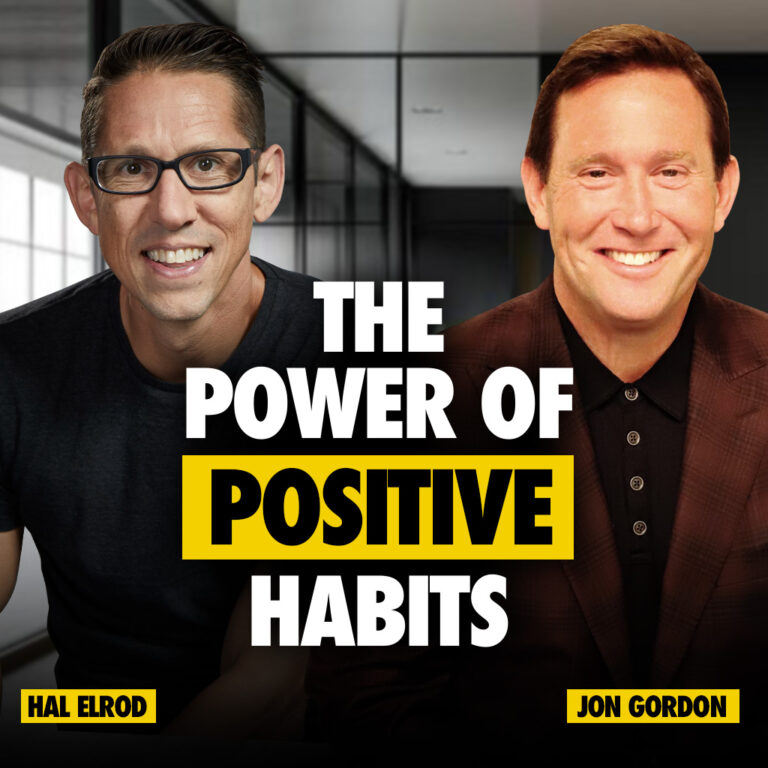


Implementing a new habit rarely feels life-changing at first. Going for a morning walk and getting a few minutes of sunlight, or visualizing checking something off a to-do list, might sound like activities that barely move the needle.
Yet over time, those small actions often become the difference between feeling stuck and becoming the person you’re capable of being. And after reading the first chapter of Jon Gordon’s newest book, The Power of Positive Habits, I felt the benefits from that one simple action in the first 5 minutes.
Jon is the bestselling author of 33 books, including The Energy Bus, which has sold more than 3.5 million copies worldwide. But before becoming one of the most respected voices in leadership and personal development, Jon struggled with negativity to the point that his wife told him their marriage wouldn’t survive unless he changed. That wake-up call led him on a journey that transformed his mindset, career, and life.
In our conversation, Jon shares the habits that reduce friction and make it easier to follow through, why becoming your own greatest encourager can change everything, and how letting go of the past can unlock the mental blocks that prevent you from becoming the best version of yourself.
KEY TAKEAWAYS
- Why Jon Wrote The Power Of Positive Habits
- The Morning Habit That Changed Everything
- The Habit Before The Habit
- Using Visualization To Follow Through
- Become Your Own Greatest Encourager
- Learn From Everyone: The Habit & Mindset
- Forgive Fast And Start Growing
- Don’t Let Old Battles Block New Victories
- Don’t Let Good Get In The Way Of Great
- The Beginning of Success for the Savannah Bananas
- How Reading Jon’s Book Will Payoff On The First Day
- How You Can Learn More with Jon Gordon
AYG TWEETABLES
“You can't be stressed and thankful at the same time. If you're feeling blessed, you won't be stressed.”
– Jon Gordon Tweet
“You don't have to be a naturally positive person. You can do habits like this that will change your mindset, shift your spirit, nurture your soul.”
– Jon Gordon Tweet
“The highlight reel is not a highlight reel of past success. You can create a highlight reel of any future success you want as well.”
– Jon Gordon Tweet
“You do these habits, and the payoff is going to be the person that you want to be, the person you know you can be, the best version of you.”
– Jon Gordon Tweet
“The words we say and the thoughts we think become the reality and the life that we live.”
– Jon Gordon Tweet
“You learn from everyone because everyone has an idea and an insight, and you never know who’s going to give you your next great idea.”
– Jon Gordon Tweet
“I’m now encouraging people, forgive fast. Release that burden you’re carrying. Release the wrong that someone did to you. Just forgive fast. Let it go. It’s like you’re grabbing onto this hot coal and you want to throw it at someone, but you’re the one who’s getting burned. But the minute you release it, you’re now free and you can start healing and growing.”
– Jon Gordon Tweet
“Don’t let old battles keep you from new victories.”
– Jon Gordon Tweet
RESOURCES
- JonGordon.com
- Jon Gordon on LinkedIn | Facebook | Instagram | YouTube | X/Twitter
- The Energy Bus: 10 Rules to Fuel Your Life, Work, and Team with Positive Energy by Jon Gordon
- The Power of Positive Habits: Proven Strategies to Exponentially Grow You by Jon Gordon
- The Power of Positive Leadership: How and Why Positive Leaders Transform Teams and Organizations and Change the World by Jon Gordon
- The Power of a Positive Team: Proven Principles and Practices that Make Great Teams Great by Jon Gordon
- The Carpenter: The 3 Greatest Success Strategies of All by Jon Gordon, Ken Blanchard
- Love, Serve, Care
- Atomic Habits: An Easy & Proven Way to Build Good Habits & Break Bad Ones by James Clear
- Tiny Habits: The Small Changes That Change Everything by BJ Fogg PhD
- John Ruhlin
- Front Row Foundation
- Matthew Kelly
- Ed Mylett
- Erik Spoelstra
- Harris Rosen
- Moe’s Southwest Grill
- Pat Flynn
- Chris Wark
- Chris Beat Cancer: A Comprehensive Plan for Healing Naturally by Chris Wark
- Taking Life Head On! (The Hal Elrod Story): How To Love The Life You Have While You Create The Life of Your Dreams by Hal Elrod
- Gordon Publishing
- Leadercast
- Jesse Cole
- The Savannah Bananas
- Sean McVay
- Liam Coen
- Jaguars
- Dave Roberts
- Dodgers
- Tucker Max
- James Clear
- The Miracle Morning App
THIS EPISODE IS BROUGHT TO YOU BY:
CURED Nutrition:
I want to talk about two of my favorite products. I’ve been taking these for four years, and they’re now a sponsor of the podcast, CURED Nutrition, Flow Gummies. I start every day with two of these. I meditate for 30 minutes without any supplements, and then I take Flow Gummies seven days a week, almost every day.
And then I go to bed with Night Oil. 30 minutes before bed I take Night Oil and it helps me fall asleep and stay asleep. So I start my day with Flow Gummies, I end my day with Night Oil.
If you want to implement my routine into your day with CURED Nutrition, go to CUREDnutrition.com/Hal and use the discount code HAL at checkout for 20% off your entire order.
Flow Gummies to start the day Night Oil to fall asleep. You’ll feel better, you’ll act better, you’ll perform better. Check it out.
RATE & REVIEW THE PODCAST
Reviews for the podcast on iTunes are greatly appreciated and will allow us to get the word out about the show and grow as a community. We read every single review and believe each one goes a long way in helping us make the show even better! If you received value from this episode, please take a moment and rate and review the podcast by clicking here.
Copyright © 2026 Miracle Morning, LP and International Literary Properties LLC
[INTRODUCTION]
Hal Elrod: What if the habits that will transform your life the fastest are actually easy, but nobody told you which ones to pick? Most habit books teach you the science of how to build habits. My guest today wrote a completely different book. He identified 93 specific positive habits, most of them under two pages each, that you can read in minutes and implement the same morning. I know because that is exactly what I did. I talked about it today with Jon Gordon. He’s the author of 33 books, including The Energy Bus, which has sold over 3.5 million copies and shaped the culture of professional sports teams, Fortune 500 companies, and organizations around the world. But before any of that, he was so negative and miserable that his wife told him if he did not change, their marriage was over.
That is where this conversation begins. Stay with us because Jon is going to walk you through the habit before the habit that removes every excuse you have for not following through with your new habits, the one habit that rewired his brain from negative to positive over 25 years ago, and why you’re going to walk away from this episode with at least one win you can use today. It is my great pleasure to bring you this conversation with my friend, Jon Gordon, author of the new book, The Power of Positive Habits. Here we go.
[INTERVIEW]
Hal Elrod: Jon Gordon, it’s good to see you, brother.
Jon Gordon: Hal, good to see you.
Hal Elrod: We were just talking about your new book, The Power of Positive Habits, and I actually, I didn’t tell you this. I was about to tell you this, but I said, “No, let’s hit record. I want to capture this.” So, when I got this book, actually, and your publisher sent me a copy, and when I got it, I was like, “Why would Jon write a book on habits? Like Atomic Habits, Tiny Habits, like there are already books on habits. What does he have to say that’s different?” And then I opened it up, and I go, “Oh, this isn’t about the science of habits. This is a buffet of upwards of almost 100 different habits that will transform your life.” And so, I love this book, and I actually want to hear your answer as to why you wrote it.
Jon Gordon: Yeah, that’s a great question because I had to answer that for myself as well. I knew there were great books on habits out there, so I did not want to deal with the science of habits. James Clear already shares how to implement habits. I actually asked ChatGPT, “What’s the difference between my book and Atomic Habits?” Here’s what ChatGPT said: “Atomic Habits will help you build better habits. The Power of Positive Habits will help you build a better life. You need both.” I wanted to offer a series of positive habits that people could choose from and use and implement in your life that would exponentially grow them.
And you know what’s funny, Hal? Years ago, when I started writing, I was writing a weekly positive tip. And I began writing that positive tip because I was working on becoming more positive myself, and I began sharing what I was doing. Well, that’s how I got my start, sharing a positive tip of the week, and people started reading my tips, and then it led me to write 32 books. Well, this is my 33rd book, so I’ve come full circle now, writing a book of positive tips, of habits that you can use that will exponentially grow you. We’re talking about leadership habits, mindset habits, because as you know, thinking is a habit. And let’s talk about the Miracle Morning. That is the ultimate habit.
If you’re dealing with a habit and want to implement a habit, have a Miracle Morning that you wrote about. You wrote a book about the best habit on earth, and I talk about mastering your morning in this book as one of the habits.
Hal Elrod: Yeah, I was going to say, yeah, that’s chapter seven. I did have an affinity to it. I was like, “Okay, we’re definitely aligned on this.” So, I want to tell you, here’s what’s neat about this book, and a lot of what you just said, I experienced. Chapter two, I actually want to circle back to chapter one here in a second, which is the habit before the habit, because I love that concept. But first I want to say, the first morning I read the book, I think I got through the first, I don’t know, four or five chapters, let’s say. And chapter number two and chapter number three, which is habit number two and habit number three, I immediately implemented that morning and got value. And then I did it again this morning. So, chapter two, habit two is take a thank you walk, right? A gratitude walk. You call it a thank-you walk. You’ve been doing it for decades.
And then chapter three is get outside and get some morning sunlight. You talk about the benefits of morning light in terms of your circadian rhythms, increasing your energy, all of these things. You’re improving your brain function. So, it’s like I can combine these two habits. I can stack these, right? So, morning sunlight walk, gratitude walk, and so I’ve been doing that every day since I read the book. And it’s like I got my money’s worth the first morning by implementing those two habits. So, talk about those two habits specifically and just how they got integrated into your life.
Jon Gordon: Yeah, I appreciate you sharing that because it is these little habits that mean everything. And this book is a series of habits where the habits are, like, one to two pages. So, we’re calling them chapters, but they’re really, like, short little sections of different habits that you can read, like, 10 habits probably in 20 minutes. It doesn’t take long to read these habits. I want people to go through all 93 and then say, “Okay, which ones am I going to really put into my life?” So, as you’re going through the book, start making a list of what habits are really speaking to you and which ones do you want to add to your life. The thank you walk literally changed my life, Hal. I was so negative. I was so miserable. My wife threatened to leave me because I was so miserable and negative, and she said, “If you don’t change, we’re over.”
Jon Gordon: So, I began researching ways I could be more positive, and this was 2001, during the emerging field of positive psychology. And I found this research that said you can’t be stressed and thankful at the same time. If you’re feeling blessed, you won’t be stressed. So, I came up with the idea of walking, which I love to do, and practicing gratitude on the walk. Well, now, over the years, we’re talking 25 years later, I have rewired my brain from negative to positive. I am naturally more positive now than ever, whereas I used to be so naturally negative. So, I’m proof that you can rewire your brain from negative to positive. You don’t have to be a naturally positive person. You can do habits like this that will change your mindset, shift your spirit, nurture your soul, like The Miracle Morning.
You have a Miracle Morning every morning, and you’re going to feel great. The gratitude walk is part of a Miracle Morning that just sets you up for a great day. And the sunlight in the morning, yeah, I mean, when I read research on that, and a lot of people know this, but a lot of people don’t. Like, as you read this book…
Hal Elrod: I wasn’t doing it. Yeah.
Jon Gordon: As you read this book, you’re going to go, “Yeah, I read that research,” or, “I heard about that, I heard about that.” But are you doing it? And I wrote it in such a way that it’s a cool little story, it’s an idea, it’s a thought, and then you go, “You know what? I’m going to go try this and see how it impacts me.” Well, you just get outside in the morning, and you get that morning sunlight, and that light gets into your eyes, right? And immediately, you actually start producing more cortisol, which increases your alertness. It actually elevates your energy, boosts your mood, and it will actually help you sleep better at night. So, you’re getting a two-for-one by getting sunlight in the morning.
Hal Elrod: Nice. And the two-for-one is that you can do both of those at the same time, right, is that your sunlight in the morning is occurring while you’re on your thank you walk in the morning, and it’s like you’re benefiting.
Jon Gordon: I love that you’re such a high achiever. You’re stacking habits already. You’re already stacking them.
Hal Elrod: That’s right. And it was even part of Miracle Morning, so I really got three habits in there. So, chapter one, which was like a master class in a page and a half. You mentioned most of the chapters are two pages or less, which I love. My next book that I’m writing, that’s the plan, is to have like three pages or less. Like, our attention spans are short. I want quick value that I can integrate into my life. Talk about what is the habit before the habit.
Jon Gordon: So, this was like the one part of the book where I said, “I want to help people implement their habits.” And I’ve always been successful with a habit before the habit, which means you have to do the habit that’s going to help you implement the habit and remove friction that is keeping you from entering and engaging in that habit. For instance, you want to work out in the morning or go for a walk, what do you do? Put out your clothes the night before. So, when you get up in the morning, you see your clothes, your sneakers are right there. Less friction. You’re more likely to actually go do the thing you want to do. If you want to read at night, which is something I want to do more of, what do you do?
The habit before the habit means you put your book out on your bed, before you go to bed, and you see that book there, and it’s going to remind you to go do it. So, you have to have a habit before the habit. If I want to write in the mornings when I’m writing a new book, I got to make sure I got my laptop ready to go. I get up in the morning, and there’s less friction, because if there’s friction, you will not do it, and you will look for every excuse not to do it. So, remove friction. So, habit before the habit, as you go through this book and you think of these 93 habits, you actually can create a habit before the habit for each one of the habits.
Hal Elrod: I love that, and I’ve used both of the ones that you just mentioned to get myself to exercise, packing. And in fact, in The Miracle Morning book, I give that as an example. I say, “Hey, to be able to implement The Miracle Morning, you got to set yourself up for success ahead of time. Have your journal set out the night before. Have your affirmations printed and set out the night before. Have your workout clothes set out the night before,” all of those things. And then the other, reading before bed was a habit I wanted to implement for a long, long, long time, and I didn’t. And I know people listening, whether it’s reading or some other habit, there’s like, “Yeah, I’ve been wanting to do that. I said I was going to do it. I tried it. I didn’t stick with it.”
It was literally as simple as deciding what are the books I’m going to read in the evening, and now those are sitting on my nightstand, and it’s automatic. I walk in. I go, “Oh yeah, there’s the book. Okay.” And it’s automatic. Not to mention I have a time that I’m going to read, so there are some other habits before the habits. What did I want to ask you?
Jon Gordon: Well, think about our friend who passed away, John Ruhlin. We love John. His memory still impacts us. He would send videos out. And he would send videos out encouraging people. I’ve never forgotten that, so I put that in the book and said, “If you want to encourage people, make short videos where you send them a video.” And it’s something that you can do very easily. But the habit before the habit, I bet John did this. He’d make a list of people he wanted to send videos to. And he would look at his list and go, “Okay, I’m going to send a video to those three people.” Just having your list and identifying the three people you’re going to send a video to is a great habit that will help you implement the habit of sharing those videos.
Hal Elrod: Yeah. And it’s so, like when you say remove friction, friction is not having that first baby step taken. Because once the first baby step is taken, that creates the momentum and the energy forward, right? Having that list of people is, like, that’s like, in some ways, you could say that’s 90% of the battle. Once the list is there, right, and you got a time in your schedule, it’s like, “Okay, now I’m going to do it.” So, I remember what I was going to share with you. This, for me, was a big habit before the habit. Years ago, actually, after I created The Miracle Morning, I decided I wanted to run a 52-mile ultramarathon to raise money for my friend’s charity, the Front Row Foundation.
And the reason that thought even got in my head was because two of my friends had done it. I would’ve never even considered it, but they had done it. I wanted to raise money. I was on the board of the charity. I’m like, “Well, if they did it, I should do it.” But I hated running, and I had never run outside of, like, the high school PE class mile once a year, you know? And so, what I did is I incorporated, so every morning, that’s how I started my visualization. I would close my eyes, and I would mentally rehearse the alarm on my phone going off at 7:00 AM, which said “Go for a run.” And then I would imagine myself going in my closet, getting dressed in my running clothes, heading out my front door, opening the door, getting excited for that run, and heading out the front door.
Here’s the power of that mental rehearsal. It only took me a minute or two. When the alarm on my phone went off at 7:00 AM, human nature was to do what most of us do, which is, “Eh, nobody really knows that I’m not going to run right now. I’m just going to go ahead and turn that off, and maybe I’ll do it tomorrow.” But because I had not mentally rehearsed not doing it, I had mentally rehearsed doing the thing. And I share that because that’s a universal habit before any habit. If you can imagine yourself doing it, visualize it, picture it, go there in your body and your emotions, get yourself excited in the morning, then when it’s time to pick up the phone and make those sales calls or open your laptop and write or do the thing that’s out of your comfort zone, that new habit, that habit of visualizing it ahead of time sets you up for success when it’s time to go.
Jon Gordon: Man, I love that. What a great idea, Hal. That’s a great one. I’m going to have to use that going forward, because people are like, “Well, what happens when I have the habit before the habit, but I don’t do the habit before the habit?”
Hal Elrod: There you go.
Jon Gordon: Like, I’d be like, “All right. Well, then I don’t know what to tell you. You have to take action.”
Hal Elrod: Yeah, your next book is going to be The Habit Before the Habit Before the Habit.
Jon Gordon: But visualization is so important, and one of the habits in the book is to play your highlight reel.
Hal Elrod: Yeah.
Jon Gordon: And the highlight reel is not a highlight reel of necessarily past success, but it’s also, you can create a highlight reel of any future success you want as well, and that’s what you’re talking about, rehearsing mentally what you want to do, what you want to be, and also, what’s the payoff? Like, there has to be a return on your habits. Why do so many people do the real estate infomercials where they see the ROI, I can get involved, and I can start making money on all these deals? They do it because they believe there’s a return on their investment. Well, we have to give people a return on their habits. You do these habits, and the payoff is going to be the person that you want to be, the person you know you can be, the best version of you. So, there has to be a return on your habits, and I love the idea of visualizing what that return is going to look like.
Hal Elrod: And I love the idea of the example you just gave, which is, to me, that’s actually the universal ROI, is to become the person that you’re capable of becoming, what Matthew Kelly called the best version of yourself. Like, that’s the ultimate payoff. When I was in sales and I set a goal to have my best year ever, it was doubling my previous best. It was a huge goal, and I got a Rolex. Like, I would get a Rolex for it. I would get a trip for it. I would earn my first six-figure year, all of these things. But that wasn’t the payoff. It was like, this was my last year with the company with Cutco, and I went, “I need to become the person that I am capable of being so that I can be that person into the future ventures that I have for the rest of my life.”
Like, that’s the payoff. Like, the money’s going to get spent, the recognition that boosts my ego is going to fade, but who I become, like, that’s forever. Like, that can be, to me, the biggest payoff for any of us in any of our habits.
Jon Gordon: Yeah, man. That’s what habits are. Habits are what are you doing to become who you want to be and who you know you can be. Lifting weights is one of the habits in the book. Well, five years ago, maybe six years ago now, during the pandemic, I was getting together with a bunch of authors, and Ed Mylett was one of those people. And Ed walks in, and Ed is jacked. And I’m not. And I looked at Ed, and I thought to myself, “You know, I used to look like that. I used to be fit like that.” And from that moment on, I was inspired to start lifting again. Well, now here we are, five, six years later, and I’ve been lifting. And I saw Erik Spoelstra recently, the Miami Heat head coach, and he’s a friend of mine.
Erik says, “Jon, you used to look like a writer. Now, you look like the former Division I athlete that you were.” Like, I look like an athlete again because I’m lifting. I knew I could be this again. Like, I didn’t have to be this blob that I was becoming. I could become that athlete I once was and am. And now I’m on the pickleball court battling these 30-year-olds in pickleball, competing all the time, lifting weights, feeling better than ever because of my habits. And my wife will tell you, “Jon looks and feels younger,” than I did when I was in my early 40s, now at 55, because of these habits.
Hal Elrod: I love it. What are some of your fave… For those that haven’t read the book or thinking about getting it, we’ve mentioned the habit before the habit, the thank you walk, getting the morning sunlight, master your mornings. What are some of your other favorite habits that you would share?
Jon Gordon: Hal, I love “Become your own greatest encourager.” I just love that one because so many of us beat ourselves up with negative thoughts and with fear and worry and doubt, and we have a negative thought, and it just spirals with overthinking, and we don’t treat ourselves very well. If you had a best friend who was struggling, what would you do? You’d say, “You got this. I believe in you. I know you can do it. You’ve overcome so much, and you can overcome this. There’s greatness inside of you, and I’m here for you.” And yet we don’t say that to ourselves. So, I want people to become their own greatest encourager, where you’re always speaking life to yourself.
And you talk about affirmations. Affirmations are powerful. The words we say and the thoughts we think become the reality and the life that we live. So, I want people to encourage themselves. And I tell the story about my wife, who was being really negative. She’s like, “I’m getting old. My body’s breaking down. I’m sore all the time. I try to work out. It doesn’t work. I try to lose weight. It doesn’t work.” She said, “I’ll never be like I was when I was younger. I should just give up. It’s pointless. It’s hopeless.” And I said, “Honey, we got to stay positive.” And she said, “Shut up, positive guy.”
Hal Elrod: Yeah. I’ve heard that. I’ve heard that many times.
Jon Gordon: Yeah. I go away to a speaking engagement. I come back after two days, and she’s like a different person. She’s all light and free and happier than ever. And I’m thinking, “Okay, what’s going on here? I’m home, she’s negative. I leave for two days. I come back, and now she’s happier than ever?” I said, “Did you find a boyfriend or something?” And she said, “No, no, I did that health coaching call with Eve. It’s that company where they look at your blood, your genes, and your DNA.” And they told her. “This is really rare. We don’t see this often. You have the genes of an Olympic athlete.”
Hal Elrod: What?
Jon Gordon: So, now my wife is now walking around the house saying, “I am an Olympic athlete. I am an Olympic athlete. You want to play pickleball tomorrow?” She said, “I’ll crush you because I’m an Olympic athlete.” The next day, she’s meal prepping for her workouts because she’s an Olympic athlete. I saw the power. I saw the change. The inflammation goes away, the soreness goes away, and here we are several years later, she feels and looks better than ever. Where did the change begin? In her thoughts, in her mind, she began to encourage herself with the words, “I am speaking life.” So, there’s so much power in that. So, my favorite parts I would say, I love the physical tips in the book, like the dead arm hangs and the squatting like a child, which I’m actually doing now, but the mindset habits are my specialty. And that’s where I’m at helping people be their best with this positive thinking, because positive thinking is a habit.
Hal Elrod: Yeah. No, you’re so right, and if anybody’s listening, think about someone that’s encouraged you in your life and how that made all the difference. I remember for me, I overheard, I moved from one Cutco office to another, and I was new, the new guy. And the number one rep in the entire country, he was out of that office. And I overheard the manager, who I knew the manager from years in the business, in the other office, and he’s smart enough that I’m pretty sure he was pretending to be on a call, knowing that I could hear what he was saying. But he was allegedly talking to our region manager, Brad Britton, and he goes, “Yeah, Brad, Jon he’s going to be the number one rep in the company this year. I mean, he’s number one. He’s not slowing down.”
He said, “You know what, though? Someone that I think’s going to give him a run for his money this fall, during the campaign, I think Hal Elrod could actually beat him this fall.” And the fall had just started. And I heard it, and I go, “Oh my,” and I literally, Jon and I were neck and neck. He beat me by it was 83,000 to 81,500. But I would have never come close to that had it not been from that encouragement, that belief. And I love what my mentors used to say, “Sometimes you have to borrow the belief that somebody else has in you until your belief catches up.” And very often when I read a book like The Power of Positive Habits, I’m borrowing the belief of Jon Gordon, right?
Like, the belief that you have in me, the reader, the human being that has limitless potential, right? Like, I am getting juiced up and learning from… Oh, that’s a great one. Learn from everyone. Habit 78.
Jon Gordon: I love learning from everyone. Can I tell you a quick story on that one?
Hal Elrod: Yes, please.
Jon Gordon: That’s a really cool one. Okay. So, learn from everyone. I learned this from this guy named Harris Rosen. I go down to Orlando. Harris Rosen owns the Rosen Hotels, the Rosen Inn, the Rosen Plaza. I’m sure you’ve spoken at many of them in Orlando, Hal. Well, years ago, he didn’t own all these hotels. He owned a few. Well, my good friend from Cornell, his dad was friends with Harris Rosen. And when I moved to Jacksonville, he said, “You’ve got to go to Orlando, and you got to meet Harris Rosen.” So, finally, I go meet Harris Rosen, and I’m sitting across from him in his office, and he turns to me and says, “And you are here because?” Like that, like very flippantly.
And I said, “Well, Mr. Burgary thought we should meet, and I love learning from successful people, and so that’s why I’m here.” And he said, “Okay.” He goes, “Well, what do you do?” I go, “Well, I just opened up some Moe’s Southwest Grill franchises, and I owned a couple of burrito places. I second-mortgaged.”
Hal Elrod: I didn’t know you had those. Okay.
Jon Gordon: Oh, yes. Hal, second mortgaged my home, $20,000 on credit cards, trying to make them work.
And eventually opened one, got it successful, opened up a second and then a third, and I sold them in 2005. But at this point, I was pretty much a restaurant owner, burrito guy, who knew I wanted to write and speak. I knew I wanted to do this. So, now, I’m sitting across from Harris Rosen and I’m telling him about this, and he goes, “Yeah. Are they going well?” I say, “Yeah, they’re successful.” I go, “We’re doing something really cool, Harris.” I said, “We are emailing people and we have an email newsletter.” No one was doing emails. This is, again, 2003. And we’re emailing them coupons via email, and whenever we open up a new location, we send them an email for a free burrito, and people are printing out the papers and coming in with these emails for their free burritos. It’s like an instant coupon, instant business, because every time we open up a new location, everyone emails all their friends around the city.
Hal Elrod: Nice.
Jon Gordon: And we have a line out the door like you would not believe. And he goes, “That’s great.” He picks up the phone, he goes, “Hold on,” calls up his restaurant person and says what I’m doing. And he goes, “Are we doing that?” And the person says, “No.” And he looks at me and he goes, “You never know.”
Hal Elrod: Wow.
Jon Gordon: “You never know.” Shaking his head, “You never know.” Basically saying, I never thought this would actually turn into a fruitful conversation and be beneficial. But he learned something from me. So, I believe you learn from everyone because everyone has an idea and an insight, and you never know who’s going to give you your next great idea.
Hal Elrod: Yeah, I love that. I love, I mean, you mention the book, some habits you might read and be like, “I’ve heard that,” or “I’ve seen that,” or “I know I should do that.” But I feel like you just share them in such a relatable way, part of it being that they’re under two pages, so it’s not like you get bombarded and overwhelmed. It’s like, “Oh, yeah, that’s–” Like, morning thank you walk, check. I’m doing that in 30 minutes now. I read it, I did it. Oh, oh, oh, morning sunlight. Oh, I’m going to stack that on top, right?
It’s like, it was me, like you talk about quick wins. Our friend Pat Flynn, he talks about quick wins, like, especially as an author, give your reader quick wins. And that’s one thing I think a lot of books don’t do. You get into the book and it might start off hot with some big promises, and then it’s getting murky and you’re like, “Wait, where’s he going with it?” And then you’re trying to get to the end to get a result, whereas very few books, you’re getting a quick win on the very first day or even the first five minutes that you’re reading it. And that’s what I found with your book, The Power of Positive Habits, is like, “Oh, I’m getting wins right away.”
Jon Gordon: I appreciate that. People have always said that over the years with my 33 books now. They say, “You take complex ideas and you make it simple, Jon, and you make it actionable, and then you go take action, and then you see results.” And as you know, that’s what it’s all about. Like, forgive fast is one of my favorite habits in the book. Like we all know we need to forgive, but forgiving fast gives it a tangible thing that you can do.
And I thought back to my life when I actually forgave fast, and it changed my life. I forgave my biological father for being a horrible father, for leaving when I was a year old, for abandonment. And I went to visit him when I was 30, 31, 32 years old, and I brought my daughter with me. Before that, Hal, I knew I wanted to write, but I couldn’t write. Like, I couldn’t write anything. And I went to visit him. I forgave him. I came back, and looking back, I remembered, oh, that’s when I started writing, after I forgave.
And so, the whole idea is that the faster you forgive, the sooner you start growing, because I wish I would’ve forgiven faster in my life. What happens if I would’ve forgiven in my 20s and not waited? I could’ve started growing in my 20s. So, I’m now encouraging people, forgive fast. Release that burden you’re carrying. Release the wrong that someone did to you. Just forgive fast. Let it go. It’s like you’re grabbing onto this hot coal and you want to throw it at someone, but you’re the one who’s getting burned. But the minute you release it, you’re now free and you can start healing and growing. And so, it’s just something that’s so simple, and yet, if we do it, it’s going to change the trajectory of our life.
Hal Elrod: I love that. And who did I interview recently? Oh, Chris Wark. He’s the author of Chris Beat Cancer. And he has a website, the same, hut he’s somebody that helped me on my cancer journey. And that’s one of his, like, I think, he has three or four beat cancer mindset keys, and one of them is forgiveness. And he talks about the science and the research of how detrimental holding burden or holding grudges and resentment is to our, not just our psychological and emotional wellbeing, but literally the physical wellbeing, and that part of healing physically is forgiveness. And so, you mentioned that you couldn’t write until you forgave, and then all of a sudden, the healing that happened in your mind freed up all of that wisdom that was contained within. And imagine anybody listening, what can that do for you?
Jon Gordon: I had to let go of the old to create the new. And it’s why one of the habits is don’t let old battles keep you from new victories. So, if you are dealing with some old battle or you have someone that’s trying to bring you back into your past or even a past issue that you keep wrestling with and fighting, no, you’ve got to let that go. You forgive so that you have the energy and the power and the wherewithal and the purpose to be able to create new victories going forward.
And to me, that’s a life-changing paradigm, because my partners wronged me when I was in the restaurant business in my 20s and they stole from me. And instead of fighting them and suing them, I took the money they gave me, which was about a fourth of what it should’ve been, I wrote about this in the book, and I left, and I moved, and I basically created a new life. I stopped fighting an old battle. I wasn’t going to win. I now had the energy to create something new, and that’s what led me to open the Moe’s. And I turned the $100,000 that they gave me, they should’ve given me $400,000, into a million dollars when I sold the Moe’s.
Hal Elrod: Wow.
Jon Gordon: Because I did not sue, I did not fight, I basically created new energy to create something in the future. And I think so many people, we’re always fighting stuff in the past. Let it go.
Hal Elrod: Let it go.
Jon Gordon: Create a new.
Hal Elrod: So, when I wrote my first book, Taking Life Head On!, and I always tell people, “Don’t read that book. It’s written at, like, a third-grade level.” I had brain damage from my car accident when I wrote it. Anyway, but I wrote that book. It was my first book, and I found a very small publisher, like a ma-and-pa publisher, and they agreed to publish it. I was so excited. They publish it. I work my butt off to promote it. It hits number six on Amazon out of every book. I’m on excited, going back and forth with the publisher.
After about a week, I send an email, don’t get a response. Call, wait, don’t get– long story short, the publisher took all of the royalties they got from my book, and they just left their home. They abandoned. They left the state. And private investigators later found that they just left. So, anyway, my parents were actually so, “How dare you? My son wrote a book about dying in a car accident. Now you’re stealing.” They were so mad. And I said, “You guys,” I said, “I’m just going to move on.” Like, they obviously are going through something that’s so difficult that they felt so desperate that they had to completely screw me over.
I have sympathy for them, not contempt, not hate. And then I learned about self-publishing. Self-published that book, then that led to The Miracle– you know what I mean? So, it’s like because I forgave and moved on, and how did you phrase? What’s that habit about letting go of the past?
Jon Gordon: Don’t let old battles keep you from new victories.
Hal Elrod: There you go, yeah. And the new victories are so much more valuable to our lives than the old battles that we’re hanging on to.
Jon Gordon: Miracle Morning was born and you wouldn’t have it if you were fighting over this old stuff. And because you learned self-publishing, it led to this incredible, huge success. Yeah, I love stories like that. It also brings up another habit, and that is adversity is our partner in growth. So, the habit is see adversity as your partner in growth because every adversity we go through, it actually will be your partner in growth if you use it for growth.
Hal Elrod: Yeah, absolutely. I actually am just curious because I did not know this about you. I didn’t know The Moe’s story. I didn’t know about your entrepreneurial history. I only know you as a world-class leadership speaker and speaker on mindset. How did you make that transition?
Jon Gordon: Yeah, people don’t know that I’m an entrepreneur at heart and a business entrepreneur at heart because it was restaurants where I started. And once I sold The Moe’s in 2005, I knew I wanted to write and speak, and I sold it to say, “Okay, I’m going to give this a shot.” And my wife did not want me to sell the Moe’s because she didn’t know if speaking would be successful. She goes, “What happens if it doesn’t work?” And I said, “There are no other options. I have to do this. This is my passion. This is what I was born to do.” Because I remember praying, “What am I born to do? Why am I here?” And writing and speaking kept on coming to me. And I knew I could’ve done 10 restaurants, 20 restaurants, 30 restaurants, and I asked myself the question, “Is that what I want? Do I want that?” And one of the habits is don’t let the good get in the way of the great.
Hal Elrod: Ooh, yeah.
Jon Gordon: It could’ve been good. I could’ve had a lot of restaurants, been very successful, made a lot of money, and it would’ve been good, but it wouldn’t have been great because I would have not have been fulfilled. And I knew right then and there, “Okay, I’m going to sell. I’m going to take the money I have after selling three restaurants, and I’m going to double down and just focus on this writing and speaking thing,” and that’s what happened. Energy Bus, wrote in 2006. Sold the restaurants in 2005. The money’s running out of the account, like, we’re living off of this money. And I’m walking and praying because it’s not going well, and I’m thinking about giving it all up and just getting a job to support my family. And The Energy Bus comes to me on that walk. Just like Miracle Morning came to you. And I wrote it in three and a half weeks. And then that book would literally, eventually get published and sell three and a half million copies and change my life.
So, it really began with just taking the leap, selling the restaurants, and saying, “I’m going to go do this thing.” And at first people are like, “Who are you? You’re the Moe’s guy. You’re the Moe’s guy.” Like, around Jacksonville, I was known as the Moe’s guy. And then I became The Energy Bus guy.
Hal Elrod: Now, for those that don’t know, what is The Energy Bus about?
Jon Gordon: That is about a guy who’s miserable and negative. His team at work is in disarray, has problems at home, and he wakes up Monday morning to a flat tire. He has to take the bus to work because there was no Uber at the time, and he gets on the bus and he meets Joy, the bus driver. And she and a cast of characters teach him the 10 rules for the ride of his life.
And at the core, it’s about everyone will have to overcome adversity, negativity, and challenges to define themselves and their team’s success. It’s about getting the energy vampires off the bus, getting the positive team on the bus, and you having that vision and purpose and loving your passengers along the way to create an amazing journey. So, a lot of sports teams have read it, a lot of companies and organizations have used it. A lot of them use it as their foundation for their culture to create a positive culture. And out of that came The Power of Positive Leadership and The Power of a Positive Team, and now, The Power of Positive Habits after all these years later. But yeah, that was written in 2007. It’s a fable, but it really is ultimately about cultivating positive energy in your team and organization.
Hal Elrod: So, most of your books are written more for leaders, would you say? And then this one is more for everybody?
Jon Gordon: Yeah, I would say this is for everyone. I write for everyone. Lately, I’ve been really thinking a lot about leaders and leadership because I know the leader can transform their team, their organization, their family. But when it comes to habits, we all need positive habits. But I also believe we can all be a leader, and we all are leading other people. If you can influence one person or a friend or a family member or your kids, you’re a leader. You might be the mom of the household, and guess what? You are the leader because you are leading your kids, you’re leading your family. And often, in my case, like, you’re leading your husband. My wife’s the boss, right? And so, that’s leadership. But we all need habits and positive habit, and mindset for me is for everyone as well, everyone needs to have a positive mindset.
Hal Elrod: Yeah. And the positive habits, the beauty of that is, again, it does transcend, every leader needs the power of positive habits. Every person on the team needs the power of positive habits. I’m curious, as an author and a speaker, we share, we’re similar professions, what do you prefer? Do you enjoy writing more or speaking?
Jon Gordon: How about you? What would you say?
Hal Elrod: Speaking, by far. Writing is a pain in the ass. It’s cumbersome. It’s hard. It takes a long, long, long time. You don’t get immediate feedback, right? Whereas, like, I mean, I would assume, like, I can guess that your answer is similar to mine, but knowing you well enough, but I’m curious.
Jon Gordon: How many books have you written?
Hal Elrod: A dozen or so.
Jon Gordon: Okay. I’ve written 33, because I think I love writing more.
Hal Elrod: Oh, really? Okay.
Jon Gordon: Yes. I love the act of writing. Like, I got six books in my phone that I put in the other day that I know I’m going to write going forward. And I always think of book titles. I give people book titles all the time. I see books, I see covers. My wife has Gordon Publishing now. We’re helping people publish their books.
Hal Elrod: Amazing.
Jon Gordon: And so, I just love that. I love writing, I love thinking about it. And when I’m in the middle of writing a book, after the first week, the first week is painful, but after the first week, when the characters start talking, and I love writing a fable more than a how-to. Power of Positive Habits is like one or two pages tips, but I’m still telling stories. But a fable is a complete story, and I love writing fables. So, that’s what I realized, like, the next bunch of books I write, I’m just going to write all fables. And I love doing that. But speaking, I used to not like, but now I’ve loved and I’ve enjoyed speaking. But you know what I enjoy more than anything of being on stage is Q&A.
Hal Elrod: Really? Okay.
Jon Gordon: I love being on stage and just doing Q&A and answering questions. That’s got to be my favorite thing. Or telling a great story is probably my favorite thing.
Hal Elrod: Yeah. And you and I have shared at least one stage, Leadercast. I know you and I, we shared that stage. We were backstage hanging out.
Jon Gordon: Me, you, Jesse Cole. That was fun.
Hal Elrod: Yeah, that was fun. That was when I met Jesse Cole, and he ambushed me backstage, and videotaped him saying Miracle Morning at me. Yeah, that was a– I’ll never forget that event for the rest of my life.
Jon Gordon: You won’t say it, I’ll say it. He said, it was cool, he said Miracle Morning had a huge impact on him and his career. And Savannah Bananas, a big reason why is because of Miracle Morning. And then he also told me that Carpenter had a huge impact on his culture and his organization. And Hal, he was on my podcast 10 years ago.
Hal Elrod: No way.
Jon Gordon: When nobody even knew of the Savannah Bananas. And he had this yellow tux. And I’m like, “Who is this guy with a yellow tux that is so strange?”
Hal Elrod: Embarrassing himself.
Jon Gordon: Yeah, he’s so strange. It was so strange, but he was so compelling. And I had him on, and then to see what he’s become now.
Hal Elrod: It’s remarkable.
Jon Gordon: Yeah, Love, Serve, Care from The Carpenter, Miracle Morning, I love that both of us had had an impact on him in that way.
Hal Elrod: Should you and I pursue a percentage of The Savannah Bananas? Do you think that would be– hey, we just want, like, 1% each, Jesse. Just do what’s fair.
Jon Gordon: Yeah, just 1%.
Hal Elrod: 1% and free tickets for our families, that’s it. That’s it.
Jon Gordon: Yeah, that’s it. Well, hey, him just talking about Miracle Morning now moves the needle, right? How cool was that?
Hal Elrod: That was amazing, man.
Jon Gordon: And to see what he’s become and the impact he’s having is just off the charts. That’s what’s so cool.
Hal Elrod: And it just keeps growing. They just sold out, like, 150,000 stadium down in San Antonio. I mean, it’s insane.
Jon Gordon: That’s a great example of vision and mission and knowing what you want, what you want to be, knowing the culture you want to create. Yeah, Hal, lately, I’m moving in, habits is great, I’m excited about habits. I wrote about commitments. I’m really getting back to, again, I’m going to write a book about culture and how to actually build a culture, because there are books on culture, but how to build it.
And then I’ve realized that’s what I’ve done, like with Sean McVay, that’s what I’ve done with Liam Coen, the coach of the Jaguars. That’s what I’ve done with Dave Roberts, the coach of the Dodgers. All these different baseball managers and coaches, I’ve helped them build their culture. Same thing in Fortune 500 companies, where I’m like, “I should write about the process of what I’ve been doing with them, and how I help them move through,” because I’ve never even done that and even thought about it formally. So, now I am.
Hal Elrod: Well, I love that. And I want to circle back to what we were saying about Jesse Cole, and here’s why. If you look at Jesse, right, his success is remarkable. And he created something from scratch. He made up a game that didn’t even– right? He took baseball, made his own version. I mean, and everybody, most people were like, “This is never going to work.”
I remember Tucker Max was like, “Yeah, I met Jesse 10 years ago, and he was all excited about this banana.” I was like, “This guy’s a– like, someone should tell him this is not going to work,” right? And so, he’s an example. My point is this, I would guarantee, right, I don’t have all 93 of the habits in The Power of Positive Habits memorized, but I’d guarantee that I know he mastered his morning. I know, right, like on and on. Jesse is a product of The Power of Positive Habits. He is living proof that any human being, no matter how wild your vision is, no matter how much people doubt it, no matter how much you doubt it, like if you integrate habits into your life that move you forward toward your best version of you, you can’t fail.
You just become better and better and better. And as you become better, what’s possible for you opens up bigger and bigger and bigger and bigger. And that’s what this book does for people. It gives them– it’s not just the science of how to do a habit, it’s like, “Hey, get up. Go for a walk.” “Hey,” right? This is telling you exactly what to do to transform yourself to create the life that you want. So, any last thoughts before we wrap up, buddy?
Jon Gordon: I think, Hal, you sell my book better than me, and I love your enthusiasm on it and the way you talk about it. But it’s how I feel. I wrote it because I want to help people have better habits to create their life. Again, James Clear, he wrote the book on how to build better habits. He did an amazing job. This is a book on, hey, what habits can you incorporate into your life that will exponentially grow you? And I guarantee, you implement these habits in your life and they will exponentially grow you. They will elevate your mindset. They will elevate you physically, mentally, spiritually, relationally, how you build your team, how you interact with others.
Hal has done these, I have done these habits, and we are the result of our habits. Jesse Cole, the result of his habits, and you will be the result of your habits. So, just pick. Pick 10. Pick your top 10 from the book, then pick your top three. Put those three into practice, and watch how they change you and transform your life.
Hal Elrod: And Jon, I want you to add one thing when you’re talking about the book on other podcasts, you need to end that with, “And the best part is you’ll benefit day one. You will literally.” Like, that’s the thing, right, is you’re going– the payoff happens not when you finish the book, it happens when you finish the first two pages, and then, again, the next two pages, and then the next. Like, it’s quickly going to– everything you just said it’s going to do in terms of transforming a person and their life, it starts the very first day they read it, and I think that is so important.
Jon Gordon: Guys, I want you to know, as you’re listening to this, I learn from everyone. And so, I want you to know what I just learned from Hal. It’s like, start with the fact that this book, day one will impact you. So, I need to be saying that to people because if you actually read this book and you do day one, you’re going to have a success and you’re going to have a win.
And I also learned to visualize, to actually visualize myself and help others visualize doing the habit that they want to do. And if they visualize themselves doing that actual habit, when they get up the next day, they’re much more likely going to do that habit. So, it’s going to be a new thing that I share with people to remove friction. Now, I got to write 94 habits, Hal. I got to add to the book. But I just learned that from Hal. Again, everyone you meet, you learn from, and that’s the beauty of life is learning from everyone.
Hal Elrod: Amen. I love that. Well, people can buy the book wherever books are sold, The Power of Positive Habits: Proven Strategies to Exponentially Grow You. And Jon, where can people find you if they want to book you to speak, bring you into their organization, or follow you in any other way?
Jon Gordon: Yeah, just go to JonGordon.com, J-O-N Gordon.com, and we have speaking requests on that website. But also, if you go to PowerofPositiveHabitsBook.com, you go there, we’re giving you also a free positive habits developer. And what is that? That’s where you put in your top three habits, and we give you a 30-day customized plan for you to implement the habits. We’re using AI technology. And people have done it. It’s been so cool. It literally customizes this plan just for you. And all you got to do is put in your top three habits.
So, you just go there, you get the book, and then you’ll get the free positive habits developer, and that will help you put these habits and principles and ideas into practice, which is so important, Hal. I just didn’t want to write a book where people go, “All right, got all these habits, but I didn’t do any of them.” I wanted to help people actually do them.
Hal Elrod: And you said that’s PowerofPositiveHabitsBook.com?
Jon Gordon: Yeah, PowerofPositiveHabitsBook.com. Little long, but that’s the website.
Hal Elrod: Jon, well, thank you for the work that you continue to do, brother, and the impact you continue to make. I’m so grateful to call you a friend and grateful for our time today.
Jon Gordon: Yeah, I appreciate your friendship, Hal. You’re awesome.
Hal Elrod: All right, y’all, go get the book, The Power of Positive Habits, and I love you and I’ll talk to you next week.
[END]