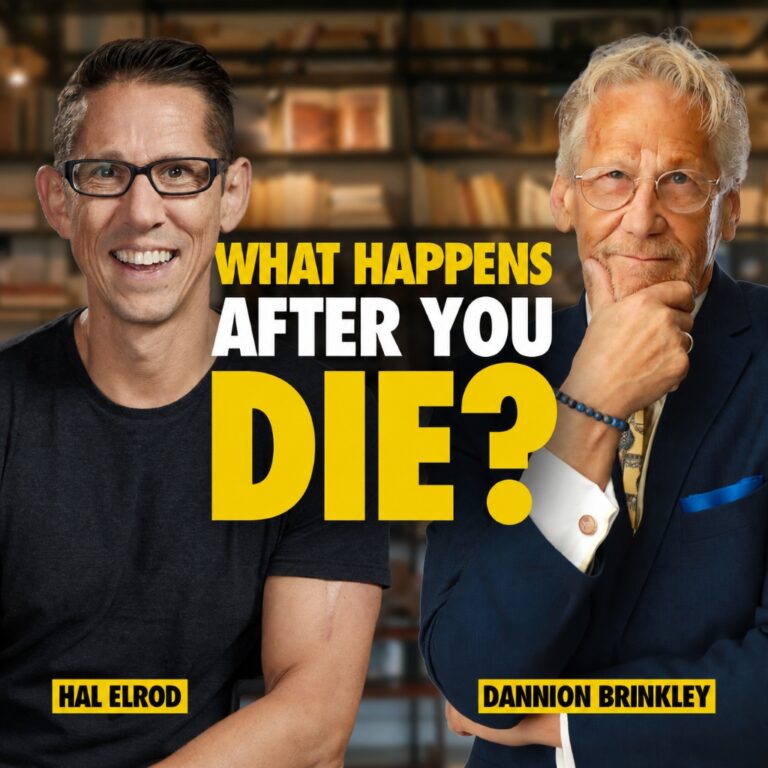


What happens after you die? It’s a question that has fascinated humanity for thousands of years. Today’s guest has an answer that might surprise you.
Dannion Brinkley has been clinically dead multiple times, and what he learned from those experiences led him to one extraordinary conclusion: nobody ever dies.
Dannion is the bestselling author of Saved by the Light and Secrets of the Light, a hospice volunteer with nearly 50 years of service, and one of the world’s most well-known near-death experience survivors.
After being struck by lightning in 1975 and clinically dead for 28 minutes, Dannion says he experienced what he calls a panoramic life review that completely transformed the course of his life.
Dannion has devoted his life to helping people face death without fear. He has spent more than 34,000 hours at the bedside of veterans in the VA, provided hospice support to over 2,000 people during their final days, and helped build one of the largest end-of-life volunteer programs for veterans, the Brinkley Center Foundation.
In our conversation, Dannion shares what he has learned from decades spent helping people navigate life’s final transition, why he believes no one truly dies, what happens during the panoramic life review, and how we can live in a way that brings more love, service, and meaning to the people around us.
KEY TAKEAWAYS
- What Dannion Experienced From the Lightning Strike
- The One Question We All Will Eventually Face
- The Visions Dannion Saw About The Future
- What Happens in 95% of Near-Death Experiences
- Dannion Describes His Other Near-Death Experiences
- When You Feel The Impact Of Your Actions In An Instant
- What People Most Need At The End Of Life
- What Dannion Says To Skeptics
- Dannion’s Message For Living Without Fear
- How To Support Caregivers And Loved Ones
- The Power Of Each Breath
AYG TWEETABLES
“I’m just sharing what’s curious to me because I’m not going to die and I’m not going to hell, and all that other stuff is complete, total nonsense. And if you believe it, you believe in nonsense too.”
– Dannion Brinkley Tweet
“The battle for the souls of humankind will be fought in healthcare.”
– Dannion Brinkley Tweet
“For all people wondering about what happens next. Number one, Nobody ever dies. The biggest, dumbest trick ever played on a spiritual being is to make 'em think they're going to die.”
– Dannion Brinkley Tweet
“What really matters is not what you do in this life, it's why you do it.”
– Dannion Brinkley Tweet
“Everybody makes their choices in their life on why they live and what value they place on their life. I'm not a judge of that. My job is to be there to be with you as you structure leaving this world.”
– Dannion Brinkley Tweet
RESOURCES
- Brinkley Center Foundation
- Dannion Brinkley’s Website
- Dannion Brinkley on Facebook | Instagram
- Saved by the Light: The True Story of a Man Who Died Twice and the Profound Revelations He Received by Dannion Brinkley, Paul Perry
- Secrets of the Light: Lessons from Heaven by Dannion Brinkley, Kathryn Brinkley
- Raymond Moody
- Pope Leo X
- Dante’s Inferno by Dante Alighieri, Henry Francis Cary
- The Miracle Morning App
THIS EPISODE IS BROUGHT TO YOU BY:
CURED Nutrition:
I want to talk about two of my favorite products. I’ve been taking these for four years, and they’re now a sponsor of the podcast, CURED Nutrition, Flow Gummies. I start every day with two of these. I meditate for 30 minutes without any supplements, and then I take Flow Gummies seven days a week, almost every day.
And then I go to bed with Night Oil. 30 minutes before bed I take Night Oil and it helps me fall asleep and stay asleep. So I start my day with Flow Gummies, I end my day with Night Oil.
If you want to implement my routine into your day with CURED Nutrition, go to CUREDnutrition.com/Hal and use the discount code HAL at checkout for 20% off your entire order.
Flow Gummies to start the day Night Oil to fall asleep. You’ll feel better, you’ll act better, you’ll perform better. Check it out.
RATE & REVIEW THE PODCAST
Reviews for the podcast on iTunes are greatly appreciated and will allow us to get the word out about the show and grow as a community. We read every single review and believe each one goes a long way in helping us make the show even better! If you received value from this episode, please take a moment and rate and review the podcast by clicking here.
Copyright © 2026 Miracle Morning, LP and International Literary Properties LLC
[INTRODUCTION]
Hal Elrod: What’s going to happen when you die? Well, you’re about to find out from one man who has died three times and was once clinically dead for 28 minutes after being struck by lightning. Before Dannion Brinkley died the first time, he was, by his own admission, not a good person. He was a bully, a Marine, and a man who did not believe in God nor in spirituality. And then in 1975, all of that changed when a bolt of lightning sent 180,000 volts through his body. His heart stopped and for 28 minutes, he was clinically dead. During that time, he relived his entire life from the perspectives of the people he had hurt. And then when he was brought back to life, he came back a changed man.
To me, what’s even more significant is what he’s done since then. For more than 45 years, Dannion has been a devoted hospice volunteer sitting at the bedside of over 2,000 people as they transition from this life, ensuring that no one has to die alone. He established the Brinkley Center Foundation to create a healing space for those navigating grief, trauma, and life’s hardest transitions. And he spent 50 years doing the one thing his near-death experience told him to do, making sure people don’t face death afraid and sharing the lessons he learned while he was dead. What he experienced on the other side of each of those deaths, what he saw, what he was shown, and what he was sent back to do is what we’re here to talk about today. Please help me welcome, Dannion Brinkley.
[INTERVIEW]
Hal Elrod: Dannion Brinkley, it is so good to be with you.
Dannion Brinkley: It is an absolute pleasure to be with you and, Hal, thanks for taking up this podcast mantra and bringing this kind of programming to people to be able to make the right decisions and like now, the critical time to make the right decisions.
Hal Elrod: Yeah. Oh, you’re absolutely welcome. Thank you for the work that you’re doing. I was telling you before we started recording that you’re the only other person I’ve met that has been clinically dead three times. And so, that you’re…
Dannion Brinkley: Well, you got to remember, you had it coming. I didn’t.
Hal Elrod: That’s funny. I hope people will understand your sarcasm and humor because I like to match it. So, let’s go. So, Dannion, when I heard about you, a mutual friend introduced us. I had not heard about you before. He said, “Have you heard of Dannion Brinkley? Struck by lightning multiple times, clinically dead multiple times.” And I started going down the rabbit hole to watch interviews with you and read articles.
And I haven’t read your book yet, but just fascinated by how you’ve taken, you took your adversity, and I just feel so aligned with this. And you’re like, how can I help others with this? How can I help other people? How can I spread the message? And so, I want to start with, first, how old were you when you had your first– I guess, the first lightning strike?
Dannion Brinkley: 25.
Hal Elrod: 25, okay. And I had read or heard you talk about that before you were struck by lightning and had your first near-death experience, you described yourself as not a great person. Is that accurate?
Dannion Brinkley: More than accurate. I was a tough guy.
Hal Elrod: A tough guy. All right, talk about who you were before. Who were you at 25 years old before the lightning struck?
Dannion Brinkley: Okay. I didn’t believe any of this spiritual stuff. I thought it was rubbish. I thought religion was stupid. I grew up as a tough guy. You hit him in the face before you ask a question. Then I played sports, and then I was a street fighter. Then I discovered the Marine Corps, which was a dream come true for a mean narcissistic asshole. Okay? And then on a Wednesday afternoon on September the 17th at 7:05 p.m., I was struck by lightning, hit me in the side of the head, went down my spine, welding the nails of the heels of my shoes to the floor, throws me in the air, suspends me in the air, slams me back down on the bed. I’m burning and I’m on fire, like battery acid burning.
And all of a sudden, I left out of my body. And from that moment on, I discovered that I was a spiritual being more than I was anything else. And I think, Hal, what’s really important about the story is what I call the panoramic life review, how you lift out of your body, everybody, and no matter what you think, what you’re hearing is the truth. I’m telling people the truth.
And people say, “Well, what’s it feel like?” Well, I left a body, burning in a fire, and paralyzed. It took me two years to learn to walk and feed myself, and I lifted out of my body. And wherever I was, I could see, I could move, and I wasn’t burning and on fire. And I could see my body lying on the bed. There is nothing but peace.
For all people wondering about what happens next, number one, here’s what happens next. Nobody ever dies. The biggest, dumbest trick ever played on a spiritual being is to make them think they’re going to die and to create a construct that traps him in a control mechanism on this side based on what’s going to happen on the next side. So, when I discovered that I was a spiritual being, all that stuff that I once was, was something I had to look at.
But here’s what will happen for everyone next, Hal, no matter what anybody thinks about, this is what will happen next, you will have a panoramic life review, the hall of records, the great book of judgment, every what they call it. We see your entire life passed before you in a 360-degree panorama. Then you will watch it from a second person point of view as though you were your own best friend. That’s the way the joy and love of the divine shows you you, because if it’s your best friend, if you’re all full of yourself, they’re going to pat you on the shoulder and calm you down. And if you’re all sad and depressed, they’re going to pat you on the shoulder and uplift you. So, you see it from a second person point of view.
And then you literally become every person that you ever encounter and you feel the direct results of your interaction between you and any other person. Nobody gets away with anything. Well, when I had to be all the people that I’d hit the face, shot, beat up, knocked out, blew up, and I had to feel the direct results, what I realized was there was no way I could keep being that. And number two, what really matters is not what you do in this life, it’s why you do it.
So, when I had a panoramic life review, Hal, there was nowhere to go. There was nowhere to go but to change. And so, realizing that we’re all spiritual beings and realizing that we were chosen to come here and we choose to come here becomes a significant perspective for everybody to give a chance to look at, because when you stop long enough to look at what we think is reality as opposed to true reality and you are a knower of what true reality is, then we have to change who we are.
So, there is a place in the panoramic life review, Hal, and I’ll say it my way that it does this. After you see your life and become every person, the question is this, if God couldn’t come today or whatever you hold to be divine could not come today and it sent you. In the life you just reviewed, what difference did you and God make? That is the only question you will ever ask yourself. That is the only question you’ll ever have to answer to the value of what you’re doing here.
I became a hospice volunteer. I built the largest end-of-life care volunteer program for dying veterans in American history. I co-wrote the standard end-of-life care model presently used by the VA, the Veterans Administration today. I’ve been with 2,017 people going from this world to the next, and after this show, I’m going to go see my 2018th veteran hospice, 10 years in the Army, junkie.
Okay? So, I’m going from 250 pounds to 116 pounds, 117 pounds. But everybody makes their choices in their life, Hal, or why they live and what they live and what value they place on their life. I’m not a judger of that or any of that. My job is to be there to be with you as you structure leaving this world. I have 34,000 hours at the bedside in the VA system, and I have another 60,000 hours at the bedside. So, if I say you’re going to be everybody and you’re going to feel the direct results in a panoramic life of you and observing the reasons and what I did as a jerk, narcissistic, tough guy, bleh, bleh, bleh, bleh. And being a hospice volunteer and then spending the last 48 years as a hospice volunteer is the dramatic point I’m trying to make why people should listen to me and what my life went from being a Marine. Now instead of sending them there, I’m helping them cross.
Hal Elrod: Wow. That’s beautiful. So, this near-death experience, you had this life review, you realized…
Dannion Brinkley: So, that was a death experience. Remember that the first was a dead for 28 minutes.
Hal Elrod: So, it was 28 minutes that you had this full life review. It all kind of– that’s what I wanted to ask you is how long did it take. And I’d imagine, I mean, my understanding is that when you die, DMT is a molecule that’s released in your brain that when you do DMT, you experience something similar. And I watched an interview recently with a gentleman that did DMT for five hours and he said it felt like six months. It was like six months of time went by and experiences he had in five hours. And so, I’d imagine those 28 minutes, you had that full life review and is it– I’m understanding that…
Dannion Brinkley: It came 50 years into the future.
Hal Elrod: 50 years into the future, explain that. What do you mean?
Dannion Brinkley: Well, what I’m famous for other than being able to get up from the dead is I wrote in Saved by the Light 30 years ago, what was called the boxes of knowledge. The visions I received, I lifted out of my body, had a panoramic life review, and then that was over, and I went to these, what I call crystal cities. I came before this altar of 12 beings with the 13th being to the right, and then 13th being would designate a being. That being would then begin to radiate when that was all I saw. And then it was like a message would come, like I always say, it looked like a laptop.
Now, I didn’t know what a laptop was then. And I always tell people, well, it looked like a laptop, opened it up, and I could see a seed in it. So, I used to say, well, maybe I died, went to the Radio Shack. But now, that’s all God. But I saw these visions of what I now know to be the future. But then, Hal, I didn’t know any of this. Remember, you’re talking about complete spiritual moron. No point of reference in it. I’m from South Carolina. Everybody goes to hell down in South Carolina. Okay?
Hal Elrod: Ouch. Okay.
Dannion Brinkley: Yeah. Well, I mean, that’s the story. You’re going to hell, and then people had been telling me I was going to hell since I was five years old because of the personality type. So, what I had was a series of visions before these 12 beings. And I wrote them down in 1977. It took two years before I could write or walk, all that stuff. I mean, I could walk, but it wasn’t far. Pass out in the yard, break my nose, knock just past, and all that stuff. So, I wrote them down. So, when I wrote Saved by the Light, I took the exact words that I’d written down in ‘77 and I put them in the book. And when I put them in the book, you realize the fall of the Soviet Union, Chernobyl, Fukushima, the pandemic, all these things I wrote down in a book 33 years ago from Nifty notebooks that I wrote down in 1977.
Hal Elrod: Wow.
Dannion Brinkley: So, when I went to the publisher, the publisher said, “We don’t want to put the boxes of knowledge in the book.” And here’s what I said, I said, “Well, then I’m not going to publish the book. You can have your money back. I don’t care.” Okay? Everything in this book will help everybody understand, has nothing to do with me, already been dead. Don’t try to tell me. And I spent 48 years of my life at the bedside. And I’ve been with thousands of people, not one or two or a dozen. Thousands. So, don’t try to tell me.
And I told them, I said, “Well, let me tell you something,” because the one about Iran and nuke and submarines, okay, that was 20 years later when I wrote this book. And the Iran getting a submarine and the time frame I said it was going to get it based on me receiving that, it’s not my prophecies. It’s not Nostra Dannion. It’s what I saw. What I saw, and so, I said, “Well, I’m not going to do it.” They said, “Well, why?” Raymond Moody and Paul Perry, and they said, “Well, why?” I said, “Well, look.” I said, “Think about this. If I put this in this book and this stuff comes true, that means there’s a life after death,” because when I got this information, they were saying I was dead. Not near dead.
Brought me in the emergency room. Patient unconscious. Patient not breathing. No EKG. Now, that’s the emergency room. So, what do you do? You cover me with a sheet. You move me in a room and you bring the next one in. Patient unconscious. Patient not breathing. No EKG. What was that in 1975, Hal?
Hal Elrod: I don’t know.
Dannion Brinkley: Done.
Hal Elrod: Yeah.
Dannion Brinkley: Yeah. So, I said, and if it doesn’t come true, everything that you all believe that it’s all hallucination or DMT or drug reaction or chemical/biological shutdown. Okay? And then I hallucinated and I owe people an apology. Well, here we are 50 years later and 32 years since the book, it’s all come true, 98% of it’s true. What they said was the probable possibility of the future based on if we keep doing the same thing we’ve been doing, this is what’s going to happen. We were in Vietnam. We were taking over the world. We were imperialist America. We fighting wars everywhere. Well, look at where we are right now. We’re on the precipice of a world war, so we didn’t change.
And so, what they showed me that would be the probable futures have come true based on the rules at which they were showing it to me. What is so great about divinity, Hal? Is this not playing with you? It has its rules. You chose and were chosen to live and function within them to achieve a certain biological, neurological, electrochemical, electromagnetic event or charge for the divine force. And then you choose to come because you can look and create obstacles that allow you to grow, that allow you deeper understanding, like getting your PhD. And that’s the purpose of this.
When you come down that you are going to die, nobody dies. It doesn’t ever happen. So, the purpose of the near-death experience, as the divine decided to put it in place, was because by doctors and chemistry and pharmaceutical companies, like you say, the only difference between God and a doctor is God never thinks he’s a doctor. So, what God’s what, I always call God feminine because at first, it makes people mad. And then second, because my relationship to the divine is a loving, kind of playful kind of relationship. You don’t scare me. You can’t threaten me. Okay? So, that’s how my relationship is.
So, she’s sitting around and she sees these doctors at pharmaceutical companies and all that. She says, look, almost sent a bunch of them jackasses back. So, how come I’m still here? Cardiopulmonary resuscitation techniques, all of those who’s controlling your life and tell you there’s nothing after this and all you are is chemicals, oh, there’s nothing that the mind is doing. Everything’s in the brain and all that nonsense. And then we come back and we tell a different story.
Hal Elrod: Yeah. And it’s consistent. I’ve studied near-death experiences and the stories are consistent across the board.
Dannion Brinkley: The stories vary based on how you find the language to describe an impossible series of events in English that does not have a charge to it. Like, most romance languages have a negative or female gender, which is the charge, positive or negative charge. So, what the purpose of the near-death experience was? In its 50th year, now in its golden year.
So, what was the cultural legacy of the near-death experience? Number one, you’re not going to die and there’s something over there. Number two, 95% of every person who has a near-death experience sees they float above their body. They see their body on the bed, on the gurney, on the side of the wreck, on the car, all that. They see it. The purpose of that is if you’re seeing your body, then tell me who the observer is. Who is the observer? That means…
Hal Elrod: Really you.
Dannion Brinkley: That means you are not that body. Okay? Then, number three, then what are you? You either got to be a solid, liquid, or a gas. So, that can’t be possible because it has to be four – north, south, east, and west; earth, wind, water, and fire, the nature of how a constructive reality comes into physical dimensional reality that we’re living in. Then, what is missing?
In 1904 on the periodic table, there was something called ether. It was an element. They took it off in 1904 and they hid it and buried it until quantum came in and renamed it plasma. Now, there are four forms of materials – solid, liquid, gas, plasma or ether. Okay? So, if you’re not that body, then who are you? You’re ether, you’re ethereal plasma. I don’t like that term, but you’re ethereal. Okay? Well, that means you’re an electrical being and that means you take the near-death experience and you explore yourself from an electrical point of view.
And if you think of yourself from an electrical point of view, then you begin to truly understand who you are as a divine being on a mission chosen to choose to come here and on this divine mission, because once you look at it from that point, the reality of the subjective nature of control in place in the world today, no longer is value, because people ask me and said, “Dannion, why are you always so happy? Why are you always laughing?” I said, “Well, why not? I didn’t die, I didn’t go to hell. So, they missed their chance at the kid.” Okay? So, why should I leave it from the South? Why should I be happy? I mean, come on.
Hal Elrod: Yeah, yeah. So, my understanding is, Dannion, I’m fascinated, I understand you’ve had three or one death experience as you just described, but then three near-death experiences, right? It’s happened more than once. What are these other three separate deaths or near deaths? And did they deliver the same message? What was different about them or what was the same? And what were they? What happened?
Dannion Brinkley: Okay. So, 1975 struck by lightning, 1989 open-heart surgery, complications of being struck by lightning, 1997 brain surgery, complications of being struck by lightning, never given a chance to survive. Never. 2018 open-heart surgery, clinically resuscitated after the open-heart surgery. Four days after the open-heart surgery, went into cardiac arrest twice and had to be resuscitated. Okay? I don’t even call the two being clinically resuscitated, even important because I didn’t go anywhere.
I went flatlined and I came out of my body. And I’m standing next to my body, watching them pound on my chest trying to revive me. Okay? But I was standing next to the charge nurse looking down at me, watching the nurses working shifts and pounding on my chest. And I didn’t go anywhere. The thing that amazed me, Hal, was you come out really fast. But when you go back in, it’s like forever, I mean, because you are putting on what I would say was cloaks. In order for a spiritual being to believe their physical, there must be some dimensional realities that they have to cloak that self in to appear to be physical.
Quantum physics says today, nothing is real. And how funny when people say, “Well, I’m physical, I’m material,” well, you say this to them, well, let me ask you something. The smallest known material thing is a neutrino, and neutrinos make up atoms. And then atoms make up molecules, and molecules make up cells. So, you got 35 billion cells in your body. And if you took all of those 35 billion cells and you put them on an electron microscope or you do one at a time, that cell would be 99.9999999% empty space.
Hal Elrod: Empty space, yeah.
Dannion Brinkley: So, quantum physics states categorically, you’re not here.
Hal Elrod: We’re here as energy, not as a physical object.
Dannion Brinkley: And the moment you start to observe the world from that point, you are accessing your own divine spiritual self. As long as you think you’re physical, as long as you think you’re going to go to hell and it’s going to rip your flesh because Pope Leo X read Dante’s Inferno and decide to make it doctrine so he could sell indulgences. That means you pay $3 and you get a letter from the Pope that says you ain’t going to hell.
Hal Elrod: Yeah. Let me, I want to circle back and spend some real time on the life review that you talked about. You said you didn’t just watch your life from what you explained, you felt the impact of your actions on other people, and I wanted to know.
Dannion Brinkley: You became the other person.
Hal Elrod: You became. So, you felt, I mean, talk about feeling it. You’re feeling it as they felt it.
Dannion Brinkley: When it happened based on your intention.
Hal Elrod: And it sounds like before you went through the death experience, you were not an empathetic person. You were an A-hole. You were a jerk. You were a narcissist as you mentioned. So, did that experience give you a new level of empathy? And what else might have come out of that?
Dannion Brinkley: Taught me to know better. What are the rules of living here? What are the rules of occupying this physical dimension and the illusion of thinking you’re a physical being? What is that illusion? We are not physical beings. Quantum physics today says and proves that you’re not even here. And people say, “Well, I’m still here.” I said, “Well, the same system that makes your cell phone work says you’re not here.” So, does your cell phone work? Answer me yes. Well, you’re not here then. So, that dramatic change, Hal, when you face yourself and you see what your motivations were, it’s embarrassing.
Hal Elrod: And what if you were a wonderful person? What would you imagine they would see?
Dannion Brinkley: They would feel the joy of the value they brought in the life, like what grandmother does. They would feel the happiness. Love that neighbor as thyself and do unto others as you and have others do unto you, pretending that you’re a physical being, being able to be afraid, scared, helpless, and alone, and still holding to the true value of trusting in the divine force that is God. Okay? Those are the rules. Religion portrays that. Corporates, institutions and governments manipulate that, but it’s all fricking nonsense. You’re not going to die. And if I didn’t go to hell, nobody listening to this podcast is going to hell. So, you’re going to have to get over it because if anybody was going, it was going to be me.
Hal Elrod: What I love about you coming out of the experience is that you became not just a hospice volunteer, but a prolific hospice volunteer. My mother is a hospice volunteer. I’m not sure how many people she’s sat with, but it’s hundreds and hundreds over the last 30 years or 40 years and…
Dannion Brinkley: Tell her I love her. Tell her, again, I love her.
Hal Elrod: Yeah, I will. I think you guys would love each other. She’s got your similar energy and your spunk. So, I’d love to ask you this, so you’ve sat at the bedside of over 2,000 people as they died. What do most people, what’s happening? What are they talking about? What are they fearing? What are they thinking? And what are you– I would imagine you’re telling them what you’re telling us.
Dannion Brinkley: Well, no. Maybe 1 out of 40. When you’re at the bedside, it’s not about you. It’s not about me. It’s about them. Okay? If somebody brings it up or asks about it, I’ll talk about it, but I am not the initiator.
Hal Elrod: I love that.
Dannion Brinkley: You don’t live in cosmology when a person’s diehard Fundamentalist Baptist is going from this world to the next and the whole family’s going crazy because they’re leaving. I mean, they’re fighting over the furniture and who’s going to get the ring out of the closet first and all of that stuff. I’d pass that person in transition needs three things. They need to know that their life had value. The fact that you’re coming to see them represents that. If you know them close, you tell them a story that happened that they affected your life, good, bad, or indifferent. So, it sets up a value for them to observe themselves. Never lie to them, they will know.
Number two, you must structure closure. How do you structure closure? No matter what condition they’re in, in the bed, as horrible as it is, in all that enormous pain, you say, look, these are the rules of being here. Life is about progression. So, you can’t sit here and watch jeopardy, you take those hit that pump and drugs, you got to make a fricking plan. And then how do you do that without saying your closure?
You start talking to them about what they did in their life as jobs, careers, thoughts, so that they start through the panoramic life review. Because when you start looking back at your life and the jobs and the stuff and what would we do now if you were 35 and what you know and what job you had, then they move into the plane. This is the big structure, Hal, of what’s going to happen, it doesn’t matter. Whether you believe me or not, it doesn’t matter. I will win this argument. Okay? And after facing myself now four times, three times, and let me tell you about the panoramic life review, it doesn’t pick up where you left off. It’s only one life.
Okay, so I had been through these three fricking times, and I had hand surgery in between those two, but it wasn’t anything. I went knocked out, went under anesthesia, had the hand surgery, woke up, got over it. No near-death experience, nothing. Open-heart surgery, struck by lightning, open-heart surgery, brain surgery, open-heart surgery. One death and three near-death experiences. And I don’t even consider the resuscitations. I didn’t go anywhere.
Here’s what was funny though, Hal. There was a guy standing. When I came back, I was back about seven or eight minutes, then they lost me again. There’s a guy standing behind a nurse to the left, kept saying, “Are you ready? Are you ready?” Okay? Well, I’m curious. I got a cardiologist yelling at me. It’s Sunday morning at 2 a.m. They just resuscitated me for the first time. And they all stand around and I go again. I go again. Are you ready? Well, what people don’t understand is that pad story, where they put the pads on your chest, they don’t do that now. They take these things to you. And this was the guy with the switch and he kept saying, “Are you ready?” Or not kept, I was thinking to myself, ready for– well, this is true. Ready for what?
And they stepped back, and he hit that switch. I was back. But I came back, no matter how fast I came back because it had to be in between heartbeats, Hal. Okay? You’re talking about a heartbeat. You had to be in between heartbeats, but it took seven coats I had to put on to get back here, and it was slow. It wasn’t coming out, but I came out fast both times. Going back in, it was like forever.
Hal Elrod: Oh, wow. Yeah.
Dannion Brinkley: Okay? These are the things that are curious to me. I mean, I’m just sharing what’s curious to me because I’m not going to die and I’m not going to hell, and all that other stuff is complete, total nonsense. And if you believe it, you believe in nonsense too. So, you either live in reality as the world is changing or you don’t.
Hal Elrod: So, I want to challenge you a little bit, for the person that there’s a version of someone listening to this or watching this who thinks you’re either delusional or you’re making it up, and I know that you’ve heard that, I’m sure countless times, what do you say to that person? And do you even care about convincing them?
Dannion Brinkley: Well, why would I be telling this? Because everybody’s going to be a fricking caregiver. Everybody based on where medicine is and where life is and the war that’s going on in healthcare, you’re going to be a caregiver. And if you don’t have sufficient information and knowledge to make the right decisions for somebody who loved and somebody who loves you, then you can think whatever you want. But I can get up from the dead with no chance to survive. I’m not like a poem. I’ve been saying the same things for 50 years. Just keeps coming true.
If somebody wants to measure whatever it is, a form of delusional opinion about me, how many times you’ve been dead and how many people have you died with? Answer that question as a value of your life, and I’ll answer that question as a value of my life. And what changed me was facing myself in a near-death experience, or I would’ve already hit you in the face.
Think of who the other person was. You’d be telling me all that stuff and act like you’ve got an opinion, but you’ll be bleeding as you say it. That’s the person that I normally and I grew up as being. It didn’t mean I didn’t lose that talent. It means it didn’t benefit the divine purpose of what I’m doing here. I tell a story that I have no fear of. I will be right. And Hal, look how many times I’ve been through this. I didn’t fall over on my bicycle. I didn’t bump my head. I didn’t overdose on a drug. It was a guy talking about DMT, saying it describes like a near-death experience, a DMT, you see the fabric of the universe. If you do it for five hours, you only have an eight or nine-minute duration on the dosage. You have to look at what the dosage is. You have to look at your serotonin levels, your endorphin levels which you trace mental destruction is, how much electrolytes in the body, and how hydrated that body is to determine exactly what he’s describing as an end result of a chemical/biological reaction in the brain. Nobody fools me with that BS, Hal. Don’t fool me with that. I understand biogenetic chemistry.
Hal Elrod: That’s an interesting distinction, yeah.
Dannion Brinkley: I understand our body. I understand how it works. I can make this do things you cannot possibly imagine. I have 20% ejection fraction. I am actively dying. Ask my cardiologist.
Hal Elrod: So, what do you mean by that, you can make your body do things that are extraordinary or however you say it? What do you mean?
Dannion Brinkley: I am actively dying.
Hal Elrod: Okay. Aren’t we all actively dying, Dannion?
Dannion Brinkley: Yeah, I’m just doing it a little faster.
Hal Elrod: How old are you, by the way, now?
Dannion Brinkley: 76.
Hal Elrod: 76 years young, all right. How is your health, by the way?
Dannion Brinkley: No, 76 years old.
Hal Elrod: Old, okay, all right. Why do you reframe it as old when I reframed it as young?
Dannion Brinkley: Well, because look, first, that’s not true.
Hal Elrod: Yeah. All right, fair.
Dannion Brinkley: Okay. And what I’m most known for, Hal, is I’m honest. I don’t have pretense to be. I know too much about me to be impressed, and I’ve already faced myself. I don’t have all that. I tell people in a way because I’m desperately trying to get across to them the need to do what I’m asking them to do or they will be caught in a trap.
Hal Elrod: And what is it that you’re asking them to do? As we’re winding down here, what’s the most important message that you want to leave someone with that they can apply to their life?
Dannion Brinkley: Three things. Number one, you are not going to die. The whole concept of terms that are used to quantify you dying, check and see who’s telling you that and ask what their intention in telling you that. If they’ve never been there, they want you to have a belief system in something they have faith in. Okay? I don’t have. Mine is a belief system.
Number two, the battle for the souls of humankind will be fought in healthcare. It’s been the mantra of my life for 50 years because if you look at where healthcare is today and you watch what happened with the pandemic, the control of the value of your life, what you will do to protect your children, your grandchildren, your grandparents, you watch. You cannot go see your mother pass from this world because some agency said you’re going to kill her and she’s in hospice. That is insanity.
Hal Elrod: Yeah, I agree.
Dannion Brinkley: That is complete and total insanity. So, I get a little pushy because I am desperate to get people to understand. If you don’t pay attention to your healthcare, look at yourself as an electrical being, so you have access to yourself as a spiritual being. And when you look at healthcare, I will make this prediction, Hal, that in the next 18 months, the pharmaceutical medical system will teach you that you are an electrical being, but the pathway they’re going to take you down and teach you do that is a trap in healthcare. And if you don’t believe that you are an electrical being today and you don’t believe what I’m asking or telling you that I think is the smartest thing to do if you love somebody, when you get off this podcast, tell them to get on their computer please and look up CRISPR. Just look up the word CRISPR.
Hal Elrod: C-R-I-S-P-E-R?
Dannion Brinkley: Not P-E-R, CRISPR.
Hal Elrod: Okay.
Dannion Brinkley: And see what is already patent and existing to modify control and manipulate your DNA, as if you are a programmable being with an electrical nervous system called the nervous system and a DNA structure that can be programmed to change, build, modify. They’re doing CRISPR now to build super soldiers. Look up CRISPR and tell me that that is not true. See, when people start with me, watch, Hal, how much fun I am, I know nobody’s going to die. It’s nonsense.
Hal Elrod: Yeah. So, you have no fear around that. It’s a different paradigm.
Dannion Brinkley: I’ve been with 358 people taking their last breath. Their last breath. Don’t try to tell me. See, I don’t tell. Don’t try to tell me all that. Listen to somebody who’s been through it. Listen to somebody who’s struggled through it, who understands it. Why am I telling you this? Because I’m scared to die. I’m not trying to convert you. You know I’m not trying to. Like you got to go and if you don’t listen to me, you go, go to hell and all that. I’m trying to do none of that. I’m trying to help you help those you love and who you care about. That’s why I’m doing it. I’m happy in my life. My health is terrible.
Hal Elrod: Now, your health is terrible.
Dannion Brinkley: Sure.
Hal Elrod: But it doesn’t affect your happiness.
Dannion Brinkley: No question. I’m going to see a hospice patient when I leave you because it’s Memorial Day. We made it better.
Hal Elrod: You’ve done so much. I mean, just sitting with thousands of people and in hospice caring for them as they’re going through that transition, is the future you continuing that mission? Is there a mission outside of that, beyond that, in addition to that?
Dannion Brinkley: Dannion.com. If people read my book, Saved by the Light, I wrote Secrets of the Light for caregivers. If you’re a caregiver and you’re having trouble, go on Amazon and buy Secrets of the Light.
Hal Elrod: I’m going to buy that for my mom right now.
Dannion Brinkley: Oh, and tell her, I wrote this book so that people who were having to deal with it had to have a stable place to operate from because it’s hard, because a part of you is passing with somebody you love as you’re trying to take care of them and you can’t trust or believe anything anybody’s telling you and everybody’s up to something. And the person who’s in transition, as you lose control, you try to take control. So, the person that you hope is going to appreciate what you’re doing ends up you resent them because they’re trying to manipulate and control you without realizing, it’s because they’re losing control. So, I write how you deal with this stuff in such a way to empower yourself.
These are, I call it the seven truths. I have a thing called the Four-Fold Path. Okay? And then I have what’s called Seven Truths that any place in the world, and if you lock onto one of those seven truths as a value of why you’re doing what you’re doing, the revelation and insight will come or someone like me will appear, or they’ll turn on the television or look on YouTube and find this podcast because that’s the nature of the law of the love of the divide operating in this conscious level.
So, what I want to leave with people is this, the battle for the souls of humankind will be fought in healthcare. And if you don’t pay attention to your healthcare, your plan, and taking better care of yourself, you will fall for the control trap being put and applied to helping you understand that you are an electrical being. We have moved in quantum dynamics to the point where you can no longer leave ether out of the periodic table because it’s now called plasma. Plasma is based on quantum mechanics. So, I might be delusional. It might be a lot of stuff. That means your cell phone is not working.
Hal Elrod: Yeah. No, I mean, quantum physics has been– it’s one of the most cutting-edge sciences, and it has proved, in fact…
Dannion Brinkley: Straight theory, chaos theory. Come on.
Hal Elrod: I believe the most recent Nobel Prize winner proved that the universe is not real, that it is closer to a simulation. This was just weeks ago that– I can’t remember his name, but I was reading the article about the latest Nobel Prize winner. So, there’s a lot more. Dannion, to me– I’m a very open-minded person. I rarely hear something and immediately dismiss it. When I was younger, I was very skeptical and I immediately, and I’m sure many people listening, they might already turn off the podcast. They go, oh, this guy’s talking crazy. You don’t ever die and this and that.
To me, so, I don’t know if arrogant is the right word, but almost naive to think that we know anything, right? Like, more and more and more, as time goes on, as scientific discoveries prove that we don’t know a lot more than we think that we know, we don’t understand the universe and how energy works and how gravity works. We can put a word to it and give it a descriptor, but we don’t actually understand it. And you having…
Dannion Brinkley: What is gravity? What is gravity? What happens if you pick a bowling ball and a BB, and you drop it off the Empire State Building? Based on gravity, which one would hit first? They hit at the same time. They fall at 32 feet per second, per second.
Hal Elrod: Wow.
Dannion Brinkley: They hit at the same time. So, what happened to the definition of gravity as you’re told what it does? Water will find the most level position. So, if you’re spinning around a thousand miles an hour, 24 hours a day, and moving through a cycle, 66,000 miles an hour, 66,000 miles an hour, and the water, based on what we call physical is not moving outward from the planet based on a gravitational field it has in relationship to nine other planets and their gravitational field to keep them balanced to your place to revolve around the sun. That’s insane. It’s insane.
So, here’s what I say to people who think I’m crazy. Thank you. And here’s what I say to those people too. Don’t just take everything that Hal’s trying to blame and put it all for my crazy self. Don’t not listen to come back to Hal because he’s trying to get the information out because he realizes that the world is bigger and broader because he’s been without breath. Every time you breathe and when you don’t breathe is the difference in the vibratory harmonic between that level of consciousness and this one.
Divine power flows. When you breathe in, it fills your sinus cavities. It stops. You are divinely connected through the sinus cavities, hold in that air, and then you set an intention and you breathe out. So, you are divinely connected to God in between each breath. Before you could breathe out, you have to stop and you breathe out. When you understand that as a value concept of who you are, you could use that. If you say you want to be close to God, hold your breath a few moments. Those people say, I’ve seen a few people say, you know, you’re really funny. Why? Because how long can you live without God? How long you can hold your breath? And if you can hold your breath long enough, you will be in her presence pretty soon.
So, when you realize that from not breathing, you realize at that moment that you stop it, you’re not breathing, you are connected to the system again. You are reconnected to the divine flow again. And the value of that space filling that divine place is where you and the divine decide why you’re going to take the action you’re taking. That’s a fact, Hal. And I have watched and studied this in the value of thousands of people leaving this world and 358 taking their last breath. Though I always say to people watch, the nature of who I am came from being dead and fighting to stay alive and finding values of what people who struggle with the lies they believe in equal to whoever thinks I don’t know what I’m talking about, and then the value comes down when you get ready to go and this is my solid place.
Evil has its greatest opportunity in palliative care. When a person is passive from this world, evil can destroy families. It can destroy love and the relationship that nurtures and builds families, and people never speak to each other again over who was fighting over and arguing. So, I am fighting evil from the bottom of my heart. I’m creating ways that people can understand how to look at something they’re terrified of.
How in the world could you be afraid of going to be home with your daddy for the rest of your life? That doesn’t impress me. I’d rather God be a woman because she’ll be fun and laughing and planting and yelling, knocking things off. I’m sorry, like I am, Hal.
Hal Elrod: No, don’t apologize at all. I appreciate who you are. And Dannion, in fact, as we close out, I want to just thank you for who you are. I want to thank you for taking your adversity and turning it into service for other people. I want to thank you for sitting with thousands of people dying and taking their last breaths and crossing over. And again, as somebody that has personally had a few near-death experiences, myself, my mother sits with hospice, like, I feel a lot of love and appreciation for you. So, thank you for who you are. Thank you for what you do and keep on doing it, brother.
Dannion Brinkley: And please, everybody, you keep on doing what you’re doing, Hal, because I think what you’re doing is very important and I think why and the nature of you only adds to that, I mean, the nature of why you’re doing this. You are me. I’m just more boisterous about it because I don’t care.
Hal Elrod: When I’m your age, I’ll probably be the exact same Dannion.
Dannion Brinkley: I support that today. That means you’ll be old. You won’t be young.
Hal Elrod: There you go.
Dannion Brinkley: I want everybody on your audience to know that I love them and appreciate them because I am them and they are me.
Hal Elrod: I feel the exact same way. We are all one, brother. Amen to that. The books, y’all go check out Dannion’s books on Amazon. They’re both rated 4.6 out of 5 stars, Saved by the Light, Secrets of the Light. And check out his website, Dannion, D-A-N-N-I-O-N dot-com. I love y’all and I’ll talk to you next week.
[END]