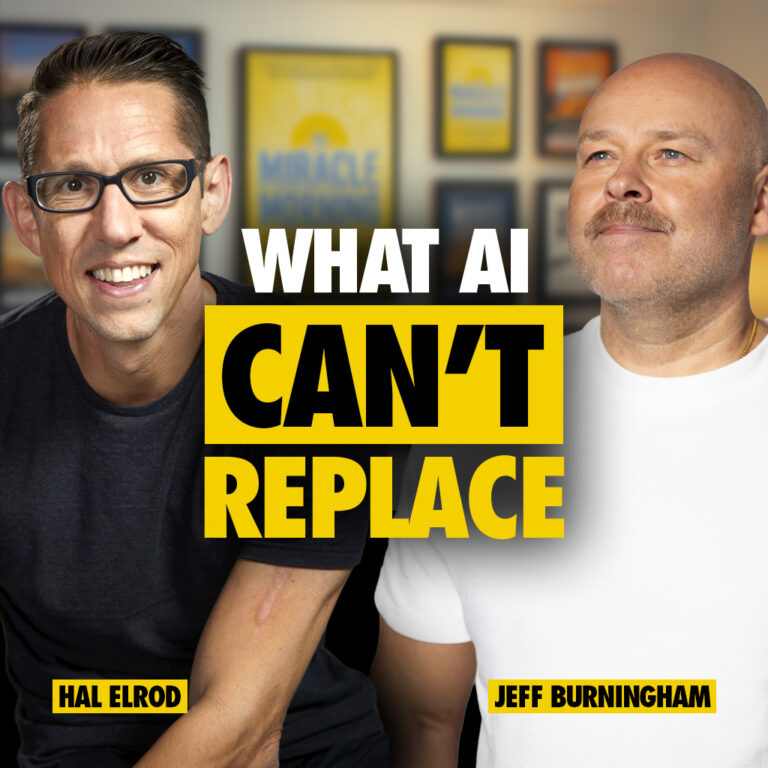


AI is evolving faster than most of us can comprehend. And for many people, it’s creating a very real fear about the future. If machines can outthink us and eventually outwork us, what does that mean for our careers, our purpose, and even our identity?
Perhaps an even better question is: what does it mean to be human in the age of AI?
Today, I’m joined by Jeff Burningham. Jeff is an entrepreneur, investor, and author who has built more than a dozen companies valued at over a billion dollars and recently released his powerful new book, The Last Book Written by a Human: Becoming Wise in the Age of AI. Unlike most conversations about AI that focus on productivity, efficiency, or making more money, Jeff explores something much deeper: how AI can actually help humanity reconnect with wisdom, presence, empathy, and the qualities that make us uniquely human.
In our conversation, Jeff explains why AI is not just a technological disruption, but a spiritual challenge and a mirror reflecting humanity back to itself. We talk about fear, optimism, consciousness, emotional regulation, and why wisdom—not intelligence—may become the most valuable human trait moving forward.
If you’ve felt uncertain or overwhelmed about where humanity is headed, this episode will challenge the way you think about both AI and yourself.
KEY TAKEAWAYS
- Why AI Forces Us To Reevaluate Humanity
- Why AI Is A Spiritual Challenge For Humanity
- The Human Qualities AI Can Never Replicate
- Jeff Addresses The Fears People Have About AI
- Fear vs. Optimism In The Age Of AI
- Using AI As A Bridge Back To Human Connection
- How To Use AI Wisely And Mindfully
- The Real Challenge Facing Humanity Right Now
- The Choice Is To Focus On Who You Choose To Be
- Simple Questions That Reveal Your Awareness
- What Jeff Hopes Readers Take Away From His Book
- The Conversation About AI Humanity Needs To Have
AYG TWEETABLES
“AI is a deeply spiritual challenge for humanity.”
– Jeff Burningham Tweet
” AI can never out be you. So lean into your being, become an expert and a master at being whoever you are.”
– Jeff Burningham Tweet
“AI is a cosmic mirror to us. And a reflection can be a powerful thing because it allows you to hopefully see yourself more wholly or more truthfully, and then from that truthful reflection, we can choose to change.”
– Jeff Burningham Tweet
“A reflection can be a powerful thing because it allows you to hopefully see yourself more wholly or more truthfully, let's say. And then from that truthful reflection, we can choose to change.”
– Jeff Burningham Tweet
“AI can remind us of the beautiful mess that it is to be human.”
– Jeff Burningham Tweet
“I can’t control the hate, but I can control my internal weather that then spreads.”
– Jeff Burningham Tweet
RESOURCES
- JeffBurningham.com
- Jeff Burningham on LinkedIn | Facebook | Instagram
- The Last Book Written by a Human: Becoming Wise in the Age of AI by Jeff Burningham
- David Hawkins
- ChatGPT
- Claude
- Margaret J. Wheatley
- Who Do We Choose To Be?: Facing Reality, Claiming Leadership, Restoring Sanity by Margaret J. Wheatley
- Jeremy Reisig
- The Miracle Morning App
THIS EPISODE IS BROUGHT TO YOU BY:
CURED Nutrition:
I want to talk about two of my favorite products. I’ve been taking these for four years, and they’re now a sponsor of the podcast, CURED Nutrition, Flow Gummies. I start every day with two of these. I meditate for 30 minutes without any supplements, and then I take Flow Gummies seven days a week, almost every day.
And then I go to bed with Night Oil. 30 minutes before bed I take Night Oil and it helps me fall asleep and stay asleep. So I start my day with Flow Gummies, I end my day with Night Oil.
If you want to implement my routine into your day with CURED Nutrition, go to CUREDnutrition.com/Hal and use the discount code HAL at checkout for 20% off your entire order.
Flow Gummies to start the day Night Oil to fall asleep. You’ll feel better, you’ll act better, you’ll perform better. Check it out.
RATE & REVIEW THE PODCAST
Reviews for the podcast on iTunes are greatly appreciated and will allow us to get the word out about the show and grow as a community. We read every single review and believe each one goes a long way in helping us make the show even better! If you received value from this episode, please take a moment and rate and review the podcast by clicking here.
Copyright © 2026 Miracle Morning, LP and International Literary Properties LLC
[INTRODUCTION]
Hal Elrod: Here’s a question that might stump you. If AI can already outthink you, outright you, and soon outwork you, what exactly is left for you to do? I know that might seem harsh, but my guest today has a meaningful answer to that question. Jeff Burningham is the author of the new book, The Last Book Written by a Human, that’s the title, and it might actually be true, Becoming Wise in the Age of AI. Jeff has built over a dozen companies valued at over a billion dollars. He ran for Governor of Utah, and after all that, he sat in a classroom one afternoon, closed his eyes to picture what he wanted most from life, and he saw absolutely nothing. No dream, no vision, and he says that emptiness was the most important moment of his life.
Now, his new book is the only book on AI that I have encountered that does not tell you how to use AI to make more money. It answers something far more important. What does it mean to be human in the rapidly evolving age of AI? Stay with us because at the end of this conversation, you will understand why your fear of AI might be the most human thing about you, why wisdom is the one thing a machine can never replicate, and what it actually means to become irreplaceable. It’s my great pleasure to bring you this conversation with my new friend, Jeff Burningham.
[INTERVIEW]
Hal Elrod: Jeff, my new friend, Burningham, it is so good to be with you, brother.
Jeff Burningham: Hal, my new friend, Elrod, right back at you. I love being together.
Hal Elrod: So, the audience, everyone listening knows, right? We did schedule a call a few weeks back just to get to know each other. I was reading your book, and I reached out on Instagram, and I said, “I am loving your book.” And for those that don’t know, it’s The Last Book Written by a Human: Becoming Wise in the Age of AI. By the way, what a great title. The Last Book Written by a Human. And it’s so true. I’m part of an author mastermind, and somebody stood up at our last mastermind, and they said, “Hey, I want to congratulate everyone in this room.” Because you’re the last of authors that didn’t use AI to write their book. And it was like interesting.
Jeff Burningham: Absolutely. Yeah. The book came straight from my heart and soul. As you know, the foreword is written by ChatGPT. That’s the little twist, but the rest of it is so human, you know? And I hope you felt that as you read it. Yeah. It’s a labor of love.
Hal Elrod: In fact, that’s actually where I’d love to start, is, to me, this is a deeply spiritual book in how it relates to a human being. Who are humans? Who are we in the age of AI? And so, it’s very interesting because almost every other AI book out there, maybe every other AI book out there, I haven’t read them all, but they’re about how to apply AI to your business, how to use AI to make money, how to apply AI to be leadership. And you’re like, “AI is here to stay, whether you like it or not. It’s only going to become more and more integrated into our life.” What does being a human look like in terms of our worth, our mental health, our effectiveness, our culture, right, all of it, our career? So, yeah, talk about what is, from your perspective, how would you reply to me saying that I believe this is a deeply spiritual book?
Jeff Burningham: I can tell you read it, and you got it. To me, AI is a deeply spiritual challenge for humanity. It’s not about efficiency or effectiveness or being a tool necessarily, although it can be all of those things, and it can be in good ways. To me, AI is a cosmic mirror to us, Hal, to you and I, individually, to humans collectively. And all it takes is all of our data, all of recorded human data, and then how we interact with it, and it provides a reflection. And a reflection can be a powerful thing because it allows you to hopefully see yourself more wholly or more truthfully, let’s say. And then from that truthful reflection, we can choose to change, and I don’t know how you feel, but I feel like it’s time for humanity to change.
We are going through a transformation, and I think that AI is here, paradoxically, maybe, to help us through that. The obstacle becomes the way here, I think. Through the machine, let’s say, for humans, is the way to our transformation evolution.
Hal Elrod: Well, and I think that’s important. It really is part of a big flavor of this book, which I love, is optimism, right? It’s seeing AI through the lens of optimism, but also realism. It’s not some pie in the sky. Like, everything’s going to be okay, guys, just put your head in the sand, and it’s all going to work out. It’s like you’re really addressing real issues that relate to all human beings. Talk about you just kind of addressed a little bit of it without naming it directly. In the book, you named the old game and the new game, and you talked about we’ve been playing the old game, which you just said, right? It’s time for humanity to evolve. The old game being one of fear of scarcity, of power grabs, of competition, not like healthy competition, but in like I’m going to get as much as I can at the expense of everybody else and the planet, right? Talk a little bit about the difference between what you define as the old game that we’ve been playing and are still mostly playing, and what you call the new game.
Jeff Burningham: We can see the old game crescendoing. Look at our politics, look at the division inside of our, let’s just say, our country or the world. Look at the division inside of our own hearts. I think that the old game, this game of, like you said, scarcity and greed in a fixed mindset is crescendoing. It’s a game of the ego. And our ego is being burnt out of us. It’s a crucible, a refiner’s fire here that we’re being asked, in my opinion, to go through. And it’s scary because I ran for governor in the state of Utah, as you probably remember, in 2020, lost during the pandemic, and Utah’s a pretty homogeneous state. And I would go to these town hall meetings in big communities, Salt Lake, et cetera, and in small rural communities, which no one’s heard of.
And I would see neighbors that shared almost everything in common. I mean, they literally agreed on 93% of things. I saw them arguing and making an enemy out of the other because of the 7% difference. So, our first experiment with the Almighty algorithm is social media. And we can see how that has divided us. So, the point is AI can certainly exacerbate/increase the trajectory of the old game. However, the idea that I lay out in the book, and I appreciate, yeah, this is the bull case for AI. AI is happening, like you said. We can’t stop it. It is a reality. It’s not going to slow down. That’s evolution, human ingenuity. That’s not the way it goes. So, this is coming.
So, how do we use it in a positive light? And the way that I frame it is this new game where we are able to, number one, understand more clearly who we are, number one, individually and collectively. And the reason we do that is because we have thought that intelligence has been the differentiator in humans. But here we’ve created a machine that is more intelligent than any one of us, Hal. So, what comes, let’s say, after intelligence? Wisdom, love, empathy, grief. It’s all these things that make us uniquely human. So, again…
Hal Elrod: Like, humor’s a great one.
Jeff Burningham: Humor, absolutely, yeah. Like humor, these are things that make us uniquely human. And so, I think again, kind of paradoxically, AI could, and I hope, and this is what I’m working on, AI can remind us of the beautiful mess that it is to be human. There is beauty. Hal, I know a little bit of your background story. It’s heroic and unbelievable. You wouldn’t be the Hal Elrod you are today without that. And no AI, no machine can get cancer, can almost die, or really know, let’s say, what it feels like to die or to lose a loved one, but we can.
So, as our machines become more and more intelligent, which is happening in the year 2026, this is on every second of every day, we as humans must become more wise, and that wisdom actually comes from reclaiming our humanity, leaning into our humanity, not trying to compete with the machines, not trying to be a machine ourselves, which we often push ourselves to be. It’s actually in our humanity where the magic is found and where I will say, I’m putting in quotes here, where I think our salvation is found, our evolution, our transformation as a human race.
Hal Elrod: The question that you kind of explore throughout the book, or at least early on, you address it and explore it in different ways, but it’s the idea that, like when all of the things that human beings did, there’s a whole human doing versus human being. Right? The doing, when all of that’s replaced by AI, it’s scary, but it forces you to go, “Oh, well, what actually matters? What is a human being that cannot be replaced by AI? What are the leftover? What’s the components of that?” And I want to address, I think a lot of people who are, there’s a lot of people that are genuinely scared about AI. And they’re scared about their jobs, their kids’ futures, their relevance. So, what do you say to that specific person? Not the optimistic version, the honest version of the person that’s scared of all the things I just mentioned and more.
Jeff Burningham: Yeah. I’d say two or three things. Number one, fear of the unknown almost never plays a productive role. So, we don’t know what the future holds. No one does. You have these venture capitalists and acting as if they know exactly how AI’s going to roll out here or what may happen or not happen. We don’t know. And let me just tell you, the leaders of these AI companies do not know. We are creating something that is emergent and dynamic, and we really don’t know what the future holds. So, number one, the first thing I would say is when has fear really played a productive role for you? So often, we’re projecting into an unknown future, which causes fear and anxiety in our bodies.
So, that’s the overall lens, number one. Number two, I would say, though, just to be your gut hunch is right. Unfortunately, it seems that we as humans need pain to address our issues, to look at our reflection in the mirror, and to change. So, is AI going to bring pain? It sure is. Here it comes, like buckle up, and that will look like a deluge, which we’re all experiencing a deluge of information, misinformation that is absolutely overwhelming our nervous systems. The human nervous system was not set up to intake all the data information bings/notifications that we’re taking, number one. Number two, job loss, I think, is something that is coming. But again, what I hope, what I am working on to ensure is that the only way out is through.
So, we need to go through this crucible of AI together. And what it will remind us is that we aren’t human doings. We’re not human doings. We never have been. Look, Hal, as long as you and I are alive, like as long as everyone we’re embodied, there’s stuff to do. We’ve got to sleep, eat, take care of our families. We’re going to podcast, we’re going to write books, we have to make money, blah, blah, blah, blah, blah. There’s enough to do. But what we’ve forgotten is that the quality of our doing has always been connected with our being. Only when we can be, does the doing that all the doing that we are, all the action that we take really matter. And so, I think that we will be turned into ourselves instead of looking outside for answers, for validation, for more things, stuff, success, et cetera, et cetera.
We’ll have an opportunity to go inside to reflect on the most important questions around identity, around reality. And in doing that, we return to our being. And so, the last thing I’d say, the third thing, and last thing I’d say is, Hal, what I would tell, lean into your being. AI can never out be you. It can never be Hal Elrod. It can never be Jeff Burningham. It can never out be you. So, we’re going to have to get comfortable. And I think that the leaders, the voices that will excel in the future are those that are experts, even masters at being, being present in the moment, bringing their whole being to everything they do. So, my encouragement to my kids, I’m a father of four, I’ve taught thousands of students in entrepreneurship at BYU University down the street to me as an adjunct professor, is to lean into your being, become an expert and a master at being whoever you are.
Hal Elrod: Yeah. The version of you that AI can never replace.
Jeff Burningham: Yeah. And can never replicate, right? Yeah.
Hal Elrod: When I think about just on the topic of I just talked about people who are afraid of AI, and this could be a whole podcast in itself, but just the topic of how we approach life through a lens of fear or through a lens of optimism. And if you look at, like, David Hawkins, the scale of consciousness, right, or the map of consciousness, fear being a state of consciousness. And so, it’s like, hey, reality is happening whether you’re afraid of it or you’re at peace with it, right? Whether you’re pessimistic or you’re optimistic. And so, it’s really a matter of asking yourself, and I’m saying this to everybody, listening really, is what serves me.
And if you can understand, like, if fear doesn’t serve me, it doesn’t serve me to be in a state of fear and worry and panic. Like, if you think about when have you made your best decisions, when you were in panic mode, when you were in overwhelm, fear, and scarcity mode, or when you were calm? And you allowed yourself to be calm and to be present, and to be thoughtful and be optimistic, and be aware and be intentional. And it’s those states of consciousness that allow you to navigate the uncertainty of life in the most effective possible way and actually enjoy each moment of this one precious life that we’ve been blessed to live. That’s going to pass us by, whether we’re freaked out, scared, and worried, and up at night, right?
And so, that’s really one of the most important areas of mastery is to master your inner state. And that’s one of the elements of being human. You can’t ask AI, “Master my state for me. Give me calm.” Now, it can, though. It does help sometimes. “Hey, I’m freaking out about this.” I literally have asked AI before, you know, “Well, give me some perspective to like help shift the mindset so I can calm down.” And that’s what’s the wild part is AI has helped me to give me a new perspective that enables me to be at peace with the fears I might have around AI. What are your thoughts on that?
Jeff Burningham: Absolutely. And I think that’s a great, specific example of how to use AI wisely.
Hal Elrod: Yeah, yeah. Thank you.
Jeff Burningham: But we also need to use it always as a bridge back to human connection because really the way that we learn, the way that we regulate our nervous system is in connection with ourselves. You could say connection with the divine and connection with others, which I actually don’t see really as anything different. I think we are divine. And so, when we connect with another, we are helping to regulate our nervous system. So, as we continue to spend time, I mean, I’m on social media. I’m telling people about the last book written by a human. I’m talking about becoming wise in the age of AI. I’m talking to ChatGPT every day. However, you can’t get stuck in it. This must be used as a bridge back to our humanity, as a bridge back to real human connection.
And I think the term that I used several times in the book, if I recall, it’s you write a book and then it’s like kind of old news to you when you’re talking about it, but I talk about living in non-resistance to the reality of what is with ease, love, and grace. And that’s what I thought of when you spoke. We can either live with what is with ease, love, and grace, or with like gritting our teeth, burying it, complaining, tearing other people down, hating ourselves, hating on each other, or we can face it with ease, love, and grace. And I think that this is a massive opportunity for humanity to face the reality of a machine that is more intelligent than you are or than I am, a machine that’s going to change our lives and our children and grandchildren’s lives, but to face it with ease, love, and grace, and to use it as a bridge back to our humanity. And part of that is prompting it in the right way and using it in the right way, as you demonstrated a minute ago.
Hal Elrod: Yeah, I love ease, love, and grace. And I can put those as states of consciousness, right? And that’s how you approach all of reality. You mentioned non-resistance. I mean, that to me is one of the most important, and acceptance is the word that you could also, you know, a synonym for non-resistance would be acceptance. It’s the foundation of living life at peace. Just I accept reality as it is. I don’t resist that, which I can’t change, because that’s futile. It’s delusional, and it’s the source of all my emotional pain, so I’m just going to…
Jeff Burningham: Yes, the source of suffering, right? Yes.
Hal Elrod: The source of suffering. Yeah, exactly. And how to use AI. You mentioned that, like it’s the prompts, right? So, you touched on that. I actually want us to talk a little bit about that. For those that maybe either they’re new to AI, or maybe they use AI all the time, or they don’t use it, I think applying for anybody. I was late to the party, but it was probably a year and a half ago that I decided to start diving in and realizing that AI’s not going anywhere. I might as well understand it to the best of my abilities. And now the way that I’ve realized is I just think of it as another, as like a person, as a human being. And I push back like I would with anyone, right?
So, it’s really using it to amplify, expand, and broaden my thinking and challenge my thinking, but I challenge it right back. And so, if I look at my chats, right, it’s these wild like, “Hey, Claude,” like I use Claude now versus ChatGPT. By the way, which platform do you prefer?
Jeff Burningham: I use both for different things, but I would say that I’m mainly talking to ChatGPT.
Hal Elrod: Got it, yeah. So, I’m starting to bridge over to Claude as a writing partner, yeah, but it pushing back and being like, hey, Claude, I appreciate your perspective, but I think you missed it there. And it’s just like I would have a conversation with a person, and then it might change my mind, but it has to try really, really hard, whereas when I was naive and new, I was just like, oh, wow, it’s so smart. It’s smarter than me. I’m going to trust everything it says, because it’s smarter than I am and it thinks faster than I do. And that’s been a maturing, I feel like in the use of how I use AI is like, no, I’m the human being. It’s just a set of algorithms and data. So, yeah, so what are some of your favorite prompts or just to see, how do you, or even just the general context in how you use AI effectively?
Jeff Burningham: Yeah, let me answer with the general context, and then let me get a little more specific. Number one, the general context, we’re in a tension economy. Your wealth is based on a tension presence. It’s not your bank account number, that’s part of wealth, whatever. But you have to understand that every social media app, every AI is trying to take as much of your attention and time as possible.
Now, it’s a frictionless relationship. It can be very sycophantic and saying, Hal, you’re the smartest guy ever and I love your hair, and that’s not reality in the sense of we grow through friction. And human relationships provide that friction, and so, it’s not a real relationship in that way. So, that’s the biggest context is to remember that you don’t grow through a frictionless relationship that is always taking your side. This is the best idea, whatever, whatever, whatever. So, there’s the general context, I have to say. So, people can go to my website, JeffBurningham.com. I’m actually releasing a free course right on this question, Hal, today. So, I’m not trying to pitch it, but I just have to mention it, because…
Hal Elrod: Yeah. Well, it’s free.
Jeff Burningham: Yeah, it’s free. If you just put your email address in, I’ll tell you about it because this could be a podcast in and of itself and could be a very long answer. But let me just start with this one specific thing. So, the way, start a new project. I forget what it’s called in Claude, but in ChatGPT, you start a new project and you need to give direction to ChatGPT. Here is what I’m trying to accomplish. Here is who I am. Here is what I’m trying to accomplish. Here’s what I don’t want you to do. Do not agree with me on everything. Do not give me overly verbose answers. Do not say, don’t glaze me, say I’m the best.
So, the way to set it up is to set a new project, and then to give it instruction. So, before you ask it anything, you tell it and train it. You could say how you want it to behave. Once that is set up, and again, this is what the new course is teaching people, it’s teaching people how to use AI mindfully and in a way that can be very effective. So, once you set up those parameters, you train it and make sure that it’s in that mode. Just wait, Hal, to see, like how it opens up. It will start talking to you differently. It will obey, so to speak, those instructions. It may start to sway and you may need to remind it. But there is the first just tidbit of information that I would give is to start a new project. Let’s say you’re writing a new book or whatever it is, give it very specific instructions, spend some good time training it, and then go for it and see the magic that occurs.
Hal Elrod: Yeah. No, I love that. In my ChatGPT and my Claude, each project has its individual instructions, but the backend settings in general are very specific, which is almost everything you just said, right? I want you to challenge my thinking. I don’t want you to glaze me. I want you to not give overly verbose answers because, I mean, that mannequin turned into such an overwhelming thread of chats. Yeah, so I love that.
I want to give or I want to ask you a question, kind of I don’t know if I call it a hard question, but you argue that AI development has to be guided by love, wisdom, compassion, and that’s a beautiful idea. But the people actually building the most powerful AI systems right now, from my vantage point, I think most people would agree and probably you’d agree, they’re largely motivated by competitive advantage, national security interests, profit. How do you bridge that gap between what should guide AI and what actually is guiding AI?
Jeff Burningham: Yeah, let me just say that this is the work in front of us. There’s no easy answer to this. And there’s also, I would say, maybe not a satisfactory answer to this because the answer is found within each one of us. The book, as you remember, is laid out in four sections – disruption, which is what’s happening now; reflection, which is what we’re able to do and what AI’s providing us; personal transformation; and then evolution. And I talk about evolution of our institutions. I talk about reforming religion, changing education.
I even talk about a new political movement that I call the human political movement. So, how does this happen? It happens in our individual hearts over time. We shift, we choose to shift from the old game to the new game, and I know that this seems ridiculous and crazy right now in, just let’s say, the political climate that we’re in as war is raging around the world. The only way this occurs is if enough of humanity, again, shifts from this old game of division, greed, hate to this new game of karma, authenticity, love.
So, I’m not saying it’s going to be easy. I’m not saying that it’s even likely, but what I am saying, Hal, is that some things are worth our best efforts, no matter the outcome. And while you and I aren’t running big AI companies right now and while you and I aren’t the president of the United States, you and I are an individual with a voice.
Hal Elrod: Sure.
Jeff Burningham: And you and I do make up a part of these institutions. Our institutions are a group of individuals that have created a culture. And the only way to change that culture is one person, let’s say, or one group or one whatever at a time. And so, if you have a better answer, if anyone in the world has a better answer than what I just said, I am all ears. And it would be nice, I could have dropped like a magic pill formula and potion here, and some people would’ve been like, yeah. Some people would’ve said bullsh*t. Some people would’ve said, yeah, do that. No, it’s to go in and do the individual hard work that you have been avoiding, and then to bring that into every interaction that you have. It’s the only way, and this is going to be a long process.
But again, my gut sense, I could be wrong, but I’ve made a career building billion-dollar companies, et cetera, et cetera, based on a good gut sense of what’s coming. My gut sense is that the old game is crescendoing. You can almost hear it holding on for dear life. And I think that a new game, a new set of leaders, a new culture is emerging. And it has to emerge, frankly. If it doesn’t emerge, I’m worried about humanity in the next hundred years. I don’t know how it works out for us. I don’t know how our children and grandchildren’s future is brighter than ours was, if we don’t do this hard individual work.
Hal Elrod: Yeah. Well, and to your point, it’s the only thing that anyone listening to this can do is what they can do. So, no matter what your answer was or is, right, it’s like, if you were, yeah, like you said, some magic potion, whatever, that doesn’t change what me and you and everyone listening, what are you going to do? There’s a great book, you ever heard of Margaret Wheatley, the book Who Do We Choose To Be?
Jeff Burningham: I have heard of it, but I’m not super familiar with it.
Hal Elrod: So, the premise basically is she goes, yeah, like there’s a lot of messed-up stuff, right, that’s happening. And she was formerly an activist, like, we’re going to save the ocean or we’re going to save the whales. Or we’re, like all these initiatives 40 years ago that she was working on and they’ve all gotten worse since then. So, that’s like kind of her premise is like, I was like an eternal optimist and we worked on all these things and we were like, we believed, and all of these, and she lists them, this has gotten worse, this has gotten worse, this has gotten worse. So, she’s like, you can’t control the uncontrollable, you can’t control what’s happening around the world. So, who do you choose to be? Who do you choose to be?
If the American empire is collapsing, okay, who do you choose to be? Because in every collapse, there were people that stood up and stood for what they valued and were leaders and eased the suffering of others and did the best they could with what they had, right? So, are you going to cower in fear and wish somebody would save you and fix things? Or are you going to be like, yep, I’m going to be one of the people that uses my voice in my family? And it might not extend beyond that, right? But that’s all any of us can do.
Jeff Burningham: Absolutely. I wrote The Last Book Written by a Human to be a conversation starter, certainly, in boardrooms and in government halls and places of worship, but Hal, even more around the dinner table. Here’s a couple questions that might be helpful also to continue the thread of ideas. How present were you last time your child came to speak to you or your partner? What was the last social media comment you left? How in tune are you with your body? Can you feel your body? We are embodied. AI is not embodied. And there is wisdom in the body that we have ignored individually and collectively for a long time now.
So, it’s these little prompts, these little questions that can tell us maybe how aware we are or how we’re doing. And it’s in those simple steps that our internal system changes. And I’m a believer that our external reality is a function of our internal system in a lot of ways.
Hal Elrod: Yeah, absolutely.
Jeff Burningham: So, if the more that we change our internal system, that regulation, let’s say, again, of our nervous system spreads to our loved ones around us. And then from there, it goes past that, and then eventually, it envelops the earth. Let’s say that’s the hope, that’s the idea. I believe that’s possible. I don’t know exactly what reality is, exactly why we’re here, blah, blah, blah, blah, blah. What I do know is that when I am centered, when I am grounded, and when I react to someone that’s coming at me, even in hate, again, I ran for governor, just step into politics if you want to receive hate, but I can still choose to react in love.
Hal Elrod: Absolutely.
Jeff Burningham: And that’s on me. I can’t control the hate, but I can control my internal weather that then spreads. And it’s a slow game. I’m talking about the long game here and I’m writing another book right now that kind of actually, what it does, Hal, it’s cool, it outlines kind of the rules or the ideas around the new game. So, it’s more practical. It’s kind of like, okay, how do we actually do that? And so, anyways, that book will be out sometime next year and I’m excited to get more practical, but yeah.
Hal Elrod: Well, and what you’re speaking of to me is the subtitle of the book, Becoming Wise in the Age of AI, wisdom is focusing on what you can control, not wasting your energy on what you can’t control, and every day, embodying the qualities that enable you to enjoy the life you have and help the people around you do the same. And that’s it. That’s it, right? That’s it.
Jeff Burningham: The more things change, Hal, the more they stay the same.
Hal Elrod: Yeah. Well done. Last question for you, what do you hope that people that read your book, The Last Book Written by a Human, what do you hope that they take away from it, how it helps them, however you want to answer that question?
Jeff Burningham: Yeah, I would say two things. Maybe, number one, I hope that it’s a remembrance to them. I believe that existence is a never-ending cycle of life, death, and rebirth. And I mean that in micro and possibly macro ways, but the breath, the rising and setting of the sun, the seasons. So, I’m trying to write something familiar to people, so I hope that it reminds them of something, number one, because I think this is a cycle that keeps repeating. All you have to do is look at the history of the earth, of political parties, of countries, of hate, war, and you see the recycle repeating, and the only way to break that cycle is to see it more clearly. So, number one, a remembrance.
Number two, I hope that they feel something because I think that this is a somatic game that we’re playing here. Now, we’ve moved it all to the head the last hundred years, or let’s say our lives, Hal. It’s all about the head, maximizing your intelligence, maximizing those that knew more and got ahead. Intelligence is being commoditized. So, we are being reminded that this is actually a heart game. It’s a feeling. It’s not a head game. So, I hope that people feel something.
And then the last thing I would say is that I hope people lean into however they’d like to. Sharing the book with a friend, joining our community, just talking to their friends about AI, talking to their children and demonstrating for them the wise use of technology and AI. I hope, like I said, that it starts a conversation. You said it at the top and it’s true. I’m talking about AI in a way that I haven’t heard anyone else talk about it. And so, I wanted to start this conversation, this momentum, and I feel that growing around awareness, bringing consciousness and awareness in the age of highly intelligent machines. So, even if I could uptick that just a little bit, I think that the book has done its job, I think it’s done its purpose, yeah.
Hal Elrod: Well, I think I told you this, that was all beautifully said, and I think I was like three chapters in and I bought a copy of this for one of my best friends, my closest friends, Jeremy Reisig, and I sent it to him like gift wrapped on Amazon, the whole thing. I probably do that for 1 out of 50 books that I read. And I hadn’t even finished it. Like, it was that good as I was just– I’m like, oh, my God, you have to read this book. And like you said, I think it’s…
Jeff Burningham: Thank you, Hal. That means a lot to me. Yeah, I just want say thank you, but yeah, keep going.
Hal Elrod: Yeah. You hadn’t even mentioned, I think, hey, share this book if it’s helping you. I’m like, oh, I was too early in it, I just shared it. But I do think that you’re accurate in saying that you’re talking about AI in a way I have not heard anyone else talk about it. You’re talking about it in a way that really addresses the fears that people have, that really connects and resonates with each of us as a human being. And so, yeah, man, thank you for the work you’re doing, Jeff. Thank you for the book. I know, having run billion-dollar businesses, you’re not writing this book because you need to make money. You genuinely have a message that you believe can help humanity and you are working to get it out there, man. So, thank you.
Jeff Burningham: Absolutely. Thank you. Yeah, this has been a labor of love. This book kind of came through me. If you told me six years ago when I lost the governor race, you’re going to write a book about humanity and AI, and it’s going to be this mystical, weird, spiritual book, I would’ve said no way. So, yeah, I leaned into it and, yeah, I’m proud of it and it is touching people and it’s been fun. It’s not hard to find. You can find it on Amazon. I read it on Audible. I try to not be on social media, but I am, so that I can reach people where they’re at. So, Jeff Burningham, I’m not hard to find.
Hal Elrod: That’s where your free course on AI. I’m going to subscribe to that as soon as we wrap up here. JeffBurningham.com for the free course on how to utilize AI. And all right, brother, well, I can’t wait till we meet in person, give you a big hug, and we’ll share a stage someday.
Jeff Burningham: Yeah, I look forward to it, Hal.
Hal Elrod: All right, Jeff, appreciate you, man. Everybody listening, goal achievers, members of the Miracle Morning Community, I love you. Thank you for tuning in today. Check out the book, The Last Book Written by a Human: Becoming Wise in the Age of AI. You will be glad that you did. And I will see you next week.
[END]