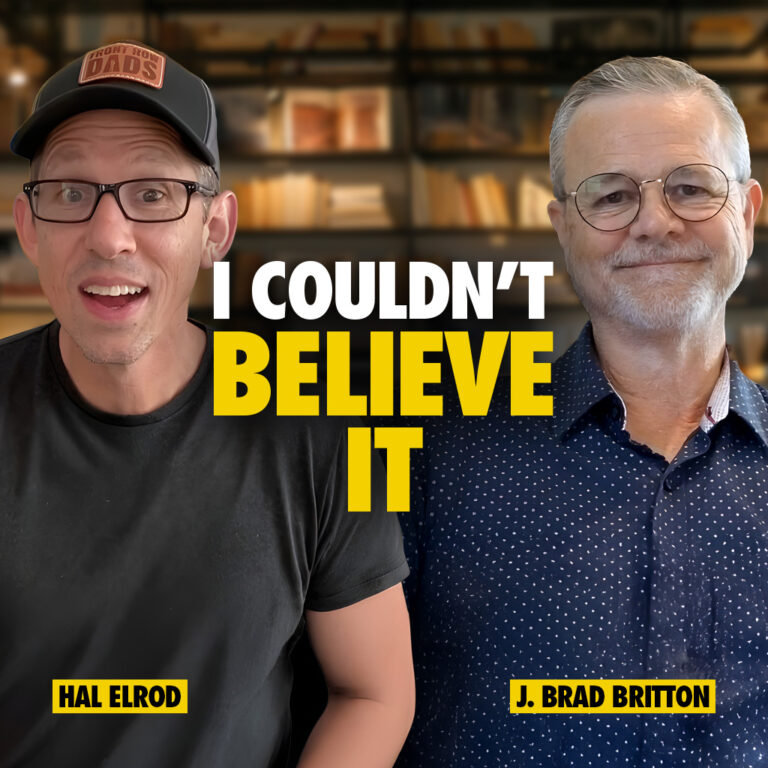


Today’s guest, J. Brad Britton, is one of my earliest mentors and the co-author of the new book, Real Words with Sam. J. Brad’s son Sam was diagnosed with autism at age two, and he remained largely non-speaking for most of his life.
But after attending a symposium and seeing the success other families had with a unique spelling method, J. Brad discovered that Sam had been thinking, listening, understanding, and was capable of communicating, often poetically, in ways that changed everything.
In our conversation, Brad shares the emotional story of how his relationship with Sam has evolved and how it has completely changed the way he understands his son, himself, and others.
You’ll also understand why this conversation is about so much more than autism, what it means to move beyond assumptions and truly see someone, and why becoming a more patient, present, empathetic human being may be one of the most powerful transformations any of us can experience.
KEY TAKEAWAYS
- The Inspiration For Writing “Real Words with Sam”
- How Brad’s Entire View of People Changed
- The Symposium That Created A Huge Breakthrough
- Spelling to Communicate Changed Everything
- The Relationship Between Apraxia and Autism
- The Power of Open Questions and Original Thought
- Everyone Needs to Be Seen and Heard
- Learning and Adapting Never Stops As a Dad
- Spiritual Lessons Learned On This Ongoing Journey
- The Chapter That Intentionally Induces Tears
- Why This Book Is For Every Human Being
AYG TWEETABLES
“If you have a choice between something easy and something hard, the harder choice is almost always the best choice.”
– J. Brad Britton Tweet
“Stimming isn’t always joy. Sometimes it’s pressure. Sometimes it’s compulsion. Sometimes it’s simply too much. And it reminds me just because something looks repetitive doesn’t mean it’s easy or even wanted.”
– J. Brad Britton Tweet
“When given a chance to wish for anything, he asked for peace. It makes me rethink what a superpower really is. If that’s how Sam sees it, not flashier grand, but necessary and kind, then maybe the rest of us already have a few superpowers of our own.”
– J. Brad Britton Tweet
RESOURCES
- Real Words with Sam
- Real Words with Sam on Facebook | Instagram
- Brad Britton on LinkedIn | Instagram
- Cutco
- Anais Nin
- California Lutheran University
- Soma Mukhopadhyay
- Ido in Autismland: Climbing Out of Autism’s Silent Prison by Ido Kedar
- Beatles
- Ringo Starr
- John Lennon
- Paul McCartney
- George Harrison
- La-Z-Boy
- California State University
- Kyle Cease
- Autism Society San Diego
- Simon Sinek
- Barry M. Prizant
- Uniquely Human: A Different Way of Seeing Autism by Barry M. Prizant
- The Miracle Morning App
THIS EPISODE IS BROUGHT TO YOU BY:
CURED Nutrition:
I want to talk about two of my favorite products. I’ve been taking these for four years, and they’re now a sponsor of the podcast, CURED Nutrition, Flow Gummies. I start every day with two of these. I meditate for 30 minutes without any supplements, and then I take Flow Gummies seven days a week, almost every day.
And then I go to bed with Night Oil. 30 minutes before bed I take Night Oil and it helps me fall asleep and stay asleep. So I start my day with Flow Gummies, I end my day with Night Oil.
If you want to implement my routine into your day with CURED Nutrition, go to CUREDnutrition.com/Hal and use the discount code HAL at checkout for 20% off your entire order.
Flow Gummies to start the day Night Oil to fall asleep. You’ll feel better, you’ll act better, you’ll perform better. Check it out.
RATE & REVIEW THE PODCAST
Reviews for the podcast on iTunes are greatly appreciated and will allow us to get the word out about the show and grow as a community. We read every single review and believe each one goes a long way in helping us make the show even better! If you received value from this episode, please take a moment and rate and review the podcast by clicking here.
Copyright © 2026 Miracle Morning, LP and International Literary Properties LLC
[INTRODUCTION]
Hal Elrod: Today’s conversation is one that will undoubtedly inspire you and it may move you to tears. My guest today is J. Brad Britton. He’s been my mentor for over 20 years, and he’s the co-author of a brand-new book, Real Words with Sam, that he co-authored with his son Sam. And it tells a remarkable story of discovering that Sam, who was diagnosed with autism at age two and had largely been non-speaking for most of his life, and he was actually believed by J. Brad and his wife Paulette and the whole family to be incapable of communicating. And then they discovered that he was actually thinking, listening, and understanding far more than anyone realized.
Through a method called spelled communication, Sam began sharing his thoughts, letter by letter, revealing intelligence, wisdom, and a voice that had been inside of him all along and he didn’t know how to communicate with people. This conversation isn’t just about autism. It is about assumptions, humility, and what happens when we finally learn how to truly listen to the people that we love. Brad is brought to tears toward the end of the episode as he reads part of the story. You might be brought to tears too. I was deeply touched. And I think you will love this conversation and you will be a more empathetic, more loving, better human being after you’re done watching or listening to this. It is my great pleasure to introduce you to my friend, the one and only Mr. J. Brad, Britton.
[INTERVIEW]
Hal Elrod: J. Brad, it is so good to be with you, brother.
J. Brad Britton: My pleasure. My pleasure. And it’s an interesting turn of events over the decades, huh?
Hal Elrod: Yeah. No, I was just about to say to you, and then I said, wait, let’s hit record, which is, who would’ve thought when I was sitting in the audience at my first ever Northern California Cutco division meeting that you were leading, that I would be sitting here today having this interview. And I’m so grateful that we are, man. I definitely feel like this moment, this is meant to be, this is divine. So, yeah, man, thanks for taking the time with me and I’m excited to share what you’re working on.
J. Brad Britton: Yeah. Well, you may or may not remember, but at those meetings, I used to say things like, someday, my claim to fame is that I knew so and so. And man, I mean, I seem like, I remember specifically pointing at you and saying, my claim to fame someday is that I knew Hal Elrod back when he was just starting his career. So, yeah, that’s what I say, interesting turn of events, right?
Hal Elrod: And you know this, I think, but for those listening or watching that may not know, one of the most life-changing lessons I’ve ever learned that guides me to this day is something that you taught me at one of those meetings, which is, the secret of success and fulfillment and happy, you name it, do the right thing, not the easy thing. That every moment we’re faced with this choice, what’s the right thing to do that would move me toward the best version of myself? And what’s the easy thing that would give me an excuse not to evolve, not to grow, not to challenge myself?
And so, whether it’s the alarm going off in the morning and going, ah, the right thing would be to get out of bed and take the day head on, right? I mean, it’s amazing. Even my life’s work, I could trace back to that philosophy, man. So, thank you for all that you poured into me.
J. Brad Britton: Well, I didn’t make it up, and there’s one step further to that and it’s the harder of, if you have a choice between something easy and something hard, the harder choice is almost always the best choice. Almost always the choice that we should be taking, so…
Hal Elrod: I love that. And I love binaries. I love something simple. It’s like, all right, this is the right thing to do, the hard thing to do. It’s going to make you a better version of myself. This is the easy thing. Let’s leave that alone. So, I want to talk about you releasing your first book. In fact, when this comes out, it will have been yesterday. So, the book, Real Words with Sam, is in the world. You and I have been talking about this for years. You reached out to me years ago. I’ve endorsed the book. I’m just such a fan of this book, your story, Sam’s story, your relationship, and how you show up for him as a father. Not to mention your wife, Paulette, and how she is as a mother. You are two of the most dedicated parents, examples for all of us other parents. And so, I’m going to start with what might be the obvious question, but the answer I do think is not going to be obvious, which is why did you write Real Words with Sam? And who is this book for?
J. Brad Britton: Yeah. Well, you mentioned this question about a week ago and I’ve had some time to ponder and think about it quite a bit. And here’s the thing. I learned something that I thought was impossible. I learned how to change history. Now I know that people change history. What are you talking about? Well, what is history, right? Our history is our memories. Our history is how we perceive our past.
And when I learned about spelling and through that process, learned that my son, who I thought has a disability, has a learning disorder, is what I thought his whole life. And I learned that he didn’t have a learning disorder. His whole life, he’s been listening, absorbing, understanding everything going on around him. When we were told by the experts that he probably never progressed past a mentality of a 6-year-old or a 7-year-old.
So, whenever I learned that he could spell by touching letters on a board like this and not only could he spell words if we said, hey, spell environment and he would spell the word environment, but he could share thoughts with us. And I learned that his thoughts are very rich, very deep, in fact, much more mature than people his age. The wisdom that he shares, the wit he shares is oftentimes poetic, oftentimes very rhythmic, the words he chooses. It’s crazy.
Anyway, when I learned all that, it changed everything I remember about every experience that I’ve had with him. That’s what I say how it changed history. So, it can change history for a lot of other parents in similar situations perhaps. But when I understood that I misunderstood Sam for so long…
Hal Elrod: How many years, by the way? What age was it that he started spelling and communicating with you?
J. Brad Britton: Yeah. Okay. So, his first like real communication where he shared like an original thought, he was 20, 20 years old.
Hal Elrod: So, 20 years where you thought he did not have– that he wasn’t even thinking, but it was just that he didn’t know how to communicate the thoughts. Is that it?
J. Brad Britton: Well, yeah, I guess so. He may have known, Hal, but he just needed help. He needs a lot of support, and I’ll kind of explain what the disorder that he does have is. I mean, definitely, he has a disorder, but it’s not a learning disorder as we thought. And it didn’t just change how I saw Sam and my history. How it really changed how I see everybody, you know? I mean, how many times have I misunderstood people or underestimated people? And the dedication at the beginning of the book is to the misunderstood and the underestimated.
Hal Elrod: Or made assumptions, right? I would say that would also fall.
J. Brad Britton: Yeah, which is all of us, by the way. We’ve all been misunderstood at one point in time and we’ve all misunderstood someone else and we’ve all been underestimated and we’ve all underestimated someone else. So, it’s an entire worldview change, adjustment shift is the buzzword these days, right? The shift. And I talk about how the book is about my shift in this. Anais Nin has a quote that I really lean into a lot. And it’s, we don’t see things as they are. We see things as we are.
Hal Elrod: I love that philosophy.
J. Brad Britton: And so, that’s kind of how I wrote the book or why I wrote the book, I guess. And as far as who I wrote it for, I tried to follow the rules for an author, have an avatar, write to a very specific person or very small niche. And I just wasn’t able, I should say I wasn’t able because I believe that I don’t like the word, but I found myself having a very challenging time doing that because as you know, I spent a lot of years as a trainer in Cutco, and we would work with all kinds of people, older people, younger people, middle-aged people, all kind of diversity, really didn’t matter. It was based on attitude.
And so, when I was teaching groups of people, whether it’s 10 people or 100 or 1,000 people, you have to be able to communicate in a way that you hope touches everybody. And so, that’s how I tried to write the book. And a lot of conclusions that I had in early drafts, I said, and here’s the lesson you should learn from these things, right, because that’s what we do as trainers. And I learned, I figured out after like three or four drafts that I could actually take away the lessons that I think people should learn and just kind of leave the information, leave the story, leave kind of some insight and let people kind of draw their own conclusions, which is why I think people, everybody draws something completely unique from this work.
There are a few chapters where I do try to bring an insight that I don’t think would be the very obvious to people. I left a few of those in, but a lot of times, it’s just like, hey, here it is. And just, I let people sit with it and people get what they get.
Hal Elrod: I know this is kind of counterintuitive to what you’re saying, but what are some of the takeaways that you do hope people get, and whether that’s general themes or specifics or somewhere in between?
J. Brad Britton: That’s a really great question. And there are many answers to that question, I think. Let me tell the story of how I learned about this spelling thing, right? And you’ll start to have a little understanding about it. So, we, as parents of an autistic or of a person with autism, right, there’s a national debate about whether it should be autistic people or people with autism, we don’t really care in our household all that much. Most autistic people actually that can advocate for themselves, they actually prefer autistic people. But people who aren’t autistic think for some reason, that’s a…
Hal Elrod: Derogatory.
J. Brad Britton: In a way, and so, they say person with autism. And up until literally, just a few days ago, the book had autistic people because that’s kind of what was understood, but I was able to get Sam to answer me if he preferred one. And he actually did seem, and even though it’s unreliable when he communicates verbally, this was a verbal communication, he seemed to lean toward people with autism. So, at the last minute, I went in and made all these adjustments.
There were eight instances in the book where I made a change on that. I don’t know that that’s relevant or not. But we’ve tried a lot of things with our son, as autism parents as we call ourselves, therapies, supplements, stem cell, going to other countries and doing stem cell replacements and hundreds of thousands of dollars, you go through. And things that seem to work for other people, maybe worked for Sam a little, maybe didn’t. He would make these little tiny progresses, but not like we would see other– we have people that started at kind of the same place as Sam when he was six, seven, eight years old, and they’re like going to college and driving cars and all kinds of things.
Well, Sam is in college. It’s not still the same as what we’ve seen with a lot of other people. And so, I kind of had got to the point where I’m kind of callous. I’m not maybe too callous, to the point. But Paulette, she really never gave up and still has never given up. And she’s always looking for new things. And so, she dragged me to the symposium up in Thousand Oaks at Cal Lutheran College, I believe it was. And I didn’t know much anything about it, but she wants to do something. I was always game, right? That was my support system.
And so, we’re going to this thing, and she’s telling me this is about communication through spelling. There are a lot of these young people that aren’t verbal, but they can spell on a keyboard or touching a letter board. In fact, I didn’t even know what a letter board was as we were driving to this thing. So, anyway, I go in, it’s pretty skeptical. We walk in and there’s 150, 200 people in there about, and Paulette says, “Oh, there’s Elliot.” And she’d mentioned that Elliot, this young man who’s Sam’s age that I’d met maybe once or twice when he was very young, six, seven years old, right?
And Elliot is very animated, right? When it comes to his behaviors, hand flapping, he’s making loud noises, drawn-out vowel sounds, sometimes just saying words. I remember him saying, quoting Dora the Explorer, swiper, no swiping, I remember, and really loudly and bouncing up and down on his toes. And he’s from our hometown of Fallbrook. Okay? And so, we walk in, and he’s there with this communication partner, this spelling coach. Her name is Julie, who Paulette had been talking to. And she said, “Oh, there’s Elliot.” And we start walking over toward them and Elliot’s bouncing.
And now, he’s 17 years old, bouncing louder than he was, as tall as me. And Julie says, “Oh, Elliot, I think you know these people.” Okay? And so, he looks up. And I mean, I couldn’t tell if there was recognition in his eyes or necessarily or not, and he just, while still making noises and kind of bouncing, she holds this thing up in front of him and he starts hitting letters on this thing, right, while he’s saying things, he’s talking the whole time, saying random things.
And she calls out the letters one at a time. We can see him hitting them, and so, we can kind of follow along. And here’s what he spelled to us. Okay? It took about two minutes. He spelled, “Hello, fellow Fallbrookians. How are the life and times of Sam Britton these days?”
Hal Elrod: Get out of here.
J. Brad Britton: My jaw dropped. I was like, I mean, you can just imagine, 20 years of basically I’ve been going through stuff. And now, that didn’t mean to me immediately that, oh, Sam can do this. I didn’t make that shift right there. But we saw dozens of examples of people at that symposium doing similar things, some typing on keyboards, and letting their iPad talk for them. And I left that optimistic, cautious, but I knew we had to try it, right? That’s how we learned about this whole thing.
Hal Elrod: Okay. And what do they call that, just spelling, or is it a type of spelling?
J. Brad Britton: There’s different methods. I don’t want to get into the history of it, but it all started with this one woman from India. Her name is Soma. And she was looking for things, she just knew her son, there was more going on than people thought. And she just basically invented this whole thing. Just a brilliant lady. And now, she’s world famous in this world. And there have been some branches from her basic program, her Spelling to Communicate or S2C. There’s a speller’s method, which is the one that we have leaned into mostly. There’s a few. And they all started from what’s called rapid prompting method, which what Soma invented. I don’t know that that’s relevant to your audience or not.
But we started Sam in the spelling program, right? And he started with someone coming to our house, and then COVID happened. She couldn’t come to our house anymore. And we had to take kind of a long break and we got him involved with the speller’s method. And so, we were taking him in. We only could do like an hour a week. It’s not an inexpensive process. So, we were doing an hour a week and, a few weeks into it, he could spell things like, the way they do it is they read a story, an age-appropriate story on jazz music, marine biology, could be on whatever. And then they start with some real simple questions.
And the big thing that stood out is how they treated Sam. They treated him like he understood every word that they said, talked to him like he’s a 20-year-old or 18-year-old at the time, 18, 19-year-old. Not like a 6-year-old, like we’d talked to him most of our life, using– just I look back and I mean, I feel shame.
Hal Elrod: Wow. But you didn’t know any better, but I understand, yeah.
J. Brad Britton: Didn’t know any better. Didn’t know any better, but I mean, what life must have been like for him, thinking they don’t think I know anything. You know?
Hal Elrod: Have you guys reconciled that? Have you actually talked to him about that, about what it was like before the method was discovered and how he was perceiving the way you were, babying him or talking to him, thinking he didn’t have this level of intellect?
J. Brad Britton: Yeah. Yes and no. I mean, I’ve talked to him about it. Sam hasn’t elevated to the level where we can just have a back-and-forth conversation with him spelled. He has to be in a very controlled environment and has to go through a very specific kind of flow. The goal is to get to where we can just have conversations. He’s even told us that when they asked him one time, what’s something you’re willing to work hard at? And he said, “I’m willing to work hard at spelling or at typing.” I think he said typing in that case. “I’m willing to work hard at typing so that I can share everyday moments with my mom and dad,” right?
We know that he wants that, but we know that it’s very hard. At that symposium, we learned about something called apraxia, right? This is at the core of all of it. Apraxia is simply when the brain is working fine, telling the body to do things, the mouth, the hands, the feet, but the body just doesn’t do it. The body does something completely different, whatever it wants to do. Sometimes it does what the brain is saying and sometimes it doesn’t. And that’s so Sam can talk. I mean, sometimes he’ll say what he means, but a lot of times, what comes out of his mouth is the opposite of what he means.
Now, there are many spellers, hundreds and hundreds, thousands and thousands probably of spellers who have got to the point where they can just kind of communicate and the things that they say about how they grew up and things like, they’ll say, mom, don’t listen to my mouth. My mouth is saying the opposite of what I want usually, right? And I could go a long, long time on these things.
There’s a book called Ido in Autismland, I-D-O is his name. And that’s a 15-year-old kid who wrote a book about his life growing up and how the therapist that would come to his house and they’d say things like, “Okay, touch your nose.” And he would go, right? And they’d say, “Oh, we’re going to have to work on this for at least another few months.” And he’s sitting there listening to them and he’s thinking, I know where my nose is. I just can’t touch my nose.
Hal Elrod: I just have an inability to do it. Wow.
J. Brad Britton: Yeah. And so, he would say, and so, I would just poop my pants to get away from him. I would start banging my head against the wall, because I want to get away from these people, right, because they’re idiots and he’s just saying how they’re– I’m not, if there’s somebody listening who’s a therapist, you know, I mean…
Hal Elrod: No, I mean, that’s real.
J. Brad Britton: This could be a controversial thing.
Hal Elrod: Now, is apraxia a form of autism?
J. Brad Britton: Okay, 67% of people with autism, according to a PubMed study in 2015, also have apraxia. Okay, 67, think about two-thirds of the people, right? It’s like someone has a stroke. They can tell, hey, pick up that glass for a drink of water, but their arm won’t do it. Okay? But their brain is functioning properly. That’s what apraxia is from a very young age. That’s how it works or how it works. So, that’s the disorder. So, he doesn’t have an input problem, he has an output problem. And this is extremely common, extremely common in people who…
Hal Elrod: And that they understand, they comprehend. They just can’t get their body or their mouth to do what they are thinking or what they want. Huh, fascinating.
J. Brad Britton: So, in Sam’s case, they do the story. Back to the method, so they do a story, then they’ll ask just to spell some words out of the story. Spell the word ocean. Spell the word whale. Spell the word, whatever it is. And he could spell words just like that. Now, he does that without even any effort. Then they ask what’s a known question, a question from the story. Maybe they do a story about the Beatles and they’ll say, name one of the Beatles, and he’ll write Ringo, right? Name all four Beatles. John, Paul, George, and Ringo. And I’m like, I’m a proud dad, right? He knows.
And then they’ll do things like kind of a multiple choice, name one animal they saw at the zoo, right? So, there’s not just one answer. There’s multiple answers. And every one of these has more cognitive work that needs to be done. And the reason it’s spelling like this is very, very low motor, right? So, when the motor goes down, the cognitive can go up. And when the cognitive goes up, the motor almost has to go down, and it’s like this, until that there’s practice and practice and practice and they can get better and better at both, but it takes an enormous amount of practice. Sometimes after Sam spelling sessions, I’ll pat him on the back, they did a good job, and he’s dripping wet with sweat.
Hal Elrod: Oh, wow.
J. Brad Britton: Just trying to do the thing, you know?
Hal Elrod: Wow. It takes that much effort for him.
J. Brad Britton: Yeah.
Hal Elrod: Wow.
J. Brad Britton: And anyway, they progress through the different kinds of questions, and the goal is to get to what’s called an open question, right? It’s not just a one-word answer. It’s an answer where it has to be like a total original thought from them, right? Not from the story. It might be related to the story.
Hal Elrod: Like their opinion of the story or something?
J. Brad Britton: It could be an opinion. It could be various things. And throughout the book, you saw between the chapters, there’s pages that were questions and answers that were asked, open questions and open answers, from this. The very first time he ever did it, I remember it. I will remember it, as long as I can remember things. And they did a story about things that people like, things people like to do, things that people enjoy. Okay? And they did the spelling words. They did the other questions. And every time you have to go through all of these steps to get them into a certain flow and to get them focused to get to the point where you ask, so there’s like usually four, five, six, seven questions before getting to an open question every single time that he does one of these things.
And sometimes, he’s so dysregulated that they never even get to the opens. Maybe he gets past the spell words and that’s it. It’s a whole hour and nothing really comes of it. Sometimes, that still happens. But they asked him a question at the end of the story, Hal, what is something that you like to do? Well, the answer to that wasn’t in the story, right? And so, he sat there. And sometimes he’ll just sit there, and you don’t know if he’s going to answer anything or not. And he pulls out his things he’s using to touch the letters and he starts touching letters. And he spells, you ready? What is something you like to do? Here’s what he spells, relaxing in an easy chair.
Hal Elrod: Really?
J. Brad Britton: Relaxing in an easy chair. Now, we have a La-Z-Boy or recliner, we call it. I don’t believe in my life, I’ve ever called it an easy chair. So, where he came up with that, I don’t know, right? And where he comes up with a lot of the words and things that he spells, I don’t know, like one time he used a word– more than once, he’s used a word that I had to look up in the dictionary. He used the word ameliorate. Ameliorate, I’m like, I don’t know what that word means. It means to make something better, like to improve upon something, right? And he used it perfectly in the context that it was in what he was trying to communicate. And I’m like, Hal, how do you know that word? He was asked a question.
Hal Elrod: Were you able ever to ask him something like that? Or does that just take it too far out of the realm of what you’re talking about?
J. Brad Britton: No, I mean, they’ll ask him to define words or give synonyms or antonyms for different words. And if we prepare a lesson ahead of time with his communication partner and say, hey, we really need to learn about something because it’s important for something in the future, they’ll work it in, they’ll work that in. I do spelling lessons with Sam at home and I can get one or two words of open-type things like what’s favorite food or things like that I can get from him.
But a few weeks ago, there’s a woman who’s really close within his program, got another job. She got another job, a better job for her at Cal State University over here. And they let all the kids know about a week in advance that she was going to be leaving. And he was really tight with her. Her name was Molly, and when she left, we weren’t sure how he was going to respond to it, but he was very dysregulated the next time to go to school. In fact, he didn’t even go to his program for a day. And the next day, we finally got him out the door an hour late. And we weren’t sure if it was because Molly wasn’t there or if it was something else. We didn’t really know.
And so, we had Ashlyn, his communication person. We told her this is going on and is there a way she could find out? And I don’t have it up in front of me, but he wrote basically that he was grieving. He didn’t use the word grieving, but he said it’s really tricky to be regulated when people have to leave or something. And so, but after he got that out and let us know, he was totally fine the next day and the next day and the next day.
Hal Elrod: Oh, wow.
J. Brad Britton: He needed to make sure– he needed to communicate that.
Hal Elrod: He needed to be heard and seen like every other human being on the planet, right?
J. Brad Britton: Even valued. Yeah, exactly. They asked him once, how do you think I’m reading this off of the page? How do you think the world would change if everyone experienced a communication disorder, was a question that they asked him. And he answered, I think people would be more kind and understanding. Everyone did that. And then they asked him, if you could, how would you change the world, right? His answer gave two parts. I would change how all people view those of us that can’t rely on our bodies, and then he added time and education should help people see the truth.
Yeah, I know, and this is to someone who, when I try to just have a conversation with him, it’s very difficult. Sometimes he’ll answer, and most of the time, the answer is just no and he turns around and leaves because he’s been used to people asking him questions all his life, like he’s a little kid. Like, do you like that pizza? Do you like that pizza, Sam? I mean, you don’t ask a 17 or 18-year-old a question like that, right? But that’s how he’s been treated his whole life. And so, he’s just, no, the answer’s just an automatic no, and then, usually, turn around and leave. And people smile and nod, like they understand, but people don’t understand.
Hal Elrod: So, Brad, let’s get really personal if you’re open to this. What has this been like for you as a dad? And when I say this, that’s a loaded, there’s 24 years that could fit into that word “this,” right? So, let me qualify it a little bit. And I guess, one way to look at it is what was life like? Who have you had to become? That’s actually the question I want to answer. Who have you had to become? Because I can’t even imagine, I can only imagine, but I can’t really imagine what it would be like to have an autistic child, right? And specifically, Sam’s form of autism, where for 20 years, I’m thinking, the level of patience you have to have. Like, it’s hard enough to be a parent with a child that doesn’t have this condition and that you’re like, you’re not listening to me.
Well, when Sam’s nonverbal and you can’t even communicate, like, who have you had to become, what qualities have you had, have you developed as a result of being Sam’s dad? And to be clear, you have a daughter as well who doesn’t have this– I’m blanking. Madison. Oh, Madison, yeah, your daughter. Yeah. Who have you had to become as a father to Sam?
J. Brad Britton: Yeah. Well, there’s about 150 pages of that in this book, that’s a big part of it. And I try to not make it about me, although everything about it is very personal, very vulnerable, very raw. But I tried to write it in such a way that people would see themselves. Anybody who’s been through hard things, deals with challenges, has been misunderstood or underestimated, or has underestimated or misunderstood someone else, there’s correlation, there’s lessons. I don’t know the word. There’s nuggets. There’s energy. I don’t know the word I’m trying to find.
Hal Elrod: I would say, and I’m going to say this, I think, when I introduce today’s episode, which is this is a book for every human being. Like, that’s what you see is you see, whether your challenge is you’ve got a child with autism or your challenge is, whatever the challenge is, what I love about the book is it’s such a raw account of being a human being and dealing with something that is difficult, that you never planned for, that you never expected. And I mean, I know you from your Cutco days. You’re a planner, you’re a goal setter. You literally are the kind of guy that you’re like, this is the life that I’m going to create. I’m going to design.
And then life, you could say, threw you a curve ball. And it’s a blessing. I’m not in any way demeaning Sam as a curve ball, right? But in no way did you plan on I’m going to have a child that for 20 years, I will believe, doesn’t even know how to communicate, right? Anyway, so when you’re answering this question, and I’m sorry to cut you off, but to me, this is like, if you’re a human being, this book applies to you.
J. Brad Britton: Yeah, I think so. I mean, to answer your question, who have I become or am I becoming? I mean, it’s still happening. I mean, I notice, I think I have more self-awareness. I always felt like I had a lot of self-awareness. I always felt like I had a lot of compassion. I always felt like I had a lot of patience. I always felt like I was a good listener. And there’s just things that you learn, like we all probably know this. The people that are closest to us, sometimes we neglect the most, right? And that happens and it even happens now. I mean, it happened this morning with Sam. He was trying to say something to me. And it’s so easy to just block out anybody that’s close to us that’s talking, right? He’s easier to block out than most, because you don’t know he could be talking about anything.
He was trying to get my attention this morning and Paulette had to point it out and she said, “Hey. Sam’s trying to talk to you before he leaves in a little bit.” And I had to put down, I had a book and a phone at the same time. I was doing something, research or something, and I had to put it down and turn and face him. And I even talk about that in the book, that that’s what I’ve learned how to do, but I’m still learning how to do it. It’s every day. You said something the other day on one of your social media posts. You said, God, I love you. God, thank you. I love you, God. Thank you, God.
Hal Elrod: I love you, God, and thank you, God. Two of my favorite phrases, yeah.
J. Brad Britton: And as I read that, my prayer has been recently, I’m listening, God, right? I’m listening, God. And…
Hal Elrod: I love that.
J. Brad Britton: I think I even commented on one of those things. And just this morning and a devotional reading that I was doing, something came up that I might use in some public speaking with some faith-based groups. And I think about this one-sided conversation I had with Sam for however many years. It’s not that I didn’t believe in Sam. I knew he existed. There he was, right? It’s not that I didn’t love Sam, right, but I didn’t believe in his capability. I didn’t believe in the ability that he had.
And I wonder if sometimes as people that maybe we are professing Christians, do we have a similar conversation with God? We believe in God. We love God, but do we believe in his capability? Do we believe in his ability to provide? And how we talk to him, is it kind of one sided? The way I was having that conversation, there’s something deep in there somewhere, I know, and I just started thinking about that this morning, I think.
Hal Elrod: Well, it goes with what you and I were talking about before we hit record, which is I’d mentioned that my friend Kyle Cease believes that God is always trying to speak through us. So, he doesn’t plan what he’s going to say often, if ever, right? It’s just showing up and allowing God, and you think about it, when do we hear those messages? And some people, if they’re an atheist, they wouldn’t think it’s God, they would just think it’s their mind. But to me, it’s some sort of higher consciousness where often it comes through me faster than I can think it. And I’m going, I don’t know, where this is coming from, but like I’ll be writing it out or something and I’m just journaling with zero thought.
And I go, there’s call that God, call that it’s something, it’s not coming from my conscious mind. And so, yeah, I think to your point that, are we listening to God? Are we– and one thing that I got when I was reading the book, Brad, is I mentioned, right, like, I don’t have an autistic child. And if someone’s listening and they don’t have, maybe I don’t know that I have anyone in my family that I’m aware with autism, so I don’t have that relationship, but I’m listening and I’m literally, Sam is becoming my kids. Sam is my wife. Meaning I’m everything that you’re talking about, I’m thinking, how do I have my own story about who this person is and what they are and aren’t capable of? And how am I talking at them and not actually listening? Not actually. And what I love about the book and about Sam and about his condition, and then who that has invited you to become is you’ve had to be infinitely more present than the average person with another human being that can talk back to you.
Like, you’ve had to be infinitely more empathetic and understanding and patient. I can’t imagine the patience. And like you said, you’re not a perfect human, right? It’s an ongoing journey, but yeah, I want to really reflect for the audience and reflect back to you, as you’re talking about this book and going on podcasts and so on and so forth, that that was what it was for me was that Sam is a loved one for you, right? He is a person in your life. He is your family. He is your blood. He is someone that you love.
And everything that you’ve learned in being Sam’s dad, I feel like it’s applicable to all of us and you’ve had to learn it at a higher level and been forced to in a way that benefits all of us, but that without having someone in our life with Sam’s condition, we would never have the opportunity to become who you’ve become and develop the abilities that you’ve developed, to be a more present, patient, loving human being. So, I say thank you for leading by example for the rest of us and putting it in this book.
J. Brad Britton: Well, I appreciate those words a lot. I have to acknowledge something though. There’s going to be people that are listening to this podcast, watching this video that have significantly greater challenges, perhaps, with a child with disability or someone in their family with a disability than we have. I mean, I meet with some men’s groups, the advocate group, the San Diego Autism Society. And there were six or seven of us that met last time and everybody went around and kind of talked about their scenario.
And I had the easiest job. I had the easiest scenario of everybody. I mean, there’s people that’s much more profoundly affected by autism or apraxia or some cases of learning disorders, I’m sure, than we are. And I just have to acknowledge that because there’s going to be somebody listening thing, oh, this guy’s getting all this praise. But he didn’t even know what it’s like. And it’s true. I mean, I can’t even, like you say, you can’t imagine.
There’s level so much deeper than what we deal with. I just want to be able to acknowledge that and I want to acknowledge something else that I learned through this process that Sam and I have something really great in common, and that is we both write better than we talk, right? Even as we’re talking here, you and I are talking, there’s been several times when I’m searching for a word and I’ve learned that when I have time to think about it and when I have time to craft and I look at my sentence, I’m like, no, that’s not exactly right. And I can, oh, substitute here, substitute there. I can put together something that is much more meaningful, much more impactful, has better flow type of thing.
Hal Elrod: Yeah. You’re a wordsmith, that’s why.
J. Brad Britton: I like to think that is the case. I fancy myself as that and I’m not trying to be arrogant about it or anything. And I would like to if, and you may not use this for the podcast, but there’s one chapter that I sent you the audiobook.
Hal Elrod: Yeah. No, I’d love for you to either read that or, yeah, please do.
J. Brad Britton: So, here’s the thing. I think one of the things when I do my public speaking, I might start off by saying this after a five-second Simon Sinek pause, I’ve learned something that may or may not work for you, but I’ve learned something, I’ve learned how to make myself cry, right? It may not work for you, but it works for me. It worked for me. And here’s what I did. I wrote this book that’s really deeply vulnerable and shares things that usually stay tucked away. And then I read it out loud recording an audiobook. And it worked.
I mean, every chapter, I’m bawling my eyes out. I don’t know if it’ll work for you, but if you want to make yourself cry, maybe write a personal book and try to record it. But yeah, the audiobook, this chapter is 3 minutes and 30 seconds long, so I’ll just try to read it and it’ll sound probably a lot like the audiobook b ecause it’s really hard to get through some of these things. But the chapter is called Superpower, and this is one of those where I do draw a conclusion, I try to bring out a lesson or a message that might have been missed, otherwise.
All right, here, I’ll try to superpower. Before I knew the word stim, I saw it in action, the hand flapping, the rhythmic rocking, the repeated sounds, the fixations on specific movements or words. For Sam, it’s often triggered by motion, credits scrolling on a screen, cars passing outside a hotel room window, trains, planes, and rollercoasters. He really likes rollercoasters. He can watch them for hours, sometimes on YouTube, sometimes in person. Not even riding them, just watching, the climb, the drop, the loops, the blur of motion. He loves the patterns, the predictability, the flow.
And sometimes he watches and sometimes, as he watches, his body echoes the excitement, flapping, rising up on his toes, stiffening his shoulders/back, wringing his hands, voicing long, drawn-out vowel sounds, stretched and repeated over and over again. They’re called stims, short for self-stimulatory behavior. They’re common in many autistic people, especially children, and they’re not random. They serve a purpose, often more than one.
As Dr. Barry Prizant writes in his book, Uniquely Human, “Many autistic people engage in repetitive behaviors called stimming. These behaviors serve an important purpose. They can help regulate anxiety, express excitement, or simply bring comfort. It’s not meaningless. In fact, it’s often the opposite, a coping mechanism for navigating a world that feels overwhelming.”
Stimming isn’t always something that needs to be fixed, but it can be exhausting. For Sam, it’s not always something he wants to be doing. Sometimes, it’s something his body’s doing, even when his mind wants something else. During one of his spelling sessions, his coach asked him a creative open-ended question. The question was this, if you could choose one supernatural power, what would it be? Sam answered, superpower is to stop stims because the tired stims need to let up. That sentence. Wow. There’s so much in it. The awareness, the exhaustion, the wish.
It tells me that stimming isn’t always joy. Sometimes it’s pressure. Sometimes it’s compulsion. Sometimes it’s simply too much. And it reminds me just because something looks repetitive doesn’t mean it’s easy or even wanted. Sam’s answer isn’t dramatic. It didn’t come with tears or raised voices, but in that one sentence, he gives us a window and to the tension he lives with every day between what his body demands and what his heart desires.
His answer wasn’t about flying or invisibility. It was about stopping suffering, his own and others like him. When given a chance to wish for anything, he asked for peace. It makes me rethink what a superpower really is. If that’s how Sam sees it, not flashier grand, but necessary and kind, then maybe the rest of us already have a few superpowers of our own, small ways we can ease someone’s struggle, quiet moments where we choose compassion, choices that don’t make headlines, but change someone’s world. Maybe that’s the kind of power that matters most. And that’s the end of the chapter. Okay, see, that’s what I talk about being able to make yourself cry.
Hal Elrod: I love that.
J. Brad Britton: But that’s just one.
Hal Elrod: I love that chapter. I love that lesson. Go ahead.
J. Brad Britton: Yeah, and a lot of the chapters are like that. They’re pretty short, either with something like that or a story about going to the barbershop or going bowling, or there’s one about how I lost him in town and he just went somewhere and trying to find him. There’s a lesson in that story as well. But I think people are going to get things out of it, as I said, that are going to be uniquely their own.
Hal Elrod: Yes. And the overall experience of reading it, Brad, it’s a feel-good book. It’s an emotionally challenging, exhilarating, just– it’s a really special feel-good book.
J. Brad Britton: Yeah, and it’s funny. And it’s funny too.
Hal Elrod: And it’s funny. And it’s funny.
J. Brad Britton: There’s a lot of things that Sam says that are out of the blue. And just people tell me, the feedback I get, people say, hey, they talk about what made them laugh. And it’s interesting, different parts make different people laugh, the two comments I get just from reading the sample chapters that are available online. Before anybody actually buys the book, I’d rather them just go to our website and read the samples. I don’t want people spend 20 bucks or whatever on a book and then not like it. Reading the first few chapters, I think people really get an idea.
Hal Elrod: And RealWordswithSam.com, is that the title or that’s the website?
J. Brad Britton: Yeah, RealWordswithSam.com. Yeah, people can go there and they can leave feedback there if they want to.
Hal Elrod: Yeah. And is the audiobook out yet? Or is it just the paperback?
J. Brad Britton: It’ll launch the same day. It’s launched the same day, yeah.
Hal Elrod: When this comes out, that will have been yesterday. So, you get the audiobook. And you read the audiobook, right? So, they can hear your voice.
J. Brad Britton: Yes, that’s me. That’s me reading it. And I got a great sound engineer in Scotland who’s doing good work with that, so.
Hal Elrod: Amazing. Awesome. Well, Brad, thank you again for putting your story and Sam’s story and your family’s story out into the world in a way that I think that anyone, any human being, this book is, if you’re a human being, that’s how you qualify, whether this book is for you. You are the avatar if you are a human being. And I think you’ll be grateful, you’ll enjoy this as a read, unlike a lot of personal growth books. And it’s interesting that you kind of pulled back on that a little bit because it’s like, it can be exhausting. You’re like, oh, my God, I’m learning so much. I’m learning so much. Like, I can only implement so much, versus like in the evening, I love reading a– I never read personal growth books in the evening. I want to experience, I read biographies because this is a biography, right? Essentially, it’s, I want to just read someone’s story, absorb the feel of what it’s been like to be that person. And you captured that remarkably here. So, thank you.
J. Brad Britton: Yeah. Well, and you’re one of the reasons, Hal, that this book is written. I mean, I’ve started writing, like I don’t know, 10 books, maybe. Different ones. And there’s good stuff, lessons and teachings and parables and fun stuff. And then, I sent you my first draft or second draft of Chapter 1, you and one other person, and both of you guys came back with the exact same thing. This is something I actually would want to read, just from reading that little bit.
And part of me was like, well, you didn’t like any of my other stuff. Oh, great. But you said, this is the book that I want to read. This is the book that the world needs to hear. And so that, I decided, okay, this is the one I’m actually going to finish, bring to completion. And I’m like 75%, 80% done with at least a half dozen other books, that maybe this will open a door to finish those. But I thank you a great deal for that encouragement or very early on.
Hal Elrod: Got it. And the beauty of that is, this is not just your book, it is Sam’s book as well. And that’s a really special gift. Think about that, think about, and I don’t know if you’ve thought of this perspective, but it just came up for me, right, which is that Sam has this disorder, that it’s the inability to communicate, and yet his story, through his dad, is now being communicated with the world. And that’s a pretty special thing.
J. Brad Britton: Yeah. Well, I just hope people like it and it’s memorable and maybe it can help people see the world or be different so that they see the world differently in a positive way.
Hal Elrod: Yeah. No, I think it enhances how we show up in our relationships for all of us, as I had said. So, all right, everybody listening or watching this, go get the book Real Words with Sam. You can either download a free sample at RealWordswithSam.com. Or if I were you, I would just go straight to– I think you’ll love the book. Go get the audiobook. You can hear Brad read it, or paperback, Kindle, whatever works for you on Amazon or wherever you buy your books. And yeah, Brad, you’ve transformed my life, and now you’re going to transform countless other lives through this book. So, thank you my friend.
J. Brad Britton: Thank you, Hal. Appreciate it.
Hal Elrod: You got it.
[END]